Sizing and Conviction
The money is made in how much you bet when the odds are extraordinary.

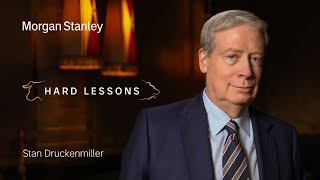
“It's funny, when I went there, I thought I would learn what makes the yen in the market go up and move.Immodestly, I learned I knew much more about that than he did. What I learned from him was sizing. It's not whether you're right or wrong, it's how much you make when you're right and how much you lose when you're wrong. And that was a, that was an invaluable lesson. So, you can have something innate. But if you don't have mentors and people to teach you, you're not going to maximize it as much as you do when you do have them.”Morgan Stanley Hard Lessons interview, 2024 · 7:33
The lesson
Druckenmiller’s central idea is that investing results come less from being right all the time than from matching position size to opportunity. Across interviews, he comes back to the same scorecard: what matters is how much you make when the odds are strongly in your favor and how little you lose when they are not123. That pushes the focus away from hit rate and toward asymmetry. A good idea with tiny size will not move the needle, while a mediocre idea with oversized risk can do real damage.
That is why conviction matters so much. He describes his edge less as superior intellect than the willingness to act decisively when the evidence lines up4. He also credits Soros with teaching him sizing, and in later reflections he says one of his own disappointments has been losing some of the courage to take very large, high-conviction positions3. In practice, this means concentrating more when the thesis is strong and understood, rather than diversifying just to feel safer6.
But size only works if the position can actually be traded. In his talks, liquidity is a core constraint: he prefers concentrating in liquid markets and sizing relative to market depth, not just portfolio capital. That helps explain why he can be very invested when the opportunity is attractive, yet also reverse quickly when the environment turns hostile78. The lesson is that conviction should be expressed where flexibility remains; a big position you cannot exit is not real optionality.
The other half of sizing is exiting without emotion. Druckenmiller stresses discipline and emotional control, and he is explicit that if the reason for owning something has changed, the prior purchase price should not matter910. He does not present risk management as a fixed mechanical stop-loss formula; instead, he frames it as ruthless objectivity about whether the thesis still holds12. When conditions worsen or the setup is poor, he would rather step aside and wait for a better pitch than force action8.
Put together, the chapter’s logic is simple: search for situations with unusually favorable upside versus downside, size them meaningfully when conviction is high, insist on liquidity so you can adapt, and leave fast when the premise breaks. This approach requires forward-looking judgment and emotional resilience, because you will still be wrong sometimes1314. The goal is not constant activity or constant certainty. It is to press hard when the odds are extraordinary and preserve capital when they are not.
5 principles from Stanley Druckenmiller
Judge ideas by payoff asymmetry, not hit rate
A strategy can work even if you are wrong often, as long as winners are much larger than losers. When evaluating any position, ask first how much you can make if right and how much you can lose if wrong, instead of obsessing over predicting perfectly.
“It's funny, when I went there, I thought I would learn what makes the yen in the market go up and move.Immodestly, I learned I knew much more about that than he did. What I learned from him was sizing. It's not whether you're right or wrong, it's how much you make when you're right and how much you lose when you're wrong. And that was a, that was an invaluable lesson. So, you can have something innate. But if you don't have mentors and people to teach you, you're not going to maximize it as much as you do when you do have them.”
Size up only when conviction is high
Druckenmiller’s edge is not knowing everything; it is acting decisively when the setup is especially strong. In practice, that means concentrating capital into your best opportunities instead of spreading it thin across many average ones.
“My advantage is not IQ. It's trigger pulling.”
Respect liquidity as part of the thesis
A large position is only safe if you can change your mind and trade out of it. Favor markets and instruments with enough depth that conviction can be expressed aggressively without trapping the portfolio.
“I was over 90 percent invested…”
Exit when the reason for the trade is gone
Do not anchor on your entry price or treat every loss as something to fight back from. Re-underwrite the position continuously, and if the original case has broken, get out and move on.
“If the reason I bought a stock is no longer the case, I don't care what I paid for it. And if I bought it at 60 and it's 50, because the markets discovered the problem before me, I have no emotion whatsoever. Soros was the same way. I didn't really learn it from him, but it was certainly reinforced.”
Stay disciplined instead of mechanical
Risk control is not presented here as a single fixed formula. The deeper rule is to stay unemotional, keep reassessing the facts, and avoid forcing trades when the environment does not offer good odds.
“You have to be disciplined, you have to be unemotional…”
In his own words
The quotes behind the lesson, word for word from the transcripts. Numbers match the lesson above.
“It's not whether you're right or wrong, it's how much you make when you're right and how much you lose when you're wrong.”
“…it's not whether you're right or wrong it's how much money you make when you're right and how much you lose when you're wrong…”
“It's funny, when I went there, I thought I would learn what makes the yen in the market go up and move.Immodestly, I learned I knew much more about that than he did. What I learned from him was sizing. It's not whether you're right or wrong, it's how much you make when you're right and how much you lose when you're wrong. And that was a, that was an invaluable lesson. So, you can have something innate. But if you don't have mentors and people to teach you, you're not going to maximize it as much as you do when you do have them.”
“My advantage is not IQ. It's trigger pulling.”
“I think diversification is really overrated…”
“I was over 90 percent invested…”
“When the Trump tweet went out, I went from 93 percent invested to net flat and bought a bunch of Treasuries. Not because I'm trying to make money, I just—I don't want to play in this environment. They're gonna be better environments to take a shot. So I think if you're confident in your long-term view and your ability to make money, this is not a great environment to be going to vet in the or Antion one way or the other. Not short, not long. It's in terms of the economy though, if you believe that…”
“You have to be disciplined, you have to be unemotional…”
“If the reason I bought a stock is no longer the case, I don't care what I paid for it. And if I bought it at 60 and it's 50, because the markets discovered the problem before me, I have no emotion whatsoever. Soros was the same way. I didn't really learn it from him, but it was certainly reinforced.”
“I've never used a stop loss in 40 years…”
“I have found it's very important never to invest in the present. Always try and envision the situation as you see it in 18 to 24 months, and then see if you feel things would be different than they are now. Would security prices reflect that? I think that's probably the biggest mistake investors make is they invest in the present rather than forward looking and looking where the puck's going instead of where the puck is.”
“I said nothing, I learned not to do that 20 years before, but I got emotional, which I fight every day. I would literally like throw up like once or twice a week, just from anxiety when I'd have a drawdown and so forth. And at some point in my career, I learned that you're going to continue to make mistakes, you're going to continue to get emotional. You're going to continue to have that happen from now and then. But you've got a gift. And just stop torturing yourself for like 48 hours or maybe longer over this because you've been doing this long enough and the record is there long enough that it's no longer like random accident, which I did not believe for like 15 years. So the hard lessons have been like hundreds of mistakes, but that they're just a moment in time. And when you have these drawdowns and if there's money managers listening to this and you're good, it's easier said than done. Just get over it and move on.”
Reflect
- Think of a current project or investment decision. Are you optimizing for being right, or for the size of the upside relative to the downside?
- Where in your work are you over-diversified across too many small commitments instead of concentrating on the few cases where you have real conviction?
- What would make you exit one of your current positions or plans immediately, regardless of the price or effort already invested?
Check your understanding
Go deeper
 Stanley Druckenmiller on Risk and Trading: Charts, Conviction, Discipline2009 · 83 min · full transcript
 Stanley Druckenmiller on Macro Investing: Size, Flexibility, and Trump2016 · 39 min · full transcript
 Stanley Druckenmiller on Investing Lessons: Invest, Then Investigate2024 · 28 min · full transcript
 Stanley Druckenmiller on Entitlement Reform: Why the Young Are Getting Squeezed2013 · 32 min · full transcript
 Stanley Druckenmiller on Macro Investing: Fed, Tariffs, and Markets2019 · 49 min · full transcript
- What did Stanley Druckenmiller learn from George Soros about investing and position sizing?
- What did Stanley Druckenmiller say is the biggest mistake investors make?
- How does Stanley Druckenmiller decide when to sell a loser?
- What did Stanley Druckenmiller say about handling mistakes and drawdowns?
- What did Stanley Druckenmiller say about the right investment posture when markets are volatile?