Innovation and AI
Structural change matters when it alters productivity, winners, and market psychology.

“I have found it's very important never to invest in the present. Always try and envision the situation as you see it in 18 to 24 months, and then see if you feel things would be different than they are now. Would security prices reflect that? I think that's probably the biggest mistake investors make is they invest in the present rather than forward looking and looking where the puck's going instead of where the puck is.”In Good Company podcast, Norges Bank Investment Management, 2023 · 18:06
The lesson
Druckenmiller treats innovation as investable when it changes the future enough to matter for earnings, productivity, and market leadership, not just when it makes headlines. His general framework is forward-looking: he tries to picture the world 18 to 24 months ahead rather than invest in the present, and he believes the edge comes from seeing a future others do not yet fully price in12. That matters in AI because a true structural shift can affect both company winners and the macro backdrop through productivity and disinflation34.
At the same time, he is careful not to confuse a powerful theme with a complete investment case. He describes AI as potentially even more transformative than the internet and unusually important for productivity, which explains why it could justify major attention from investors34. But his broader method is still to act where the payoff is asymmetric and then size correctly, because the real driver of results is not just being right about a theme but making more when right than losing when wrong56.
A practical part of his edge is knowing what he does not know. Rather than pretending to be the technical expert on everything, he relies on expert teams and outside knowledge, while keeping the responsibility for judgment and action himself; he explicitly says his advantage is not raw IQ but decisive execution7. In fast-changing areas like AI and biotech, that distinction matters: the technology may require specialists, but the investment decision still requires pattern recognition, timing, and position sizing.
He also frames innovation inside a messy market reality. He is a market practitioner more than a formal economist, skeptical that the world can be reduced to neat models, and aware that new forces can interact with financial conditions, flows, and even algorithmic trading in ways that blur simple cause-and-effect8910. So even when a structural change is real, he stresses open-mindedness and humility, especially in periods when forecasting is unusually difficult1112.
The final distinction is between admiring a story and having an edge. For Druckenmiller, an edge comes from combining future vision, expert input, conviction, and the willingness to change your mind when the original reason for owning something breaks213. That is why innovation investing is not about buying every exciting narrative; it is about identifying where structural change is strong enough, differentiated enough, and actionable enough to justify a meaningful position.
5 principles from Stanley Druckenmiller
Look past the hype to the 18-to-24-month impact
When a new technology appears, ask what the world could look like in one to two years if it works better than most people expect. Focus on whether that future would materially change profits, productivity, or competitive position, not just public attention.
“I have found it's very important never to invest in the present. Always try and envision the situation as you see it in 18 to 24 months, and then see if you feel things would be different than they are now. Would security prices reflect that? I think that's probably the biggest mistake investors make is they invest in the present rather than forward looking and looking where the puck's going instead of where the puck is.”
A big theme is not enough; size the asymmetric opportunity
Even if you believe a structural change is real, the investment only works if the upside meaningfully outweighs the downside. Apply the theme through position sizing and risk-reward, not by treating every exciting idea as equally investable.
“It's not whether you're right or wrong, it's how much you make when you're right and how much you lose when you're wrong.”
Use experts without outsourcing judgment
In technical fields like AI or biotech, you may need specialist insight to understand the landscape. But the final job of the investor is still to decide, act, and manage the position with conviction.
Treat innovation as a macro force when it changes productivity
Druckenmiller is interested in innovation not only because it creates company winners, but because it can alter inflation, growth, and the broader market environment. A technology becomes especially important when it improves output enough to matter beyond one sector.
“I think it has the potential to be as transformative and bigger and bigger than the internet. And I'm not a fad buyer, you know, quite the contrary, to see opposite. But the implications of this thing are just mind-boggling. They're mind-boggling for macro in terms of disinflation, in terms of productivity. It turns out the internet didn't turn out to be very productive because everybody's on their phone, you know, for two hours a day not doing work. This, this stuff, this stuff is just amazing.”
Stay open-minded and detach from the original story
Structural change is powerful, but markets are still uncertain and can invalidate your thesis. If the reason for owning something changes, update quickly instead of defending the narrative.
“I would say the most important answer I give that is keep an open mind…”
In his own words
The quotes behind the lesson, word for word from the transcripts. Numbers match the lesson above.
“I have found it's very important never to invest in the present. Always try and envision the situation as you see it in 18 to 24 months, and then see if you feel things would be different than they are now. Would security prices reflect that? I think that's probably the biggest mistake investors make is they invest in the present rather than forward looking and looking where the puck's going instead of where the puck is.”
“…you envision the future, particularly in a way that others have not…”
“I think it has the potential to be as transformative and bigger and bigger than the internet. And I'm not a fad buyer, you know, quite the contrary, to see opposite. But the implications of this thing are just mind-boggling. They're mind-boggling for macro in terms of disinflation, in terms of productivity. It turns out the internet didn't turn out to be very productive because everybody's on their phone, you know, for two hours a day not doing work. This, this stuff, this stuff is just amazing.”
“We're in one of the biggest productivity inflection booms since the late 1800s.”
“It's not whether you're right or wrong, it's how much you make when you're right and how much you lose when you're wrong.”
“It's funny, when I went there, I thought I would learn what makes the yen in the market go up and move.Immodestly, I learned I knew much more about that than he did. What I learned from him was sizing. It's not whether you're right or wrong, it's how much you make when you're right and how much you lose when you're wrong. And that was a, that was an invaluable lesson. So, you can have something innate. But if you don't have mentors and people to teach you, you're not going to maximize it as much as you do when you do have them.”
“My advantage is not IQ. It's trigger pulling.”
“I'm more of a market animal than an economist…”
“No, no, but apparently some very good coders and very good algorithms really know how to make money. You see, so you can do that, but it's not a necessary condition to make money as an investor. I do think in today's world, you better know what you're doing because then, particularly if you're in the trading business like I am, they influence markets and you have to know if a particular price move is happening because of them or if it's happening for more natural causes.”
“Graduate economics. They were trying to jam the world into a mathematical equation, and I just didn't think it fit. I think I've been proved right on that. When you look at the 800 PhDs at the Fed and their predictive record, it's not so good. But I didn't want to go into math; I wanted to go into sort of figuring out the world, and I just didn't think the world could be stuffed into a mathematical formula. And the problem is these people believed their models, and there was just no way. So it wasn't for me.”
“…this is easily the most challenging period I've had a confident forecast in my career…”
“I would say the most important answer I give that is keep an open mind…”
“If the reason I bought a stock is no longer the case, I don't care what I paid for it. And if I bought it at 60 and it's 50, because the markets discovered the problem before me, I have no emotion whatsoever. Soros was the same way. I didn't really learn it from him, but it was certainly reinforced.”
Reflect
- Think of a technology trend you are excited about. What specific change in productivity, profits, or industry structure do you expect 18 to 24 months from now?
- Where in your work do you confuse a compelling story with a real edge? What extra evidence or expertise would you need before acting?
- Describe a time you kept believing a theme after the original reason no longer held. What would it look like to respond the way Druckenmiller suggests?
Check your understanding
Go deeper
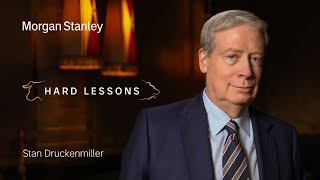 Stanley Druckenmiller on Investing Lessons: Invest, Then Investigate2024 · 28 min · full transcript
 Stanley Druckenmiller on Macro Investing: Inflation, Fed Mistakes, AI2023 · 52 min · full transcript
 Stanley Druckenmiller on Macro Investing: Hard Landing Risks, AI, and the Dollar2023 · 63 min · full transcript
 Stanley Druckenmiller on Future Vision: Seeing Ahead First2024 · 71 min · full transcript
 Stanley Druckenmiller on Macro Investing: Fed, Tariffs, and Markets2019 · 49 min · full transcript