Sara Blakely on Rejection And Persistence
Sara Blakely treats rejection as part of building something new: persist through the no’s, trust your own conviction, and keep finding scrappy ways forward.
- Rejection is normal when you are creating something unfamiliar, so no’s are not a signal to stop.
- Persistence means taking the next practical step instead of waiting for permission or expertise.
- Self-doubt is part of the journey, but belief in your own insight has to be stronger.
- Not knowing the rules can help you innovate rather than conform.
- To get past rejection, lead with the problem you solve and make people feel the benefit.

“I ended up getting on the internet and looking up hosiery mills, and I went to a website called ThomasNet.com where I found a list of all U.S. manufacturers, and I literally went down the list finding hosiery and shapewear and started calling each one of them on the phone. Well, I did this for about six to eight months, and everybody said the same thing, which was basically no. I believed in my product. I still wanted to get it made. So, I started going to all the local craft stores here in Atlanta. I went to Michaels. I went to Hancock Fabric, and I started making homemade versions of my idea, buying…”The Edge Connection talk in Atlanta, 2016 · 3:00
Rejection is built into doing something new
Blakely does not present rejection as an exception; she presents it as the expected cost of introducing an idea that other people do not yet understand. In her case, the resistance was sustained, not occasional: she says she heard no for two straight years while trying to get the product made, especially from manufacturers who did not immediately grasp the problem she was solving.12
That matters because it changes the meaning of rejection. A no is not automatically proof that the idea is bad; sometimes it just means the market, the expert, or the gatekeeper cannot yet see what you see. Her approach was to separate other people's skepticism from her own conviction.23
Persistence is not stubbornness; it is resourcefulness
Blakely's persistence is active and practical. When manufacturers rejected her for months, she did not stop; she kept calling down lists of mills and then began making homemade versions so she could keep moving the idea forward.4
She used the same approach when experts were expensive or unhelpful. Instead of concluding that she lacked the credentials to proceed, she researched patents herself, wrote her own patent, and then found limited help only where she truly needed it.56
This is her deeper standard for persistence: do not let progress depend entirely on someone else opening the door. Work hard, navigate around obstacles, and keep the outcome as much as possible in your own hands.7
“I ended up getting on the internet and looking up hosiery mills, and I went to a website called ThomasNet.com where I found a list of all U.S. manufacturers, and I literally went down the list finding hosiery and shapewear and started calling each one of them on the phone. Well, I did this for about six to eight months, and everybody said the same thing, which was basically no. I believed in my product. I still wanted to get it made. So, I started going to all the local craft stores here in Atlanta. I went to Michaels. I went to Hancock Fabric, and I started making homemade versions of my idea, buying…”The Edge Connection talk in Atlanta, 2016 · full transcript →
The hardest battle is often with self-doubt
Blakely is clear that rejection does not only create external obstacles; it also amplifies internal ones. She describes self-doubt as one of the hardest parts of the early journey, and repeated no’s from manufacturers made that doubt louder.2
Her answer was mindset work. She says confidence came from years of practicing trust in her own inner knowing, which helped her keep moving even when she knew very little about fashion, manufacturing, or retail.8
This is why she talks about fear and failure so often. For her, the real issue underneath fear of failure is fear of embarrassment and fear of what other people think, so persistence requires learning not to let social discomfort run your decisions.91011
Not knowing can become an advantage
Blakely repeatedly argues that inexperience can help rather than hurt. If you do not already know how something is supposed to be done, you are less likely to inherit the assumptions that keep an industry stuck.121314
That idea matters for rejection because many no’s come from insiders defending the current way of doing things. If you treat their certainty as final, you may give up precisely where fresh thinking is needed. Blakely instead trusted what she saw as a customer and as an outsider.815
Her persistence was tied to this belief. She was willing to keep going because she did not assume that the experts were right just because they were experts.148
Persistence works better when you show the problem clearly
Blakely did not overcome rejection just by repeating her pitch louder. She learned to translate the idea into immediate customer benefit, a habit she developed in door-to-door sales where she learned to focus on what is in it for the other person.16
That is why she emphasizes selling the problem, not just the product. People respond faster when they can feel the frustration being solved.17
Her Neiman Marcus moment shows this in action. When words were not enough, she changed the setting, made the benefit visible, and created understanding instantly. Persistence, in her style, includes changing how you communicate until the value becomes obvious.18
Blakely on rejection and persistence, in her own words
“I was in it to win it.”
“I think failure and your attitude and the way that you embrace the fear of failure is a big part of where we end up in our lives…”
Where to watch
 Sara Blakely on Entrepreneurship: Start Small, Think Big46 min · full transcriptBest for her clearest account of repeated rejection, self-doubt, and why confidence and persistence mattered as much as the idea.
 Sara Blakely on Entrepreneurship: Going for It Despite Fear2016 · 60 min · full transcriptShows her operating mindset: go for it despite fear, keep learning on the fly, and push through the no’s.
 Sara Blakely on Entrepreneurship: From Fax Sales to Spanx2016 · 28 min · full transcriptBest for the scrappy mechanics of persistence, from calling manufacturers to winning buyers in person.
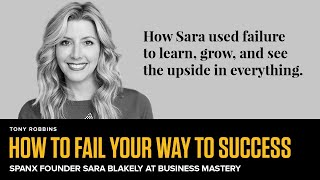 Sara Blakely on Fear of Failure: Embracing Embarrassment2019 · 12 min · full transcriptBest for her view that fear of failure is really fear of embarrassment, and how to loosen its grip.
 Sara Blakely on Mindset And Failure: Bootstrapping Spanx2021 · 27 min · full transcriptStrong on mindset, innovation, and why not knowing the rules can help you persist creatively.
 Sara Blakely on Big Ideas and Persistence: Find It, Then Act2016 · 41 min · full transcriptUseful for how she searched for an idea, acted on it quickly, and kept moving without waiting to feel fully ready.
Questions people ask
- How did Sara Blakely convince Neiman Marcus to carry Spanx?
- How did Sara Blakely get Spanx made when no manufacturers would say yes?
- How does Sara Blakely define hustle?
- What did Sara Blakely say about not knowing how something is supposed to be done?
- What did Sara Blakely say is the real root of the fear of failure?
- What did Sara Blakely say was the hardest part about getting Spanx off the ground?
Sources
Every quote above, word for word from the transcripts. Numbers match the text.
“I heard the word no for two straight years…”
“There were two things that were happening. One was my own self-doubt was a really hard part of the journey and then the beginning of all the manufacturers that I was having to cold call, and talked to to try to get my product made were all men. And it was much harder to explain and to try to get them to understand the concept of what the product was. So I heard the word no for two straight years trying to get it made, which then increases the self-doubt that can happen and one of the interesting things about being an inventor is you don't go to school for it. There isn't an inventor class. You can't major in inventing. And so it's really a belief system in yourself and the willingness to look stupid or to have people laugh at you or to fail at something that you believe, you're your own gut check on that.”
“I was in it to win it.”
“I ended up getting on the internet and looking up hosiery mills, and I went to a website called ThomasNet.com where I found a list of all U.S. manufacturers, and I literally went down the list finding hosiery and shapewear and started calling each one of them on the phone. Well, I did this for about six to eight months, and everybody said the same thing, which was basically no. I believed in my product. I still wanted to get it made. So, I started going to all the local craft stores here in Atlanta. I went to Michaels. I went to Hancock Fabric, and I started making homemade versions of my idea, buying…”
“I immediately went and researched patents at the Georgia Tech Library, and I wrote my own patent.”
“I went to Barnes & Noble. No way! And I bought a book called Patents and Trademarks, and I wrote the patent. And then I called one of the patent lawyers that was the nicest to me and said, "Please, please, please, will you write the claims over the weekend for a discounted price? I've done all the other, rest of the patent." Yeah, the leg work you'd done. Yeah, you just kind of needed to button it up and, yeah, you needed to do the legal part. And so he did. He actually admitted to me that when I came to visit him, he thought I'd been sent by Canon Camera, which—let me put it in your words, I know Canon Camera—I know. He thought he was being punked.”
“I feel like hustle is the willingness to work really, really hard, and then also your willingness to get the job done. Like kind of navigating and doing what it takes. And there's so much about my journey where I was like, I am not going to let the outcome, or my success, be contingent on other people, as much as I can control it, help it, navigate it, I'm going to.”
“You know, absolutely it did. But because I've been working on mindset since I was 16, it didn't shake my confidence. You know, I had this belief, and I've been listening to conversations and reading books about trust your inner knowing. We all have an inner knowing, and so I think because I've been doing that work, I was willing to take the leap knowing nothing. And what I tell people now is, you know what, you don't know will be your greatest asset if you let it. You know, because it means you don't know how it's supposed to be done. And when you don't know how it's supposed to be done, there's the innovation, there's the magic.”
“My definition of greatness would be going for it no matter what, despite fear…”
“I'm always like why, why, why, why, why—'til I get to the very last why I can get, because that's really where the truth always is. And so why is our, as human beings, the biggest fear failure? Well, it's because we don't want to be embarrassed, right? So it's really ultimately fear of embarrassment, which then led me to fear of what other people think of me is the real root of the issue. So that is where I spent a lot of time working myself. I've been a student of that for, for since I'm 16. I've been working on not caring what other people think about me, and it took me a minute. But I realized that not caring what other people think about me doesn't have to mean I don't care about…”
“I think failure and your attitude and the way that you embrace the fear of failure is a big part of where we end up in our lives…”
“What you don't know can be your greatest asset if you let it…”
“You know what, you don't know will be your greatest asset if you let it.”
“I like to tell people what you don't know can be your greatest asset if you let it…”
“I've basically made the garment.”
“I did it for seven years in a company. I was in an office equipment company where most people, you know, kind of rotated out every four to six months. And I think the things that it taught me, it taught me the importance of differentiating myself. It taught me about what's in it for me. We'd talk about it, WIIFM—that when you get a moment with someone, they're looking for the what's in it for them. And I learned I need to deliver that in my message very quickly or I lose them. Yes, you know, so it wasn't like, "Hey, I'm selling a fax machine." It was like, "Hey, I really believe I can improve your life and improve the quality of what you're doing, because the business, just like yours..." You know, I made it about them. Yes.”
“…sell the problem you’re solving, not the product…”
“You need to come to the bathroom with me.”
How this guide was made: drafted with AI from the full transcripts of the recordings cited, then checked: every quotation must match a transcript word for word and be the speaker's own words, and an independent review gates accuracy. Methodology and corrections.


