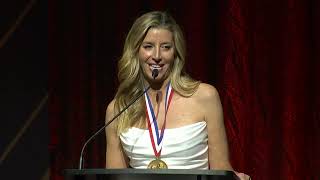
Sara Blakely on Failure & Resilience
Sara Blakely treats failure as a signal to try, learn, and redirect, and she builds resilience by managing fear, embarrassment, and self-doubt instead of waiting for them to disappear.
- Her father taught her that the real failure is not trying, not getting a bad outcome.
- She turned setbacks like the LSAT into questions about direction instead of proof she was incapable.
- Resilience means acting despite fear, especially fear of embarrassment and regret.
- She survived rejection by treating mindset as a daily skill and self-belief as an investment.
- She often sees inexperience and not knowing as an advantage because it opens the door to innovation.

“I basically failed it, and I remember at that moment it being this life-changing moment that set me on a different course. And the way that I initially handled it was, try again. I took the course; I tried it again. And then, when it didn't go as I planned, I asked myself a lot of questions. You know, what is life trying to tell me? Do I have a different path? Maybe I'm supposed to be open to something else. And that's what set me on the journey that ended up creating Spanx.”Forbes interview, 2016 · 0:45
For Blakely, failure means not trying
Blakely’s core reframe is simple: she does not judge failure mainly by outcome. She learned early that failure is about refusing to take the shot, not about missing it. That turns resilience from a personality trait into a behavior: make the attempt.1
This helps explain why she repeatedly pushes action despite uncertainty. Her idea of greatness is not fearlessness; it is moving anyway. That mindset keeps a setback from becoming an identity.2
A setback can be redirection, not defeat
When she failed the LSAT, she did not make that result the final word on her future. First she tried again, and when it still did not work, she asked a better question: what direction was opening instead. That is one of her most practical resilience habits—turn disappointment into inquiry.34
This approach matters because it preserves agency. Instead of asking what is wrong with her, she asks what she is being shown. In her story, that shift eventually opened the path that led to Spanx.34
“I basically failed it, and I remember at that moment it being this life-changing moment that set me on a different course. And the way that I initially handled it was, try again. I took the course; I tried it again. And then, when it didn't go as I planned, I asked myself a lot of questions. You know, what is life trying to tell me? Do I have a different path? Maybe I'm supposed to be open to something else. And that's what set me on the journey that ended up creating Spanx.”Forbes interview, 2016 · full transcript →
Resilience is acting through fear, embarrassment, and self-doubt
Blakely does not present courage as the absence of fear. She says greatness is going for it despite fear, and she often traces fear down to something even more specific: embarrassment and concern about what other people think. Her answer is not to wait until those feelings vanish, but to weaken their control over her decisions.2
She also uses regret as a stronger force than fear. If she imagines the cost of not acting, it becomes easier to make the cold call or walk through the door. In her view, fear of regret is more useful than fear of failure because it pushes motion.789

“My fear of regret is greater than the fear of doing it.”Impact Theory interview, 2016 · full transcript →
Persistence is practical: keep going after no
Blakely’s resilience is not abstract. She spent months calling manufacturers and kept hearing no, then kept building homemade versions anyway. She describes hearing no for two straight years while trying to get the product made, all while battling her own self-doubt.1112
What kept her moving was a mix of belief and hustle. She did not want her success to depend entirely on whether other people approved quickly, so she kept looking for ways to move the project forward herself. Resilience, for her, includes being resourceful when the obvious path is blocked.1314
Mindset is a skill you work on, not a mood you wait for
Blakely talks about positive mindset as a skill and a daily asset, especially in uncertain periods. She credits years of self-work with helping setbacks and uncertainty not shake her confidence. Resilience, in this view, is trained before the crisis arrives.
Her tools are concrete: journaling, protecting time to think, visualizing outcomes, and challenging self-doubt. She believes people can either be carried by their thoughts or learn to direct them, and that inner work helps them navigate uncertainty without collapsing into it.
This is also why she says self-investment mattered most. Before building a company, she was building an internal operating system that could absorb rejection, embarrassment, and not knowing.
Not knowing can become an advantage
Blakely repeatedly argues that inexperience can help rather than hurt. If you do not know how something is supposed to be done, you are freer to question assumptions and invent a new way. That turns one common source of insecurity into a creative edge.22
This idea is deeply connected to resilience. People often quit because they think they are disqualified by what they do not know. Blakely’s answer is to treat that gap as room for innovation, as long as you keep learning and moving.23
Blakely on failure & resilience, in her own words
“My fear of regret is greater than the fear of doing it.”
Where to watch
 Sara Blakely on Fear of Failure: Embracing Embarrassment2019 · 12 min · full transcriptBest for her deepest explanation of fear of failure, embarrassment, and the lesson she learned from her father.
 Sara Blakely on Entrepreneurship: Start Small, Think Big46 min · full transcriptBest for the gritty reality of self-doubt and hearing no for years while trying to build Spanx.
 Sara Blakely on Mortality And Regret: Don’t Forget You’re Going To Die2016 · 8 min · full transcriptBest for understanding why fear of regret helps her act when she is scared.
 Sara Blakely on Entrepreneurship: Perseverance, Authenticity, and Spanx2016 · 4 min · full transcriptBest for the LSAT story and how she turns failure into redirection.
 Sara Blakely on Mindset And Failure: Bootstrapping Spanx2021 · 27 min · full transcriptBest for her view that mindset and not knowing are major assets in adversity.
 Sara Blakely on Self-Belief and Originality: FSU Commencement2026 · 20 min · full transcriptBest for her practical advice on directing your thoughts, handling embarrassment, and investing in yourself.
Questions people ask
- What did Sara Blakely say about failing the LSAT and finding her path?
- What did Sara Blakely say about mindset during hard times?
- What did Sara Blakely say about not knowing how something is supposed to be done?
- What did Sara Blakely say about self-doubt and thinking time?
- What did Sara Blakely say is the real root of the fear of failure?
- What does Sara Blakely say she fears most?
Sources
Every quote above, word for word from the transcripts. Numbers match the text.
“Failure for my brother and me became about not trying versus the outcome.”
“My definition of greatness would be going for it no matter what, despite fear…”
“…what is life trying to tell me?”
“I basically failed it, and I remember at that moment it being this life-changing moment that set me on a different course. And the way that I initially handled it was, try again. I took the course; I tried it again. And then, when it didn't go as I planned, I asked myself a lot of questions. You know, what is life trying to tell me? Do I have a different path? Maybe I'm supposed to be open to something else. And that's what set me on the journey that ended up creating Spanx.”
“My fear of regret is greater than the fear of doing it.”
“I use my own mortality a lot to help me walk through the door and make that cold call.”
“I'm scared about regrets. So I'm scared about the things that I'm gonna leave on the table when I'm all done and I'm 60, 70, 80, and I can't do them. I don't want to look back and be like, I didn't do this because fill in the blank. So your fear of regret is greater than the fears of not doing? My fear of regret is greater than the fear of doing it.”
“I ended up getting on the internet and looking up hosiery mills, and I went to a website called ThomasNet.com where I found a list of all U.S. manufacturers, and I literally went down the list finding hosiery and shapewear and started calling each one of them on the phone. Well, I did this for about six to eight months, and everybody said the same thing, which was basically no. I believed in my product. I still wanted to get it made. So, I started going to all the local craft stores here in Atlanta. I went to Michaels. I went to Hancock Fabric, and I started making homemade versions of my idea, buying…”
“There were two things that were happening. One was my own self-doubt was a really hard part of the journey and then the beginning of all the manufacturers that I was having to cold call, and talked to to try to get my product made were all men. And it was much harder to explain and to try to get them to understand the concept of what the product was. So I heard the word no for two straight years trying to get it made, which then increases the self-doubt that can happen and one of the interesting things about being an inventor is you don't go to school for it. There isn't an inventor class. You can't major in inventing. And so it's really a belief system in yourself and the willingness to look stupid or to have people laugh at you or to fail at something that you believe, you're your own gut check on that.”
“I feel like hustle is the willingness to work really, really hard, and then also your willingness to get the job done. Like kind of navigating and doing what it takes. And there's so much about my journey where I was like, I am not going to let the outcome, or my success, be contingent on other people, as much as I can control it, help it, navigate it, I'm going to.”
“I went to Barnes & Noble. No way! And I bought a book called Patents and Trademarks, and I wrote the patent. And then I called one of the patent lawyers that was the nicest to me and said, "Please, please, please, will you write the claims over the weekend for a discounted price? I've done all the other, rest of the patent." Yeah, the leg work you'd done. Yeah, you just kind of needed to button it up and, yeah, you needed to do the legal part. And so he did. He actually admitted to me that when I came to visit him, he thought I'd been sent by Canon Camera, which—let me put it in your words, I know Canon Camera—I know. He thought he was being punked.”
“You know what, you don't know will be your greatest asset if you let it.”
“The world does not need another version of how it's supposed to be done.”
How this guide was made: drafted with AI from the full transcripts of the recordings cited, then checked: every quotation must match a transcript word for word and be the speaker's own words, and an independent review gates accuracy. Methodology and corrections.