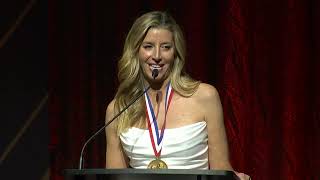
Sara Blakely on Spanx
Sara Blakely sees the Spanx origin story as proof that a great business can start with a personal frustration, a better solution, and the willingness to keep going before you feel ready.
- Spanx started with her own wardrobe problem under white pants.
- She built it by acting before she had expertise, money, or permission.
- Rejection was constant, but she treated persistence as part of the job.
- Her edge came from solving how women feel, not just how they look.
- She turned a product idea into a category through direct selling and bold demos.

“…the inspiration came from my own butt…”NAPW National Networking Conference keynote, 2012 · 0:02
Spanx began with a specific, lived problem
Blakely does not present Spanx as a vague dream or abstract business plan. She traces it to a concrete consumer frustration: she needed something better to wear under white pants, and the gap was obvious because she was the customer experiencing it herself.123
That matters because her model of entrepreneurship starts with either filling a void or improving what already exists. In her telling, Spanx worked because it was rooted in a real inconvenience and a clear improvement opportunity, not in trend-chasing or theory.34
Her broader ambition was also larger than one garment. She wanted to create something that could help huge numbers of people feel better, which gave the idea emotional force from the start.5
“…the inspiration came from my own butt…”NAPW National Networking Conference keynote, 2012 · full transcript →
She prototyped first and learned by doing
Blakely's origin story is deeply hands-on. She cut, tested, and adjusted the concept herself, trying to make the garment work in real life rather than waiting for formal credentials or expert approval.67
She repeatedly argues that lack of industry knowledge can help rather than hurt. Because she did not know the accepted rules, she was more willing to question them and invent around them.8910
This is one of her clearest lessons from Spanx: start before everything is figured out. She describes entrepreneurship as building while moving, and her own path fits that exactly.111213

“I immediately went and researched patents at the Georgia Tech Library, and I wrote my own patent.”Masters of Scale interview, 2016 · full transcript →
Persistence mattered as much as the idea
Blakely is unusually direct that the early Spanx story was not smooth. She says she faced years of rejection from manufacturers, and the emotional challenge was not just external resistance but also managing her own self-doubt while hearing no again and again.1415
What separates her origin story from a lucky break is the decision to keep moving anyway. She frames courage less as fearlessness than as acting despite fear, and she treats the way you handle failure as central to where you end up.1617
Her persistence was practical, not just motivational. She kept calling, kept making homemade versions, and kept pushing until she could get the product made.1819
She bootstrapped the business by controlling as much as she could
In Blakely's telling, Spanx was built with very little money but a high level of personal commitment. She bet on herself with savings from selling fax machines and made progress step by step instead of waiting for outside backing.20
That scrappiness extended into the legal and brand foundations of the company. She researched patents herself, wrote her own patent materials, and even trademarked the name herself for a minimal cost.212223
The practical lesson is that early entrepreneurship often means reducing dependence on gatekeepers. Rather than letting cost or missing expertise stop her, she found the parts she could do herself and pushed the rest forward later.1913

“I had $5,000 in savings and an idea and bet on myself.”NBC Today interview, 2014 · full transcript →
She sold the problem, not just the product
Blakely says one of the key moves in building Spanx was communicating the problem in a way customers and buyers could instantly feel. Her principle is to sell the problem you are solving, because that is what makes the product click.24
This explains one of the most famous moments in the origin story: when a standard pitch was not landing, she physically demonstrated the difference to the Neiman Marcus buyer in a bathroom. She won by making the need visible and undeniable.2526
That same philosophy shaped the product itself. She focuses on how women feel in the garment, not only how it looks on a form, and she treats that emotional reality as the design standard.2728

“You need to come to the bathroom with me.”The Edge Connection talk in Atlanta, 2016 · full transcript →
Blakely on spanx, in her own words
“…the inspiration came from my own butt…”
“…sell the problem you’re solving, not the product…”
“I had $5,000 in savings and an idea and bet on myself.”
“You just have to believe in yourself and come up with a better solution or solve a problem.”
Where to watch
 Sara Blakely on Spanx Origin Story: Bootstrapping a New Category2012 · 45 min · full transcriptBest full walkthrough of how the idea became a product, brand, and new category.
 Sara Blakely on Entrepreneurship: Going for It Despite Fear2016 · 60 min · full transcriptStrong on the early hustle, patent story, and the Neiman Marcus breakthrough.
 Sara Blakely on Entrepreneurship: From Fax Sales to Spanx2016 · 28 min · full transcriptShows the scrappy mechanics of prototyping, naming, pitching, and learning from scratch.
 Sara Blakely on Big Ideas and Persistence: Find It, Then Act2016 · 41 min · full transcriptBest for understanding how she searched for a big idea and recognized Spanx when it appeared.
 Sara Blakely on Mindset And Failure: Bootstrapping Spanx2021 · 27 min · full transcriptConnects the origin story to her mindset on failure, inexperience, and innovation.
Questions people ask
- How did Sara Blakely come up with the idea for Spanx?
- How did Sara Blakely come up with the name Spanx?
- How did Sara Blakely convince Neiman Marcus to carry Spanx?
- How did Sara Blakely get Spanx made when no manufacturers would say yes?
- What did Sara Blakely say about how to start an entrepreneurship idea?
- What did Sara Blakely say about not knowing how something is supposed to be done?
Sources
Every quote above, word for word from the transcripts. Numbers match the text.
“…the inspiration came from my own butt…”
“I am just a frustrated consumer.”
“For anybody that wants to be an entrepreneur, two main reasons you become one.”
“FOR ANYBODY THAT WANTS TO BE AN ENTREPRENEUR, TWO MAIN REASONS YOU BECOME ONE. YOU FILL A VOID, CREATE A PRODUCT THAT DIDN'T EXIST OR TAKE AN EXISTING PRODUCT AND MAKE IT BETTER. IF YOU ARE IN THOSE TWO BUCKETS, THERE'S ALWAYS THE RIGHT TIME IS NOW. YOU KNOW, BEING AN ENTREPRENEUR IS LIKE JUMPING OFF A CLIFF AND ASSEMBLING THE PLANE ON THE WAY DOWN. PEOPLE THAT HAVE AN IDEA, KNOW HOW TO MAKE A PRODUCT OR SERVICE BETTER, DO IT NOW. DON'T WAIT TO HAVE IT ALL FIGURED OUT. NO ENTREPRENEUR DOES. YOU FIGURE IT OUT ON THE WAY THROUGH IT. DIFFERENTIATE YOURSELF AND SOLVE THE PROBLEM. YOU HAVE TO BE AUTHENTIC, PUT LOVE INTO WHAT YOU DO.”
“I want to invent a product that I can sell to millions of people that will make them feel good.”
“I've basically made the garment.”
“I have got to figure out a way to comfortably keep this down on the leg…”
“What you don't know can be your greatest asset if you let it…”
“You know what, you don't know will be your greatest asset if you let it.”
“I like to tell people what you don't know can be your greatest asset if you let it…”
“There's always the right time is now.”
“Being an entrepreneur is like jumping off a cliff and assembling the plane on the way down.”
“You just have to believe in yourself and come up with a better solution or solve a problem.”
“I heard the word no for two straight years…”
“There were two things that were happening. One was my own self-doubt was a really hard part of the journey and then the beginning of all the manufacturers that I was having to cold call, and talked to to try to get my product made were all men. And it was much harder to explain and to try to get them to understand the concept of what the product was. So I heard the word no for two straight years trying to get it made, which then increases the self-doubt that can happen and one of the interesting things about being an inventor is you don't go to school for it. There isn't an inventor class. You can't major in inventing. And so it's really a belief system in yourself and the willingness to look stupid or to have people laugh at you or to fail at something that you believe, you're your own gut check on that.”
“My definition of greatness would be going for it no matter what, despite fear…”
“I think failure and your attitude and the way that you embrace the fear of failure is a big part of where we end up in our lives…”
“I ended up getting on the internet and looking up hosiery mills, and I went to a website called ThomasNet.com where I found a list of all U.S. manufacturers, and I literally went down the list finding hosiery and shapewear and started calling each one of them on the phone. Well, I did this for about six to eight months, and everybody said the same thing, which was basically no. I believed in my product. I still wanted to get it made. So, I started going to all the local craft stores here in Atlanta. I went to Michaels. I went to Hancock Fabric, and I started making homemade versions of my idea, buying…”
“I feel like hustle is the willingness to work really, really hard, and then also your willingness to get the job done. Like kind of navigating and doing what it takes. And there's so much about my journey where I was like, I am not going to let the outcome, or my success, be contingent on other people, as much as I can control it, help it, navigate it, I'm going to.”
“I had $5,000 in savings and an idea and bet on myself.”
“I immediately went and researched patents at the Georgia Tech Library, and I wrote my own patent.”
“I went to Barnes & Noble. No way! And I bought a book called Patents and Trademarks, and I wrote the patent. And then I called one of the patent lawyers that was the nicest to me and said, "Please, please, please, will you write the claims over the weekend for a discounted price? I've done all the other, rest of the patent." Yeah, the leg work you'd done. Yeah, you just kind of needed to button it up and, yeah, you needed to do the legal part. And so he did. He actually admitted to me that when I came to visit him, he thought I'd been sent by Canon Camera, which—let me put it in your words, I know Canon Camera—I know. He thought he was being punked.”
“I trademarked the name Spanx for $150 with my credit card on uspto.gov.”
“…sell the problem you’re solving, not the product…”
“You need to come to the bathroom with me.”
“I went in and halfway through the pitch, I could tell I was losing her. So I said, you know what? Will you please come to the bathroom with me? And she was like so buttoned up. I mean, Neiman Marcus, like her pen matched her belt that matched her shoes. And she was like, what? You're like, what am I going to do in the bathroom? I was like, just follow me in the bathroom and show you my own panty line. And I went in the stall with Spanx in my pants and without it in my pants. And she was like, oh, I totally get it. It's awesome. And I'm going to put it in seven stores. Wow. Yeah, just like that.”
“I HAVE BEEN ADVOCATING FOR WOMEN THROUGH PRODUCT. THAT'S HOW I FEEL. AND THE TEAM AT SPANX FEELS THAT WAY. WHEN I STOOD IN THE MANUFACTURING PLANTS TWO YEARS AGO, I WAS ONE OF THE ONLY WOMEN IN THE PLANT. THEN WE'RE MAKING UNDERGARMENTS. I'M LIKE WE'RE NOT COMFORTABLE IN THEM. SPANX HAS BEEN TAKING THE POSITION OF FOCUS ON HOW SHE FEELS FIRST IN EVERYTHING WE MAKE. EVERY PROTOTYPE. SOMETIMES IT TAKES MANY, SOMETIMES WE NEVER LAUNCH A PRODUCT. WE'RE ALWAYS HOW DO YOU FEEL. WE WANT WOMEN TO HAVE THAT SPANX FEELING.”
“We want women to have that Spanx feeling.”
How this guide was made: drafted with AI from the full transcripts of the recordings cited, then checked: every quotation must match a transcript word for word and be the speaker's own words, and an independent review gates accuracy. Methodology and corrections.