Sara Blakely on Career & Purpose
Sara Blakely treats career and purpose as an active search for where your strengths, curiosity, courage, and usefulness to others meet.
- Setbacks can redirect you toward the path that fits you better.
- Purpose grows from knowing your strengths and solving a real problem for people.
- You find your path by acting, not by waiting to feel certain.
- Mindset and self-investment matter because career change starts inside first.
- Even the right next chapter can involve grief, identity loss, and starting again.

Failure is not the end of the path; it can reveal the right one
Blakely does not frame career setbacks as proof that you are stuck or unqualified. Her failed LSAT became a turning point because it pushed her to stop forcing one plan and ask a better question about what direction her life was pointing her toward. Instead of treating disappointment as final, she used it as information.12
That same pattern shows up in how she talks about wrong-fit work. When she realized she was in the wrong environment, she did not just complain; she stepped back, took stock of what she was actually good at, and began reorienting around that. For her, purpose is often found by noticing misfit honestly rather than pretending it is fine.3
“…what is life trying to tell me?”Forbes interview, 2016 · full transcript →
Purpose starts with self-knowledge and a problem worth solving
Blakely's version of purpose is not abstract. She ties it to a direct intersection: your real strengths, your own lived experience, and something useful you can create for other people. She knew she could sell, and she wanted to create something that could reach millions and make them feel good.34
That is why her career story is less about chasing status and more about paying attention to a specific unmet need. She actively looked for a big idea, then recognized one through a problem she personally had. In her view, purpose often becomes visible when you stop waiting for a grand calling and start noticing everyday friction that you are unusually motivated to fix.45
She also puts unusual value on inexperience. Not knowing the standard way can help you question assumptions and attempt what more experienced people might dismiss too quickly. That makes career purpose less about credentials and more about resourcefulness.67
Act before you feel ready, because regret is worse than fear
A central driver in Blakely's career philosophy is that fear should not get the final vote. She says the fear that matters most to her is regret, and that perspective helped her make calls, take risks, and move even while scared. Purpose, in this sense, is not something you discover from the sidelines; it is something you get closer to by walking through doors.8910
This is practical advice for anyone considering a career shift. If you wait for confidence, perfect timing, or universal approval, you may stay parked in the wrong life. Blakely's example suggests a better rule: take the next concrete step, gather feedback, and let motion clarify what matters.95
She also warns against letting embarrassment control your decisions. The more power embarrassment has over you, the smaller your career becomes; the less power it has, the more freedom you have to experiment, recover, and keep building.11
Career clarity depends on mindset, thinking time, and originality
Blakely sees inner work as career work. She argues that mindset is a skill, not a personality trait, and that how you think will shape whether you can navigate uncertainty and stay creative under pressure. That is why she emphasizes becoming the driver of your thoughts rather than being carried by them.1213
She is especially insistent on protecting time alone to think, journal, daydream, and challenge limiting beliefs. For her, this is not self-help fluff; it is how you hear your own signal underneath noise and distraction. Career purpose gets easier to hear when you stop outsourcing your direction.15
Originality also matters. Blakely pushes people not to become copies of what already looks successful. The world does not need another imitation, and a meaningful career is more likely to come from leaning into your own way of seeing and building.1617
Success is not the finish line; purpose keeps changing
Blakely's later reflections are useful because they show that even after major success, career and purpose do not freeze in place. She sold a company she deeply loved because she wanted her mental energy back for what might come next. That means purpose is not just about building; sometimes it is about releasing an identity that has become complete.1819
She is clear that a right decision can still hurt. Missing a chapter does not always mean you should return to it, and sadness does not prove you chose wrong. For anyone changing careers, leaving a role, or outgrowing a long-held ambition, that is a crucial distinction.202122
Her broader measure of success is also wider than money. She treats money as something that amplifies who you already are, not as a trustworthy measure of purpose by itself. Real success includes how you live, what you contribute, and whether your work still feels aligned with who you are becoming.232425

“You can make the right decision and still be sad.”No Magic Pill podcast interview, 2026 · full transcript →
Blakely on career & purpose, in her own words
“…what is life trying to tell me?”
“I just wanted my mental share to be freed up…”
“You can make the right decision and still be sad.”
Where to watch
 Sara Blakely on Self-Belief and Originality: FSU Commencement2026 · 20 min · full transcriptBest single overview of her advice on self-belief, originality, thought habits, and building a path after setbacks.
 Sara Blakely on Entrepreneurship: Perseverance, Authenticity, and Spanx2016 · 4 min · full transcriptShows how failing the LSAT redirected her career and how she turned disappointment into a better question.
 Sara Blakely on Big Ideas and Persistence: Find It, Then Act2016 · 41 min · full transcriptBest for understanding how she searched for purpose through a real consumer problem and then acted on it.
 Sara Blakely on Mortality And Regret: Don’t Forget You’re Going To Die2016 · 8 min · full transcriptExplains the courage piece: why fear of regret can be a better career compass than fear of failure.
 Sara Blakely on Midlife Transition: Letting Go and Starting Again2025 · 66 min · full transcriptUseful for anyone navigating a later-life pivot, identity shift, or the need to let go of a once-central role.
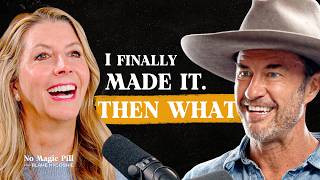 Sara Blakely on Post-Success Purpose: Grief, Growth, and Enough2026 · 68 min · full transcriptShows how purpose continues after success, including grief, enoughness, and choosing a new chapter.
Questions people ask
- How does Sara Blakely say people should think about their own thoughts?
- What did Sara Blakely say about failing the LSAT and finding her path?
- What did Sara Blakely say about mindset during hard times?
- What did Sara Blakely say about self-doubt and thinking time?
- What did Sara Blakely say to do when you feel stuck in the wrong career?
- What did Sara Blakely say was the most important investment she ever made?
Sources
Every quote above, word for word from the transcripts. Numbers match the text.
“…what is life trying to tell me?”
“I basically failed it, and I remember at that moment it being this life-changing moment that set me on a different course. And the way that I initially handled it was, try again. I took the course; I tried it again. And then, when it didn't go as I planned, I asked myself a lot of questions. You know, what is life trying to tell me? Do I have a different path? Maybe I'm supposed to be open to something else. And that's what set me on the journey that ended up creating Spanx.”
“And distinctly remember saying, like, I'm in the wrong movie. Like, call the director, call the producer, cut. This is not my life. I'm changing the script. And I went home that night, and I wrote in my journal, "What the heck are you good at?" And the only thing really in my positive column was sales. I knew I could sell. Then I asked myself some important questions, which I always think is really helpful for us in self-ex-excavating where we want to be, where we should head, and what are our strengths.”
“I want to invent a product that I can sell to millions of people that will make them feel good.”
“I immediately went and researched patents at the Georgia Tech Library, and I wrote my own patent.”
“What you don't know is your greatest asset…”
“I like to tell people what you don't know can be your greatest asset if you let it…”
“My fear of regret is greater than the fear of doing it.”
“I use my own mortality a lot to help me walk through the door and make that cold call.”
“I'm scared about regrets. So I'm scared about the things that I'm gonna leave on the table when I'm all done and I'm 60, 70, 80, and I can't do them. I don't want to look back and be like, I didn't do this because fill in the blank. So your fear of regret is greater than the fears of not doing? My fear of regret is greater than the fear of doing it.”
“Turns out there's a really fancy word for crotch called gusset. And that helped me find my search and I found a crotch maker in the very last hour and was able to deliver the Spanx order to Neiman Marcus. When you're the driver of your thoughts, crisis, or in my case, crotches, don't derail you. They push you. You will be embarrassed. But the fear, when the fear of being embarrassed loses its power over you, that's when you become the most powerful. I'm going to tell you one of my most…”
“You can be a passenger of your thoughts or you can be the driver of your thoughts.”
“What I would say is positive mindset is a skill. So I would say if you are that person and you're at home right now, listen to anything that helps you have a positive frame of mind, because right now, more than ever, your greatest weapon and the greatest thing that's going to get you through this and maybe determine who really thrives first, who survives through this, yeah, is going to be mindset. So listening to, you know, I have my favorites. I grew up on Wayne Dyer, you know, there's Tony Robbins, Wayne Dyer. There's so many great up-and-coming people in this space. Louis, your stuff is so positive to listen to. I would do that. There's a lot of golden nuggets that you could learn also right now from other...”
“You will be faced with tremendous uncertainty too, but because of the work you do on yourself, you'll navigate through it. You're living in a very, very distracted time. The world is grabbing for your attention. You have to protect your time alone. You have to protect your time to think, to daydream, to visualize where you want to end up, to challenge your self-doubts, and to reframe your limiting self-beliefs. Because here's the deal. Everybody has self-doubt. But the people who are the most successful have just learned how to…”
“In a world of copycats, you become an original.”
“The world does not need another version of how it's supposed to be done.”
“I just wanted my mental share to be freed up…”
“I sold to free up my mental share…”
“You can miss it and still not want it back.”
“You can make the right decision and still be sad.”
“You can make the right decision and still be sad…”
“…money just makes you more of who you already were…”
“I do not subscribe at all to "money is the root of all evil.”
“I think money just makes you more of who you already were…”
How this guide was made: drafted with AI from the full transcripts of the recordings cited, then checked: every quotation must match a transcript word for word and be the speaker's own words, and an independent review gates accuracy. Methodology and corrections.


