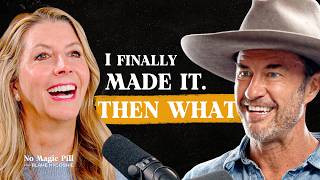
Sara Blakely on Mindset And Manifestation
Sara Blakely treats manifestation as disciplined thought training: visualize clearly, protect time to think, trust inner knowing, and then take bold action despite fear.
- Mindset is a daily skill, not a personality trait.
- Manifestation starts with clear visualization, writing things down, and learning how to think.
- She pairs inner belief with aggressive action, like cold calls, bootstrapping, and direct selling.
- Her version of manifestation depends on originality and trusting what you know before the world validates it.
- The real enemy is regret, distraction, and letting fear or embarrassment run your mind.

“What I would say is positive mindset is a skill. So I would say if you are that person and you're at home right now, listen to anything that helps you have a positive frame of mind, because right now, more than ever, your greatest weapon and the greatest thing that's going to get you through this and maybe determine who really thrives first, who survives through this, yeah, is going to be mindset. So listening to, you know, I have my favorites. I grew up on Wayne Dyer, you know, there's Tony Robbins, Wayne Dyer. There's so many great up-and-coming people in this space. Louis, your stuff is so positive to listen to. I would do that. There's a lot of golden nuggets that you could learn also right now from other...”Lewis Howes podcast interview, 2020 · 29:56
For Blakely, mindset is the main asset behind manifestation
Blakely does not present manifestation as wishful thinking. She treats mindset as a skill that must be practiced, especially when life is uncertain or hard. In her view, the biggest advantage a person has is the ability to direct thought instead of being ruled by it.12
That is why she keeps returning to mental training as foundational. She says her real early investment was not outside capital but inner work, and she links long-term confidence to that decision.34
Her core distinction is simple: many people are taught what to think, but not how to think. Manifestation begins when you learn to shape your own attention, beliefs, and interpretations instead of inheriting them passively.56
“What I would say is positive mindset is a skill. So I would say if you are that person and you're at home right now, listen to anything that helps you have a positive frame of mind, because right now, more than ever, your greatest weapon and the greatest thing that's going to get you through this and maybe determine who really thrives first, who survives through this, yeah, is going to be mindset. So listening to, you know, I have my favorites. I grew up on Wayne Dyer, you know, there's Tony Robbins, Wayne Dyer. There's so many great up-and-coming people in this space. Louis, your stuff is so positive to listen to. I would do that. There's a lot of golden nuggets that you could learn also right now from other...”Lewis Howes podcast interview, 2020 · full transcript →
Visualization works when it becomes specific, repeated, and personal
Blakely says she has practiced visualization and manifestation since high school, and she traces that habit back to Wayne Dyer’s influence. The point was not just positive vibes; it was learning to imagine outcomes clearly enough that they felt reachable and worth acting on.78
She reinforces that practice with journaling and scheduled thinking time. Rather than filling every moment with noise, she protects space to daydream, visualize where she wants to end up, challenge self-doubt, and reframe limiting beliefs.69
Her approach is also highly personal. She is not trying to mimic someone else’s blueprint, because she believes originality matters more than copying accepted models. Manifestation, for her, is strongest when it is connected to your own inner picture of what should exist.1011
Trusting inner knowing matters more than waiting to feel ready
A major theme in Blakely’s mindset is trust in inner knowing. She says that years of mental work helped her take leaps even when she lacked expertise, and that this is exactly where innovation appears.412
This is why she repeatedly frames inexperience as an advantage, not a handicap. If you do not already accept the standard way things are done, you are more likely to question assumptions and create something original.131415
She extends that trust beyond business tactics into life decisions. Creating mental space, listening for what feels true, and honoring that signal are part of how she navigates major transitions as well as entrepreneurial risk.1617
Manifestation only counts if you act through fear
Blakely’s version of manifestation is inseparable from action. She defines greatness as going for it despite fear, and she repeatedly connects success to doing the uncomfortable thing anyway.1819
That is why mortality and regret play such a big role in her mindset. She uses the thought of limited time to move herself toward action, including hard outreach and cold calls, because regret feels more dangerous to her than failure.202122
Her career examples match that philosophy. She bootstrapped, wrote her own patent materials, and sold buyers directly by demonstrating the product instead of waiting for permission. In her framework, manifestation is not complete until it becomes behavior.2324

“I use my own mortality a lot to help me walk through the door and make that cold call.”Impact Theory interview, 2016 · full transcript →
Protect your mind from distraction, embarrassment, and borrowed standards
Blakely believes modern life constantly pulls attention away from the inner work that keeps people grounded. Her answer is to protect alone time, thinking time, and the mental room needed to visualize and question your own assumptions.9
She is equally direct about embarrassment. Fear of looking foolish loses power when you stop letting it govern your choices, and that freedom makes bolder action possible.25
This is also why she resists copycat thinking. A strong mindset is not just optimistic; it is independent. It helps you stay focused on the problem you want to solve and the product or path you actually believe in, rather than chasing approval or convention.10112627

“You will be faced with tremendous uncertainty too, but because of the work you do on yourself, you'll navigate through it. You're living in a very, very distracted time. The world is grabbing for your attention. You have to protect your time alone. You have to protect your time to think, to daydream, to visualize where you want to end up, to challenge your self-doubts, and to reframe your limiting self-beliefs. Because here's the deal. Everybody has self-doubt. But the people who are the most successful have just learned how to…”Florida State University commencement address, 2026 · full transcript →
Blakely on mindset and manifestation, in her own words
“I’ve been practicing visualization and manifestation since the '80s.”
“I use my own mortality a lot to help me walk through the door and make that cold call.”
“I have spent 16 years of my life being taught what to think, but no one has ever taught me how to think.”
Where to watch
 Sara Blakely on Manifestation: Ask, Believe, Receive2025 · 69 min · full transcriptHer clearest direct discussion of visualization, manifestation, asking clearly, and using those habits in entrepreneurship.
 Sara Blakely on Mindset And Failure: Bootstrapping Spanx2021 · 27 min · full transcriptBest for how mindset training, inner knowing, and reframing inexperience supported building Spanx.
 Sara Blakely on Self-Belief and Originality: FSU Commencement2026 · 20 min · full transcriptStrong practical advice on journaling, thought training, self-belief, and becoming the driver of your thoughts.
 Sara Blakely on Mortality And Regret: Don’t Forget You’re Going To Die2016 · 8 min · full transcriptShows how she turns fear of regret and awareness of mortality into immediate action.
 Sara Blakely on Success and Happiness: Mindset, Gratitude, and Focus2020 · 73 min · full transcriptUseful for her broader view that mindset is the key skill for surviving difficulty and staying grounded in success.
 Sara Blakely on Midlife Transition: Letting Go and Starting Again2025 · 66 min · full transcriptAdds how intuition, mental space, and inner knowing shape big life transitions, not just business growth.
Questions people ask
- How does Sara Blakely say people should think about their own thoughts?
- What did Sara Blakely say about mindset during hard times?
- What did Sara Blakely say about not knowing how something is supposed to be done?
- What did Sara Blakely say about self-doubt and thinking time?
- What does Sara Blakely say she fears most?
- How does Sara Blakely build confidence and make bold decisions?
Sources
Every quote above, word for word from the transcripts. Numbers match the text.
“What I would say is positive mindset is a skill. So I would say if you are that person and you're at home right now, listen to anything that helps you have a positive frame of mind, because right now, more than ever, your greatest weapon and the greatest thing that's going to get you through this and maybe determine who really thrives first, who survives through this, yeah, is going to be mindset. So listening to, you know, I have my favorites. I grew up on Wayne Dyer, you know, there's Tony Robbins, Wayne Dyer. There's so many great up-and-coming people in this space. Louis, your stuff is so positive to listen to. I would do that. There's a lot of golden nuggets that you could learn also right now from other...”
“You can be a passenger of your thoughts or you can be the driver of your thoughts.”
“I sold that company in 2021. I was the sole founder, and I had zero investors. And when I look back on my journey, the most critical thing that I did, the thing that everyone here today can do, is I made one big investment early on in the process. I invested in me. When I was 16 years old and in high school, my parents were separating and getting divorced. And my dad came into my bedroom and…”
“You know, absolutely it did. But because I've been working on mindset since I was 16, it didn't shake my confidence. You know, I had this belief, and I've been listening to conversations and reading books about trust your inner knowing. We all have an inner knowing, and so I think because I've been doing that work, I was willing to take the leap knowing nothing. And what I tell people now is, you know what, you don't know will be your greatest asset if you let it. You know, because it means you don't know how it's supposed to be done. And when you don't know how it's supposed to be done, there's the innovation, there's the magic.”
“I have spent 16 years of my life being taught what to think, but no one has ever taught me how to think.”
“But fast forward 20 years later, I end up on the cover of Forbes magazine and my friends from Clearwater High texted me and all they wrote was, "Damn, should have listened to that shit." And you should, too. You can be a spectator in your life or a participant. You can be an action taker or a sit-around and waiter. You can be a passenger of your thoughts or you can be the driver of your thoughts. I chose to be the driver. I journaled. I scheduled time to think.”
“I’ve been practicing visualization and manifestation since the '80s.”
“I think the latter. I'm always asking why in everything. It's like why is it like this? Why? Why? Why? How long has it been this way? Why hasn't it? who was the first to think of this? Could it be better? So, I think it's more about not accepting the status quo. And you know, I want to just mention I've been working on my mindset since I'm 16 years old. I started listening to tapes. I'm dating myself uh by Dr. Wayne Dyer and it was how to be a no limit person. But it was really talking about visualizing what you want, manifesting it, law of attraction, not fearing failure, not caring what other people think about you. And um that is really important especially as women for us to find that confidence because if you are going to say I want to buck the whole system. That's scary. You have to have a lot of inner strength and a and a very strong inner compass to be able to stand in that space.”
“You will be faced with tremendous uncertainty too, but because of the work you do on yourself, you'll navigate through it. You're living in a very, very distracted time. The world is grabbing for your attention. You have to protect your time alone. You have to protect your time to think, to daydream, to visualize where you want to end up, to challenge your self-doubts, and to reframe your limiting self-beliefs. Because here's the deal. Everybody has self-doubt. But the people who are the most successful have just learned how to…”
“In a world of copycats, you become an original.”
“The world does not need another version of how it's supposed to be done.”
“You know what, you don't know will be your greatest asset if you let it.”
“What you don't know can be your greatest asset if you let it…”
“What you don't know is your greatest asset…”
“I wake up every day and there's innovators and there's imitators, and I'd far rather be an innovator.”
“I just wanted my mental share to be freed up…”
“I sold to free up my mental share…”
“My definition of greatness would be going for it no matter what, despite fear…”
“I was in it to win it.”
“My fear of regret is greater than the fear of doing it.”
“I use my own mortality a lot to help me walk through the door and make that cold call.”
“I'm scared about regrets. So I'm scared about the things that I'm gonna leave on the table when I'm all done and I'm 60, 70, 80, and I can't do them. I don't want to look back and be like, I didn't do this because fill in the blank. So your fear of regret is greater than the fears of not doing? My fear of regret is greater than the fear of doing it.”
“I went to Barnes & Noble. No way! And I bought a book called Patents and Trademarks, and I wrote the patent. And then I called one of the patent lawyers that was the nicest to me and said, "Please, please, please, will you write the claims over the weekend for a discounted price? I've done all the other, rest of the patent." Yeah, the leg work you'd done. Yeah, you just kind of needed to button it up and, yeah, you needed to do the legal part. And so he did. He actually admitted to me that when I came to visit him, he thought I'd been sent by Canon Camera, which—let me put it in your words, I know Canon Camera—I know. He thought he was being punked.”
“I went in and halfway through the pitch, I could tell I was losing her. So I said, you know what? Will you please come to the bathroom with me? And she was like so buttoned up. I mean, Neiman Marcus, like her pen matched her belt that matched her shoes. And she was like, what? You're like, what am I going to do in the bathroom? I was like, just follow me in the bathroom and show you my own panty line. And I went in the stall with Spanx in my pants and without it in my pants. And she was like, oh, I totally get it. It's awesome. And I'm going to put it in seven stores. Wow. Yeah, just like that.”
“Turns out there's a really fancy word for crotch called gusset. And that helped me find my search and I found a crotch maker in the very last hour and was able to deliver the Spanx order to Neiman Marcus. When you're the driver of your thoughts, crisis, or in my case, crotches, don't derail you. They push you. You will be embarrassed. But the fear, when the fear of being embarrassed loses its power over you, that's when you become the most powerful. I'm going to tell you one of my most…”
“…sell the problem you’re solving, not the product…”
“And that's a really important quality. It took you two years to start to build your company. You didn't rush, you obsessed on product. Obsessed. Okay, you just always say, you can have all the marketing flair, you might be a celebrity that comes out with a line, or, you know, you might get a lot of funding to do a big ad campaign. People will buy your product once if it's not good. So to me, everything starts with product. You could go all the way to the 99 yard line, and if it's not right, start all over again.”
How this guide was made: drafted with AI from the full transcripts of the recordings cited, then checked: every quotation must match a transcript word for word and be the speaker's own words, and an independent review gates accuracy. Methodology and corrections.