Sara Blakely on Marketing & Sales
Sara Blakely treats marketing and sales as clear problem-solving: lead with the customer's benefit, show the difference fast, and sell with honesty, hustle, and personal conviction.
- Lead with the problem you solve, not the product.
- Differentiate quickly and explain your value in seconds.
- Use direct demos, hustle, and persistence to get buyers to understand.
- Talk to customers like real people and be honest about who you are.
- Founders are often best early messengers because belief is contagious.

“I did it for seven years in a company. I was in an office equipment company where most people, you know, kind of rotated out every four to six months. And I think the things that it taught me, it taught me the importance of differentiating myself. It taught me about what's in it for me. We'd talk about it, WIIFM—that when you get a moment with someone, they're looking for the what's in it for them. And I learned I need to deliver that in my message very quickly or I lose them. Yes, you know, so it wasn't like, "Hey, I'm selling a fax machine." It was like, "Hey, I really believe I can improve your life and improve the quality of what you're doing, because the business, just like yours..." You know, I made it about them. Yes.”Tony Robbins interview, 2019 · 0:44
Start with a real customer problem
Blakely's approach to marketing begins before messaging: find a genuine frustration and build around that. She describes herself first as a frustrated consumer, and Spanx began from a problem she personally wanted solved, which gave her sales story natural clarity and urgency.1
That is why she emphasizes explaining the problem, not just describing the item. When people immediately recognize the discomfort, inconvenience, or insecurity being fixed, the product becomes easier to understand and easier to want.45
This also helps a founder avoid vague positioning. Her instinct is to keep asking why until she reaches the root truth, then communicate from there.6
Win attention fast by making the benefit obvious
Blakely learned in door-to-door sales that people decide quickly whether to keep listening. Her habit was to move immediately to what is in it for the other person, rather than leading with features or with the fact that she was selling something.7
That lesson carried into Spanx. She says a company has to differentiate itself obsessively and be able to explain in 30 seconds or less why it is different, why existing options are worse, and why the customer needs it.89
In practice, this means concise messaging, not polished jargon. For Blakely, good marketing is not sounding corporate; it is helping someone grasp the value quickly enough that they care.710
“I did it for seven years in a company. I was in an office equipment company where most people, you know, kind of rotated out every four to six months. And I think the things that it taught me, it taught me the importance of differentiating myself. It taught me about what's in it for me. We'd talk about it, WIIFM—that when you get a moment with someone, they're looking for the what's in it for them. And I learned I need to deliver that in my message very quickly or I lose them. Yes, you know, so it wasn't like, "Hey, I'm selling a fax machine." It was like, "Hey, I really believe I can improve your life and improve the quality of what you're doing, because the business, just like yours..." You know, I made it about them. Yes.”Tony Robbins interview, 2019 · full transcript →
Show, don't just tell
One of Blakely's clearest sales beliefs is that a direct demonstration can do more than a polished pitch. When she felt herself losing the Neiman Marcus buyer, she changed course, showed the product's effect physically, and the buyer understood immediately.
That moment captures how she sells: reduce abstraction, create a visible before-and-after, and let the customer experience the difference. This is especially powerful when a product solves an everyday but under-discussed problem that words alone may not fully convey.12
Her early willingness to cold-call retailers and personally sell in stores shows the same principle. She did not wait for brand prestige to do the work; she created understanding face to face.
Honesty, vulnerability, and humor make people root for you
Blakely believes customers want conversation that feels human. She argues that people want to be talked to, not talked at, and she avoided glossy language that felt fake or overproduced.1013
She also did not pretend Spanx was bigger or more established than it was. Instead of hiding that she was building from her apartment, she found that honesty opened doors and made people root for her.1413
Humor and vulnerability are part of the same strategy. In her view, dropping the facade lowers resistance and helps a message connect, whether in selling, leadership, or brand-building.15
Persistence and founder-led hustle matter early
Blakely's sales philosophy is unusually active: do not let progress depend entirely on other people when you can push it forward yourself. She describes hustle as hard work plus a willingness to navigate and do what it takes to get the job done.16
That mattered because she faced long stretches of rejection. She says she heard no for two straight years, especially from manufacturers who did not immediately understand the concept.1718
Instead of reading that rejection as a stop sign, she kept calling, learning, rewriting, and showing up. Her career in fax sales had already trained her to differentiate herself, tailor the message, and keep moving after discomfort or dismissal.71920

“I feel like hustle is the willingness to work really, really hard, and then also your willingness to get the job done. Like kind of navigating and doing what it takes. And there's so much about my journey where I was like, I am not going to let the outcome, or my success, be contingent on other people, as much as I can control it, help it, navigate it, I'm going to.”Stanford Graduate School of Business interview · full transcript →
As the company grows, keep the message clear and hand off the rest
Blakely sees a founder's strengths as a strategic asset in marketing and sales. Early on, she stayed close to inventing, selling, and promoting, while recognizing that other people should run functions where she was weaker.2122
Her rule is to hire your weaknesses as soon as you can afford it. That lets the founder keep contributing where conviction and instinct are strongest, while the business becomes more capable operationally.2122
She applies the same thinking to communications. She preferred passionate in-house PR because belief in the product changes how the message lands, and because authenticity is part of the brand itself.924

“I always say, as soon as you can afford to hire your weaknesses or the things you don't enjoy as much, do it. And anytime that you can delegate and clone yourself kind of and try to get some additional support, it's a great moment in a small business. You know, I hired my day-to-day CEO about two years into starting Spanx. And up until that point, you know, when you have no money, you're every department. So, um, I got to learn very quickly what I'm really better at, what I'm not as good at, what I enjoy doing, what I don't enjoy doing. And I couldn't wait to hire someone to fill in my weaknesses, and just focus on my strengths.”DailyCandy interview on startup tips, 2012 · full transcript →
Blakely on marketing & sales, in her own words
“I did it for seven years in a company. I was in an office equipment company where most people, you know, kind of rotated out every four to six months. And I think the things that it taught me, it taught me the importance of differentiating myself. It taught me about what's in it for me. We'd talk about it, WIIFM—that when you get a moment with someone, they're looking for the what's in it for them. And I learned I need to deliver that in my message very quickly or I lose them. Yes, you know, so it wasn't like, "Hey, I'm selling a fax machine." It was like, "Hey, I really believe I can improve your life and improve the quality of what you're doing, because the business, just like yours..." You know, I made it about them. Yes.”
Where to watch
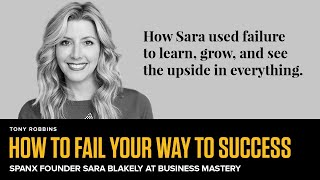 Sara Blakely on Fear of Failure: Embracing Embarrassment2019 · 12 min · full transcriptBest short explanation of the sales lessons she learned door to door: lead with the customer's benefit, differentiate fast, and adapt your message.
 Sara Blakely on Entrepreneurship: Going for It Despite Fear2016 · 60 min · full transcriptShows how she sold Spanx from scratch, including the Neiman Marcus bathroom demo and her direct, persistent selling style.
 Sara Blakely on Startup Tips: Hire Weaknesses, Stay Clear2012 · 4 min · full transcriptMost concise advice on differentiation, 30-second messaging, customer communication, and founder-led PR.
 Sara Blakely on Mindset And Failure: Bootstrapping Spanx2021 · 27 min · full transcriptExplains why she believes the strongest marketing starts with the problem being solved rather than the product itself.
 Sara Blakely on Entrepreneurship: Start Small, Think Big46 min · full transcriptUseful for understanding how confidence, persistence, and founder strengths supported Spanx's growth without outside funding.
 Sara Blakely on Brand Building: The Skinny on Spanx2019 · 18 min · full transcriptGood overview of how she turned a consumer frustration into a brand through cold-calling, in-store selling, and curiosity.
Questions people ask
- How did Sara Blakely convince Neiman Marcus to carry Spanx?
- How does Sara Blakely define hustle?
- How does Sara Blakely say entrepreneurs should differentiate their product?
- What did Sara Blakely say about being honest as a founder?
- What did Sara Blakely say about hiring weaknesses in a startup?
- What did Sara Blakely learn from door-to-door sales?
Sources
Every quote above, word for word from the transcripts. Numbers match the text.
“I am just a frustrated consumer.”
“…sell the problem you’re solving, not the product…”
“I want to invent a product that I can sell to millions of people that will make them feel good.”
“I'm always like why, why, why, why, why—'til I get to the very last why I can get, because that's really where the truth always is. And so why is our, as human beings, the biggest fear failure? Well, it's because we don't want to be embarrassed, right? So it's really ultimately fear of embarrassment, which then led me to fear of what other people think of me is the real root of the issue. So that is where I spent a lot of time working myself. I've been a student of that for, for since I'm 16. I've been working on not caring what other people think about me, and it took me a minute. But I realized that not caring what other people think about me doesn't have to mean I don't care about…”
“I did it for seven years in a company. I was in an office equipment company where most people, you know, kind of rotated out every four to six months. And I think the things that it taught me, it taught me the importance of differentiating myself. It taught me about what's in it for me. We'd talk about it, WIIFM—that when you get a moment with someone, they're looking for the what's in it for them. And I learned I need to deliver that in my message very quickly or I lose them. Yes, you know, so it wasn't like, "Hey, I'm selling a fax machine." It was like, "Hey, I really believe I can improve your life and improve the quality of what you're doing, because the business, just like yours..." You know, I made it about them. Yes.”
“…differentiate yourself and be obsessive about it…”
“They're being paid by someone to tell me about this. Does that impact me more, or does it impact me more to have someone call me that's super passionate about the product that either created it or works with the company? And that's just where I net it. I mean, I know a lot of companies have done amazing things, and I'm a big advocate of PR, whether you get it from an outside firm or yourself. I just happen to do it internally. One of the biggest things I can say is differentiate yourself and be obsessive about it. You know, like tell, tell yourself in the mirror or be able to tell anyone in 30 seconds or less why you're different, why what's out there isn't as good, and why the customer needs it.”
“…customers want to be talked to and not talked at…”
“I call that BS before Spanx…”
“I think customers want to be talked to and not talked at. And I think a lot of companies talk at a customer and it's very sort of glossy speak and it doesn't seem real. And from day one, I just, I never tried to hide that I was the girl in my apartment with the red backpack. It's like, this is who I am. And, um, I find that people end up rooting for you and opening more doors if you're really honest early on. Some people start businesses and try to come across that they're much bigger than they are because they feel like that's the only way they're going to be taken seriously.”
“…you don't have to apologize for being out of your home or your apartment or being small…”
“I love the idea of leaders and CEOs showing vulnerabilities, and showing the ups and downs, and I just don't really subscribe in the feeling that I need to put on any kind of a facade to be taken seriously as a leader. And so it's like this is my life, this is who I am. I'm a mom of four, some days I'm working it out, some days I'm not. And I think that's important. I also sort of have my own filter for Instagram, it's not planned out, I do it 100% myself. And I'm having fun with it, if I wake up one day and it's not fun anymore, then I'll figure out a plan B. But so everything kind of happens organically and in the moment for my Instagram.”
“I feel like hustle is the willingness to work really, really hard, and then also your willingness to get the job done. Like kind of navigating and doing what it takes. And there's so much about my journey where I was like, I am not going to let the outcome, or my success, be contingent on other people, as much as I can control it, help it, navigate it, I'm going to.”
“I heard the word no for two straight years…”
“There were two things that were happening. One was my own self-doubt was a really hard part of the journey and then the beginning of all the manufacturers that I was having to cold call, and talked to to try to get my product made were all men. And it was much harder to explain and to try to get them to understand the concept of what the product was. So I heard the word no for two straight years trying to get it made, which then increases the self-doubt that can happen and one of the interesting things about being an inventor is you don't go to school for it. There isn't an inventor class. You can't major in inventing. And so it's really a belief system in yourself and the willingness to look stupid or to have people laugh at you or to fail at something that you believe, you're your own gut check on that.”
“I was in it to win it.”
“My definition of greatness would be going for it no matter what, despite fear…”
“…as soon as you can afford to hire your weaknesses or the things you don't enjoy as much, do it…”
“I always say, as soon as you can afford to hire your weaknesses or the things you don't enjoy as much, do it. And anytime that you can delegate and clone yourself kind of and try to get some additional support, it's a great moment in a small business. You know, I hired my day-to-day CEO about two years into starting Spanx. And up until that point, you know, when you have no money, you're every department. So, um, I got to learn very quickly what I'm really better at, what I'm not as good at, what I enjoy doing, what I don't enjoy doing. And I couldn't wait to hire someone to fill in my weaknesses, and just focus on my strengths.”
“11 years old, and we've never advertised and we've never had PR outside of Spanx. I interviewed a lot of PR firms here in New York. I flew up here. I went back and forth. It was a very mixed decision for me throughout, and I just kept coming back that it was better for me to have somebody in-house that I knew really believed in the product and was really passionate about it and wasn't necessarily being paid to tell somebody about it. So, I always, in business, I always put myself in the very end person's, um, thought process. So in that, I was, I was thinking, okay, if I'm the newspaper and I get a call from a PR agency that I know has called me for seven other products in the past, and…”
How this guide was made: drafted with AI from the full transcripts of the recordings cited, then checked: every quotation must match a transcript word for word and be the speaker's own words, and an independent review gates accuracy. Methodology and corrections.


