Sara Blakely on Innovation
Sara Blakely sees innovation as ordinary people noticing frustrating problems, refusing the status quo, and building better solutions with persistence and self-belief.
- Innovation starts with a real problem you personally feel.
- Questioning the status quo matters more than formal credentials.
- Originality comes from trusting intuition and not copying how things are usually done.
- Great ideas still require persistence through rejection, prototyping, and iteration.
- Product quality and how people feel using it come first.

Innovation begins with a problem that bothers you
Blakely’s approach to innovation starts with personal frustration, not abstract brainstorming. She looks for something in daily life that feels broken, inconvenient, or outdated, then treats that irritation as a clue that a better product should exist.12
That is how Spanx began: not from industry expertise, but from her own wardrobe problem and desire to feel better in her clothes. She has said she wanted to build something that could help many people feel good, which ties innovation to practical usefulness rather than novelty for its own sake.34
This also explains why she is drawn to neglected categories. If a problem is common but accepted as normal, she sees an opening for invention.2
The core skill is questioning what everyone else accepts
Blakely treats innovation as an attitude before it is a technique. She keeps asking why things are done a certain way, how long they have been done that way, and whether they could be better. That habit of inquiry helps her notice opportunities other people overlook.56
In her view, inventors do not need elite credentials or perfect knowledge. What matters is the willingness to solve a problem and believe that a better solution is possible.78
She also believes ignorance can sometimes help originality. When you do not fully absorb the accepted rules of an industry, you are less likely to copy them automatically and more likely to rethink the whole setup.910
“I think the latter. I'm always asking why in everything.”Forbes interview, 2025 · full transcript →
Original ideas require intuition and independence
Blakely does not frame innovation as a purely analytical process. She puts unusual weight on intuition, especially when entering markets that others dismiss or misunderstand.112
That independence shows up in her larger philosophy too. She urges people to become originals rather than more polished versions of what already exists, and she argues that the world does not need another copy of the standard playbook.1213
For her, innovation is partly mental: you have to direct your thinking instead of letting fear, convention, or outside opinion steer it. Time to think, journal, and challenge self-doubt is not separate from creativity; it supports it.141516
Scrappy execution turns a hunch into an invention
Blakely’s story makes innovation look less like a flash of genius and more like a long stretch of resourceful action. After recognizing the opportunity, she prototyped the product herself, researched patents, and pushed forward even without formal training.171819
She often describes the early phase as full of rejection and uncertainty. Hearing no for years did not mean the idea was wrong; it meant she had to keep searching for a path to make it real.202122
Her practical motto is to begin modestly but keep the ambition large. Innovation, in this sense, is not just having an idea. It is being willing to do the unglamorous work that lets the idea survive contact with reality.23
A better product matters more than hype
Blakely keeps returning to one standard: does the product actually make people feel better? She focuses especially on women’s lived experience, arguing that product decisions should start with comfort, confidence, and real use rather than theory or appearances.24
That is why she emphasizes repeated prototyping and a willingness to abandon launches that are not good enough. Innovation is not complete when the idea sounds clever; it is complete when the solution truly works.2425
She also sees this as a competitive edge. You can market a weak product once, but if it does not solve the problem, it will not last. Real innovation earns trust by improving the user’s experience in a meaningful way.25
Blakely on innovation, in her own words
“I think the latter. I'm always asking why in everything.”
“The world does not need another version of how it's supposed to be done.”
Where to watch
 Sara Blakely on Big Ideas and Persistence: Find It, Then Act2016 · 41 min · full transcriptBest overview of how she actively searched for a big idea, recognized a consumer gap, and acted on it.
 Sara Blakely on Entrepreneurship: From Fax Sales to Spanx2016 · 28 min · full transcriptShows the scrappy mechanics of innovation: prototyping, patent work, and learning an industry from scratch.
 Sara Blakely on Betting on Yourself: Build What Women Need2025 · 21 min · full transcriptExplains her innovation mindset clearly: personal problems, intuition, questioning old rules, and disrupting overlooked categories.
 Sara Blakely on Brand Building: The Skinny on Spanx2019 · 18 min · full transcriptA concise version of how consumer frustration became both a product and a brand.
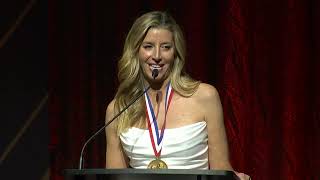 Sara Blakely on Inventing With Confidence: Hall of Fame Induction2023 · 6 min · full transcriptStrong short statement of her belief that inventing is for problem-solvers, not just experts.
Questions people ask
- How did Sara Blakely get Spanx made when no manufacturers would say yes?
- What did Sara Blakely say about not knowing how something is supposed to be done?
- What did Sara Blakely say about starting products from a personal problem?
- How does Sara Blakely build confidence and make bold decisions?
- What did Sara Blakely say about designing products for women?
- What does Sara Blakely say about product development?
Sources
Every quote above, word for word from the transcripts. Numbers match the text.
“I am just a frustrated consumer.”
“Well, I for me everything starts with a problem and it's usually a problem that I'm experiencing. Um I couldn't find a solution of what to wear under white pants. I got frustrated with the undergarment options and then with sneaks obviously high heels are very uncomfortable and have been for like hundreds of years and I really wanted to take a new fresh approach at that. I think it's interesting that both of the industries that I decided to go in and try to disrupt were were really kind of on the decline.”
“…my exit strategy is that I want to exit a room and look good…”
“I want to invent a product that I can sell to millions of people that will make them feel good.”
“I think the latter. I'm always asking why in everything.”
“I think the latter. I'm always asking why in everything. It's like why is it like this? Why? Why? Why? How long has it been this way? Why hasn't it? who was the first to think of this? Could it be better? So, I think it's more about not accepting the status quo. And you know, I want to just mention I've been working on my mindset since I'm 16 years old. I started listening to tapes. I'm dating myself uh by Dr. Wayne Dyer and it was how to be a no limit person. But it was really talking about visualizing what you want, manifesting it, law of attraction, not fearing failure, not caring what other people think about you. And um that is really important especially as women for us to find that confidence because if you are going to say I want to buck the whole system. That's scary. You have to have a lot of inner strength and a and a very strong inner compass to be able to stand in that space.”
“What's so cool about being an inventor is you don't have to be the smartest.”
“You just have to believe in yourself and come up with a better solution or solve a problem.”
“I like to tell people what you don't know can be your greatest asset if you let it…”
“You know, absolutely it did. But because I've been working on mindset since I was 16, it didn't shake my confidence. You know, I had this belief, and I've been listening to conversations and reading books about trust your inner knowing. We all have an inner knowing, and so I think because I've been doing that work, I was willing to take the leap knowing nothing. And what I tell people now is, you know what, you don't know will be your greatest asset if you let it. You know, because it means you don't know how it's supposed to be done. And when you don't know how it's supposed to be done, there's the innovation, there's the magic.”
“I'm going to honor my intuition.”
“In a world of copycats, you become an original.”
“The world does not need another version of how it's supposed to be done.”
“You can be a passenger of your thoughts or you can be the driver of your thoughts.”
“But fast forward 20 years later, I end up on the cover of Forbes magazine and my friends from Clearwater High texted me and all they wrote was, "Damn, should have listened to that shit." And you should, too. You can be a spectator in your life or a participant. You can be an action taker or a sit-around and waiter. You can be a passenger of your thoughts or you can be the driver of your thoughts. I chose to be the driver. I journaled. I scheduled time to think.”
“You will be faced with tremendous uncertainty too, but because of the work you do on yourself, you'll navigate through it. You're living in a very, very distracted time. The world is grabbing for your attention. You have to protect your time alone. You have to protect your time to think, to daydream, to visualize where you want to end up, to challenge your self-doubts, and to reframe your limiting self-beliefs. Because here's the deal. Everybody has self-doubt. But the people who are the most successful have just learned how to…”
“I've basically made the garment.”
“I immediately went and researched patents at the Georgia Tech Library, and I wrote my own patent.”
“I went to Barnes & Noble. No way! And I bought a book called Patents and Trademarks, and I wrote the patent. And then I called one of the patent lawyers that was the nicest to me and said, "Please, please, please, will you write the claims over the weekend for a discounted price? I've done all the other, rest of the patent." Yeah, the leg work you'd done. Yeah, you just kind of needed to button it up and, yeah, you needed to do the legal part. And so he did. He actually admitted to me that when I came to visit him, he thought I'd been sent by Canon Camera, which—let me put it in your words, I know Canon Camera—I know. He thought he was being punked.”
“I heard the word no for two straight years…”
“There were two things that were happening. One was my own self-doubt was a really hard part of the journey and then the beginning of all the manufacturers that I was having to cold call, and talked to to try to get my product made were all men. And it was much harder to explain and to try to get them to understand the concept of what the product was. So I heard the word no for two straight years trying to get it made, which then increases the self-doubt that can happen and one of the interesting things about being an inventor is you don't go to school for it. There isn't an inventor class. You can't major in inventing. And so it's really a belief system in yourself and the willingness to look stupid or to have people laugh at you or to fail at something that you believe, you're your own gut check on that.”
“I ended up getting on the internet and looking up hosiery mills, and I went to a website called ThomasNet.com where I found a list of all U.S. manufacturers, and I literally went down the list finding hosiery and shapewear and started calling each one of them on the phone. Well, I did this for about six to eight months, and everybody said the same thing, which was basically no. I believed in my product. I still wanted to get it made. So, I started going to all the local craft stores here in Atlanta. I went to Michaels. I went to Hancock Fabric, and I started making homemade versions of my idea, buying…”
“I feel like hustle is the willingness to work really, really hard, and then also your willingness to get the job done. Like kind of navigating and doing what it takes. And there's so much about my journey where I was like, I am not going to let the outcome, or my success, be contingent on other people, as much as I can control it, help it, navigate it, I'm going to.”
“I HAVE BEEN ADVOCATING FOR WOMEN THROUGH PRODUCT. THAT'S HOW I FEEL. AND THE TEAM AT SPANX FEELS THAT WAY. WHEN I STOOD IN THE MANUFACTURING PLANTS TWO YEARS AGO, I WAS ONE OF THE ONLY WOMEN IN THE PLANT. THEN WE'RE MAKING UNDERGARMENTS. I'M LIKE WE'RE NOT COMFORTABLE IN THEM. SPANX HAS BEEN TAKING THE POSITION OF FOCUS ON HOW SHE FEELS FIRST IN EVERYTHING WE MAKE. EVERY PROTOTYPE. SOMETIMES IT TAKES MANY, SOMETIMES WE NEVER LAUNCH A PRODUCT. WE'RE ALWAYS HOW DO YOU FEEL. WE WANT WOMEN TO HAVE THAT SPANX FEELING.”
“And that's a really important quality. It took you two years to start to build your company. You didn't rush, you obsessed on product. Obsessed. Okay, you just always say, you can have all the marketing flair, you might be a celebrity that comes out with a line, or, you know, you might get a lot of funding to do a big ad campaign. People will buy your product once if it's not good. So to me, everything starts with product. You could go all the way to the 99 yard line, and if it's not right, start all over again.”
How this guide was made: drafted with AI from the full transcripts of the recordings cited, then checked: every quotation must match a transcript word for word and be the speaker's own words, and an independent review gates accuracy. Methodology and corrections.


