Sara Blakely on Product Development
Sara Blakely treats product development as problem-solving from real lived frustration, then obsessively iterating until the product makes women feel better, not just look better.
- Start with a problem you personally feel and understand deeply.
- Question industry norms and trust intuition when data or incumbents miss the customer.
- Prototype scrappily, keep improving, and launch only when the product truly works.
- Judge products by how people feel using them, not by theory, tradition, or marketing.
Great products start with a real frustration
Blakely’s starting point is not abstract market analysis. She begins with a problem that is bothering her in everyday life, then treats that annoyance as a signal that a broader customer need may be hiding in plain sight. That is how Spanx began, and it is also how she describes later products.123
She frames entrepreneurship in simple product terms: either create something missing or improve something that already exists but fails people. In her telling, the best ideas come from noticing an unmet need, not from waiting for permission or perfect credentials.46
This also explains the scale of her ambition. She wanted to build something useful enough to reach millions and make them feel good, which gave her a practical filter for what kinds of ideas were worth pursuing.78
Consumer empathy matters more than industry convention
Blakely repeatedly comes back to one test: how the customer feels. She saw a gap between what manufacturers were making and what women actually experienced wearing those products, and she built around that gap. For her, product development is advocacy through design.9
That is why she resists building from tradition alone. She keeps asking why things are done a certain way, how long they have been done that way, and whether they could be better. This habit helps her spot stale assumptions that entire categories have normalized.
Her emphasis is not just on appearance or technical correctness. She wants a product to change comfort, confidence, and ease in real use, which is why she says the goal is a distinctive feeling, not just a better-looking object.129
Prototype with whatever you have, then keep refining
Blakely’s process is notably hands-on and scrappy. She did not wait for expertise, a full team, or ideal manufacturing support before making the first version. She started by altering an existing product herself and learning through direct experimentation.1314
She also did the unglamorous development work herself: researching patents, writing her own patent, calling manufacturers, and building homemade versions when factories said no. Her model is to move from idea to crude prototype quickly, then improve from there.151617
This approach fits her broader belief that entrepreneurs figure things out while doing the work. Instead of trying to eliminate uncertainty before starting, she begins with a workable solution and develops it through action.
Obsess over product quality, because marketing cannot save a weak product
Blakely is unusually blunt on this point: product comes first. Brand, celebrity, funding, and promotion may win an initial purchase, but they do not create a lasting business if the product disappoints.20
That belief makes her willing to spend time iterating and even to walk away from launches that do not meet the standard. She describes a process where some products take many prototypes and some never launch at all because the feeling is not right yet.920
Her quality bar is tied to repeat value, not launch theater. In her view, getting close is not enough; if the product is wrong at the last moment, you go back and rebuild it.20

“And that's a really important quality. It took you two years to start to build your company. You didn't rush, you obsessed on product. Obsessed. Okay, you just always say, you can have all the marketing flair, you might be a celebrity that comes out with a line, or, you know, you might get a lot of funding to do a big ad campaign. People will buy your product once if it's not good. So to me, everything starts with product. You could go all the way to the 99 yard line, and if it's not right, start all over again.”Impact Theory interview, 2016 · full transcript →
Use rejection and inexperience as advantages
Blakely’s development process was shaped by resistance. She spent years hearing no from manufacturers, especially in a category dominated by men who did not intuitively understand the problem she was solving. Instead of reading rejection as proof the idea was weak, she treated it as part of the path.2122
She also argues that not knowing the accepted way to do things can help product development. Inexperience leaves more room for unconventional solutions because you are less bound by the rules insiders take for granted.232425
That mindset is paired with self-belief and intuition. She repeatedly says she chose to trust her inner sense of what women needed, even when external validation came slowly.26276
Blakely on product development, in her own words
“And that's a really important quality. It took you two years to start to build your company. You didn't rush, you obsessed on product. Obsessed. Okay, you just always say, you can have all the marketing flair, you might be a celebrity that comes out with a line, or, you know, you might get a lot of funding to do a big ad campaign. People will buy your product once if it's not good. So to me, everything starts with product. You could go all the way to the 99 yard line, and if it's not right, start all over again.”
Where to watch
 Sara Blakely on Entrepreneurship: Solve the Problem2014 · 7 min · full transcriptBest short overview of her product philosophy: solve a void or improve an existing product, and start before you feel ready.
 Sara Blakely on Entrepreneurship: From Fax Sales to Spanx2016 · 28 min · full transcriptShows her scrappy development process from first insight to prototype, patent, and manufacturing.
 Sara Blakely on Entrepreneurship: Build What Women Actually Need2025 · 50 min · full transcriptConnects her original Spanx method to later product development and explains why iteration and unmet needs still drive her.
 Sara Blakely on Big Ideas and Persistence: Find It, Then Act2016 · 41 min · full transcriptUseful for understanding how she actively searched for ideas, prototyped, and learned by doing.
 Sara Blakely on Betting on Yourself: Build What Women Need2025 · 21 min · full transcriptBest on intuition, questioning the status quo, and building in categories others overlook.
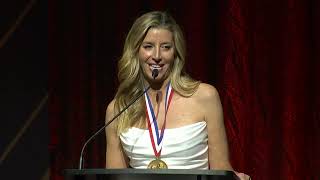 Sara Blakely on Inventing With Confidence: Hall of Fame Induction2023 · 6 min · full transcriptConcise statement of her inventor mindset: believe in yourself and solve the problem with a better solution.
Questions people ask
- How did Sara Blakely come up with the idea for Spanx?
- How did Sara Blakely get Spanx made when no manufacturers would say yes?
- What did Sara Blakely say about how to start an entrepreneurship idea?
- What did Sara Blakely say about starting products from a personal problem?
- What did Sara Blakely say about designing products for women?
- What does Sara Blakely say about product development?
Sources
Every quote above, word for word from the transcripts. Numbers match the text.
“Well, I for me everything starts with a problem and it's usually a problem that I'm experiencing. Um I couldn't find a solution of what to wear under white pants. I got frustrated with the undergarment options and then with sneaks obviously high heels are very uncomfortable and have been for like hundreds of years and I really wanted to take a new fresh approach at that. I think it's interesting that both of the industries that I decided to go in and try to disrupt were were really kind of on the decline.”
“…the inspiration came from my own butt…”
“I am just a frustrated consumer.”
“For anybody that wants to be an entrepreneur, two main reasons you become one.”
“You just have to believe in yourself and come up with a better solution or solve a problem.”
“I want to invent a product that I can sell to millions of people that will make them feel good.”
“I wrote in my journal, "I want to invent something that I can sell to millions of people that will make them feel." And I had no idea what it was going to be. I just wrote it in my journal, and then I asked the universe for the idea. I said, "Give me the idea and I won't squander it." And it was two years later that I cut the feet out of control top, C-Y hose, to solve a homegrown problem that women had, which was, what do I wear under these white pants? And because I had set that intention two years prior, I just was ready to give it a shot.”
“I HAVE BEEN ADVOCATING FOR WOMEN THROUGH PRODUCT. THAT'S HOW I FEEL. AND THE TEAM AT SPANX FEELS THAT WAY. WHEN I STOOD IN THE MANUFACTURING PLANTS TWO YEARS AGO, I WAS ONE OF THE ONLY WOMEN IN THE PLANT. THEN WE'RE MAKING UNDERGARMENTS. I'M LIKE WE'RE NOT COMFORTABLE IN THEM. SPANX HAS BEEN TAKING THE POSITION OF FOCUS ON HOW SHE FEELS FIRST IN EVERYTHING WE MAKE. EVERY PROTOTYPE. SOMETIMES IT TAKES MANY, SOMETIMES WE NEVER LAUNCH A PRODUCT. WE'RE ALWAYS HOW DO YOU FEEL. WE WANT WOMEN TO HAVE THAT SPANX FEELING.”
“We want women to have that Spanx feeling.”
“I've basically made the garment.”
“I have got to figure out a way to comfortably keep this down on the leg…”
“I immediately went and researched patents at the Georgia Tech Library, and I wrote my own patent.”
“I ended up getting on the internet and looking up hosiery mills, and I went to a website called ThomasNet.com where I found a list of all U.S. manufacturers, and I literally went down the list finding hosiery and shapewear and started calling each one of them on the phone. Well, I did this for about six to eight months, and everybody said the same thing, which was basically no. I believed in my product. I still wanted to get it made. So, I started going to all the local craft stores here in Atlanta. I went to Michaels. I went to Hancock Fabric, and I started making homemade versions of my idea, buying…”
“I trademarked the name Spanx for $150 with my credit card on uspto.gov.”
“And that's a really important quality. It took you two years to start to build your company. You didn't rush, you obsessed on product. Obsessed. Okay, you just always say, you can have all the marketing flair, you might be a celebrity that comes out with a line, or, you know, you might get a lot of funding to do a big ad campaign. People will buy your product once if it's not good. So to me, everything starts with product. You could go all the way to the 99 yard line, and if it's not right, start all over again.”
“I heard the word no for two straight years…”
“There were two things that were happening. One was my own self-doubt was a really hard part of the journey and then the beginning of all the manufacturers that I was having to cold call, and talked to to try to get my product made were all men. And it was much harder to explain and to try to get them to understand the concept of what the product was. So I heard the word no for two straight years trying to get it made, which then increases the self-doubt that can happen and one of the interesting things about being an inventor is you don't go to school for it. There isn't an inventor class. You can't major in inventing. And so it's really a belief system in yourself and the willingness to look stupid or to have people laugh at you or to fail at something that you believe, you're your own gut check on that.”
“I like to tell people what you don't know can be your greatest asset if you let it…”
“You know, absolutely it did. But because I've been working on mindset since I was 16, it didn't shake my confidence. You know, I had this belief, and I've been listening to conversations and reading books about trust your inner knowing. We all have an inner knowing, and so I think because I've been doing that work, I was willing to take the leap knowing nothing. And what I tell people now is, you know what, you don't know will be your greatest asset if you let it. You know, because it means you don't know how it's supposed to be done. And when you don't know how it's supposed to be done, there's the innovation, there's the magic.”
“What's so cool about being an inventor is you don't have to be the smartest.”
“I'm going to honor my intuition.”
“I left corporate America and bet on myself…”
How this guide was made: drafted with AI from the full transcripts of the recordings cited, then checked: every quotation must match a transcript word for word and be the speaker's own words, and an independent review gates accuracy. Methodology and corrections.


