Sara Blakely on Fear of Failure: Embracing Embarrassment

What Blakely talks about
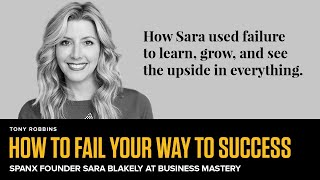
Sara Blakely spoke in this Tony Robbins interview in 2019 about overcoming fear of failure in business, drawing on her sales experience, her father’s view of failure, and the role of embarrassment.
Also known as: SPANX Founder Sara Blakely on Overcoming Fear of Failure in Business; Sara Blakely on Fear of Failure: Embracing Embarrassment.
Sara Blakely says door-to-door sales taught her to differentiate herself, adapt to different personality types, and quickly communicate the benefit to the other person. She credits those lessons with helping her sell effectively and succeed in business.
A major theme is how her father reframed failure: not trying became the real failure, and every setback was treated as a chance to find a positive. Blakely says this trained her to try things without fear and to look for meaning in outcomes.
She also argues that the real root of fear of failure is fear of embarrassment and fear of what other people think. To weaken that fear, she intentionally embarrasses herself and treats those moments as useful, even connecting, stories.
Tony Robbins interviews Blakely and prompts the discussion; Blakely speaks for the substantive answers.
In her words
“My definition of failure became not about the outcome but about not trying.”
“The real root of the issue”
“I intentionally embarrass myself.”
“Mindset's pretty much what”
Key points
- Door-to-door sales taught her to lead with the customer’s benefit, not the product.
- She learned to adapt her communication style to different personality types.
- Vulnerability and humor can open doors in selling and in life.
- Her father encouraged failure as a normal part of growth and effort.
- She defines failure as not trying because of fear.
- The deeper fear behind failure is embarrassment and concern about others’ opinions.
- Mindset, not formal business training, was central to building Spanx.
Full transcript: Sara Blakely, Tony Robbins interview on fear of failure (2019)
(applause) (music) Something that I found is the most common denominator, the most successful people ever known, is intelligence. I love, well, get the intelligent people. You're obviously wickedly smart, and so is your husband, but they're not locally smart, that never maximized, because they don't have that sense of urgency or a sense of a purpose or a meaning larger than themselves. Tell me a little bit about, 'cause I also worked door-to-door sales. Tell me what you got out of door-to-door sales that became helpful to you to succeed in business, if something did. Like, what was some of the distinctions or experiences that helped to make you successful as a business person? Whoa, well first of all, it's super humbling. It's really intense, like I said.
I did it for seven years in a company. I was in an office equipment company where most people, you know, kind of rotated out every four to six months. And I think the things that it taught me, it taught me the importance of differentiating myself. It taught me about what's in it for me. We'd talk about it, WIIFM—that when you get a moment with someone, they're looking for the what's in it for them. And I learned I need to deliver that in my message very quickly or I lose them. Yes, you know, so it wasn't like, "Hey, I'm selling a fax machine." It was like, "Hey, I really believe I can improve your life and improve the quality of what you're doing, because the business, just like yours..." You know, I made it about them. Yes.
And it's as soon as you can give them the benefit, do it. I used to mirror and the importance of humor. You do that as part of your marketing? Yeah, it's just not taking myself too seriously and being vulnerable. I think when you're vulnerable, oftentimes life will surprise you and people will be much kinder to you and much more willing to give you a few moments. But a lot of people think of vulnerability as weakness, and I don't. I think it's a big strength. So sometimes I would walk in a door and be like, you know, okay, I just messed up, can I redo that? You know, how to walk out and come back in, and they'd be like, what's going on with this girl? You know, but I was always kind of.
Calling out my own, like, I'm really nervous right now, or you know, thank you. This is my 15th call and it's really hot outside, and you know, do you mind if I get a sip of water and you know, things like that. That would help open the door. So, and then when you're doing this really intense selling all day, every day, cold, you learn that there's about four different personality types that you're selling to. One, other, and what is always gonna click with you because it's your personality type, but if you want to improve your closing ratio, you got to kind of figure out the other three types. And they're called lots of different things. When I was in sales and really training it all, so we call them socializers, relators, directors, and thinkers. And like, for example, I'm more
Of a socializer, director, and selling to a thinker was my hardest sale because thinkers want every piece of data and information, whether they're gonna use it or not. And I'm like, this is a waste of time, you know? And I kept losing sales to thinkers. And then finally I was like, I gotta, I gotta talk to them the way they want to be talked to. So, here's every detail, and here it is, and, you know, instead of projecting my style that I liked on them. Yes, many of you know the DISC model, you've used the DISC model. If the S and the C would be more, then thinker, right? The director would be the—I, it would be that social person. So you can translate, many of you, based on something you already understand. But the inability to adapt makes people fail, and so you learn, you keep adapting. Seven years of it. Tell me.
About the role your father's played, and you live, you'd focus if one of those important ones how he got you to realize you could control and direct your own thinking. Let's talk about the failure thing you shared with me. Is that my memory accurate? My dad, growing up, would actually encourage me to fail. So, I would come home from school and he would say to my brother and me, "So, what? You guys fail it this week?" And if I didn't have something, he would actually be disappointed. So, you know, it flipped the whole model on its head. And I would come home from school and I couldn't remember. I'd be like, "Dad, dad, I tried out for this and I was horrible." And he'd be like, "Way to go!" High-five me. And I didn't realize it at the time, but he was just changing my definition of failure. My definition of
Failure became not about the outcome but about not trying. And so, for me, going through life, my only failures are when I didn't try it because I was scared. And my dad even took it a step further. He would ask us, what did you get with the benefit, or what positive came from the home? So, we'd get to the dinner table and I'd be like, you know, I failed. I tried out for cheerleading and I was horrible, or I had tried for chorus, I couldn't sing at all. But then he'd always go, well, what positive came from it? And it trained our brains also to find that. And then it became like, of course, I want to try these things because, right, you're not so focused on the outcome. I met my best friend in cheerleading tryouts. Had I not done that,
You know, so you see these moments of that. What you get out of it—that was really cool. How incredible for all of us as a parent to be able to deliver that. I've shared with some of you the greatest basketball coach of all time from UCLA, John Wooden. When I interviewed him and asked him, you know, what was the best team that you had—he won 10 out of 12 national championships and they were all new players. And if you know basketball history, almost everybody knows the best team. It was Kareem Abdul-Jabbar, a group of people, and he didn't name that team. And he named a team I'd never heard of. And I said, why would they be the best? He said because they maximize their potential. He said the other guys had more talent, and he also teaches players. He said, I didn't want to teach them to play the game. I wanted them to play great human beings. And so his goal was, he said, you never know the score. You never know what. Do you want to lose by the score?
Because sometimes you'll get lucky. Sometimes a call, the ball dropped for you, or you'll get a good call, something go your way. You have a higher score, but you didn't really win. And sometimes somebody else's higher score—they got lucky or they got a bad call against you. He said the only way I know you won is he left everything on that floor every moment you were there. You gave your all. He said then, you know, do you want to lose control of that? And your father taught you to come up with meanings in such a beautiful way. Amazing. He's still alive today. (laughs) Oh my gosh, he must be so proud of you. It's really cool we honored your dad. Yeah, and my mom. My mom was amazing. Jamal, my mom is an artist. She was a stay-at-home mother. She's very—
Shy. She's very just very creative. And it was an interesting balance that some of them, you know, had like a trial attorney that was a litigator that I basically was on the witness stand since birth. You know, I had to learn to be quick on my feet. You know, I did. And then my mom was just this most unbelievable nurturer. Like, just, you know, she was the, like, warm blanket through the whole thing, like who I could lean on at any moment. It was there. But, you know, I want to talk briefly about failure a little bit more because you talk about it so much. And in all the years that I've been listening to you—but what I like to think about, 'cause you mentioned this—that it's the number one fear is fear of failure. And so I like to take things a step further.
I'm always like why, why, why, why, why—'til I get to the very last why I can get, because that's really where the truth always is. And so why is our, as human beings, the biggest fear failure? Well, it's because we don't want to be embarrassed, right? So it's really ultimately fear of embarrassment, which then led me to fear of what other people think of me is the real root of the issue. So that is where I spent a lot of time working myself. I've been a student of that for, for since I'm 16. I've been working on not caring what other people think about me, and it took me a minute. But I realized that not caring what other people think about me doesn't have to mean I don't care about
them, which is a big important thing to recognize. But, you know, so—and I will practice embarrassing myself. Tony, I intentionally embarrass myself. I mean, I'll randomly just start singing in an elevator or—and it's super embarrassing, and everyone looks at me like I'm crazy. Or, you know, I just—if I notice I will feel if it's been too long since I've been really mortally embarrassed, and then I will do it. Because if you're seeking it, it loses its power over you, you know. Then all of a sudden it's like, well, being embarrassed is the goal. And what I also realized by being embarrassed over and over again, it makes a great story. I mean, a lot of people will get embarrassed and
then the worst thing to do is be like, I hope no one saw that. I hope, you know, I never want to talk about that again or whatever. I'm like, hey guys, you're not gonna believe what happened to me. And I realize it's one of the best ways to connect with other humans. So their gifts. I'm like, every time I'm embarrassed, it's such a gift. What can I do with that? How important would you say psychology has been in this? One path: strong psychology, mindset. I mean, it's kind of everything, Tony, because I've never taken a business class in my life. I had no context in the industry, and I took on billion-dollar companies with $5,000. So I would say mindset's pretty much what I'm really touched by is you've not stopped growing, right? Your company has stopped going over 20
years. You continue to grow, but you keep growing, you keep growing. And she keeps—no, she keeps conditioning and training, like the training never stops in her mindset. She could easily say, "Where I've done these pieces, I know what to do," but you continue to do it. Plus, what the beautiful thing is—it breaks down barriers because most people would be intimidated if they think you're some way. And when you could just be natural and open, and you share something you were truly embarrassed by, it certainly opens the door. I just thought of a really embarrassing moment in my business journey. Can I share it, please? Okay. When I was first starting Spanx, I had, you know, cold-called all the department stores and been on some media here, and I decided to go over to the UK and try to launch Spanx there, and I got this moment where I got a chance to be
On the BBC and it's obviously kind of like Europe CNN, and the guy interviewing me was like, "So Sarah, tell us what Spanx can do for women in the UK?" And I was like, "Well, it's all about the fanny. It smooths your fanny. It lifts your fanny." Okay, I have no idea, but apparently fanny means vagina in England. I made the same mistake. Yeah, I said, "Get off your fat ass," and I got really, oh my god, see, I don't even ever use the word fanny. Very British. So I was like, "It makes your fanny look smooth," and the guy, like, lost all the colour in his face. He's
just like, I had to call back my team of two in my apartment in Atlanta, and I was like, "Our international expansion is off to a great start. I just told all of England I'm gonna smooth their vaginas." Why not? The most rally the Friday. That is so funny. I was Australian. "Tres semanas up your fanny." Finally, somebody whispered in my ear when I made that, "That is hilarious. Get up off your vagina," basically what you said. It alerts. I've never met anyone else that made
From YouTube captions, lightly punctuated for readability. Timestamps link to the video above. Errors are possible.
Cite this recording
Sara Blakely, “Tony Robbins interview on fear of failure (2019)”, 2019. Transcript and video: Thinkers Archive, https://thinkersarchive.com/sara-blakely/fear-of-failure-tony-robbins-interview-2019/
Quoting a passage? Link to its exact moment: every timestamp above has its own anchor (for example https://thinkersarchive.com/sara-blakely/fear-of-failure-tony-robbins-interview-2019/#t-131).