Sara Blakely on Fear And Regret
Sara Blakely treats regret as the real danger, using mortality, self-directed thinking, and a looser relationship with embarrassment to act despite fear.
- Regret scares her more than failure, so she acts before chances close.
- She uses mortality as a practical push to make the call, take the risk, and stop stalling.
- For her, failure means not trying, not getting a bad outcome.
- A lot of fear is really fear of embarrassment and other people's opinions.
- You manage fear by training your mindset and becoming the driver of your thoughts.
Regret is the fear Blakely takes most seriously
Blakely’s core move is simple: she compares the pain of action with the pain of looking back later, and the second one feels worse to her. That is why she says regret outweighs the fear of doing something hard.12
This changes the decision rule. Instead of asking whether a step feels comfortable now, she asks whether avoiding it will leave something unfinished or unlived later. That mindset pushes her toward risk, initiative, and experiments that many people postpone.12
She uses mortality to create urgency, not dread
Blakely does not treat mortality as a dark idea to avoid. She uses it as a practical reminder that time is limited, which helps her move through hesitation and take the next concrete step.3
In her telling, this is not abstract philosophy. Remembering that life is finite helps her walk through the door, make the cold call, and stop waiting for the perfect moment. Fear may still be present, but the clock matters more than the discomfort.3
Failure matters less when not trying becomes the real loss
A big reason Blakely can live with fear is that she was taught to define failure differently. For her, failure is more about not trying than about the outcome going badly.4
That reframing lowers the emotional cost of action. If the real mistake is sitting still, then rejection, awkwardness, and failed attempts become part of forward motion rather than proof that you should have stayed safe. Her description of greatness follows the same logic: go for it despite fear.54
Much of fear is really fear of embarrassment
Blakely digs underneath fear of failure and asks what is really there. Her answer is that people often fear embarrassment and, underneath that, fear what other people will think.6
That insight matters because it gives you a more specific enemy to work on. If the real issue is social discomfort, then the path forward is not waiting to feel fearless. It is loosening the grip of other people’s opinions and becoming more willing to look foolish while you learn.67
Her own story fits this pattern. She endured long stretches of rejection and self-doubt, yet kept going because invention required belief in herself and a willingness to look ridiculous before others understood the idea.89

“I'm always like why, why, why, why, why—'til I get to the very last why I can get, because that's really where the truth always is. And so why is our, as human beings, the biggest fear failure? Well, it's because we don't want to be embarrassed, right? So it's really ultimately fear of embarrassment, which then led me to fear of what other people think of me is the real root of the issue. So that is where I spent a lot of time working myself. I've been a student of that for, for since I'm 16. I've been working on not caring what other people think about me, and it took me a minute. But I realized that not caring what other people think about me doesn't have to mean I don't care about…”Tony Robbins interview, 2019 · full transcript →
Managing fear is a mindset practice, not a one-time breakthrough
Blakely does not suggest that fear disappears. She suggests that you can train how you respond to it by working on your thoughts consistently over time. Her language is active: be the driver of your thoughts instead of the passenger.1011
That means protecting time to think, challenge self-doubt, and reframe limiting beliefs. In her view, successful people are not free of uncertainty; they have learned how to navigate it because they have practiced doing inner work.12
This is also why she treats self-investment as foundational. Confidence under pressure is built before the big moment, through habits that help you trust your own judgment and keep moving when fear shows up.1314
The practical application is to act before certainty arrives
Blakely’s philosophy leads to a very concrete style of action: start, call, ask, show up, and solve the next problem without waiting to know everything. She repeatedly argues that not knowing can become an advantage because it frees you from assumptions about how things are supposed to be done.151614
That is especially useful when fear says you need more credentials, more permission, or a perfect plan. Her answer is to move anyway, stay committed, and let the process teach you. This is how regret loses power: you stop leaving your life up to hesitation.17185
Blakely on fear and regret, in her own words
“I'm always like why, why, why, why, why—'til I get to the very last why I can get, because that's really where the truth always is. And so why is our, as human beings, the biggest fear failure? Well, it's because we don't want to be embarrassed, right? So it's really ultimately fear of embarrassment, which then led me to fear of what other people think of me is the real root of the issue. So that is where I spent a lot of time working myself. I've been a student of that for, for since I'm 16. I've been working on not caring what other people think about me, and it took me a minute. But I realized that not caring what other people think about me doesn't have to mean I don't care about…”
Where to watch
 Sara Blakely on Mortality And Regret: Don’t Forget You’re Going To Die2016 · 8 min · full transcriptBest direct statement of her view that regret is scarier than failure and mortality should push you to act.
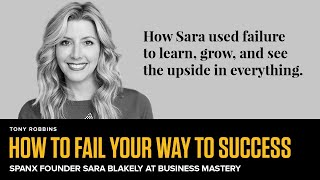 Sara Blakely on Fear of Failure: Embracing Embarrassment2019 · 12 min · full transcriptExplains her idea that fear of failure often hides fear of embarrassment and other people’s opinions.
 Sara Blakely on Entrepreneurship and Leadership: Building Spanx2023 · 22 min · full transcriptShows the family lesson that made not trying, rather than losing, the real definition of failure.
 Sara Blakely on Self-Belief and Originality: FSU Commencement2026 · 20 min · full transcriptBest for her method of managing fear through self-belief, journaling, and becoming the driver of your thoughts.
 Sara Blakely on Entrepreneurship: Going for It Despite Fear2016 · 60 min · full transcriptConnects her anti-regret mindset to action, persistence, and going for it despite fear.
Questions people ask
- How does Sara Blakely say people should think about their own thoughts?
- What did Sara Blakely say about embarrassment and success?
- What did Sara Blakely say about not knowing how something is supposed to be done?
- What did Sara Blakely say about self-doubt and thinking time?
- What did Sara Blakely say is the real root of the fear of failure?
- What did Sara Blakely say was the hardest part about getting Spanx off the ground?
Sources
Every quote above, word for word from the transcripts. Numbers match the text.
“My fear of regret is greater than the fear of doing it.”
“I'm scared about regrets. So I'm scared about the things that I'm gonna leave on the table when I'm all done and I'm 60, 70, 80, and I can't do them. I don't want to look back and be like, I didn't do this because fill in the blank. So your fear of regret is greater than the fears of not doing? My fear of regret is greater than the fear of doing it.”
“I use my own mortality a lot to help me walk through the door and make that cold call.”
“Failure for my brother and me became about not trying versus the outcome.”
“My definition of greatness would be going for it no matter what, despite fear…”
“I'm always like why, why, why, why, why—'til I get to the very last why I can get, because that's really where the truth always is. And so why is our, as human beings, the biggest fear failure? Well, it's because we don't want to be embarrassed, right? So it's really ultimately fear of embarrassment, which then led me to fear of what other people think of me is the real root of the issue. So that is where I spent a lot of time working myself. I've been a student of that for, for since I'm 16. I've been working on not caring what other people think about me, and it took me a minute. But I realized that not caring what other people think about me doesn't have to mean I don't care about…”
“Turns out there's a really fancy word for crotch called gusset. And that helped me find my search and I found a crotch maker in the very last hour and was able to deliver the Spanx order to Neiman Marcus. When you're the driver of your thoughts, crisis, or in my case, crotches, don't derail you. They push you. You will be embarrassed. But the fear, when the fear of being embarrassed loses its power over you, that's when you become the most powerful. I'm going to tell you one of my most…”
“I heard the word no for two straight years…”
“There were two things that were happening. One was my own self-doubt was a really hard part of the journey and then the beginning of all the manufacturers that I was having to cold call, and talked to to try to get my product made were all men. And it was much harder to explain and to try to get them to understand the concept of what the product was. So I heard the word no for two straight years trying to get it made, which then increases the self-doubt that can happen and one of the interesting things about being an inventor is you don't go to school for it. There isn't an inventor class. You can't major in inventing. And so it's really a belief system in yourself and the willingness to look stupid or to have people laugh at you or to fail at something that you believe, you're your own gut check on that.”
“You can be a passenger of your thoughts or you can be the driver of your thoughts.”
“But fast forward 20 years later, I end up on the cover of Forbes magazine and my friends from Clearwater High texted me and all they wrote was, "Damn, should have listened to that shit." And you should, too. You can be a spectator in your life or a participant. You can be an action taker or a sit-around and waiter. You can be a passenger of your thoughts or you can be the driver of your thoughts. I chose to be the driver. I journaled. I scheduled time to think.”
“You will be faced with tremendous uncertainty too, but because of the work you do on yourself, you'll navigate through it. You're living in a very, very distracted time. The world is grabbing for your attention. You have to protect your time alone. You have to protect your time to think, to daydream, to visualize where you want to end up, to challenge your self-doubts, and to reframe your limiting self-beliefs. Because here's the deal. Everybody has self-doubt. But the people who are the most successful have just learned how to…”
“I sold that company in 2021. I was the sole founder, and I had zero investors. And when I look back on my journey, the most critical thing that I did, the thing that everyone here today can do, is I made one big investment early on in the process. I invested in me. When I was 16 years old and in high school, my parents were separating and getting divorced. And my dad came into my bedroom and…”
“You know, absolutely it did. But because I've been working on mindset since I was 16, it didn't shake my confidence. You know, I had this belief, and I've been listening to conversations and reading books about trust your inner knowing. We all have an inner knowing, and so I think because I've been doing that work, I was willing to take the leap knowing nothing. And what I tell people now is, you know what, you don't know will be your greatest asset if you let it. You know, because it means you don't know how it's supposed to be done. And when you don't know how it's supposed to be done, there's the innovation, there's the magic.”
“What you don't know can be your greatest asset if you let it…”
“You know what, you don't know will be your greatest asset if you let it.”
“I was in it to win it.”
“I feel like hustle is the willingness to work really, really hard, and then also your willingness to get the job done. Like kind of navigating and doing what it takes. And there's so much about my journey where I was like, I am not going to let the outcome, or my success, be contingent on other people, as much as I can control it, help it, navigate it, I'm going to.”
How this guide was made: drafted with AI from the full transcripts of the recordings cited, then checked: every quotation must match a transcript word for word and be the speaker's own words, and an independent review gates accuracy. Methodology and corrections.


