Sara Blakely on Money And Success
Sara Blakely sees money and success as amplifiers of character, best pursued with intuition, resilience, gratitude, and the intent to create real value for others.
- Money is not bad; it can be joyful to earn, spend, and give away.
- Money and success magnify your existing character rather than changing it.
- Success should include health, relationships, mindset, and integrity, not just net worth.
- She built wealth by betting on herself, solving real problems, and pushing through rejection and self-doubt.
- Her decisions are driven more by regret avoidance, intuition, and authenticity than by prestige or old business rules.

“I feel like success just makes you more of who you already were. I feel like money and success just does that, so it's like it holds a magnifying glass up to who you are. People always ask me that, and I am like, I don't know who else to be, I am who I am. So the money, the success, and so I like to say if you were a jerk before you got really successful, and a lot of money, you become a bigger jerk, really. And if you were insecure, you'll become more insecure, if you were nice, you become nicer. If you were generous, you become become more generous, it's literally just a magnifying glass.”Stanford Graduate School of Business interview · 33:49
Money is a tool, not a moral stain
Blakely rejects the idea that money is inherently corrupting. She talks about earning, using, and giving money as positive experiences, which puts money in the category of tool and opportunity rather than guilt or taboo12.
That stance matters because it removes shame from ambition. In her view, wanting to make money does not make someone selfish; what matters is what kind of person is holding it and what they do with it afterward23.
Money and success magnify who you already are
Her central idea is that wealth does not transform character so much as reveal and intensify it. If someone is generous, insecurity-prone, kind, or arrogant before success, money tends to enlarge those traits rather than replace them456.
This is why she links money to self-awareness. Chasing success without doing inner work is risky, because the reward can amplify unresolved flaws just as easily as it amplifies the best parts of a person46.
The practical lesson is to build character in parallel with career. On her view, generosity, authenticity, and emotional steadiness are not side benefits of success; they are the qualities that determine what success turns into once it arrives367.
“I feel like success just makes you more of who you already were. I feel like money and success just does that, so it's like it holds a magnifying glass up to who you are. People always ask me that, and I am like, I don't know who else to be, I am who I am. So the money, the success, and so I like to say if you were a jerk before you got really successful, and a lot of money, you become a bigger jerk, really. And if you were insecure, you'll become more insecure, if you were nice, you become nicer. If you were generous, you become become more generous, it's literally just a magnifying glass.”Stanford Graduate School of Business interview · full transcript →
Success is bigger than wealth alone
Blakely does not treat money as a complete definition of success. She emphasizes mindset, gratitude, relationships, health, and the way you show up for other people, which broadens success from a scoreboard into a whole-life measure89.
She is also proud not only of building a large company, but of doing it in a way she could feel good about. That suggests success for her includes ethical alignment and self-respect, not just growth or status.
Even after major business success, she describes grief, identity disruption, and sadness around leaving what she built. That shows that external wins do not cancel emotional complexity, and that getting what you want can still force a painful transition101112.
Wealth comes from betting on yourself and solving a real problem
Blakely's path to success starts with a simple principle: solve a problem you genuinely understand. She began from personal frustration, trusted her own experience as signal, and built around a product that made people feel better131415.
She also ties financial success to self-belief and ownership. She left a safer path, backed herself, and kept pushing despite years of rejection, self-doubt, and people not understanding the idea161718.
Her approach combines modest beginnings with ambitious scale. Start with what you can control, make the product excellent, and do not let progress depend more than necessary on others' permission1920.

“I left corporate America and bet on myself…”Forbes interview, 2025 · full transcript →
The right relationship to success is intuitive, brave, and generous
Blakely often chooses intuition over convention. She trusts the repeated inner signal, questions accepted rules, and refuses a model of business built around combativeness or imitation212223.
She also acts from fear of regret more than fear of failure. That mindset helps her take risks, make the call, endure discomfort, and pursue opportunities before time closes the window242526.
Finally, she treats success as something to circulate, not just keep. Paying things forward and giving others a leg up are part of what makes money meaningful in her framework3271.
Blakely on money and success, in her own words
“…money just makes you more of who you already were…”
“I do not subscribe at all to "money is the root of all evil.”
“I left corporate America and bet on myself…”
Where to watch
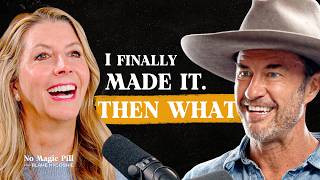 Sara Blakely on Post-Success Purpose: Grief, Growth, and Enough2026 · 68 min · full transcriptBest for her mature view of money, enough, grief after success, and why wealth does not solve identity on its own.
 Sara Blakely on Success and Happiness: Mindset, Gratitude, and Focus2020 · 73 min · full transcriptBest for her broader definition of success across mindset, gratitude, relationships, and life balance.
 Sara Blakely on Entrepreneurship: Start Small, Think Big46 min · full transcriptBest for seeing how self-doubt, rejection, ownership, and persistence actually turned into financial success.
 Sara Blakely on Betting on Yourself: Build What Women Need2025 · 21 min · full transcriptBest for her idea of betting on yourself, using intuition, and building wealth by solving ignored problems.
 Sara Blakely on Entrepreneurship: Perseverance, Authenticity, and Spanx2016 · 4 min · full transcriptBest short introduction to her belief that money is positive and reveals who you already are.
 Sara Blakely on Mortality And Regret: Don’t Forget You’re Going To Die2016 · 8 min · full transcriptBest for her risk philosophy: fear regret more than failure, and use mortality to act.
Questions people ask
- How did Sara Blakely describe the grief she felt after selling Spanx?
- How does Sara Blakely define hustle?
- What did Sara Blakely say about failing the LSAT and finding her path?
- What did Sara Blakely say about mindset during hard times?
- What did Sara Blakely say about starting products from a personal problem?
- What does Sara Blakely say she fears most?
Sources
Every quote above, word for word from the transcripts. Numbers match the text.
“…money is really fun to make, really fun to spend, and really fun to give away…”
“I do not subscribe at all to "money is the root of all evil.”
“…the power of paying things forward…”
“…money just makes you more of who you already were…”
“I think money just makes you more of who you already were…”
“I feel like success just makes you more of who you already were. I feel like money and success just does that, so it's like it holds a magnifying glass up to who you are. People always ask me that, and I am like, I don't know who else to be, I am who I am. So the money, the success, and so I like to say if you were a jerk before you got really successful, and a lot of money, you become a bigger jerk, really. And if you were insecure, you'll become more insecure, if you were nice, you become nicer. If you were generous, you become become more generous, it's literally just a magnifying glass.”
“I love the idea of leaders and CEOs showing vulnerabilities, and showing the ups and downs, and I just don't really subscribe in the feeling that I need to put on any kind of a facade to be taken seriously as a leader. And so it's like this is my life, this is who I am. I'm a mom of four, some days I'm working it out, some days I'm not. And I think that's important. I also sort of have my own filter for Instagram, it's not planned out, I do it 100% myself. And I'm having fun with it, if I wake up one day and it's not fun anymore, then I'll figure out a plan B. But so everything kind of happens organically and in the moment for my Instagram.”
“What I would say is positive mindset is a skill. So I would say if you are that person and you're at home right now, listen to anything that helps you have a positive frame of mind, because right now, more than ever, your greatest weapon and the greatest thing that's going to get you through this and maybe determine who really thrives first, who survives through this, yeah, is going to be mindset. So listening to, you know, I have my favorites. I grew up on Wayne Dyer, you know, there's Tony Robbins, Wayne Dyer. There's so many great up-and-coming people in this space. Louis, your stuff is so positive to listen to. I would do that. There's a lot of golden nuggets that you could learn also right now from other...”
“Put your soul into whatever you do…”
“You can miss it and still not want it back.”
“You can make the right decision and still be sad.”
“So, I let it go. I went into profound grief. And then the second part of the equation that I was going to tell you is I don't know if this triggered it or it was going to happen inevitably, but to make an enormous life decision at the exact same time that you go into severe perimenopause is probably not ideal. So, if I could go back and say, "Sara, what about the timing of this?" But I was in such hormonal imbalance and my body was in extreme fluctuations that I wasn't used to. >> Yeah. >> And that compounded how I was feeling. It, it gave me very deep depths of sadness.”
“Well, I for me everything starts with a problem and it's usually a problem that I'm experiencing. Um I couldn't find a solution of what to wear under white pants. I got frustrated with the undergarment options and then with sneaks obviously high heels are very uncomfortable and have been for like hundreds of years and I really wanted to take a new fresh approach at that. I think it's interesting that both of the industries that I decided to go in and try to disrupt were were really kind of on the decline.”
“I want to invent my own product that I can sell to millions of people that will make them feel good.”
“…my exit strategy is that I want to exit a room and look good…”
“I left corporate America and bet on myself…”
“I heard the word no for two straight years…”
“There were two things that were happening. One was my own self-doubt was a really hard part of the journey and then the beginning of all the manufacturers that I was having to cold call, and talked to to try to get my product made were all men. And it was much harder to explain and to try to get them to understand the concept of what the product was. So I heard the word no for two straight years trying to get it made, which then increases the self-doubt that can happen and one of the interesting things about being an inventor is you don't go to school for it. There isn't an inventor class. You can't major in inventing. And so it's really a belief system in yourself and the willingness to look stupid or to have people laugh at you or to fail at something that you believe, you're your own gut check on that.”
“I feel like hustle is the willingness to work really, really hard, and then also your willingness to get the job done. Like kind of navigating and doing what it takes. And there's so much about my journey where I was like, I am not going to let the outcome, or my success, be contingent on other people, as much as I can control it, help it, navigate it, I'm going to.”
“And that's a really important quality. It took you two years to start to build your company. You didn't rush, you obsessed on product. Obsessed. Okay, you just always say, you can have all the marketing flair, you might be a celebrity that comes out with a line, or, you know, you might get a lot of funding to do a big ad campaign. People will buy your product once if it's not good. So to me, everything starts with product. You could go all the way to the 99 yard line, and if it's not right, start all over again.”
“I'm going to honor my intuition.”
“I think the latter. I'm always asking why in everything. It's like why is it like this? Why? Why? Why? How long has it been this way? Why hasn't it? who was the first to think of this? Could it be better? So, I think it's more about not accepting the status quo. And you know, I want to just mention I've been working on my mindset since I'm 16 years old. I started listening to tapes. I'm dating myself uh by Dr. Wayne Dyer and it was how to be a no limit person. But it was really talking about visualizing what you want, manifesting it, law of attraction, not fearing failure, not caring what other people think about you. And um that is really important especially as women for us to find that confidence because if you are going to say I want to buck the whole system. That's scary. You have to have a lot of inner strength and a and a very strong inner compass to be able to stand in that space.”
“I don't want to go to war.”
“My fear of regret is greater than the fear of doing it.”
“I use my own mortality a lot to help me walk through the door and make that cold call.”
“I'm scared about regrets. So I'm scared about the things that I'm gonna leave on the table when I'm all done and I'm 60, 70, 80, and I can't do them. I don't want to look back and be like, I didn't do this because fill in the blank. So your fear of regret is greater than the fears of not doing? My fear of regret is greater than the fear of doing it.”
“Richard Branson is, you know, all about stepping way outside of your comfort zone. We have a lot of similarities with the branding of our companies and sort of the marketing and PR aspect of him being the face of the Virgin brand. I've learned a lot of tips by observing and speaking to him about that. And Oprah, she's always taught me from afar the power of paying things forward and also the power of being authentic. She's just authentically who she is, and that's very powerful. So some examples of how I've been paying it forward is at Spanx, we have a leg up program where we hire a female entrepreneur that's just starting out like I was, and we put her in our catalog that goes out to over a million subscribers.”
How this guide was made: drafted with AI from the full transcripts of the recordings cited, then checked: every quotation must match a transcript word for word and be the speaker's own words, and an independent review gates accuracy. Methodology and corrections.
