Sara Blakely on Midlife Transformation
Sara Blakely sees midlife as a chrysalis: a season of grief, hormonal upheaval, intuition, and identity release that can free up space for a more aligned next chapter.
- Midlife is a transformation, not just a crisis, and letting go is part of it.
- You can make a right decision and still feel real grief afterward.
- For Blakely, intuition is a key guide when identity and direction are shifting.
- Hormonal change is not incidental; it can deeply affect mood, sleep, memory, and sadness in midlife.
- The goal is not to cling to an old role, but to free up mental space for what comes next.
Midlife is a chrysalis, not a collapse
Blakely treats midlife as a period of transformation rather than proof that something has gone wrong. Her emphasis is on shedding, growth, and becoming, which makes midlife less about decline and more about transition into a new form of life and self-understanding.1
That framing matters because it changes the job of this season. Instead of trying to preserve an old identity at all costs, she suggests accepting that some disorientation is part of growth, and that moving forward may require losing sight of the familiar before the next chapter becomes clear.2
The right change can still bring grief
A central part of Blakely’s view is that midlife transformation is emotionally expensive. She does not present major change as clean, empowering, or instantly clarifying; she says you can make a right decision and still feel sadness, loss, and longing for what you left behind.34
That is especially true when the thing you release was once deeply loved and bound up with your identity. Her point is that missing a former role or chapter does not mean you chose wrong; it means the attachment was real.5
This is a useful correction to the usual self-help story. Midlife change does not have to feel good in order to be good, and grief does not cancel wisdom.35
Identity has to loosen before the next chapter can emerge
Blakely describes one of the deepest midlife challenges as the need to loosen an identity you have lived inside for years. After spending decades mentally focused on one thing, she wanted more than a financial outcome; she wanted room in her mind for what was next.67
This shows how she thinks about transformation: not mainly as adding more, but as creating space. Midlife growth may require releasing roles, obligations, and stories that have consumed your attention so that something new has the chance to appear.67
Her larger message is that enoughness matters here. If your worth is fused to performance or a past success, transition feels like erasure. If you can stand in the belief that you are enough, then change becomes more survivable and more creative.1
Listen for the quiet inner call
Blakely’s method for navigating midlife is strongly intuitive. She describes big life calls as quiet, repeated, and felt in the body, not always as logical arguments that arrive fully formed.
She ties this to a long practice of managing and directing thought. Earlier in life she learned to question inherited scripts, journal, and deliberately think for herself, which helps explain why she trusts inner signals when facing major transitions.8
This does not mean passivity. Her version of intuition is active: create solitude, reflect, notice recurring nudges, and ask sharper questions about what fits now. When the old script no longer feels true, the work is to change it rather than keep performing it.
Midlife transformation is physical as well as emotional
Blakely is unusually direct that midlife change is not only psychological or spiritual. She connects sadness, brain fog, sleep disruption, memory issues, and emotional intensity to hormonal change, and treats that reality as a serious part of the experience rather than a side note.
In her account, the difficulty of transition was compounded by severe perimenopause at the same time she was making an enormous life decision. That overlap deepened the sadness and made the season harder to interpret.
This matters because it keeps people from moralizing their struggle. If you are in midlife and feel unlike yourself, Blakely’s view suggests asking not only existential questions but also physical ones, since clarity and emotional steadiness may depend partly on restoring balance in the body.
Use midlife to become more generous and more yourself
Blakely does not describe midlife as a narrowing of life but as an expansion of what you can offer. Experience, in her view, increases your value to others because it deepens perspective, empathy, and contribution.
She also links this stage to a healthier relationship with enoughness and with resources. Money does not solve identity, but it can magnify what is already there, so inner work still matters; the point is to become more aligned, not just more accomplished.1
Applied personally, her approach is to ask what kind of life actually fits now, honor inner knowing, and build the next phase from that place instead of from fear or external pressure.
Where to watch
 Sara Blakely on Connect The Dots: Midlife as a Chrysalis2024 · 62 min · full transcriptBest overview of her midlife framework: chrysalis, hormones, intuition, and enoughness.
 Sara Blakely on Midlife Transition: Letting Go and Starting Again2025 · 66 min · full transcriptBest for understanding identity release and why freeing up mental space mattered more than holding onto an old role.
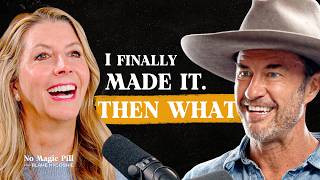 Sara Blakely on Post-Success Purpose: Grief, Growth, and Enough2026 · 68 min · full transcriptBest for the emotional truth of post-success grief and how a right decision can still hurt.
Questions people ask
Sources
Every quote above, word for word from the transcripts. Numbers match the text.
“A midlife truth for me is I'm enough…”
“In order to discover new land, you must be willing to lose sight of the shore.”
“You can make the right decision and still be sad.”
“You can make the right decision and still be sad…”
“You can miss it and still not want it back.”
“I just wanted my mental share to be freed up…”
“I sold to free up my mental share…”
“I have spent 16 years of my life being taught what to think, but no one has ever taught me how to think.”
How this guide was made: drafted with AI from the full transcripts of the recordings cited, then checked: every quotation must match a transcript word for word and be the speaker's own words, and an independent review gates accuracy. Methodology and corrections.