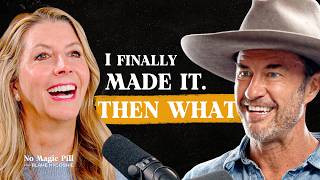
Sara Blakely on Intuition
Sara Blakely treats intuition as a practical form of inner knowing that gets clearer when you protect space, trust your own experience, and act before outside approval arrives.
- She trusts inner knowing, especially when facing uncertainty and big decisions.
- Intuition gets louder when you make time to think, journal, daydream, and be alone.
- She often starts with a problem she personally feels instead of waiting for consensus or perfect data.
- For her, intuition is tied to originality: questioning the status quo and not copying how things are supposed to be done.
- Following intuition does not make hard choices painless; a right decision can still bring grief.
Intuition is inner knowing you can trust before you can prove it
Blakely’s basic stance is simple: she believes people have an inner knowing, and she sees real progress as coming from trusting it even when certainty is unavailable. She connects her willingness to take big entrepreneurial leaps to years of learning to trust that inner signal rather than waiting until she knew everything.2
That is why she frames not knowing as an advantage instead of a handicap. If you do not already accept the standard way something is supposed to be done, you are freer to notice a better path and follow it.3
She hears intuition best when she creates mental space
For Blakely, intuition is not something you access in constant noise. She emphasizes protecting time alone, time to think, daydream, visualize, and challenge your own fearful thoughts, because distraction drowns out the signal.4
She also describes concrete practices that help her hear herself more clearly: journaling, scheduled thinking time, and becoming the driver of her own thoughts instead of the passenger. Her view is that inner guidance is easier to hear when your attention belongs to you.5
This also helps explain later life decisions. She wanted her mental share freed up, which shows that for her, clarity is connected to available inner space, not just external opportunity.78
Her intuition starts with lived problems, not abstract theories
Blakely does not treat intuition as vague inspiration detached from reality. She often starts with a problem she personally experiences, then trusts her own frustration enough to build around it. That pattern runs from shapewear to footwear.910
This matters because it shows what intuition looks like in practice for her: noticing what feels wrong, asking why it has to stay that way, and refusing to accept the status quo. Her instinct is not passive; it pushes her to investigate and create.1112
She is especially drawn to places others overlook or dismiss, which fits her broader habit of trusting her own perception over conventional signals. Instead of using consensus as proof, she uses felt need and curiosity as the starting point.92
Intuition and originality go together
Blakely links intuition with originality because both require independence from imitation. She wants to be an innovator, not an imitator, and she urges people not to produce another version of how things are already supposed to be done.1314
That mindset began early with learning how to think for herself, not just what to think. In her view, intuition grows when you question assumptions, ask why repeatedly, and stop outsourcing judgment to convention.1511
She also ties this to leadership style. She deliberately wanted to honor the knowing inside her and build without flattening what she saw as feminine energy, because she viewed that as a strength rather than something to suppress.1617
Following intuition can be right and still feel painful
Blakely does not romanticize intuition as a path that makes everything easy. One of her clearest points is that you can make the right decision and still feel deep sadness afterward.1819
Her reflections on selling Spanx show this clearly: she experienced grief even while believing she was responding to a real inner call toward what came next. Missing something does not automatically mean the choice was wrong.2021
This is an important part of her philosophy. Intuition is not validated by comfort alone; sometimes you know the move is right while your emotions still have to catch up, and other factors in the body can intensify that difficulty.22
Blakely on intuition, in her own words
“I think the latter. I'm always asking why in everything. It's like why is it like this? Why? Why? Why? How long has it been this way? Why hasn't it? who was the first to think of this? Could it be better? So, I think it's more about not accepting the status quo. And you know, I want to just mention I've been working on my mindset since I'm 16 years old. I started listening to tapes. I'm dating myself uh by Dr. Wayne Dyer and it was how to be a no limit person. But it was really talking about visualizing what you want, manifesting it, law of attraction, not fearing failure, not caring what other people think about you. And um that is really important especially as women for us to find that confidence because if you are going to say I want to buck the whole system. That's scary. You have to have a lot of inner strength and a and a very strong inner compass to be able to stand in that space.”
Where to watch
 Sara Blakely on Midlife Transition: Letting Go and Starting Again2025 · 66 min · full transcriptBest for seeing how she uses intuition, signs, and mental space in major life transitions.
 Sara Blakely on Mindset And Failure: Bootstrapping Spanx2021 · 27 min · full transcriptShows how trusting inner knowing helped her act despite inexperience and uncertainty.
 Sara Blakely on Self-Belief and Originality: FSU Commencement2026 · 20 min · full transcriptStrong practical advice on journaling, thinking time, and becoming the driver of your thoughts.
 Sara Blakely on Betting on Yourself: Build What Women Need2025 · 21 min · full transcriptExplains how she honored intuition over old business rules and built from personal need.
 Sara Blakely on Connect The Dots: Midlife as a Chrysalis2024 · 62 min · full transcriptUseful for understanding how solitude and reflection help her connect the dots in midlife.
Questions people ask
- How does Sara Blakely say people should think about their own thoughts?
- What did Sara Blakely say about building Spanx with feminine energy?
- What did Sara Blakely say about not knowing how something is supposed to be done?
- What did Sara Blakely say about self-doubt and thinking time?
- What did Sara Blakely say about starting products from a personal problem?
- How does Sara Blakely build confidence and make bold decisions?
Sources
Every quote above, word for word from the transcripts. Numbers match the text.
“I'm going to honor my intuition.”
“You know what, you don't know will be your greatest asset if you let it.”
“You will be faced with tremendous uncertainty too, but because of the work you do on yourself, you'll navigate through it. You're living in a very, very distracted time. The world is grabbing for your attention. You have to protect your time alone. You have to protect your time to think, to daydream, to visualize where you want to end up, to challenge your self-doubts, and to reframe your limiting self-beliefs. Because here's the deal. Everybody has self-doubt. But the people who are the most successful have just learned how to…”
“You can be a passenger of your thoughts or you can be the driver of your thoughts.”
“I just wanted my mental share to be freed up…”
“I sold to free up my mental share…”
“Well, I for me everything starts with a problem and it's usually a problem that I'm experiencing. Um I couldn't find a solution of what to wear under white pants. I got frustrated with the undergarment options and then with sneaks obviously high heels are very uncomfortable and have been for like hundreds of years and I really wanted to take a new fresh approach at that. I think it's interesting that both of the industries that I decided to go in and try to disrupt were were really kind of on the decline.”
“I just want them to be as comfortable as my sneaker.”
“I think the latter. I'm always asking why in everything. It's like why is it like this? Why? Why? Why? How long has it been this way? Why hasn't it? who was the first to think of this? Could it be better? So, I think it's more about not accepting the status quo. And you know, I want to just mention I've been working on my mindset since I'm 16 years old. I started listening to tapes. I'm dating myself uh by Dr. Wayne Dyer and it was how to be a no limit person. But it was really talking about visualizing what you want, manifesting it, law of attraction, not fearing failure, not caring what other people think about you. And um that is really important especially as women for us to find that confidence because if you are going to say I want to buck the whole system. That's scary. You have to have a lot of inner strength and a and a very strong inner compass to be able to stand in that space.”
“I think the latter. I'm always asking why in everything.”
“I wake up every day and there's innovators and there's imitators, and I'd far rather be an innovator.”
“The world does not need another version of how it's supposed to be done.”
“I have spent 16 years of my life being taught what to think, but no one has ever taught me how to think.”
“What would it look like for me? Like what? And that's part of why I was really careful about getting investors. I was like, I'd rather bootstrap it and kind of honor this divine feminine and this knowing inside of me along with my masculine, but I didn't want to squash the feminine to get to where I wanted to be. And so I was very intentional about trying to create Spanx with a lot more feminine energy, which at the time — it's getting better, but at the time feminine was really seen as a weakness, in my opinion. It felt like it wasn't taken seriously, and I saw it as a superpower.”
“I saw the feminine as a superpower.”
“You can make the right decision and still be sad.”
“You can make the right decision and still be sad…”
“You can miss it and still not want it back.”
“In order to discover new land, you must be willing to lose sight of the shore.”
“So, I let it go. I went into profound grief. And then the second part of the equation that I was going to tell you is I don't know if this triggered it or it was going to happen inevitably, but to make an enormous life decision at the exact same time that you go into severe perimenopause is probably not ideal. So, if I could go back and say, "Sara, what about the timing of this?" But I was in such hormonal imbalance and my body was in extreme fluctuations that I wasn't used to. >> Yeah. >> And that compounded how I was feeling. It, it gave me very deep depths of sadness.”
How this guide was made: drafted with AI from the full transcripts of the recordings cited, then checked: every quotation must match a transcript word for word and be the speaker's own words, and an independent review gates accuracy. Methodology and corrections.