Richard Feynman on Mathematics
For Feynman, mathematics matters because it reveals hidden patterns in nature and gives workable rules for calculating what the world will do.
- Mathematics is valuable because it exposes nature’s patterns and makes prediction possible.
- He likes mathematical rules that are few, clear, and powerful, even when their meaning feels strange.
- He often teaches mathematics through geometry and concrete constructions, not just formal algebra or calculus.
- In quantum theory, mathematics is not optional: amplitudes must be added first, then squared to get probabilities.
- He judges mathematical ideas by whether they match experiment and help you get the next result.
Good mathematics is simple in form and rich in consequences
Feynman repeatedly favors mathematical frameworks built from a small number of rules. In quantum theory, he stresses that there are only a few principles for computing amplitudes, and that once those rules are in hand they can be applied again and again across many situations.45
This is part of why he admires fundamental theories like quantum electrodynamics. The mathematics may lead to conclusions that are hard to picture, but he values the compactness and reach of the rules more than any comforting analogy.67
He also links this power to beauty. When a law is simple and still accounts for many phenomena, mathematics is not decoration; it is the form in which nature’s economy shows up.26
He teaches mathematics through concrete constructions
Feynman often presents mathematics as something you can see being built. In his lecture on orbits, he chooses a geometric route to show that an inverse-square force gives an ellipse, emphasizing a proof that works through diagrams, tangents, areas, and velocity changes rather than leaning on formal machinery.91011
That choice shows an important part of his style: mathematics is understanding when you can follow why each step must be true. He wants the learner to see how equal areas come from a central force, and then how the inverse-square law adds the extra structure needed to force the orbit into a particular curve.12
He does not confuse elementary with easy. A proof can use little prior technique and still demand sharp thinking, which is one reason his mathematical teaching feels both accessible and demanding.11
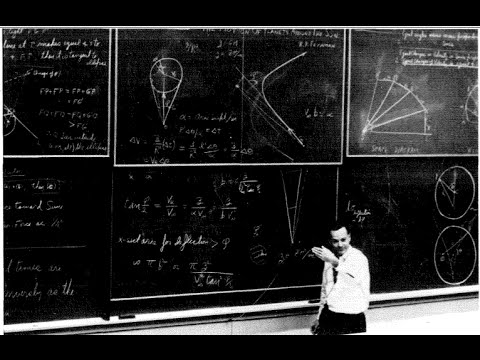
“I would prefer—I prefer to give you a demonstration of the ellipse in a completely strange and unique, a different way than you're used to.”Caltech freshman physics lecture, 1964 · full transcript →
In quantum mechanics, mathematics gives rules you must follow
Feynman’s clearest statement about mathematics appears in his treatment of probability. Physics, as he presents it there, is about calculating probabilities, and quantum mechanics reduces that task to calculating amplitudes and then taking the square of their length.14165
What makes the mathematics distinctive is that alternatives are handled in a nonclassical way. When something can happen by more than one route, you add the amplitudes first, not the probabilities, and for linked events you multiply amplitudes. Those rules are mathematically precise even when they clash with ordinary intuition.41718
He accepts that this can feel opaque and even unreasonable at first. But his position is that the job is not to replace the mathematics with a familiar picture; it is to learn the rules nature actually follows.717
Mathematics earns trust by prediction, not by philosophical comfort
Feynman is suspicious of arguments that merely sound reasonable. He thinks mathematics in physics has to prove itself by helping you calculate what happens next, not by fitting a philosophical preference about how the world ought to work.19
That attitude explains both his realism and his restraint. He is willing to use strange mathematical structures if they succeed, and he is just as willing to discard verbal explanations that add no predictive power.1917
This also sheds light on his respect for bold theoretical moves such as Dirac’s. A mathematical form can come first, with interpretation following later, if that form captures the requirements imposed by quantum mechanics and relativity and leads to real consequences such as the need for antiparticles.21
Feynman on mathematics, in his own words
“I would prefer—I prefer to give you a demonstration of the ellipse in a completely strange and unique, a different way than you're used to.”
Where to watch
 Richard Feynman on Probability and Uncertainty: Quantum Rules1964 · 115 min · full transcriptBest single explanation of how Feynman thinks mathematical rules work in physics: amplitudes, squaring, and probability.
 Richard Feynman on Planetary Orbits: A Geometric Proof of Ellipses1964 · 78 min · full transcriptShows his taste for elegant, visual mathematics through a geometric proof of planetary ellipses.
 Richard Feynman on Physical Law: Simplicity, Symmetry, and Discovery1964 · 360 min · full transcriptGives the broadest picture of mathematics as the route to hidden physical law and predictive power.
 Richard Feynman on Quantum Electrodynamics: Light, Amplitudes, and Reality1979 · 369 min · full transcriptShows how he handles advanced mathematics that is accurate and powerful even when it resists intuition.
 Richard Feynman on Antiparticles: Why They Must Exist1986 · 13 min · full transcriptA compact example of mathematical reasoning forcing a deep physical conclusion: antiparticles.
Questions people ask
- How does Richard Feynman say to calculate amplitudes when there is more than one way something can happen?
- What did Richard Feynman mean when he said he would not simplify the truth?
- What did Richard Feynman say about not understanding quantum mechanics?
- What did Richard Feynman say about probability in physics?
- What did Richard Feynman say about why probabilities come from arrows in quantum mechanics?
- What did Richard Feynman say about multiplying quantum amplitudes?
Sources
Every quote above, word for word from the transcripts. Numbers match the text.
“This is the key of modern science and is the beginning of the true understanding of nature…”
“…nature has a simplicity and therefore a great beauty…”
“So the Earth's gravitational field never ends but peters out very slowly in a precise and careful law probably to the edges of the universe. The law of gravitation is different than many of the others. It is very important in the economy or in the machinery of the universe. There are many places where gravity has its practical applications as far as the universe is concerned but…”
“Then in the next aspect of the theory, therefore, would be to calculate amplitudes, and I would like to tell you the nature of the rules or the formulas that have been found for computing amplitudes. And there are a number of steps and a number of principles, and they're not very many. We've already got two of them, and there may be four altogether. So we're halfway there. The first... One of the rules is that if a thing appears to be able to happen in more than one way, then we find the amplitude for each way and add. So if there... I summarize that idea in shorthand by saying alternative ways, apparently alternative way, amplitude, total amplitude or final amplitude or whatever, total amplitude, that means the final arrow, is equal to the sum of an amplitude or an arrow that's identical.”
“The probability of event is what we're calculating in physics. That's the central question. We discovered that there's a framework in which it can be done. It can always be written as the square, what we call an absolute square, which means the square of the length. Absolute square. Well, I never mind saying the absolute. This line is supposed to say that. The square of another quantity, which we call our amplitude. And that's general. These things I'm telling you are general. I've only given you an examples of it. That's the first problem. The next... Therefore, the probability... The problem of calculating the probability is the same as the problem of calculating the amplitude followed by one minor step, which is after you have the final amplitude to find the square of it.”
“We have a theory which is called quantum electrodynamics, which is our pride and joy.”
“I can't help it. Okay? If I'm going to tell you honestly what the world looks like to to the to human beings who have struggled as hard as they can to understand it, I can only tell you what it looks like, and I cannot make it any simple. I'm not going to do this. I'm not gonna simplify it. I'm not gonna fake it. I'm not gonna make... Tell you something like a ball bearing on a spring. It isn't. So I'm gonna tell you what it really is like. And if you don't like it, that's too bad. Okay?”
“…the purpose of this lecture mainly to demonstrate, that therefore the orbit is an ellipse.”
“I would prefer—I prefer to give you a demonstration of the ellipse in a completely strange and unique, a different way than you're used to.”
“So the orbits are ellipses: elementary but difficult.”
“All we've used so far is that the force is directed toward the center of the circle, toward the center of the sun. But it could be any force law whatsoever. So this law of equal areas only proves that the force is in the direction of the center. And therefore, no matter what you do, you'll never get the ellipse out of that because it could have been a different curve from a different force law. So we must insert the law inverse square somewhere. And the secret idea is that that's very simple to state. It means that equal change of velocity occur in equal angles. That's the inverse square law.”
“The probability of event is what we're calculating in physics.”
“…the square of the length, I mean.”
“Either one is something, either one alone, but both is nothing. That works fine for the amplitudes, but to think logically about probabilities, it makes it very difficult, because you usually think if those that would do it, and the greens would do it, and you put them both there, they'll do it even better. So, uh, we can add amplitudes instead of adding probabilities. That is illegal, but adding probabilities is the wrong way. You have to add the amplitudes first and then make the square. Why? I don't know. Nature works that way.”
“Alright? Either because they have to happen in succession or because they have to happen simultaneously. It doesn't make any difference. You multiply the amplitudes together. I will emphasize that still a little bit further because it it it makes a very big difference. It's where most people who learn quantum mechanics in schools and start... Have the biggest trouble because they don't learn... You see, just like we did. In all of the simple examples, we only had one photon.”
“In the earliest days of science, we got confused arguing philosophically what was a reasonable reason for nature of hoard or vacuum or it seemed to be nice that gods were doing it. There are different kinds of psychological reasons for thinking it probably is alright after you discovered what it was. These things were never useful for predicting what should happen next, and we soon learned not to make these arguments. It's useless. It doesn't add anything.”
“…why there must be antiparticles if you try to put quantum mechanics with relativity.”
How this guide was made: drafted with AI from the full transcripts of the recordings cited, then checked: every quotation must match a transcript word for word and be the speaker's own words, and an independent review gates accuracy. Methodology and corrections.