Richard Feynman on Quantum Mechanics
Feynman treats quantum mechanics as a strange but reliable way to calculate what can happen, using amplitudes and probabilities instead of familiar pictures of hidden microscopic reality.
- Quantum mechanics is fundamentally correct, even if it resists ordinary intuition.
- Its job is to predict probabilities, not to supply a comfortable visual picture of what particles really are.
- The central rule is to calculate amplitudes, add them for alternatives, and square the result to get probabilities.
- Measurement matters because you cannot assume quantum properties were simply sitting there with definite values before you checked.
- Feynman thinks attempts to replace quantum behavior with familiar hidden machinery are likely misguided.

“And I want to be... Have worked with you because I want to tell you something. The students do not understand it either. And that's because the professor doesn't understand it. Which is not a joke, but a very interesting, I think. And I would like to explain it. My task really is to explain all this is to convince you not to turn away because it appears incomprehensible. That's what it takes four years of us to do to the student. Just to get him so he doesn't run away because it looks crazy. The thing that's exciting about this is that nature is strange as it can be in this sense. That the rules that are gonna be obeyed... That I'm gonna tell you about by which this stuff is analyzed, by which we understand nature.”University of Auckland lecture, 1979 · 21:15
Quantum mechanics is true even when it feels impossible to picture
Feynman’s starting point is not that quantum mechanics is easy to visualize, but that nature at small scales is radically unlike everyday experience. He says the difficulty is not a temporary failure of imagination so much as the fact that atomic behavior is wonderfully different from large-scale behavior, and ordinary images break down when you push them too far.123
That is why he refuses to soften the theory into familiar analogies that would mislead. He would rather keep the strangeness than offer a false picture, because the honest description of nature matters more than comfort.567
Still, he does not treat this as defeat. He thinks the right response is to keep imagining boldly while accepting that the best theory may come without a satisfying visual model.8910
“And I want to be... Have worked with you because I want to tell you something. The students do not understand it either. And that's because the professor doesn't understand it. Which is not a joke, but a very interesting, I think. And I would like to explain it. My task really is to explain all this is to convince you not to turn away because it appears incomprehensible. That's what it takes four years of us to do to the student. Just to get him so he doesn't run away because it looks crazy. The thing that's exciting about this is that nature is strange as it can be in this sense. That the rules that are gonna be obeyed... That I'm gonna tell you about by which this stuff is analyzed, by which we understand nature.”University of Auckland lecture, 1979 · full transcript →
Its purpose is prediction: quantum mechanics gives numbers
Feynman presents quantum mechanics less as a picture of microscopic objects and more as a method for predicting outcomes. He says the theory does not explain in the ordinary storytelling sense; it delivers the numbers for what will happen in experiments.1112
For him, that is not a weakness but the proper task of physics. The central question is the probability of an event, and quantum mechanics provides a general framework for calculating that probability.131415
He is also skeptical of philosophical add-ons that sound satisfying but do not improve prediction. If an idea does not help you say what happens next, he treats it as useless decoration.
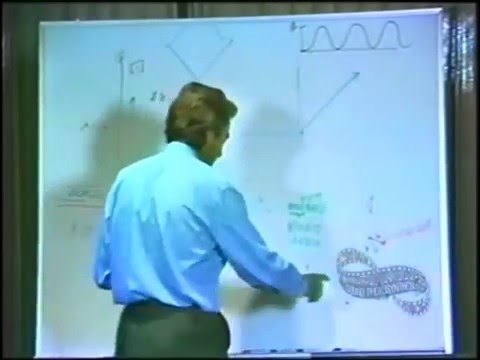
“It doesn't explain anything. It just gives you numbers…”Auckland lectures, 1979 · full transcript →
The core rule is amplitudes first, probabilities second
The most important technical idea in Feynman’s account is that quantum mechanics works with amplitudes before it works with probabilities. When an event can happen in more than one way, you do not add the probabilities for each route first; you find the amplitude for each alternative and add those amplitudes.171418
Only after combining the amplitudes do you convert the result into a probability by taking the square of its length. That rule is what produces interference and many of the surprising outcomes in experiments with light, reflection, thin films, and multiple paths.191520
He treats this as the heart of the subject: strange, mathematically clean, and non-negotiable. You may want nature to behave by ordinary probability logic, but it does not.2021

“Then in the next aspect of the theory, therefore, would be to calculate amplitudes, and I would like to tell you the nature of the rules or the formulas that have been found for computing amplitudes. And there are a number of steps and a number of principles, and they're not very many. We've already got two of them, and there may be four altogether. So we're halfway there. The first... One of the rules is that if a thing appears to be able to happen in more than one way, then we find the amplitude for each way and add. So if there... I summarize that idea in shorthand by saying alternative ways, apparently alternative way, amplitude, total amplitude or final amplitude or whatever, total amplitude, that means the final arrow, is equal to the sum of an amplitude or an arrow that's identical.”Cornell University Messenger Lectures, filmed by BBC, 1964 · full transcript →
Observation changes what can be said about a system
Feynman argues that quantum mechanics forces a change in what we are allowed to claim before a measurement is made. In his box-and-button examples, he rejects the idea that a system simply carries a full set of definite answers waiting to be revealed by checking.22
That is why observation matters so much in quantum physics. The act of arranging an experiment is tied to what can meaningfully be predicted, and trying to assign unmeasured properties the same way we do in classical physics leads to trouble.12
He distinguishes this from ordinary randomness like Brownian jiggling, which comes from many hidden atomic motions. Quantum uncertainty is not just ignorance about a deeper classical mechanism.24

“…you can't say that this thing has a potential for producing red, green, and green that's there before you push to check it.”Quantum mechanical view of reality lecture · full transcript →
Feynman trusts the theory and follows it into deeper physics
Feynman says plainly that he believes quantum mechanics is fundamentally correct. He treats quantum electrodynamics as a major success, even calling it a source of pride, because it describes light and electrons with extraordinary power despite its conceptual weirdness.2526
He also shows that quantum mechanics is not a sealed-off subject but the basis for later developments. When combined with relativity, it leads to consequences such as the need for antiparticles, which he presents as required rather than optional.27
His broader attitude is exploratory. Paradoxes are valuable because they teach us something new, and physics advances by extracting more information about how nature is built rather than waiting for a final comforting picture.282930
Feynman on quantum mechanics, in his own words
“I really do believe that quantum mechanics is fundamentally correct…”
“It doesn't explain anything. It just gives you numbers…”
“…you have to add the amplitudes first and then make the square…”
“The probability of event is what we're calculating in physics.”
“And I want to be... Have worked with you because I want to tell you something. The students do not understand it either. And that's because the professor doesn't understand it. Which is not a joke, but a very interesting, I think. And I would like to explain it. My task really is to explain all this is to convince you not to turn away because it appears incomprehensible. That's what it takes four years of us to do to the student. Just to get him so he doesn't run away because it looks crazy. The thing that's exciting about this is that nature is strange as it can be in this sense. That the rules that are gonna be obeyed... That I'm gonna tell you about by which this stuff is analyzed, by which we understand nature.”
“Either one is something, either one alone, but both is nothing. That works fine for the amplitudes, but to think logically about probabilities, it makes it very difficult, because you usually think if those that would do it, and the greens would do it, and you put them both there, they'll do it even better. So, uh, we can add amplitudes instead of adding probabilities. That is illegal, but adding probabilities is the wrong way. You have to add the amplitudes first and then make the square. Why? I don't know. Nature works that way.”
Where to watch
 Richard Feynman on Quantum Reality: Why probabilities come from arrows1979 · 119 min · full transcriptBest short route into Feynman’s central claim that quantum mechanics predicts probabilities through amplitudes rather than pictures.
 Richard Feynman on Probability and Uncertainty: Quantum Rules1964 · 115 min · full transcriptGives the clearest step-by-step account of adding amplitudes and squaring to get probabilities.
 Richard Feynman on Quantum Reality: Why Observation Matters117 min · full transcriptBest for understanding why measurement matters and why hidden pre-set properties fail.
 Richard Feynman on Quantum Electrodynamics: Light, Amplitudes, and Reality1979 · 369 min · full transcriptShows how Feynman connects the strange rules to quantum electrodynamics, his flagship example.
 Richard Feynman on Imagining Atomic Reality: why things are really as they are1983 · 67 min · full transcriptUseful for seeing why imagination matters and why small-scale reality resists everyday intuition.
 Richard Feynman on Antiparticles: Why They Must Exist1986 · 13 min · full transcriptShows how Feynman extends quantum thinking into relativity and the necessity of antiparticles.
Questions people ask
- How did Richard Feynman explain why a particle model fails for thin-film reflection?
- How does Richard Feynman say to calculate amplitudes when there is more than one way something can happen?
- What did Richard Feynman mean when he said he would not simplify the truth?
- What did Richard Feynman say about not understanding quantum mechanics?
- What did Richard Feynman say about teaching people to understand quantum mechanics?
- Why did Richard Feynman say you can't picture a photon?
Sources
Every quote above, word for word from the transcripts. Numbers match the text.
“It's very hard to imagine all the crazy things that things really are like.”
“Nothing's really as it seems.”
“Then there would be some kind of difficulty in understanding and imagining reality. And that difficulty we are in. The behavior of things on a small scale is so fantastic. It's so wonderfully different, so marvelously different than anything that behaves on a large scale. You say, electrons act like waves. No. They don't exactly. They act like particles. No. They don't exactly. They act like a kind of a fog around the nucleus. No. They don't exactly. And if you would like to get a clear, sharp picture of an atom so that you can tell exactly how it's going to behave correctly. I have a good image, in other words, a really good image of reality. I don't know how to do it because that image has to be mathematical. We have a mathematical expression, strange as mathematics.”
“I can't help it. Okay? If I'm going to tell you honestly what the world looks like to to the to human beings who have struggled as hard as they can to understand it, I can only tell you what it looks like, and I cannot make it any simple. I'm not going to do this. I'm not gonna simplify it. I'm not gonna fake it. I'm not gonna make... Tell you something like a ball bearing on a spring. It isn't. So I'm gonna tell you what it really is like. And if you don't like it, that's too bad. Okay?”
“I can't explain that attraction in terms of anything else that's familiar to you. For example, if we say the magnets attract like as if they were connected by rubber bands, I would be cheating you because they're not connected by rubber bands. I shouldn't be in trouble. You'd soon ask me about the nature of the bands. And secondly, if we were curious enough, you'd ask me why rubber bands tend to pull back together again and I would end up explaining that in terms of electrical forces, which are the very things that I'm trying to use the rubber bands to explain. So I have cheated very badly, you see. So I'm not going to be able to give you an answer to why magnets attract each other except to tell you that they do.”
“I could tell you that the magnetic forces are related to the electrical forces very intimately. That our relationship between the gravity forces and electrical forces remains unknown and so on. But I really can't do a good job, any job of explaining magnetic force in terms of something else that you're more familiar with because I don't understand it in terms of anything else that you're more familiar with.”
“I think we should just have fun imagining it, not worry about...”
“We have to imagine what's there.”
“But if you ask more specific questions and you get down to questions like, how is it that when you cool helium down even to absolute zero where there's not supposed to be any motion, It's a perfect fluid that has many viscosity, has no resistance, flows perfectly, and isn't freezing. Well, if you want to get a picture of atoms that has all of that in it, I can't do it, you see. But I can explain why the helium bays as it does by taking my equations and sowing the consequences of them is that the helium will behave as it is observed to behave. We know we have the theory right, but we haven't got the pictures that will go with the theory.”
“It doesn't explain anything. It just gives you numbers…”
“As you've already learned from the previous discussion, we're going to have a lot of trouble in picturing anything that we haven't directly measured. If we try to say how big a photon is or how it's spread out or what it looks like, we're going to get into some difficulty, because with some experiment it isn't going to behave that way you'd expect. So you're going to be very disappointed, because it's going to be impossible for me to tell you how big a photon is, where it is, and so forth. Nevertheless, depending on your point of view, I'll tell you a series of crazy rules by which you can tell exactly what will happen in any experiment with photons—what's the chance that the photomultiplier will go off in this situation, in that situation—without ever having been able to say.”
“The probability of event is what we're calculating in physics.”
“The probability... The problem of calculating the probability is the same as the problem of calculating the amplitude followed by one minor step…”
“The probability of event is what we're calculating in physics. That's the central question. We discovered that there's a framework in which it can be done. It can always be written as the square, what we call an absolute square, which means the square of the length. Absolute square. Well, I never mind saying the absolute. This line is supposed to say that. The square of another quantity, which we call our amplitude. And that's general. These things I'm telling you are general. I've only given you an examples of it. That's the first problem. The next... Therefore, the probability... The problem of calculating the probability is the same as the problem of calculating the amplitude followed by one minor step, which is after you have the final amplitude to find the square of it.”
“…you have to add the amplitudes first and then make the square…”
“Then in the next aspect of the theory, therefore, would be to calculate amplitudes, and I would like to tell you the nature of the rules or the formulas that have been found for computing amplitudes. And there are a number of steps and a number of principles, and they're not very many. We've already got two of them, and there may be four altogether. So we're halfway there. The first... One of the rules is that if a thing appears to be able to happen in more than one way, then we find the amplitude for each way and add. So if there... I summarize that idea in shorthand by saying alternative ways, apparently alternative way, amplitude, total amplitude or final amplitude or whatever, total amplitude, that means the final arrow, is equal to the sum of an amplitude or an arrow that's identical.”
“…the square of the length, I mean.”
“Either one is something, either one alone, but both is nothing. That works fine for the amplitudes, but to think logically about probabilities, it makes it very difficult, because you usually think if those that would do it, and the greens would do it, and you put them both there, they'll do it even better. So, uh, we can add amplitudes instead of adding probabilities. That is illegal, but adding probabilities is the wrong way. You have to add the amplitudes first and then make the square. Why? I don't know. Nature works that way.”
“Alright? Either because they have to happen in succession or because they have to happen simultaneously. It doesn't make any difference. You multiply the amplitudes together. I will emphasize that still a little bit further because it it it makes a very big difference. It's where most people who learn quantum mechanics in schools and start... Have the biggest trouble because they don't learn... You see, just like we did. In all of the simple examples, we only had one photon.”
“…you can't say that this thing has a potential for producing red, green, and green that's there before you push to check it.”
“As the generations develop, will they invent ways of teaching and where... So that the new people will learn the tricky ways of looking at things and be so trained, so well trained that they won't have our troubles with the atom picturing. There's still a school of thought that cannot believe that the atomic behavior is so different than large scale behavior. I think that's a deep prejudice. It's a prejudice from being so used to large scale behavior. And they're always seeking to find... To waiting for the day that we discover that underneath the quantum mechanics, there's some mundane ordinary balls hitting or particles moving inside. I think they're gonna be defeated. I think nature's imagination is so much greater than man's.”
“I really do believe that quantum mechanics is fundamentally correct…”
“We have a theory which is called quantum electrodynamics, which is our pride and joy.”
“…why there must be antiparticles if you try to put quantum mechanics with relativity.”
“It's these paradoxes that makes the whole subject very interesting because we're bound to learn something new.”
“The idea is not to find the complete... Necessary to find a complete answer, but to find out more and more information.”
“But the idea is not to find the complete... Necessary to find a complete answer, but to find out more and more information. It's like exploring. If you're exploring a country, the fact that when you went through the country, it may be that on the other side, you come across a river... Ocean that you'd have to pass and you couldn't pass, doesn't mean that it wouldn't be interesting to explore the new country that you discovered. So in the same way, the question as to whether this is a never ending search or that the search will end with the quark is not exactly relevant to our interest in finding out just more about the way matter is constructed.”
How this guide was made: drafted with AI from the full transcripts of the recordings cited, then checked: every quotation must match a transcript word for word and be the speaker's own words, and an independent review gates accuracy. Methodology and corrections.
