Richard Feynman on Science
For Feynman, science is an adventurous way of finding out how nature really works through curiosity, imagination, experiment, and rigorous honesty.
- Science is finding out how nature is, not memorizing words or trusting authority.
- It needs imagination because reality is often nothing like everyday appearances.
- Its test is experiment: good ideas must face reality and may be wrong.
- Scientific integrity means not fooling yourself and reporting what goes against your own idea.
- Science does not drain wonder; understanding adds beauty, awe, and the pleasure of exploration.

“The name doesn't tell me anything about the bird.”National Science Teachers Association convention, New York, 1966 · 11:42
Science is a way of finding out, not a set of words
Feynman draws a sharp line between knowing a name and understanding a thing. You can memorize terminology and still miss what is happening, which is why he treats science as a way of looking, asking, and judging rather than a vocabulary list.123
He also resists treating science as a body of statements delivered by authority. For him, the point is to ask how anybody knows, what was observed, and what experiment justifies the conclusion, because experience is what teaches.45
That is why he says science is not about repeating what experts say but about remaining open to correction. In practice, this means tracing claims back to observation and refusing to confuse definitions with understanding.645
“The name doesn't tell me anything about the bird.”National Science Teachers Association convention, New York, 1966 · full transcript →
Science begins in curiosity and grows through imagination
Feynman thinks science starts from a genuine desire to find out more about the world. He describes it as exploration: not forcing nature into a preselected answer, but following puzzles because you want to know what is there.789
But curiosity is not enough by itself, because reality is often far stranger than common sense suggests. He keeps stressing that science is hard partly because you have to imagine processes you cannot directly see, and because ordinary appearances are misleading.11121314
This is why he asks people to look from a fresh point of view, as if seeing familiar things for the first time. New understanding often begins when you stop accepting the usual framing of a problem and ask what is really going on underneath.15161718

“…we're exploring; we're trying to find out as much as we can about the world.”Quest for Tannu Tuva documentary, 1988 · full transcript →
The aim is reality, even when reality is hard to picture
Feynman prefers an honest difficulty to an easy fake explanation. If nature does not fit a familiar picture, then making up a comforting analogy only hides the problem instead of solving it.192021
That matters because much of science deals with things that are invisible or behave unlike everyday objects. Atoms, electrons, forces, and other basic features of nature often require abstract thinking, and he sees that demand for imagination as a normal part of serious understanding.11222324
So the scientific attitude is not to demand a simple picture at all costs. It is to keep asking what nature is actually like, accept when the answer is strange, and use the best available theory even before a satisfying image arrives.2318
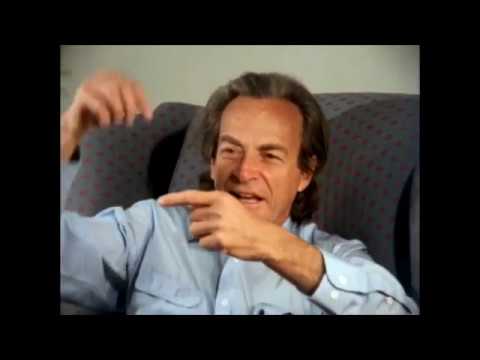
“It's very hard to imagine all the crazy things that things really are like.”BBC documentary, 1983 · full transcript →
Experiment is the judge, and good laws reveal hidden patterns
For Feynman, science does not win by sounding reasonable or philosophically pleasing. It wins when an idea matches what happens and helps you get the next thing right, which is why experiment is the real test and historical or verbal justifications are secondary.1725
He presents physical law as pattern discovered through careful analysis rather than mere direct seeing. A successful law condenses many facts into a simple relation and then proves its worth by predicting new effects or unseen objects.262728
This makes science both disciplined and creative: you imagine possibilities, but nature decides. Feynman is comfortable with partial knowledge and degrees of certainty because the strength of science lies in this repeated submission of ideas to reality.295

“This is the key of modern science and is the beginning of the true understanding of nature…”Complete lecture series recording, 1964 · full transcript →
Scientific integrity means refusing to fool yourself
Feynman's moral center for science is intellectual honesty. The first danger is self-deception, because once you want a result, it becomes easy to ignore what weakens it.3031
So he says real scientific integrity requires leaning over backwards to show where your interpretation might fail. You should report contrary facts, publish unfavorable results too, and make it as easy as possible for others to judge the idea fairly.323334
He applies the same standard beyond the lab. In the Challenger case, the problem was not bad luck but warnings being discounted by a faulty system and bad judgment, which shows what happens when institutions stop letting reality speak plainly.3537

“The first principle is that you must not fool yourself and you are the easiest person to fool.”Caltech commencement address, 1974, 1975 · full transcript →
Science adds wonder instead of taking it away
Feynman rejects the idea that explanation kills beauty. Understanding how things work deepens awe because it reveals hidden structure, larger scale, and unexpected order beneath ordinary experience.3827
That is why he talks about science with such delight: the world is richer when you see heat as motion, matter as restless atoms, and complex events as consequences of simple rules. Knowledge makes familiar things more alive, not less.133938
In the end, science is both method and adventure. It is a disciplined search for how nature is, carried out in a spirit of curiosity, uncertainty, and pleasure in discovery.7829

“Science knowledge only adds to the excitement and mystery, the awe of a flower.”BBC Horizon documentary, 1981 · full transcript →
Feynman on science, in his own words
“…science is the belief in the ignorance of experts.”
“The first principle is that you must not fool yourself and you are the easiest person to fool.”
“…we're exploring; we're trying to find out as much as we can about the world.”
“The world is a dynamic mess of jiggling things if you look at it right.”
“I have approximate answers and possible beliefs and different degrees of certainty about different things, but I'm not absolutely sure of anything and I don't have to be.”
“Science knowledge only adds to the excitement and mystery, the awe of a flower.”
Where to watch
 Richard Feynman on What Is Science: Why Names Aren’t Understanding1966 · 32 min · full transcriptHis clearest statement that science is not names or definitions but understanding how the world works.
 Richard Feynman on Scientific Integrity: How Not to Fool Yourself1975 · 21 min · full transcriptBest on the ethical core of science: honesty, error-checking, and not fooling yourself.
 Richard Feynman on Curiosity and the Scientific Method1981 · 26 min · full transcriptShows how curiosity, doubt, and wonder fit together in the scientific method.
 Richard Feynman on Imagining Atomic Reality: why things are really as they are1983 · 67 min · full transcriptDemonstrates why science needs imagination to grasp realities hidden behind appearances.
 Richard Feynman on Physical Law: Simplicity, Symmetry, and Discovery1964 · 360 min · full transcriptExplains how science finds lawful patterns and why good laws predict more than they were built to explain.
 Richard Feynman on Perspective in Science: Look From Another Point of View45 min · full transcriptUseful for seeing science as a habit of changing perspective and questioning familiar assumptions.
Questions people ask
- What did Richard Feynman mean when he said he would not simplify the truth?
- What did Richard Feynman say about fooling yourself in science?
- What did Richard Feynman say about honesty in science and technology?
- What did Richard Feynman say about names and real understanding?
- What did Richard Feynman say about publishing only good results?
- What did Richard Feynman say about teaching science with definitions like energy?
Sources
Every quote above, word for word from the transcripts. Numbers match the text.
“The name doesn't tell me anything about the bird.”
“There is a difference between the name of the thing and what goes on. The result of this is that I cannot remember anybody's name, and when people discuss physics with me, they often are exasperated when they say the FitzCronin effect and I ask, "What is the effect?" and I can't remember the name. I would like to say a word or two. May I interrupt my little tale about words and definitions because it is necessary to learn the words? It is not science that—doesn't mean just because it is not science that we don't have to teach the words. We are not talking about what to teach. We are talking about what science is.”
“I finally figured out a way to test whether you have taught an idea or you have only taught a definition. Test it this way: you say without using the new word which you have just learned, try to rephrase what you have just learned in your own language without using the word energy. Tell me what you know now about the dog's motion. You cannot. So you learn nothing about science. That may be all right; you may not want to learn something about science right away. You have to learn definitions, but for the very first lesson—is that not possibly destructive? I think for lesson number one, to learn a mystic formula for answering questions is very bad.”
“…science is the belief in the ignorance of experts.”
“As a matter of fact, I can also define science another way: science is the belief in the ignorance of experts. When someone says science teaches such and such, he is using the word incorrectly. Science doesn't teach anything; experience teaches it. If they say to you, "Science has shown such and such," you might ask, "How does science show it? How did the scientists find out how, what, where?" It should not be "Science has shown," but "This experiment, this effect has shown." And you have as much right as anyone else upon hearing about the experiments, but be patient and listen to all the evidence to judge whether a sensible conclusion has been arrived at.”
“What science is is not what the philosophers have said it is…”
“…we're exploring; we're trying to find out as much as we can about the world.”
“I don't look at my — my interest in science is to simply find out about the world, and the more I find out, the better it is.”
“It's the kind of a puzzle I love.”
“It's very hard to imagine all the crazy things that things really are like.”
“Nothing's really as it seems.”
“The world is a dynamic mess of jiggling things if you look at it right.”
“It's interesting that some people find science, so easy and others find it kind of dull and difficult, especially kids. You know? Some of them are just eat it up. And I don't know why it is. It's the same perhaps for all subjects. For instance, lots of people love music and I never could carry a tune. And it's... I lose a great deal of pleasure out of that. And I think people lose a lot of pleasure who find the science dull. In the case of science, I think that one of the things that make it very difficult is it takes a lot of imagination. It's very hard to imagine all the crazy things that things really are like. Nothing's really as it seems. We're used to get, you know, hot and cold and all that hot and cold is is the speeds that the atoms are jiggling.”
“What I'm trying to argue for is to think about things from a new point of view.”
“There's a way of looking at something new as if you never saw it before for the first time.”
“A thing like the history of the idea is an accident of how turn the history around to try to get a new way of looking at it doesn't make any difference. I, I don't care. The only thing that the real test in physics experiment and history is fundamentally irrelevant. The most enduring legacy from his father was not just learning to question the physical world but an enthusiasm for the inquiry, which at 54 Street ill shares today. It has to do with curiosity. It has to do with people wondering what makes something do something, and then to discover that if you try to get answers.”
“Find out not how nature could be, but how nature is. See, how what's right? Don't find it. You see, I don't think you ever find it a C. See, and your idea is to find out what nature could be—different possibilities. What I think is interesting. Yeah, even if it's wrong, common ground is enthusiastically explored. But is it only shared experience and knowledge that forms a bond between working scientists and separates them from us, the interested layman or even the artist? I mean, scientific fields are…”
“I can't help it. Okay? If I'm going to tell you honestly what the world looks like to to the to human beings who have struggled as hard as they can to understand it, I can only tell you what it looks like, and I cannot make it any simple. I'm not going to do this. I'm not gonna simplify it. I'm not gonna fake it. I'm not gonna make... Tell you something like a ball bearing on a spring. It isn't. So I'm gonna tell you what it really is like. And if you don't like it, that's too bad. Okay?”
“I can't explain that attraction in terms of anything else that's familiar to you. For example, if we say the magnets attract like as if they were connected by rubber bands, I would be cheating you because they're not connected by rubber bands. I shouldn't be in trouble. You'd soon ask me about the nature of the bands. And secondly, if we were curious enough, you'd ask me why rubber bands tend to pull back together again and I would end up explaining that in terms of electrical forces, which are the very things that I'm trying to use the rubber bands to explain. So I have cheated very badly, you see. So I'm not going to be able to give you an answer to why magnets attract each other except to tell you that they do.”
“I could tell you that the magnetic forces are related to the electrical forces very intimately. That our relationship between the gravity forces and electrical forces remains unknown and so on. But I really can't do a good job, any job of explaining magnetic force in terms of something else that you're more familiar with because I don't understand it in terms of anything else that you're more familiar with.”
“Then there would be some kind of difficulty in understanding and imagining reality. And that difficulty we are in. The behavior of things on a small scale is so fantastic. It's so wonderfully different, so marvelously different than anything that behaves on a large scale. You say, electrons act like waves. No. They don't exactly. They act like particles. No. They don't exactly. They act like a kind of a fog around the nucleus. No. They don't exactly. And if you would like to get a clear, sharp picture of an atom so that you can tell exactly how it's going to behave correctly. I have a good image, in other words, a really good image of reality. I don't know how to do it because that image has to be mathematical. We have a mathematical expression, strange as mathematics.”
“But if you ask more specific questions and you get down to questions like, how is it that when you cool helium down even to absolute zero where there's not supposed to be any motion, It's a perfect fluid that has many viscosity, has no resistance, flows perfectly, and isn't freezing. Well, if you want to get a picture of atoms that has all of that in it, I can't do it, you see. But I can explain why the helium bays as it does by taking my equations and sowing the consequences of them is that the helium will behave as it is observed to behave. We know we have the theory right, but we haven't got the pictures that will go with the theory.”
“So again, it turns out it's hard to understand and you do have to do a lot of imagining that the real world has its as its base, A force which acts at a long distance that we haven't got much experience with that force. We have peculiar phenomena here and there, but ordinarily, we don't have much experience with that force is simply because that's what requires explanation. That's what requires imagination. The long distance force, we have no other picture for. And then the example of the generator, what happens is that the electrons which are part of an atom, you have to... They're pushed by the motion of the copper wires. And it's it's wonderful to think that you push a few here and they get too close together so they push the others because they repel at a long distance.”
“In the earliest days of science, we got confused arguing philosophically what was a reasonable reason for nature of hoard or vacuum or it seemed to be nice that gods were doing it. There are different kinds of psychological reasons for thinking it probably is alright after you discovered what it was. These things were never useful for predicting what should happen next, and we soon learned not to make these arguments. It's useless. It doesn't add anything.”
“This is the key of modern science and is the beginning of the true understanding of nature…”
“…nature has a simplicity and therefore a great beauty…”
“So the Earth's gravitational field never ends but peters out very slowly in a precise and careful law probably to the edges of the universe. The law of gravitation is different than many of the others. It is very important in the economy or in the machinery of the universe. There are many places where gravity has its practical applications as far as the universe is concerned but…”
“I have approximate answers and possible beliefs and different degrees of certainty about different things, but I'm not absolutely sure of anything and I don't have to be.”
“The first principle is that you must not fool yourself and you are the easiest person to fool.”
“The first principle of physics is that you must not fool yourself. And you are the easiest person to fool.”
“It's a kind of scientific integrity, a principle of scientific thoughts that corresponds to a kind of utter honesty, a kind of leaning over backwards.”
“One example of the principle is this, If you've made up your mind to test a theory or you want to explain some idea, you should always decide to publish it whichever way it comes out. If we only publish results of a certain kind, we can make the argument look good. We must publish both kinds of result. For example, let's take advertising again. Suppose some particular cigarette has some particular property like low nicotine. It's published widely by the company that this means it is good for you. They don't say, for instance, that the tars are a different proportion or that something else is the matter with the cigarette. In other words, publication probability depends upon the answer.”
“Now it behooves me, of course, to tell you what they're missing, but it would be just about as difficult to explain to the South Sea Islanders how they have to arrange things so that they get some wealth in their system. It is not something simple like telling them how to improve the shapes of the earphones, But there is one feature I noticed that is generally missing in cargo cult science. That is the idea that we all hope you have learned in studying science in school. We never explicitly say what this is, but just hope that you catch on by all the examples of scientific investigation. It is interesting, therefore, to bring it out now and speak of it explicitly. It's a kind of scientific integrity, a principle of scientific thoughts that corresponds to a kind of utter honesty, a kind of leaning over backwards. For example, if you're doing an experiment, you should report everything that you think might make it invalid.”
“…the warnings were disregarded out of incompetence, out of a faulty system, out of bad judgment.”
“NASA owes it to the citizens from whom it asks support to be frank, honest, and informative so that these citizens can make the wisest decisions for the use of their limited resources. For a successful technology, reality must take precedence over public relations, for nature cannot be fooled.”
“Science knowledge only adds to the excitement and mystery, the awe of a flower.”
“Physics is the grammar of the universe.”
How this guide was made: drafted with AI from the full transcripts of the recordings cited, then checked: every quotation must match a transcript word for word and be the speaker's own words, and an independent review gates accuracy. Methodology and corrections.


