Richard Feynman on Computer Architecture: Hardware, Software, and Heuristics

What Feynman talks about
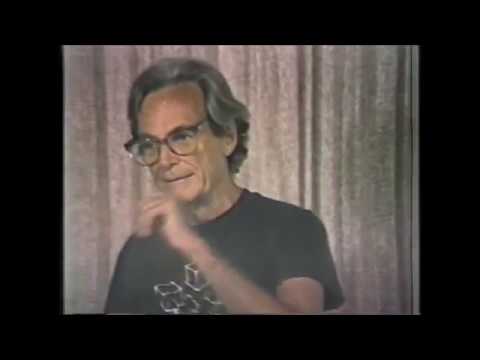
Richard Feynman gives this lecture on computer science, explaining hardware, software, logic, memory, and heuristics, and how definite procedures let computers imitate forms of reasoning.
Also known as: Computer Science lecture; Can Machines Think?; Richard Feynman Computer Science Lecture.
Feynman explains computers by comparing them to a filing system: a fast, streamlined clerk that stores data, follows instructions, and moves information between memory and output. He uses this analogy to show that a computer’s real power comes from precise procedures rather than arithmetic alone.
He then builds up from simple one-bit operations to logic gates, transistors, memory, and program counters, showing how electrical switches can replace human clerks. From there he explains why the same machine can solve many different problems just by loading different instructions.
In the closing section, he turns to parallel processing and heuristics, describing efforts to make machines act more “intelligent” by trying promising possibilities first. His point is that computers can imitate many forms of reasoning, but only when the procedure can be made definite.
Feynman speaks throughout.
In his words
“A computer is a high-class, super-speed, nice streamlined filing system”
“Computer does not primarily compute in the sense of doing arithmetic”
“They're data handlers”
“The key of it all is dumber but faster”
“We are getting close to intelligent machines”
Key points
- A computer is better understood as a high-speed filing system than as an arithmetic machine.
- Input and output are separate from the central logic and memory of the machine.
- Multiplication, addition, and other operations can be reduced to step-by-step procedures stored as instructions.
- Binary representation lets a machine work with two-state signals such as on/off, red/blue, or 1/0.
- Logic operations like AND and OR can be implemented with switches and valves, leading to transistors in real computers.
- Different programs make the same machine do many different jobs; the limitation is mostly efficiency and memory size.
- Heuristics can help machines search intelligently, but they can also produce strange, self-defeating behavior.
Full transcript: Richard Feynman, Hardware, Software and Heuristics lecture
(music) (music)
Okay, what I want to tell you about is computers, because they have computers all over the place and everybody's talking about them and using them, is frightened by them, or else you find them very great assistants and so forth. And I wanted to tell you a little bit about how they work, what's inside them, what the idea is, what the mechanism is, so that you're gonna get a better idea from that of what you can expect them to do and not be able to do and so on. So I want— that's what we're doing. We will expose what a computer really is. Actually, the first aspect is, you see, there are many different kinds of computers. There are computers that you can put the data in by talking to it.
Even, there are computers you have to type the data in. There are computers that get that data from the machinery of an automobile or something, and computer how much they should shift the gears, so they have an automatic transmission but, I mean, controlled by an automatic computer. Computers that are you feeling how fast you're going and what the hill height strength is. That’s called the input part of the computer—that is the information coming from different kinds of sources, their keyboard or telephone sensors inside the automobile that measure temperature or acceleration or something like that. And there's another aspect called output. For example, the thing that goes out might be the control of the gasoline in the automobile. It might be
to make pictures on a TV screen that you can read or look at. It might be that it makes music and makes sounds and so forth. Now, in the plot, that's the input and the output which makes computers look different is not the part I'm talking about. There is in between the input and the output, the input is converted to some electrical form, then something's done in the computer and it spits out another electrical signal which is used for the output. So for instance, in the automobile thing, the various sensors are sending electrical signals to a box which is the proper computer proper or the part of the computer that I'm going to talk about and then in the output of
this box is other electrical [signals] which go to control magnets or something which turn on and off the gasoline or else control magnets which pushing it out a diaphragm very rapidly. It makes sounds or controls the electrical currents running in the beam that's going all the time on the screen and it makes a picture on the screen and so on. So what we're going to talk about, which is really the computer proper, is the part in middle. So it's sort of we don't care where the stuff comes from, we don't care where it's going on. Now, what is the stuff in the middle? That's what's manually really manufactured in the computer. Of course, a real computer that's sold is advertised and it's good because it's got a big screen,
or it's got a small screen, or it's got a tiny keyboard that your fingers are too big to push the buttons, or it's got a big keyboard that has so many buttons on it you can't figure out which one to push, and they have advantages and disadvantages, which is not what we're talking about. We'll talk about what's on the inside—the central part of the computer proper which I'm going to call it the computer proper. But the whole computer, of course, is the real thing. So, but we just talk about the guts in the middle, the thinking part, if you like to imagine that computers think. But what is it? I'd like to compare it to a filing system. As a matter of fact, I'll anticipate the end: a computer is a
high-class, super-speed, nice streamlined filing system. And I'm going to start out with an ordinary old-fashioned business filing system and that'll tell you ways that you can change it and improve it and so forth until it becomes a computer. One of the miseries of life is that everybody names things a little bit wrong and so it makes everything a little harder to understand in the world than it would be if it were named differently. Computer does not primarily compute in the sense of doing arithmetic. Strange, although they call them computers, that's not what they primarily do. They primarily are filing systems.
People in the computer business say they're not really computers; they're data handlers. All right, that's nice. Data handlers would be a better name because it gives a better idea of the idea of a filing system. There's a lot of data on cards and your handler—you take cards out, look at them, put them back, and so on. So that's what the computer does. And I'm going to describe first an old-fashioned filing system, and then we'll talk about how it's improved, or how it might be improved. Okay, actually it's improved to the point of being made automatic and made mechanical, electrical actually, and that's our computer. And an old-fashioned filing system is something that many of you are perhaps even, unfortunately, familiar with.
It's a whole lot of boxes, drawers, cards, and things you know which all have stuff, numbers it, and facts on them. For example, in a business that has lots of salesmen, that maybe each salesman has a card. He has his name on it and his address, what his general salary is, what his commission rate is, how much he sold last month, and where he lives, things like that, let's suppose. And it's written on lots of cards because there's lots of salesmen in the boxes. And then the problem for a file clerk might be, for example, a boss comes in and says, "Would you figure out?" Oh, the commission rate is given on the card, like a certain percentage, and how much you sold during the month, but now you have to figure out.
How much do we have to pay him? So what you do is you take out a card, and you look at how much he sold that month, and you look at the commission rate. You multiply the two numbers, and you write it on the card and put it back, and do this on card after card. Okay, what does it mean? You're taking a card, then yet looking at some things and doing something to them—that is, looking at some data on the card. The easiest way to think of it, to simplify just a little bit, is that we have scrap paper that we can erase and use again, use again. So we take them, we rewrite the numbers off the card—the amounts before—so while we're doing the multiplication we can do it with the numbers without dirtying up the card. So we copy the numbers over and then do the...
Calculations. See the answer. And if the rule is to put the result back on this man, Scott, okay, so we write it on this card. It may be that we would like to put this on some other card. Maybe cards about expenses that have to be paid or something, you see? So you'd put that somewhere else. Or perhaps, to make another example, that you would like to add together all—well, I'll forget that. You want to add together all the money to know how much you're gonna have to pay out. That's another example. But they're all the same, of course. That you take that numbers from the cards and write them down and recalculate and put it back in the numbers. So you have two kinds of—three kinds of operations: taking cards from places, looking at information on the cloud, doing something to the information on the card, writing.
Things on the card and putting the cards back. Okay, actually, it could be a little bit simpler. You could say you take the thing out and take the information off the card, immediately put the card back, this saves it. Now you do the calculation and when you get the answer, you pull a particular card out that you want to put the answer on. It may be the same man's card, but wherever you want to put the answer, you take it out right at that, put it back. Okay, so we have two operations: picking up a particular card, getting data off of it, doing something to it, and then putting numbers onto cards from our scrap paper on different cards, and that's all. If the file clerk does it. To take another example, suppose that we wanted to, suppose we have.
Figured out, or the amount of money that we owe each salesman, and we would like to know how much to draw out of the bank in total. So, we need the total amount of all the sales. Then we could do that by having a special card, call it "total card," and writing zero on there. And this is a way of kind of — I'm talking about the details of what we have to do it. Everybody knows what to do. You tell a file clerk, "They add the numbers." But this is what you might do: write zero on this particular thing called "total sales costs in California." And do the fine. Then, you take the first salesman's card; you look — he's not from California. We want the total amount of money we have to spend on California salesmen, all right, just as an example, so…
You put that one back. Take the next card. Is it from California? Put it back. Next card. In California? Yes. Then the next instruction is to look at how much money you are with this man and write that by—what's on the total card. You take the number that's on the total card and the number that's on this man's card, add them together, and write that back onto the total card, right? You're keeping the total running, see? So the next time when you take another card that has a number on it, just take the new total you just cooked up from before. There was no trouble last time; you had zero. But this time it's getting harder. You add on and put the sum back on the total card. So you see, you got a kind of a steady thing, and when you're all done going through all the file, the total has been changed and changed and changed and changed. And the last thing you read is
The real total of all the numbers. Okay, that's what the file clerk might do in that situation. And now, what we're going to try to do is improve the filing system. To improve it, you see, we have to have a fairly intelligent file clerk; a file clerk that can multiply and add and so on, read cards, get instructions from the boss, and remember what they are naturally, and know how to do all these things. Has to know how to, where to go, to run up and down and pick the cards out of the boxes. And has to read the place to find the cards and know where they are at. So, it's a lot of stuff. Well, another one comes along, we've got a new...
File clerk. I got a new file clerk for you, say, five times faster than the old one. Oh, well, we'll hire. But you discover suddenly that he doesn't know how to do multiplication. Well, how in the hell is he going to handle their finding the commissions by multiplication? This guy isn't any good, but he's five times faster, so it's very tempting if we can only get him to be able to multiply. So what do you do? He is sending to school? Too much waste of time. Better idea, to teach him, have him—you tell him how to multiply as follows. I've taught, he's very fast at picking up cards and putting them down. So he takes the cards and he looks at, say, two numbers and you
Tell him to look at the last end of the number. One's an eight and one's a seven, right? Then that instruction—look at card number 78 in a multiplication file. When card number 78—no multiplication says 56. The multiplication table, which we worked so hard to learn in school, is easy to put on a set of cards. On each card, which has—which is labeled by a number, let's say the card number 78 or 7/8, the card label—I don't have to convert it to a number or card called multiply seven eight answers sixteen—there’s written on a card. So all he has to do is pick up the right card. He's very good at that, and he's very fast. See? So he sees the seven eight, take the cockpit, sink, okay? And so it goes. He
doesn't have to know how to multiply. You tell them a series of instructions what to do exactly. You give him in the instructions as to which cards to look for at what time. So when you say multiply, you don't even tell them that. You tongue look in this box now, take that card out and write down—write down what that one says. It's so on. So you see that we can describe multiplication as a definite procedure—a precise procedure of handling numbers in a kind of a dumb way. And things that would have to be memorized are never a problem. Memorization is no problem. That's what a filing system is for. That's what cards are for. We write everything on the cards. Every damn thing is suppose you've learned where all this effort is written.
On a card. So with cards, we can make this fast filing clerk actually able to multiply. Of course, it's slower to have to look up each time in the multiplication table because he has no memory worth a damn for numbers of this coin. So he can't even remember that he’s use of seven times eight fifty—five times. But it still has to look it up again, so he's slower in the sense of the number of operations to multiply than the original file clerk was. But he's really faster because altogether he handles the card so much faster that in spite of the fact that if there's a lot of multiplication problems he isn’t five times faster than other clerks, but he might be two times faster because he slowed up in the process of
multiplication. So our filing clerk does not know how to—know how to multiply. Well, we'll get a faster one. I got another one that's ten times faster than last night. He can't add, no problem, right? I mean, we have an adding table too, right? No problem. Okay, he's easy, he's better. He can't add. He can multiply. Can't handle numbers at all, but he can compare it, read and check that what it says on the cards is the same. He doesn't even know that these are numbers. He sees this shape and compares it to this shape and takes the cards out according to the instructions. Okay, now where does he get his instructions?
They're in a series of cards that says do this, then do this, then do this. You see? So we have a sequence of cards with instructions on them. He doesn't even have to remember the instructions. He's rather stupid. The first filing clerk could say go get the card. That instruction meant go into room five, open the drawer, push your fingers through the card, lift, and so forth. Okay, so if you want to get the card to read it and then carry it back and write it down, you could have a list of instructions for this idiot. Instead of saying get the card, you say look in this set of instructions, please. First instruction, walk over to the file. Second,
rope, pull out the drawer. But if at home, so he's done and so forth. So all he has to do is keep track of which instruction comes after which. He's really quite stupid, but man is he fast. Dumber but faster, okay? The key of it all is dumber but faster, right? And so what we're having is filing systems with ever-increasing speed of the file clerk but ever stupider file clerks. Okay, and they're getting better assistant. Chris Brevis file everything. Now the last fellow that we've got in this—not the last one, but the Willit next to the last one—is unable to remember which
instructions on. Well, what's the next instruction? Oh, but he can add one. He knows how to change something with one. He has a little counter, but he pushes a button and it goes up one. Okay, so all he has to remember is the following: push the button on there’s a little register that he can read. Okay, that's a push that we call it the program counter or instruction count. All right, push the button that changes the instruction count by one. That's the only button he knows how to push, that okay. That's the first thing spike. Read the number there on the program counter and take that card out, that instruction number out.
Okay, and that says go get this paper or transfer this, so whatever it is. You see because we have already put all the instructions in a certain order and then put the card back. You're finished. Do the intern, take out, read the instruction and through the instruction and put the card back. Okay, then the next cycle, he has push the button on the program counter, read the program counter—it’s the next number. You know, anybody couldn't remember so he has it there. It's the next card, takes the next corner and it tells him what to do next and so on. Okay, so he doesn't even have to remember where he's at as long as he's got this one little gadget inside, which I've beginning to think you could see could be done mechanically—that is, we can make a
Device that all you push a button and number changes by one, right? In fact, so that that almost got it but we find out very much fast at ten times faster than this marvel who was so stupid but so fantastically fast, which ten times faster than this fellow but he can't read letters. He doesn't know what they mean, doesn't know what the numbers mean. Okay, so how is he gonna, what can he do if he can't read anything? He can't do anything. I grant you that. I grant you that. But he can distinguish two signs, one from the other which we'll call high and low or black and white or one and
zero or mark and norma, whatever. All right, just he only can read not any kind of letter but just one little spot. It's yes, let's say we always make it red and blue, you see? Is it red or is it blue? So we make a lot of spots for him, red-blue spots. It's all he can read. What I need to eat, how can we make him do anything? How can he know what an A is? Suppose we got letters, we want to write the letters for names or something like that, so we would like to instruct him in the letters for the names to see. So instead of saying we tell him which — Oh, first better to give a better example by this time because they have to use so many cards in so many files, the files have gotten larger, right? There are lots of filing cabinets in many rooms all
over and we, this poor fool has to be able to find the right cabinet. Now previously we labeled all the cabinets with the names of the sections from from small stoop to zoology and so forth here, and this is in box 34, and this is all over it's like that places in Esalen have numbers on them and so forth. I'll show you how we could do that without having only with red and blue dots on the rooms for those particular kind of workshop people who cannot read numbers. All right, I will still be able to do it. I'm not sure how we'll do it. Let's do it with the Esselman rooms. It just makes it more interesting. I don't propose this as a practical device but perhaps it is and it goes as follows just till you take the map and you
divide the rooms through the middle and say these are the red first level red and blue rooms, okay? Then you take the red rooms and divide them in half, let's say those are the higher part of the hill and the lower part and say they are secondary red or blue and the blue ones the main blue ones have been divided at the primary and secondary rooms like this. No, I see that I don't have red and blue so I'll use brown and orange. It's perfectly all right. Had I said brown and orange it would be more like they understand that we couldn't be any two colors. Okay? So and let's first draw
what in yellow a lot of rooms can't see the rooms. Okay, I don't have enough thing so these are the rooms will be all right. Let's say we had this many rooms. I've got them all laid out in a straight line but it doesn't make any difference where they are on the map, right? We got eight rooms I know you got more rooms than eight rooms but just see the scheme will work just as well for any number of rooms. So what we're gonna do is we're gonna mark all these rooms with a black dot as a first dot I mean a brown one, all right? And these will get orange dots.
Okay, now of the brown dotted rooms we think of the brown dotted rooms and we look at the next dot, which says the first half of them get brown on that dot and the second half of those get orange, all right? And then the first half of these get brown and the second half gets orange. I say but still you're filled, okay? Now you look at the brown brown rooms so any pet is a brown brown, the brown orange rooms, the orange brown rooms, and the black orange orange rooms of the brown brown rooms we label the side ones brown as
the first. Each pair gets the front end brown and the other one gets orange, and lo and behold we got eight rooms, and with three little dots each of which can only have one of two colors we can identify the room. So the guy who has to locate himself and you can't read numbers but can read whether a dot is brown or orange will in this system be very easy to find his unique room. In fact, it's easy to find the room which is different. Of course, as you already know, the numbers on these rooms around here do not locate the rooms right, but this new system really in locate the room. The first brown tells us to kind of go over here somewhere, the next round swap more is it orange
take that side. So if the filing cabinet can happen, this can be very large and have labels on him which I like these brown dots and orange dots, but because instead of being eight, there are say a thousand such rooms, the read turns out you only need ten dots to do it. A million such rooms is only twenty dots because there's so many different combinations of brown brown brown orange brown I'm bombed around by men for twenty long so many ways, in a million different ways. So you have that way you can label a large number of different cabinets and have a file clerk which you can only read that's one of two alternatives and make sense of it, and so we can do it with rooms and also.
With the letters of the alphabet, because we take the letters of the alphabet and write them along and label them the Bradford—the letters on this side of the alphabet of the brown letters first, primary brown, and the others are orange and never those. You make the brown, so these could have been ABCDEF, yo. So he could teach him a different way to write his alphabet. He's so dopey he could only read these, but we smart enough to convert it so he can be, therefore using names and numbers, but they're written in a different code. It's like the dot-dash system of Morse, only slightly more organized. We call it ones and zeros, brown and orange. I'd call, again, whatever. You can only read two possible things, okay, so
this, the new file clerk can only make out one of two alternatives in any particular spot. Of course, he has to realize is do first the first one, and then he's up to the second. When he saw him first makes one choice and then the next choice and next choice, and according with this, and then determines the letter of the alphabet. If he had to talk to us and make an output, he's not going to be able to just put this ones and zeros. We're not going to be able to read it. So suppose he wants to say something, and he wants to put an output. But you ask him for the name of the, the best-selling, the guy who sold the most in California, and he does it with his dots, and I'll tell you a little more about how you can do that and comes out that his name starts with an 'A-E' say, or let's say
starts with a C, whereas a C for him it's a three-dot 'Sanna' - right? But he wants to print C for you. What can you do? We wanted to see it look like a scene. So what we have done for him is we imagine he's going to write this on some kind of a screen that we have divided into squares, okay, like this. I should make more, and we tell him whether to mark the square or not in the electronic device with a pulse, so it lights up on the screen or not by whether it's a brown or an orange dot. There, so he put a brown dot here. Well, let me first draw the C, or C is going to
look like this. This is where the orange dots go, okay? There's the C. All right, not a very good 'see,' but to see if you add more dots and a finer screen, it would make a much better C. So, we put all these browns and so on, and then we put into a filing cabinet under the labeling for the third letter of the alphabet this pattern. So when it — 'cause his, when he's not working internally, which is, you can use this other system, but wants to communicate with us, we told him how to do it. What we get for a seat by putting in the filing of that that he's supposed to put out on the screen. So when he's finished looking at that, we look at the
little white dots and black areas, we see a shape of a seat. So the hardest thing he has is communicating with us, getting the information, converting at the dot and getting the dots back to the form that we've — we're used to. The same thing can be done with numbers, of course. Suppose that he had only dealt with numbers from one to a thousand and twenty, zero to a thousand and twenty-three. It's a happy case, where you can divide ten times, you can divide those in half. You say, "Oh, numbers described by the same bunch of dots by taking the, you know, the top half of the numbers or the bottom half of the numbers." I already did it with numbers. It was the numbers on the rooms. So we can use these dots and so forth to
represent numbers the same way. And now we can use, in a particularly insane—I mean stupid—a file clerk, perfect. And it's only useful, of course, if he's really very fast, because everything requires him to looking and his damn files all the time because he knows so little. And that's what ultimately has been developed, first of all, in order to get up speed. Instead of having to get up and walk over to the file, we put the files not on cards but on little tape decks, huh? Little tape decks, electrical, and we send the signal, "Turn on the tape," they can listen to the signal that comes out. We don't have to run over there. We've got a telephone, so to speak. You, we tell which one to go off,
then it sends back what's on that tape. So you see that we can file things not on pencil and paper, but there the electrical signals or magnetic, different kinds of techniques. They're off of electrically saving information. And it turns out you can do that smaller and smaller until the filing cabinet is the speak which contains millions of items. And what happened, what you're doing is you're signaling to the different filing cabinets depending upon the ones and zeros. There are switches inside that tells which one it goes to, and the information comes in and out electrically. That's much faster than carrying cards around and running around in sneakers, and so that's the way that's done. And by the time we got a file clerk
this stupid, we can do it mechanically. We can tell whether two dots are the same, for instance. We can ask him when the two looked the same, do this. So if there's two brown ones or two orange ones, do this. Now it's rather easy to make mechanical devices which will do things like that. For example, instead of brown and orange dots, you could have electrical voltages which are either up or down. You know, there's current, dah, no there isn't. So instead of a dot of different colors, we just have a voltage or no voltage on a particular wire at a given moment, or if you would like. But this isn't the way, it's the electrical one is the way it's done. But if you would prefer, you can imagine you made a hydraulic computer with pipes with
pressure with water going through, and if you look at the pipe and water squirts, that's a black dot. And there's no water there; that's the other kind. So it's about that easy. So you'd make the pipes go squirt, squirt, not squirt, squirt, squirt, not squirt. That's that. This one is this room right now. What we need is a situation to compare things that only squirts of two things. Let's suppose we were looking for both dots be brown; only then should you make a brown dot. In other words, two pipes such that if both pipes have water in them, then only then should water come out. The other one, what we need, only a valve, a valve operated by water. We have a pipe like this with a
valve, which is a thing you don't turn on, let the water through. The water's trying to go through here; it's turned off by a faucet which only takes a small turn and has sticking out above it, instead of an ordinary handle, a flat vane. Okay, that we're going to scrape with water, and that's going to push the vane around and open the valve. So here's the four things coming in with the water to operate that. So when the water goes here, it turns the water on there. Now, if I put two such valves in succession in the pipe, okay, and I had the water coming in need two different pipes, then it was only work—that is, water will only come out of here if both of these pipes are squirting, because if I got only one pipe squirting and the other not, this valve was off but
this one on, so water doesn't get through, on a counter that's in the way, and vice versa. Okay, so this is what you call an AND. You get a result here: when both this and that are on, then you get that on. You could do an OR just as well, when you get a result if either one is on, but that's a different kind of logic. And the way to do that is simple enough, just arrange the pipes so that the water that's coming in is split into two possible pipes. Let me see how I draw this. Yes, well, the brown and the orange is just an accident of fate of having put the orange cap on the brown gadget; that some would straighten that
out right now, and here we go. The pipes go like this: the input is here, but we go with the two valves this way. Here's the one with the other valve, okay? And the two squares. Let's say this one squirts here and this one squirts here. You've got to get some geometry; as three-dimension, you've got to get this pipe on top of this pipe. Wouldn't be trouble. Anyway, the idea is that these then come together, and you might ask under what circumstances does water come out of there? Well, clearly, if either this is open or that's open, too, either goes around this way or it goes around this way or both—that's an OR. You get choked out only when one or the other or both is on. And so we could say very simple comparisons of these black
these dots or Bennett ones and zeroes, or fresh it water and no water, or electricity and no electricity, voltage or no voltage, electrons or no electron. And so we can make the device simple enough now that we don't need a human being anymore to do the file work, and the whole system is now a computer. It's all done electrically, and it has this kind of switches in it. Valves are electrical valves are called transistors, and how they work in detail, of how the electrons come in here affect the electrons going there, I won't describe, but they're just granting that transistors are like the analog of a valve but for electric current, then you're going to understand
that large numbers of transistors, lots of these valves making comparisons, switching where the current goes, to find the right filing place in the box where all the stuff is filed and so forth, would constitute a computer. And that a computer does is what a filing cabinet system can do. It can do everything that an ordinary—most things that an ordinary file clerk system can do. It can multiply numbers because it's got—we store the numbers, we store the combinations. They can add; it can do all these things, even though it hardly do anything. And you might ask, is there some kind of designer computers that can do more than other kinds of computers? And the answer is no. It turns out, once you begin to understand this, that if you try to add
more complicated things, you can always put them back in filing systems and use the same system to do a more elaborate thing. So all the computers can do the same things, but maybe they take longer, or so, it may be a matter of efficiency, but they can all do the same things. They're all universal inside if they're big enough. Their limitations are: how big is your filing system? Maybe there's not enough room for all the cards you want to put in, and things like that. But that's the only—the only differences between the different machines. And in any rate, that is supposed to be an exposé of what the heck's inside the machine. Now let's ask what the miss such a machine could do. First of all, the same machine can be used for
more than one problem by just having different instructions. List some instructions: what to do, do this, then that, to do that, to deep, deep, deep, deep, and another problem you do something entirely different. This might have been a business with salesmen and so on, and now you want to do oral company reports and listings of what they discover when they drill. All right, so all new numbers or all new instructions of how to handle the numbers, everything. What do you do? By another filing system. It's more expensive to do that than to do the following: throw away all the cards from the business company. Wait a minute, suppose you want to come back in. All right, take everything that's on the cards of the business company and make photocopies and store them in the
Basement now. Erase all the cards. So if you want to come back, we'll come back. Then you go down the basement from the time, year, last year, when you were doing the oil company problem, and pick up from the photocopies, all this stuff that was supposed to be on the cards for oil business, and then just fill out, fill up all the cards with the oil companies' job, with the instructions for oil companies. And our dumb file clerk is now an oil company file system. Okay? Because he's got new instructions and these things that in the basement. The analogy that I had, wanna make is those things are dead, not operating, and I just stored. They're not easy to get at. It's hard to get down to the basement. It
Takes a long time to pull them up and set them in all those cards, but you do that just once in a while when you want to change your problem. When you've got them all in, then you can rapidly take them and put them in, compare them and do this and do this, let the filing cop click is supposed to do. So, we have cassette tapes or hard disks or floppy disks or various and sundry different ways of taking a large number of instructions out and sticking them on the disk and leaving them there, putting them in your back pocket, throwing them around in the boxes while the computer is doing something else. Then, if you want to change a computer to a word processor instead of a game or whatever it is, then you just take out one, this put the
Other disk kid puts new stuff into the computer, all new instructions done. File clerk working like a son-of-a-bitch and a big memory outside. And that's why computers could do so many things, apparently the same computer. It doesn't do so many things; it always does the same thing. It follows instructions, and the instructions are very done, and it is low-level. Okay, that's the end of the exposé, but they would like to make some remarks and some things about, because people like to think of things more than just how does it work. They would like to know what's the future, why can't we improve this, looks what we've got now. We
Have this enormous memory with lots of data all around which is sort of sitting there, and this one little section where something's happening, which I call the file clerk, before which is the systems which go and get something, pull it in here, and do something over, you better put it there, and it takes something else and puts it here and puts it there, puts it there. What a great! So this poor file clerk is working perpetually with a tremendous rate of speed, going practically crazy, and he does, in fact. I just estimated something like 10 million times faster than an ordinary file clerk. That's 10 times faster, seven times if you know what I mean. Ten tons, ten tons. But it spans fast, and that's the electrical things of that.
Fast, and, but he's working very hard. But the rest of the system, which is the memory—and you've heard—they made now memories with 256 K bytes. K just means a thousand and twenty-four, so they mean 256 times 1,024. Eight-dot were symbols in one tiny chip. Okay, it's a lot. And you put several chips and you got a terrific computer, except for the guy, the file clerk, which is called the central processor, who has to look at this, this program, can't do and check and change it and look at the next instruction, and going, going, alright. And he's working very hard. So an obvious way to improve the thing is to get another file clerk.
Why not have an army of file clerks? Turns out, at first, that it looked extremely difficult to do that because there's all kinds of technical difficult problems. Suppose that one guy has taken a number out and he's getting ready to change it. He's gonna do something and then change the number. The man just sold something, he wants to change his, and then put it back. And while he's doing that, the other file clerk is taking the card. He doesn't know whether it's before or after the first file clerk has changed the number. And it's very important to know that because he's going to use that number there. So there has to be a certain amount of organization among the file clerks, and don't forget that kind of dumb. So the organization must also be fairly done, and has turned out for many years, it was.
A belief that it was difficult or almost impossible to easily arrange a system with many file clerks, they were always turned out to be easier to make. One file clerk worked very hard, that they made several working because of all the what you might call bugs and difficulties that come from them all using the same information and changing it on each other, and so on. And organizing that—the part of laying out the instructions—is called programming, and a programmer works out how to put what instructions to write: the machinery, the wires, memory, and the boxes, where to put the cards. But it's not an analogy in the little processor in the middle with little switches. It's
Called the hardware, so it always turned out that with a little more clever software, which means cleverer programs, this single file clerk could do what the others would do. Because the others were confounded by the problem of interference. But recently, it's been shown that it's a misunderstanding, and with clever new ways of analyzing the thing, we have now figured out how to make things run with numbers of file clerks. There's two different general systems. There's one system which has, you know, a reasonable number, like 64, 128 file clerks all working on
It’s saying, similarly, they work on almost separate parts of the memory. That’s the way it’s organized, and only once in a while exchange information. So they’re not doing anything to each other's cards; they’re each working in separate sections. And there’s also a machine called a Connection Machine, which has 64,000 processors in it, which is a sort of a leap into the blue, wild blue yonder at a time when they were trying to do with two processes. And if the 64,000 processors that could all be made to work at the same time, it’ll be 64,000 times faster than it was before just like that because they’re all working together. The only problem is to organize the problem and the program so that you can do the job in a way that
does use 64,000 guys at the same time. It turns out that’s not as hard as it looked at first, and that’s a thing for the future. I’m talking about the future. They’re building such a machine and they’re learning how to program it; that is, how to arrange the 64,000 processes, which, by the way, are each, in fact, somewhat stupider than the program that I was talking about before, because they can't even read the code for their instructions. But I mean, they know as instructions — read what’s in that file, place that; means go over, switch this switch, that, take you, go over, get the file open, the drawer closes — for they have, they can't even read that. So that they have to be instructed on the goal, and so there’s another machine
on the outside that instructs some more on what to do, but it has to tell them all, because, see, they all have to do the same thing at the same time, because the instructions go to everybody: "Do this," and they all do it. But if they all do it, you’re going to be in great difficulty if they all do exactly the same thing. And the only opportunity they have, the only thing you two can do that’s different is that you can instruct, or they can keep a little memory thing that says "Don’t pay attention to this instruction." In other words, you can get some to do something and the others to do nothing. Then next time you want them to do something: if you wanted one to do one thing and one to do another you have to do it in two steps. Do this, you stay put; do this, you stay bored; and so on, okay? And so on. So it’s rather interesting because, in
trying to manage the 64,000, they all have to be much simpler, and all the time it gets simpler, it gets sort of slower, but the question is whether we gain from the 64,000 what we lose from the slowness, and it depends. We learn by experience, that’s the future. Finally, I would like to just say somewhere it’s about what the computers can do, and you’ll see they can do only what you would be expected to be able to do with a filing system and a reasonable file clerk. I’ll explain an example of an unreasonably good file clerk later, that’s better than one that we can make with machinery. Okay? So far, we seem to be able to imitate any file clerk, real file clerk, with machinery, but I’ll mention a few cases that we don’t know how to do.
That what we need to do, of course, is to get a definite procedure to convert what you want the clerk to do into an absolutely definite procedure — every step is precisely defined in this stupid way, exactly. And if you can do that, then you can get the system to work. Now, will the system think if you could define exactly a definite procedure, tell somebody exactly how to think, which by the way is what the members of my workshop have expected me to do for them: to tell them exactly step-by-step what to do to think? If I could do that, I could do it for a computer, and I wouldn’t have
you know, they could get the computer, the thing, but nobody knows what we do or how to define exempt, which correspond to something abstract like thinking. But nevertheless, we could make the machines which play chess, which was supposed to be something that takes thinking. And what exactly do they do? What definite procedure can you make with a big file system, very fast operating gadget, by which the thing could be used to play chess? Never mind the input and output, the information of where their pieces on the chessboard are converted into numbers or black dots and so forth, ones and zeroes, they’re called inside the machine, and then it proceeds. So never mind a translation. The idea is in a given position, which is a whole lot of
information — that’s where it is — you want to know which way to move, so you say, well, there are many ways I could move. You look at the rules for how to move: the knight goes this way, the bishop this way, and so on, and you just list all the different ways it could move, and you see all the new gap possible positions. Then you say, in each one of those, which way could the other guy move? They’re getting pretty big, isn’t it? But there are big machines and they’ve got lots of storage space, so there’s how does it, what’s the next room? And if he does that, what can I do? And you just check every one of the positions after, let’s say, four or five or six half moves — these are called half moves with one side moves to the other side move — and see which of the final positions you’re better off and better off might
Be some little rule like you haven't been in check, I mean, haven't had your King lost. That means you're not dead and you've got more pieces than the other guy. Okay, so you look down six steps down to see which move is the best to make, where you got the best possible outcome, and you make that move. Then your opponent makes a move, then you start again this time going down six again. Of course, you're going deeper now because the game is proceeded a little bit further, and that's all there is to it. What the machines do is just a tremendous amount of trying different positions. Human beings don't. The human being tries about 35; the sponsor—he can tell when he's in a position. He tries about 35, looks at different moves before he makes a decision. Whether the machine makes
something like 35 million positions to check, that doesn't make the machine better than the other guy. We don't understand how we do it. We cannot give a direct procedure for this. The man does it by recognizing a pattern. Oh, this knight can—can this knight can fork the king and queen or something if it goes here. So I have to watch out about that square. He sees patterns, at least it describes it that way. We really don't know how it works. And this business of describing patterns and so forth is something that we haven't been able to put into a precise form. When he says it looks, oh, I just see that it's a good idea to try this, and I tried it. We don't know how he does that, so we can't make it play like a human plays. But we can make it play better than almost all in
human machines. Computing machines have been used, for instance, for designing machinery or designing something in particular, designing a computing machine, for instance, or something like that. In a computing machine, yet, that the different elements—the memory and so on—and different locations with wires in such a way that the wire, the wire lengths are shortest so that the time is quickest, and the paths that are being used most are closest to where you want to use them, and things like that. And so you try to figure where should you lay them out on this chip of silicon, and there has been quite a problem of design. We have engineers that worked very hard at designing these things and working these things out. In all, we do in the
computer now is to try it—try large numbers of possible arrangements. We just give it an instruction, put it here, put this here, then this, this, this, this, and how much, why do you need now, put here, here, here, here, here, over there, and then pick the one out which has the biggest, more ones, the biggest of the lowest, the best quality, whatever it is you do to measure how good this particular design is, like the amount of time that it takes to do a calculation or how much silicon you use or something like that. So we can select from a very large number of alternatives the best alternative, what narrowly a person doing that
doesn't waste his time with obviously useless alternatives, but we do not know how to put, well, that idea of the obviously useless. If we try to make the rule that it's useless, we miss sometimes a good opportunity that would have been a good thing. So that's as far as we can go with that. You've probably heard that machines have been used to the dock, to be almost like doctors, expert systems which can diagnose disease. Now, how can a damn file clerk? Why, it's easy, isn't it? How would you diagnose disease? You write down all the symptoms, and then you'd like to have a book that you could look up that says, "Here's all the symptoms and this is what you go," and in complicated cases, you list all the symptoms, and in there it
says it's either cholera morbus or the Borba sore, it's back there, a see Miele, whatever it is. You see, however, you can tell the difference by looking with ultraviolet, like up the nostril, like, but what nobody, I don't bother to look with ultraviolet light off at the nostril, so you don't know the answer to that. So the thing comes back and says, "Look with ultraviolet on the nostril and tell me whether it gets through or not." Say yes, okay, it's back to see me. So this filing system contains all this stuff plus the incomplete decisions that require more information, and once it's been arranged so that when it comes to a place it's incomplete, it simply sends back and says make the following test and tell me the result. Their thing doesn't work as well
as a real doctor, but anyway, you get some idea of how machines can be doctors, how machines can be chess players, and our machines can be designers of equipment or layouts for businesses or whatever, routing for trucks and so on, but just trying what kinds of rulings and seeing which is the best. That's all there is to it. It's a filing system, and anything that you can put in a filing system, and think of how a big filing system could do it, especially things that you just have to remember a lot of stuff or try out a lot of possibilities, those things can be done with a machine. It's fun to compare. Everybody wants to install, particularly well, I'll let that be
in the questions to compare. No doubt somebody will ask me how about this and that, so I'm done. Okay, well, I'll answer questions. What time is it? I used to hope I'm fine. Okay, I got time for questions. Yes, sir. And different languages, but if
You take my view: that is just a glorified high-class, very fast but stupid filing system. Then you can understand the universality. It's just as universal as a set of boxes and drawers and cards and so forth with a clerk. It could know how to write the numbers and the things down in it. She can use, or he—it's always a pain—he can do one kind of a job or another kind of a job depending on what's written on the cards and what kind of instructions are given to the clerk. And that type of universality is precisely the universality you're talking about. That's what the universality of the computer, the computing machine, is: an
automatic filing system. With regard to that question, first of all, do they think like human beings? I would say no, and I'll explain in a minute why I say no. And second, that they be more intelligent than human beings—is the question: intelligence to be defined? If you were to ask me, I have a better chess player than any human being possibly can be. Yes, I get you someday, and they can best better chess players than most human beings right now. One of the things, by the way, that we always do is we want the dawn
machine to be better than anybody, not just better than us. If we find a machine that can play chess better than us, it doesn't impress us much. We keep saying, "And what happens when it comes up against the Masters?" We imagine that we human beings are equivalent to the Masters and everything, right? The machine has to be better than a person in everything that the best person does at the best level. Okay, but it's hard on the machine. But with regard to the question of whether to make it to think like a machine, my opinion is based on the following idea: that we try to make these things work as efficiently as we can with the materials that we have. The materials are different than nerves and so on. If we would like to make something
that runs rapidly over the ground, then we could watch a cheetah running. We could try to make a machine that runs like a cheetah. But it's easier to make a machine with wheels, with fast wheels or something that flies just above the ground in the air. When we make a bird, the airplanes don't fly like a bird. They fly, but they don't fly like a bird, okay? So, they don't flap the wings exactly. They have in front another guy, a gadget that goes around, or the more modern airplane has a tube that you heat the air and squirt it out the back—a jet propulsion, a jet engine, internal rotating fans and so on—and it uses gasoline. It's different, right? So there's no question
that the later machines are not going to think like people think. In that sense, with regard to intelligence, I think it's exactly the same way. For example, they're not going to do arithmetic the same way as we do arithmetic, but they'll do it better. Let's take arithmetic, very elementary mathematics: arithmetic. They do arithmetic better than anybody, much faster and differently, but it's fundamentally the same because, in the end, the numbers are equivalent, right? So that's a good example of we're never going to change how they do arithmetic to make it more like humans. That would be going backwards because the arithmetic done by humans is slow, cumbersome, and confused and full of errors, whereas these guys are fast. If one
compares what computers can do to the human beings, we find the following rather interesting comparison. First of all, if I give the human being a problem like this: I'm going to ask you for these numbers back every other one in reverse order, please. Right now, a greater series of numbers, and I want them to—you didn't give me what to me back in reverse order every other one. I'll tell you, I'll make it easy for you. Just give me the numbers back the way I gave them to you. Here they are: one, seven, three, nine, two, six, five, eight, three, one,
seven, two, six, three. Anybody gonna be able to do that? No. And that's more than, not more than twenty or thirty numbers, but I can give fifty thousand numbers to a computer. (Laughter) Yes, I think you can do it. Obviously, he can do it. Good. But you can give a computer fifty thousand numbers like that and ask it for many reverse order, the sum of them all, do different things with them,
and so on, and it doesn't forget them for a long time itself. So there are some things that a computer does much better than a human, and you'd better remember that if you kind of compare machines to humans. But what a human has to do for his own, always, they always do this; they always try to find one thing they can do better than the computer. So we now know many, many things that the humans can do better than the computer. She's walking down the street; she's got a certain kind of a wiggle, and you know that change, right? Or the sky's going in, and you see his hair flip just a little bit. It's hard to see at a distance, but that particular funny way that it did back of his head looks—that's Jack. Okay? To recognize things. To recognize
patterns seems to be something that we have not been able to put into a definite procedure. You would say, "I have a good procedure for recognizing Jack: just take a lot of pictures of Jack." By the way, a picture can be put into the computer. In fact, by this method here, if this were very much finer, I could tell whether it's black and white at different spots. You know, in fact, you get pictures in a newspaper by black and white dots, and if you do it fine enough, you can't see the dots. So with enough information, I can load pictures in. So you put all the pictures of Jack on the different circumstances, and then the machine tries to compare it. The trouble is that the actual new circumstance is different, the lighting is different, the distance is different, the tilt of the head is different, and you have to figure out how to allow for
All that, and it's so complicated and elaborate that even with the large machines, with the amount of storage that's available and the speed that they go, we can't figure out how to make a definite procedure that works at all or at least that works anywhere within a reasonable speed. So recognizing things is difficult for the machines at the present time, and some of those things are done snap by a person. So there are things that humans can do that we don't know how to do in a filing system. So it is recognition, and that brings me back to something I left, which is what kind of a file clerk can't be imitated by the machine? A file clerk that has some special skill, which represents which
Requires recognition of a complicated kind. For instance, a file clerk in the fingerprint department, who looks at the fingerprints and then makes a careful comparison to see if these fingerprints match, has not been—it's just about ready to be—it's hard to do, almost possible to do by a computer. It's nothing to it: I look at fingerprints and see if all the blood dots are the same. But, of course, it's not the case. The finger was dirty, the print was made at a different angle, the pressure was different, and the ridges are not exactly in the same place. If you were trying to match exactly the same picture, it would be easy. But where the center of the print is, which way the finger is turned, whether it's been squashed a little more or a little bit less, where there's some dirt on a finger, whether in the meantime it
Got a wart on his thumb and so forth are all complications. These little complications make the comparison so much more difficult for the machine. For the blind filing clerk system, that is too much, much, much too slow to be, certainly, utterly impractical almost at the present time. I don't know where they stand, but they're going fast, trying to do it, whereas a human can go across all that somehow, just like they do in the chess game. They seem to be able to catch on the patterns rapidly, and we don't know how to do that rapidly automatically. Okay, is there another question? Yes, sir. Well, haven't any idea, of course, about I
I have no idea about that, whether anything is more useful or destructive to the world, whether Yoga is more useful or destructive to the world. With all these things, these things give us the power to do something, to do many things, and the power to do something may or may not be destructive. As long as you, any time you do something, you can do destructive and non-destructive or, or not, the opposite may be creative things. But we don't know how to make a device that guarantees to produce only creative things, with the exception of the telephone, as far as I—
Can I tell? I mentioned that because it's rather interesting. If you think about inventions, almost all the inventions have a destructive element in a war. The telephone has an effect in war; it helps communications. Maybe in that sense it's destructive, 'cause it helps the army to destroy you. But other than that, it's a relatively peaceful device. It doesn't directly kill, not at least directly. That's rather interesting. Bruce, it's hard to find one that doesn't directly available for killing. A knife. The question is, where the knife was invented. Okay, and the guy's explaining what a knife is. It's a sharpened piece of stuff that I melt, and I get, and I'm used metal knives, or maybe they stone knives a.
Sharpened piece of stone, and you can use it to cut things, so it's easy to get the vegetables off of the plants and so forth and so on. There's some guy we're sitting there saying, on the other hand, it's very destructive because you can cut my head off with it. And that problem has been with us forever, and there's nothing special about computers. Absolutely anything that can do anything has this problem, and we can discuss this general problem in our workshop, but it's not a problem for computers particularly. I think it's my view, that's my view. I, I know, but which is better—the Big Brother or the cutting the head off-er in?
Fact, that's what makes Big Brother possible. He has the knives and so forth; it's not so easy. Okay, it's true that you're worried about the fact that some information, there, be able to store information better and have more information about people, and whether that will produce a Big Brother. That depends on the attitude of the leaders of the society. Rather interestingly, the country which is more democratic and which is less interested in all the information about what everybody is doing to make sure is where the computers have developed the most; and the place where you'd think the government would find a computer's greatest use because you can file all the information about everybody, you...
Don't develop the computer very much, and you don't know how to use it. It's only a curiosity, one of life's contradictions. Is there another question? This man, that's right. Yes, well, it depends what you mean themselves, and it's hard to discover new.
Relationships our computers can do. There have been computers which do things like problems—they're improving in geometry or something, in which they've converted the problem of finding a proof of a theorem into a definite procedure. Ok, and once you do that, although it's an elaborate and dumb way to do proofs, they can do it. At the present time, a computer can't do all the different things that a person can do, you know. It's very difficult to find some way of defining rather precisely something we can do that we can say a computer will.
Never be able to do. There are some things that people make up that say that while it's doing it, would it feel good? Or while it's doing it, will it understand what it's doing? Or some other abstraction. I'd rather feel that these are things like, while it's doing it, we'll be able to scratch the lice out of its hair. No, it hasn't got any hair dyes to scratch from. Ok, so there are, if you've got to be careful when you say what the human does, if you add to the actual result of his effort some other things that you like—the appreciation of the aesthetic—or you didn't do that. I'm not saying you did, but a lot of people do that when they ask questions, and if
we add things that we think we're doing on top of what we actually do, and just look at not just the result of what we're doing but a lot of extra things, then it gets harder and harder for the computer to do it because the human beings have a tendency to try to make sure that they can do something that no machine can do somehow. It doesn't bother them anymore. It must have bothered them in early times that machines are stronger physically than they are. They can lift weights that are heavier than people, that can move things faster than people, that can run fast, if you can fly you could do; it's terribly strengths, and so forth, and we don't still sit around worrying that there's some way that the machine can
hand that some machine can do that mean thinking business we—yes, we can easily make machines that are better than us in predicting the weather, for instance. Because what you do to predict the weather is to look at old records and see when the circumstance was similar and guess that the results will be similar, added to that a certain amount of analysis of the movement of wind according to the laws of physics and a current amount of hocus-pocus put
together. Okay, now the speed will be higher and the effectiveness of the prediction is greater if you could look at more cases so you get a better chance of getting one closer, and put more a longer and more elaborate calculation including more variables, which is too hard for us to do in time to make the prediction. Now, we have to make the prediction of the weather, let's say that weather for three days from now has to be predicted in three days or the damn thing is useless, right? And we work at a certain speed, but the computers worked faster and can do more and therefore, for instance, for weather prediction, in the end maybe not today but someday it's not at all inconceivable that the machine could do weather prediction faster and more effectively and more accurately than we do. We will have, however, given it the procedure. Now the question is, what
happens if we don't give it the procedure? Well, a man, that people have tried that, this game of giving it, instead of a direct procedure, a kind of what has been called heuristics: try an analogy, to get a new idea of how to do something; compare this to that; try an extreme case, etc. And a man by the name of Lund that has gone the farthest with this. Do I have time? Much time? Do I have? Because we want to see these slides. What? I know that's interesting information, but how much? How much time do I have? It's time for the slideshow now. Since I have no more time, I will say no more
about the subject. What? No, but it takes a few minutes. That's why I asked for the time. Okay, you make this machine which was again a filing cabinet. You understand what it does is it looks, it tries to find the answer to something by looking at the different possible possibilities, but which ones it tries is something like patterns in chess instead of everything. It says try moves near the center of the board first, you know, and never mind the ones in the corner or something like that, or some sorts of principles. And he first applied it to a kind of naval game. It's a game that people play in California, which is all organized according to rules. It's
kind of fun. Someone sets out all the rules. Dreadnoughts cost this much, armor costs this much, guns cost this budget, so forth, and you got this much budget for your navy and you're going to make various kinds of ships with different kinds of armaments. And then this kind of a ship, the armament of a certain thickness that costs a certain amount, can only resist shells of a certain strength, you know, and so on. So you tried to, with the money, arrange to buy different—to design different kinds of ships so that your navy is better than next one. Then, when they're brought together, there's ways of calculating what—there's not real navies, yeah. It's a game, which is the best one, and all the rules are laid out in a
great big volume, ok? But the cost of everything and the power of everything, you know, armor-piercing possibilities and so on, and it's a nice game. And Mr. Lund tried his program on this game and put into his program heuristics like: try the extreme case and things like that. And he won the championship in California. Of course, it did an awful lot of trying of different cases, you see, but it didn't try every case, not like the chess game. There were too many things, but it was guided by its own stuff. Now, inside of that was this—that if you've got a better navy by your own calculation and you used one of the URIs—tx
Mark that you raise it up a notch as being more valuable. Now use the most valuable heuristics first. So that the ability of the machine depended on its learning, so to speak, which ones of its tricks work most effectively most of the time, and then they become more used. So it's just exactly what you would like to make it look intelligent. Well, he won. And how did he win? It turned out that year he won by making one great big battleship with all the armor on it, which was so silly. But when you go to calculate, sure enough, it's better than any of the normal things, which nobody thought of, but his machine. The next year, he
entered again, and this time he won by tricking all his money in making one hundred thousand, because they changed the rules so that the big battleship wouldn't win, you know, by changing to one hundred thousand little boats, very narrow, carrying each one gun, which were very liable to be knocked out. Okay, but there were 100,000 of them, didn't cost much each one, and they couldn't knock them all out. So his lousy little gnats would come. And it turned out, when you calculated again, he won. The third year, he was not allowed to play in, and he has applied this, this, this machine and this heuristic business to a
number of other problems, tries it out a lot, and tries new heuristics and so forth, and it has become very interesting. He complained that there were a number of bugs in it, and when he gave a talk on it, I said that I thought I'd say my comment afterwards. One of the bugs, for instance, was that the machine got a heuristic and made up your wrist, excited make up your wrist Excel. So the damn machine—what he—the way he had it was because it's hard to get computer time, he needed a hell of a lot of computer time. He had 50 machines at night from a U.A. packet company or something like that. He would work always at night. Coming in the morning, damn
things would try all their things and come in with the results. I used it to do mathematics and various other things. It comes in one day, and it's done a heuristic you develop, the heuristic when he puts a problem in or a new idea he writes it, says whether it's from him or from the machine, and I said learn math or a machine. Okay, and this was every year's tic over every question that hasn't won that on it, pay no attention to that, saves a lot of time. It could do much better. It didn't have any problem at this to it for, so it paid no attention. Well, in that night, okay? So I'd fix that bug. The next time he had a bug, it was he looked, was he came
in and he looked, he found that heuristic number 693 had gotten a score of 999 out of a thousand, was a damn useful heuristic. All night long this thing kept using the heuristic 9693 more and more, and it was a new, wonderfully heuristic. It seemed to solve every problem, it was terrific. Okay, we found out what the heuristic was. It was the following: you see, in order to make this thing work so that you change the numbers on the heuristics whenever something worked job, this to assign credit, so to speak, to the heuristics that were used. Okay, so this heuristic was when assigning credit, always assign credit to heuristic 693
and so that thing came up at all. Now I say that both of these show intelligence. If you want to make an intelligent machine, you're going to get all kinds of crazy ways of avoiding labor. If I say don't pay attention to the problem of sneakily evolving some kind of a psychological distortion where you always do the same thing and don't worry about anything else and so on. So I think that we are getting close to intelligent machines, but they're showing the necessary weaknesses of intelligent
(applause)
From YouTube captions, lightly punctuated for readability. Timestamps link to the video above. Errors are possible.
Cite this recording
Richard Feynman, “Hardware, Software and Heuristics lecture”. Transcript and video: Thinkers Archive, https://thinkersarchive.com/richard-feynman/computer-architecture-lecture-1960s/
Quoting a passage? Link to its exact moment: every timestamp above has its own anchor (for example https://thinkersarchive.com/richard-feynman/computer-architecture-lecture-1960s/#t-150).