How did Richard Feynman explain AND and OR gates?
Feynman explained AND as a setup where output happens only when both inputs are on. He used water pipes and valves to show how simple physical devices can implement logic. He also noted that OR is another logic relation, where output can happen if either input is on.
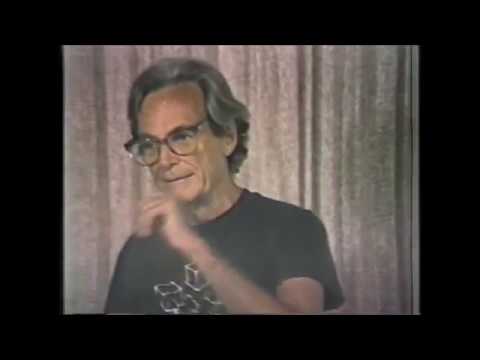
“Okay, so this is what you call an AND. You get a result here: when both this and that are on, then you get that on. You could do an OR just as well, when you get a result if either one is on, but that's a different kind of logic. And the way to do that is simple enough, just arrange the pipes so that the water that's coming in is split into two possible pipes. Let me see how I draw this. Yes, well, the brown and the orange is just an accident of fate of having put the orange cap on the brown gadget; that some would straighten that…”
Key takeaways
- Logic gates can be built from simple physical mechanisms.
- AND means both conditions must be true for output.
- Different logical rules can be implemented by changing the pipe or switch arrangement.
Context
Near the end of the excerpt, Feynman moved from abstract bits to the physical devices used to implement logic in computers. The quote above is taken word for word from the recording's transcript.
In the transcript
…water goes here, it turns the water on there. Now, if I put two such valves in succession in the pipe, okay, and I had the water coming in need two different pipes, then it was only work—that is, water will only come out of here if both of these pipes are squirting, because if I got only one pipe squirting and the other not, this valve was off but
Okay, so this is what you call an AND. You get a result here: when both this and that are on, then you get that on. You could do an OR just as well, when you get a result if either one is on, but that's a different kind of logic. And the way to do that is simple enough, just arrange the pipes so that the water that's coming in is split into two possible pipes. Let me see how I draw this. Yes, well, the brown and the orange is just an accident of fate of having put the orange cap on the brown gadget; that some would straighten that…
out right now, and here we go. The pipes go like this: the input is here, but we go with the two valves this way. Here's the one with the other valve, okay? And the two squares. Let's say this one squirts here and this one squirts here. You've got to get some geometry; as three-dimension, you've got to get this pipe on top of this pipe. Wouldn't be trouble.…
Topics
More questions about Richard Feynman
- What did Richard Feynman say computers really are?
- How does Richard Feynman explain how computers do multiplication?
- What did Richard Feynman say about the weaknesses of intelligent machines?
- What did Richard Feynman say about why science can feel difficult or dull?
- What did Richard Feynman say about why magnets attract each other?
- What did Richard Feynman say about why atoms are hard to picture?
All Richard Feynman answers · All Richard Feynman recordings
How this answer was made: the quote is checked word for word against the transcript of the recording and confirmed as the speaker's own words; the summary above it was drafted with AI from that transcript and quality-checked. Methodology and corrections.