Richard Feynman: Feynman's Lost Lecture
On Planetary Orbits: A Geometric Proof of Ellipses

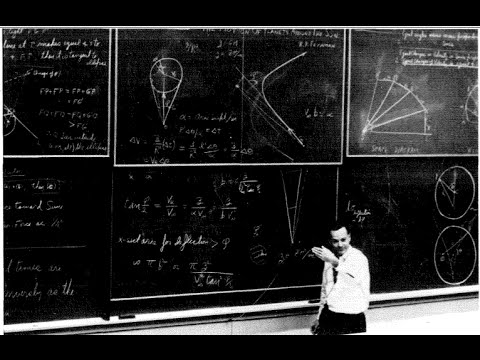
What Feynman talks about
Richard Feynman gave this freshman physics lecture at the California Institute of Technology on March 13, 1964, presenting a geometric proof that planetary orbits under an inverse-square force are ellipses.
Also known as: Richard Feynman's Lost Lecture - Complete; Feynman's Lost Lecture I; A Geometric Proof of Ellipses.
Feynman explains how Newton connected Kepler’s laws to gravity, then sets out to prove geometrically that a planet under an inverse-square force must move in an ellipse. He emphasizes the elegance of doing it without calculus, using only diagrams, tangents, foci, and velocity constructions.
He first derives key properties of ellipses, then shows how equal areas in equal times follow from a force directed toward the sun. From there, he builds a geometric argument that the inverse-square law makes the velocity changes trace a circle in velocity space, which leads to an ellipse as the orbit.
Feynman speaks throughout, with brief student interjections near the end.
In his words
“The purpose of this lecture mainly to demonstrate, that therefore the orbit is an ellipse.”
“Elementary means that nothing, very little, is required to know ahead of time in order to understand it except to have an infinite amount of intelligence.”
“I would prefer—I prefer to give you a demonstration of the ellipse in a completely strange and unique, a different way than you're used to.”
“So the orbits are ellipses: elementary but difficult.”
Key points
- Kepler’s observations: ellipses, equal areas in equal times, and the period-radius relation.
- A force toward the sun implies equal areas are swept out in equal times.
- The inverse-square law implies equal changes in velocity occur at equal angles.
- Those velocity changes trace a circle in velocity space.
- A geometric construction from that circle yields an ellipse as the orbit.
- Feynman contrasts elegant geometry with the easier but less beautiful analytic method.
- He briefly extends the same ideas to Rutherford scattering and inverse-square forces.
Full transcript: Richard Feynman, Feynman's Lost Lecture (1964)
Of this lecture is the motion of planets around the sun Pre1364. After that, uh, after the bad news you just heard announced, I have some good news for the same reason that since the exam is coming up on Tuesday, nobody wants to give a lecture that you have to study. So I'm giving a lecture just for the fun of it, for your entertainment and, uh, all right, all right. I won't be able to give it now. Save all that for the end and then make up your mind. Uh, the history of our subject of physics.
One of the most dramatic moments of the real beginnings was when Newton suddenly understood so much from so little. And the history of this discovery is, of course, the long story about Copernicus, Tycho making his measurements of the positions of the planets, and Kepler finding the laws which empirically describe the motion of these planets. It was then that Newton discovered that he could understand the motion of the planets by stating another law, and you know all this from a lecture on gravitation. So I continue directly from there with a quick summary of that pre-material. In the first place, Kepler observed that the planets went in ellipses around the sun.
Uh, with the sun as the focus of the ellipse. He also observed—he had three observations. He also observed that the area, to describe the velocities, that the area that's swept out by a line drawn from the sun to the orbit is proportional. This area here is proportional to the time. Finally, to connect planets in different orbits, he discovered that the planets with different orbits have periods or times of rotation around the complete orbit which bear a three-half power ratio to the major axis of the ellipse. If it was circles to make it easy, it would mean that the time to go around the circle is proportional to the...
Cube, the square of the times proportional to the cube of the radius of the circle. Now, Newton was able to discover two things from this. First, he noticed that equal areas in equal times meant, from his point of view about inertia, that the material would continue in a straight line at a uniform velocity if it were not disturbed. That the deviations from the uniform velocity are always directed toward the sun and that equal areas in equal times is equivalent to the statement that the forces are toward the sun. So he used one of Newton-Kepler's laws already to deduce that the forces were toward the sun and then he was—it is easy to argue, especially in the for the special case of circles, from the third law that force...
Such circles, the force which would be directed toward the sun would have to go inversely as the square of the distance. The reason for that is something like this. Suppose that we take a certain fractional part of an orbit, some fixed angle of small angle, and a particle has a certain velocity in one part of the orbit and another velocity later on. Then the changes in velocity for fixed angle are evidently proportional to the velocity. And the changes in velocity during an interval of time, during a fixed time, which is the force, is evidently proportional to the velocity in the orbit times the time that it takes to go across this fraction of the orbit. I mean, divided by the time. So the velocity change is proportional to...
The velocity and the time over which that change has taken place is inversely—is proportional to the time that it takes to go around the whole orbit because it is a fixed angle like 100th of the orbit. Therefore, the centripetal acceleration or change per second of the velocity in the direction of the center is proportional to the velocity on the orbit divided by the time it takes to go around. You can put that in many different ways because, of course, the time it takes to go around is related to the velocity by this relation: the speed times the time is the distance around or rather that the speed times the time is proportional to the radius. And so you can either substitute for the time obtaining your famous v²/r or better...
I substitute for the velocity r/t. The velocity is evidently proportional to the radius divided by the time that it takes to go around. So that the centrifugal acceleration goes as the radius and inversely as the square of the time to go around. But Kepler tells us that the time to go around squared is proportional to the cube of the radius. That is, the denominator is proportional to the cube of the radius. And therefore, the acceleration toward the center is inversely as the square of the distance. So Newton was able to deduce—in fact, Hooke deduced earlier than Newton in the same way—that this force would be inversely as the square of the distance. So from two of Kepler's laws, we come only with two conclusions. No one can verify anything that way. This may be of...
No particular interest because the number of hypotheses entered is equal to the number of guesses that the number of facts checked or the number of guesses used. On the other hand, what Newton discovered, and which was the most dramatic of his discovery, was that the third law of Kepler was now a consequence of the other two. Given that the force is toward the sun and given that the force varies inversely as the square of the distance, to calculate that subtle combination of variations in velocity to determine the shape of the order and to discover that it's an ellipse is Newton's contribution. And therefore, he felt that the science was moving forward because he could understand three things in terms of two. As you well know, he understood ultimately many more than three things.
That the orbits, in fact, are not ellipses, that they perturb each other, that the motion of the Jupiter satellites is also understood, the motion of the moon around the earth, and so on. But let us just concentrate on this one item in which we disregard the interactions of one planet with another. Newton, therefore, summarized this—I can summarize what Newton said in this way about a planet—that the changes in the velocity in equal times are directed toward the sun and, in size, they are inversely as the square of the distance. It is now our problem to demonstrate, and is the purpose of this lecture mainly to demonstrate, that therefore the orbit is an ellipse. It is not difficult, when one knows the calculus, to write the
differential equations and to solve them to show that it's an ellipse. We, I believe, in lectures here or at least in the book, calculated the orbit by numerical methods and saw that it looked like an ellipse. That's not exactly the same thing as proving that it's exactly an ellipse. The mathematics department ordinarily is left the job of proving its ellipse so that they have something to do over there with their differential equations. I would prefer—I prefer to give you a demonstration of the ellipse in a completely strange and unique, a different way than you're used to. I am going to give what I will call an elementary demonstration. By elementary, I do not mean easy to understand.
Elementary means that nothing, very little, is required to know ahead of time in order to understand it except to have an infinite amount of intelligence. It is not necessary to have knowledge but to have intelligence in order to understand an elementary demonstration. There may be a large number of steps that are very hard to follow, but each step does not require already knowing calculus, already knowing Fourier transforms and such. So, an elementary demonstration—I mean one that goes as far back as one can with regard to how much has to be learned. Of course, an elementary demonstration in this sense could be first to teach calculus and then to make the demonstration. This
however is longer than a demonstration which I wish to present. Secondly, this demonstration is interesting for another reason: it uses completely geometrical methods. We have, perhaps, some of you who were delighted in geometry in school with the fun of trying, having your ingenuity to discover the right construction lines. The elegance and beauty of geometrical demonstrations is often appreciated by lots of people. On the other hand, after all, geometry can be reduced to algebra, and today all mechanics and all these things are reduced to analysis with symbols on pieces of paper and not by geometrical methods. On the other hand, at the beginning of our science—that is, in the time of Newton—the geometrical method of
analysis in the historical tradition of Euclid was very much the way to do things. And as a matter of fact, Newton's Principia is written in a practically completely geometrical way, all the calculus things being done by making geometric diagrams. We do it now by writing analytic symbols on the blackboard. But for your entertainment and interest, I want you to ride in a buggy for its elegance instead of in a fancy automobile. So, we're going to derive this fact by purely geometrical arguments. Well, by essentially geometrical arguments and because I don't know what that means precisely, I don't know what it means like purely
geometric, but essentially geometrical arguments, and we'll see how well we get out. So, our problem is to demonstrate that if this is true—that the changes in velocities are directed toward the sun and that the inversely is the square of the distance in equal times—that the orbit is an ellipse. We then have first to understand; we must start with something. We first must know what an ellipse is. If there is no available definition of an ellipse, it is going to be impossible to demonstrate the theorem. And furthermore, if you cannot understand the meaning of this proposition, of course you also cannot demonstrate the theorem. So many people have said, "Oh yeah, but you've got to know something about an ellipse." I know, but that's part of—you can't state the statement otherwise, and also you have to have some understanding
of this idea. That's also true, but beyond that, I think we don't need much extra knowledge but a large amount of attention please and careful thinking. That's not easy, and it's quite a job and it's not worthwhile; it's much easier to do it by the calculus. But you're going to do it that way anyway, and you must remember that this is to see how it would look if you didn't complain. There are several ways of defining an ellipse and I have to choose one, and I will suppose that the one with which everyone is familiar is the fact that an ellipse can be made, or an ellipse is the curve that can be made, by taking two strings at two tacks and one string rather from two tacks and putting a pencil in here and
going around. Or mathematically, it's the locus—nowadays they say the set of all points. All right. The set of all points such that the sum of the distance FP and the distance from P to the two fixed points remains constant. I suppose you know that that's the definition of an ellipse. You may have heard another definition of an ellipse if you wish. These two points are called foci. And this focus means that light emitted from F will bounce to F prime from any point on the ellipse. Let me just demonstrate the equivalence of those two propositions at least. So, the next step is to show, to demonstrate, that light will be reflected from F to F prime. The light is reflected as though
The surface here were a plane tangent to the actual curve. What I therefore have to demonstrate is this: and you know, of course, that the laws of reflection for light from a plane is that the angle of incidence and reflection are the same. Therefore, what I have to prove is this: that if I were to draw a line here such that its angles made with the two lines FP and FP prime P are equal, that that line is then tangent to the ellipse. Proof. Here's the line drawn as the sky. Make the image point of FP prime in this line. That is to say, extend the perpendicular from FP prime to the line the same distance on the other side to
obtain G prime, the image of F prime. And now connect the point P to G prime. Notice, because of the equal angles, that this angle here is the vertical angle is equal to this angle because these two triangles—I'm sorry, these two right triangles—are exactly the same. It's an image. So this side is the same as that side, and these two angles are equal. This is a straight line. So that the FPG part here is exactly equal to the F prime P part, and, uh, this incidentally, FGP prime is a straight line. So that the FP plus F prime P, which is the sum of these two distances, is in fact FP plus G prime
P, because F prime P equals G prime P, and that's together FG prime. Now the point is, if you take any other point on the tangent, say Q, and you took the sum of these two distances to Q, it's easy to see that the distance F prime Q is again the same as G prime Q. So that the sum of these two distances, F prime Q to F, is the same as the distance from F to Q and Q to G prime. In other words, the sum of the distances from the two foci on any point on the line is equal to the distance from F to G prime by going up to that point and across—evidently larger, evidently always larger than going on the straight line across. In other words, the sum of the two
distances to a point Q is greater than it is for the ellipse for any point Q except for point P. For any point on this line, then, the sum of the distances to these two points is greater than it is for a point on the ellipse. Now, I take the following to be evident, and perhaps you can devise a proof to satisfy that if the ellipse is the curve in which the sum of the two points is a constant, that the points outside the ellipse have the sum of the two points greater, and the points inside the ellipse have the sum to the two points less. So that since these points on the line have a sum greater than a point on the ellipse, all this line lies outside the ellipse, with the sole exception of the point P. Whence it must be tangent and must not intersect
in two points, nor ever come inside. All right. So the thing is, therefore, tangent, and we know that the reflection law is right. I have another property to describe about an ellipse, the reason for which will be completely obscure to you, but it's something which I'll need later in this demonstration. May I say that, although the methods of Newton were geometrical, he was writing in a time in which the knowledge of the conic sections was the thing that everybody knew very well, and so he perpetually uses very, for me, completely obscure properties of the conic sections, and I have, of course, to demonstrate my properties as I go along. I would like, however, for you to take the same diagram again, which I made here, and
draw it over again. It's drawn exactly the same. Here's F prime and F. There's that tangent line. Here's the image point G prime of F. However, I would like you to imagine what happens to the image point G prime as the line point P goes around the ellipse. It is evident, as I already indicated, that PG prime is the same as F prime P. So that FP plus F prime P is a constant means that FP plus P G prime is a constant. In other words, that FGP prime is a constant. In short, the image point G prime runs around the point F in a circle of constant radius. All right. At the same time, I draw a line from F prime to G prime and I find my
tangent is perpendicular to it. That's the same statement as all that was before. And I just want to summarize that to remind you of a property of an ellipse, which is this: that as a point G prime goes around a circle, a line drawn from an eccentric point to this point G prime—this is the off-center point—to the point G prime will always be perpendicular to the tangent of the ellipse, or the other way around. The tangent is always perpendicular to the line, or line drawn from an eccentric point. All right, that's all. I just—we'll come back to it and we'll remember, we'll review it again. So don't worry, that's just a summary of some of the properties of an ellipse starting from the facts that's the ellipse. Now on the other hand, we
have to learn dynamics. We have to put them together. So now we have to explain what dynamics is all about and what this proposition—that's the geometry. Now for the mechanics. What this proposition means, what the proposition—what Newton means by this is this: that if this is the sun, for instance, the center of the attraction, and at a given instant a particle were to, say, be here, and let me suppose that it moves to another point from A to B in a certain interval of time, then, were there no forces acting toward the sun, this particle would continue in the
Same direction and go exactly the same distance to a point C. But during this motion, there's an impulse toward the sun, which, for the purposes of analysis, we will imagine all occurs at the instant, the middle instant. In other words, at this instant. In other words, we concentrate all our impulses in an approximate way of thinking to this middle moment, and therefore the impulse is in the direction of the sun, and this might represent the change in motion. That means that instead of this moving to here, it moves to a new point which is capital C, which is different than C.
Because the ultimate motion is this motion compounded from the original plus the additional impulse given from the center toward the center of the sun. So that the ultimate motion is along the line BC, and at the end of the second interval moment of time, the particle will be at C. I emphasize that C, this is small c, the large C, small c is parallel to and equal to BV, let us say, the impulse given from the sun. It is therefore parallel to a line from B to the center of the sun. Finally, the rest of the statement is that the size of BV will vary inversely as the square of the distance as we go around the orbit.
I have drawn the same thing over again here, exactly the same way. No change at all except in color makes it more interesting. Here's the motion that the particle would have has in the first instant of time, and the motion which would have continued to have if it were to continue for the second interval of time with no force. May I point out to you that the areas that would be swept through in that case would be equal during those two intervals of time, for these two distances AB and BC are evidently equal, and therefore the two triangles SAB and SB little c, which are the two areas, will be equal, for they have equal bases and a common altitude. As if you draw, extend the base
and draw the altitudes, it's the same altitude for both triangles, and since the bases are equal, the areas then swept through are equal. On the other hand, the actual motion is not to the point little c but to the point capital C, which differs from the position little c by a displacement in the direction of the sun at the moment B, that is in the blue line parallel to the original blue line. Now, I would like to point out to you that the area that would be most, uh, occupied, I mean, which would, uh, be swept out in that second interval of time, even if there were a force, namely the area SB capital C, is the same as the area that there would be if there were no force, namely SB little c. The reason is that we have two triangles which have a
common base and who have an equal altitude, for they lie between parallel lines. Since the area of the triangle SB capital C and the triangle SA B are equal. But since those points A, B, and C represented positions in succession at equal times in the orbit, we see that the area moved through in equal times are equal. We can also see that the orbit remains a plane, that the point C being in the plane and the line CC being in the plane of ABS, the remaining motion is in the plane ABS. And I have drawn a succession of such impulses around this imaginary polygonal orbit. Of course, the actual orbit, to find the actual orbit, we need to make the same
analysis with a much smaller interval of time, with a much finer rate of impulsing until we get the limiting case in which we have a curve. And in the limiting case in which we have a curve, the area swept by this thing, where the curve will lie in a plane, and the area swept will be proportional to the time. So that's how we know that we have equal areas in equal times. The demonstration you have just seen is an exact copy of one in the Principia Mathematica by Newton, and the ingenuity and delight which you may or may not have gotten from it is that already existing in the beginning of time.
Now, the remaining demonstration is not one which comes from Newton, because I found he needed—I couldn't follow it myself very well because it involves so many properties of conic section. So I cooked up another one. We have equal areas in equal time. I would like now to consider what the orbit would look like if instead of using equal times one was to think of the succession of positions which correspond to equal angles from the center of the sun. In other words, I rep the orbit with the diagram with the succession of points J, K, L, M, N, which correspond not to equal instances as they did in the diagram before, but rather equal angles
of inclination from the original position. To make this a little bit simpler, although it's not at all essential, I have supposed that the original motion was perpendicular to the sun at the first point, but that's not essential. It just makes the diagram cleaner. Now we know from the proposition previously that equal angles, uh, are occupy equal times to be, uh, swept through them. Now listen, I would point out to you that equal angles mean that the areas—equal angles, which is what I'm aiming for, means that areas are not equal. No, but they are proportional to the square of the distance from the sun. For if I have a triangle of a given air, of a given
angle, it is clear if I make two of them that they are similar, and the proportional area of similar triangles proportional to the square of their dimensions. Equal angles, therefore, mean since areas are proportional to time, equal angles, therefore, mean that the times of this to be swept through these equal angles are proportional to the square of the distance. In other words, these points J, KL, LL, and so on do not represent pictures of the orbit at equal times. No, but they represent pictures of the orbit with successions of times which are proportional to the square of the distance. Now, the dynamical law is that there are equal changes in velocity.
Know that the changes in velocity vary inversely as the square of the distance from the sun. That is, the changes of velocity in equal time. Another way of saying the same thing is that equal changes of velocity will occupy times proportional to the square of the distance. It's the same thing. If I take more time, I get more change in the velocity. And in order to, although they are falling off for equal times, inverseity is a square. If I make my times proportional to the square of the distance, then the change in velocity will be equal, or the dynamical law is equal change in velocity occur in times proportional to the square of the distance. But look equal angles were times proportional to the square of the distance. And so we have the conclusion
From the law of gravitation that equal changes of velocity will occur in equal angles in the orbit. That's the central core from which all will be deduced. That equal changes in velocity occur when the orbit is moving through equal angles. So I now draw on this diagram a little lines to represent the velocities. Unlike the other diagram, those lines are not the complete line from J to K, for in that diagram those were proportional to the velocities for the times were equal, and the times divided the length divided by equal times represented the velocities. But here I must use some other scale to represent how far the particle would have gone in a given unit of time rather than in the times which are in fact proportional to the square of distance.
So these represent the velocities in succession. It is quite difficult in that diagram to find out what the changes are. I therefore make another diagram over here which I'll call a diagram of the velocities in which I draw a picture on a magnified scale only for convenience. These are supposed to represent exactly these same same lines. This would represent the motion per second of a particle at J or in a given interval of time FJ. This would have represent the motion that a particle would have made from a given from the beginning in a given interval of time and I put them all at a common origin so that I can compare the velocities. So I have then a series of the velocities for the succession of these points. Now what are the changes in the
velocity? The point is that in the first motion, this is the velocity. However, there is an impulse toward the sun and so there is a change in velocity indicated by the green line between that produces the second velocity VK. Likewise, there's another impulse toward the sun again, but this time the sun is at a different angle which produces the next change in the velocity VL and so on. Now the proposition that the changes in the velocities were equal for equal angles, which is the one that we deduced, means that the length of these succession of segments are all the same. That's what it means. And what about their mutual angles? Since this is in the direction
of the sun at this radius, since this is a direction of the sun at that radius, and since this is in the direction of the sun at that radius and so on. And since these radii successively have a common angle to one another. So it is likewise true that these little changes in the velocity have mutually to one another equal angles. In short, we are constructing a regular polygon. A succession of equal steps, each turn to a gi equal angle, will produce a series of points on the surface on the line a circle. It will produce a circle. Therefore, the end of the velocity vector, if you call it that, the end of these velocity points, I suppose you know what a vector is in
this elementary description, uh, will lie on a circle. I drew the circle again. I review what we found out. I take the continuous limit where the intervals of angle are very tiny indeed to obtain a continuous curve. Let theta be the angle total angle to some point P and let VP represent the velocity of that point in the same way as before. Then the circle di the diagram of velocities will look like this. This is the origin of the velocity diagram the same O is over there and this is the velocity vector to
the corresponding to this point P. Then this lies on a circle, but O is not necessarily the center of that circle. However, the angle that you've turned through in the circle is the same theta as here. The reason for that is that the angle turned through from the beginning by one of the by this thing is proportional to the angle turned through by the orbit because it's a succession of the same number of small angles and therefore it will produce a circle. Therefore, the end of the velocity vector of that, the end of these velocity points, I suppose we know what a vector is in this elementary
description, uh, will lie on a circle. I drew the circle again. I review what we found out. I take the continuous limit where the intervals of angle are very tiny indeed to obtain a continuous curve. Let theta be the angle total angle to some point P and let VP represent the velocity of that point in the same way as before. Then the circle di the diagram of velocities will look like this. This is the origin of the velocity diagram. The same O is over there. And this is the velocity vector to the corresponding to this point
P, then this lies on a circle but O is not necessarily the center of that circle. However, the angle that you've turned through in the circle is the same theta as here. The reason for that is that the angle turned through from the beginning by one of the by this thing is proportional to the angle turned through by the orbit because it's a succession of the same number of small angles and therefore this angle in is the same angle as in here. So here's the problem. We have here's what we've discovered that if we draw a circle and take an off-center point then take an angle in the orbit any angle you want in the orbit and draw
The corresponding angle inside this constructed circle and draw a line from the eccentric point. Then this line will be the direction of the tangent because the velocity is evidently the direction of motion at the moment and is the tangent to it is in a direction of the tangent to the curve. So our problem is to find a curve such that if we draw a point from an eccentric center, the direction of the tangent to that curve will always be parallel to that when the angle of the curve is given by the angle in the center of that circle. In order to make clearer where it's going to come out of this thing,
I'll turn the velocity diagram of 90° about so that the angles correspond exactly and are parallel to each other. This diagram under here then is precisely the same diagram as the one you see above but turned 90 degrees only to make it easier to think. This then is the velocity vector except that it's turned 90° because the whole diagram is turned 90°. That is, this is perpendicular evidently to that and therefore this is evidently perpendicular to that. In short, we must find a curve such that if we put the orbit in it, I think I've started. Yes. Well, I'll just say it and then I'll draw it again. If we put the orbit in it, at a given point here,
where this line intersects the orbit, never mind the scales. They're all imaginary. I mean, it's all in proportion. Where this line intersects the orbit, the tangent should be perpendicular to that line from an eccentric point. I draw again to show you how it is. You know now what the answer is, but here's a picture again of the same velocity circle but this time the orbit is drawn inside at a different scale so that we can see this picture laid right over this picture so the angles correspond. So since the angles correspond, I can draw the single line to represent both the point P on the orbit and the point little p on the velocity circle. Now what we have discovered is that the orbit is of such a character that a line drawn from the eccentric point to here from an extension
of this point onto a circle outside will always be perpendicular to the tangent to the curve. I know that curve is an ellipse and you can find that out by the following construction. Construct the following curve because the curve I'm going to construct will satisfy all the conditions. Construct the following curve. Always use, take the perpendicular bisector of this line and ask for its intersection with the other line CP and call that intersection point capital P. This is the perpendicular bisector. Now I'll prove two things. First that the locus of this point that's been generated there is an ellipse. And
second that this line is a tangent there too, that is to the ellipse and therefore satisfies the conditions in all as well. First that it's an ellipse. Since this was the perpendicular bisector, it is at equal distances from O and from little P. It is therefore clear that capital P little p is equal to P O. That means that CP plus PO, which is therefore equal to OP plus capital P little p, is the radius of the circle which is evidently constant. So the curve is an ellipse for the sum of the two distances is a constant. And next it's tangent. This line is tangent to the ellipse because since this triangle—
these two triangles are perpendicular bisectors, the two triangles are congruent. This angle here is equal to this angle here. But if I extend this line on the other side, it also is that angle equal. So therefore the line in question makes an equal angle with the two lines for the foci. But we proved that that was one of the properties of an ellipse, the reflection property. Therefore, the solution to the problem is an ellipse or the other way around really is what I proved—that the ellipse is a possible solution to the problem and it is the solution. So the orbits are ellipses: elementary but difficult. I have considerable more time and so I'll say a few things about this. In the first place, I would like to say
where I—how I got this demonstration. The fact that the velocities went in a circle. The demonstration up to this point was due to Mr. Faro and I read it. And after that, to prove that it was an ellipse took me an awful long time. That is the obvious simple step. You turn it this way and you draw that and all that. Very hard. And like all these elementary demonstrations, they require a large amount. Like any geometrical demonstration requires a large amount of ingenuity, but once presented it's elegantly simple. I mean, it's just finished but the fun of it is that you've made a kind of carefully put together piece of pieces. It is not easy to use the analytic meth—the geometrical
method to discover things. It is very difficult, but the elegance of the demonstrations after the discoveries are made are really, is really very great. The power of the analytic method is that it's much easier to discover things and to prove things, but not in any degree of elegance. Just a lot of dirty paper with X's and Y's and crossed out cancellations and so on. I would like to point out a number of interesting cases. It of course can happen that the point O lies on the circle or even that the point O lies outside the circle. It turns out that the point O lying on the circle does not produce, of course, an ellipse. It produces a parabola. And the point O lying outside the circle
Which is another possibility, produces a different curve, a hyperbola. I leave some of those things for you to play with. On the other hand, I would like now to make some application of this and to continue the argument that Mr. Faro originally made for another purpose. He was going in a different direction. I'd like to show you that what he was trying to do is to make an elementary demonstration of a law which was very important in the history of physics in 1914. And that has to do with the so-called Rutherford's law of scattering. If we have an infinitely heavy nucleus, which we don't have but we suppose, and
if we shoot a particle by that nucleus, then it will be repelled by an inverse square law because of the electrical force. If Q sub b is the charge on an electron, the force then, the charge on the nucleus is Z * Q sub electron where Z is the atomic number. Then the force between the two things is given by 4 pi epsilon * the square of the distance, which for simplicity I will write temporarily is z / r², a constant over r². That's, uh, excuse me, never mind this. I don't know whether you've done this in the class or not, but I'll suppose that I'll put a defy another
thing, because few electron square over 4 pi epsilon will be written e square for short, then this thing can just z² over r². Anyway, that's the force inversely is the square of the distance, but it's a repulsion. And now the problem is the following: if I shoot a lot of particles at these nuclei where I can't see the nuclei, how many of them will be deflected through various angles? What percentage will be deflected more than 30°? What percentage will be deflected more than 45 degrees? And how are they distributed in angle? And that was the problem that Rutherford wanted solved. And when we had the correct solution, he then checked it against a sperm. And he found that the ones that were supposed to be
deflected through large angles were not there. In other words, the number of particles deflected through large angles was much less than you would think. And he therefore deduced that the force was not as strong as 1 / r² for small distances. Because it is obvious that to get the small, the large angle, you need a lot of force. And it corresponds to the ones that hit almost head on. So those which come very close to the nucleus do not seem to come out the way they ought to. And the reason is that the nucleus has a size, and that the—oh, I got the story backwards. If the nucleus had a big size, then those which were supposed to come out at large
angles wouldn't get their full force because they would get inside the charge distribution and would be deflected less. I got the story backwards. Excuse me. I got mixed up. I start again. Rutherford deduced how it should go if all the forces were concentrated at the center. In his day, it was supposed that the charge at an atom was distributed uniformly over the atom. And in order to discover this distribution, he thought that if he scattered these particles, they would show a weaker deflection. They would never show a very large—the very large deflection corresponding to a very close approach to the repulsion center because a close approach has no center. He, however, did find the large angle deflections and
deduced that the nucleus was small and that the atom had a—all its mass at a very small central point. I got it backwards. It wasn't—it was later that it was demonstrated by the same thing again that the nucleus has a size, but the first demonstration was that the atom is not as big for this kind of electrical purposes as the whole atom is known to be; that is, all the charge was concentrated at the center and thus the nucleus was discovered. However, we need now to understand this. We need to know what the law is for the angle of deflection here, and that we can obtain in this way. Suppose that we do the same thing as we
did before and we draw the orbit. Here's the charge, and here is the motion of a particle going around—only this time it's repulsion. I start the picture at this point for the fun of it, and I draw my velocity circles as before. This is the velocity. We know that the velocity, the initial velocity at this point. We know that the velocities—I should use the same colors so you know what I'm doing—that the velo—this should be then blue, the velocity. This orbit is red. Now, the velocity changes lie on a circle, but the changes in the velocity
this time are repulsions, and the sign is reversed. And after some minor thought, you can see that the deflections go like that. And at the center of the calculation lies the center of this thing, which used to be called the origin of the velocity space. O is lying on the outside of the circle, and the succession of small velocity changes lying on the circle and the succession of velocities then in the orbit are these lines until a very interesting point comes, until we get to this tangent. At this tangent point to the curve, what does it mean? It means that all the change in velocity are in the direction of the velocity. But the change in the velocity are in the direction of the sun. And
that means that this velocity in this part of the diagram is in a direction of the sun because it's in a direction of the changes. That is to say, this point here, as we approach this point here which I could call, uh, x, it corresponds to having come from infinity toward the sun along a line. Here that is very far out, we are directed toward the sun very accurately, closely, or not the sun, but the nucleus. And then as it comes around here—this diagram should be the other way, the arrows should be—I got the changes the wrong way in time—it comes around here and goes out this right? And going out that way corresponds to going with a velocity off in this direction. Now, if we draw then the orbit
More carefully, it will look very much like this. It goes along like this. If I call this point here velocity infinity, then the velocity that the particle has at the beginning is velocity infinity. If on the same scale I call the rad the radius of this circle, v sub the velocity corresponding to the radius of the circle, then we have all the equation. I'm going to make up some equation, I'm not
going to do it completely geometrically, but to save time and so on, I've done all the work. One should not ride in the buggy all the time, has the fun of it and then gets out. Now first I want to find the velocity of the center, the velocity of the—the radius of the velocity circle. In other words, I'm now going to come down and make some of these geometric things more analytic. I'll suppose that the force is some constant, the force, the acceleration rather, is some constant over r². For gravity, this constant is Gm, and for electricity, it's z² over m over m because of the... it's the
acceleration. That is to say, the changes in velocity are always equal to z over r² times the time. Now let us suppose that we call alpha a constant which is a constant for the motion, the area swept by the orbit per second. That is, then, this way the time; if I wanted to change this to angle, I have the following: r² d theta would be the area. If I divide that by the t, the rate that area is swept through, this tells me how much time it takes to sweep an angle. The time is then, for given
angles, proportional to the square of the distance. All this I'm saying now analytically what I said in words before. Substitute this delta t in here to find out how the changes in the velocity R with respect to angle and one obtains R² delta theta over alpha, or the R squares cancel, and it means that the changes in velocity are as advertised for equal angles equal. Now then, in the d velocity diagram, although this isn't the piece of the orbit that you can get to, never mind, here are these are changes in the velocity and these are changes in the angle in the orbit. So delta V is also equal by the geometry
of that circle to the radius of the circle, which I called VR, times delta theta. In other words, we have that the radius of the velocity circle is equal to Z over alpha, where alpha is the rate of area swept per second and Z is a constant having to do with the law of force. Now, the angle through which this planet has deflected is this one here, and I call it phi, is the angle of deflection from the—the planet, I mean the charged particle from the nucleus. It is evident from my discussion that
that's the same as this angle in here, phi, because these velocities are parallel to the two original directions. It is clear therefore that we have a relation; we can find phi if we can get the relation with v infinity and vr. You see, look, tangent of phi over 2 is equal to vr over v infinity and that gives us angle. The only thing is that, uh, we need to get-- we have to substitute for VR, Z over alpha R alpha, and then we have that much. Now it
doesn't do us much good until we know alpha for this orbit. An interesting idea is this: to think of this thing as approaching this so that if there were no force, it would miss by a certain distance B. This is called the impact parameter. We imagine the thing comes from infinity aimed for the nuclear—for the force center, but it's missing because it misses. It's deflected by how much? Is it deflected if it was aimed to miss by B? That's the question. If it's aimed to miss by a distance B, how much will it get deflected? So I need now only determine how alpha is related to B. V infinity is V infinity; it's the distance gone in 1 second.
So if I were to draw way out here a horrible looking area, a triangle of a terrible looking triangle, then I got a factor two somewhere. Yeah, the area of a triangle is 1/2 base times height. There are two factors two which you will straighten out, please, when the time comes. There's a half in here and there's a a half somewhere else. Now, which I'm now going to make the area of this triangle is the base V infinity times the height B times a half. So now that area, that triangle is a triangle, uh, through which a particle would sweep
with the radius would sweep in 1 second, and this is therefore alpha. So therefore, we have that this goes as Z over B v infinity squared. That tells us then, given the impact distance, the aiming accuracy, what angle we would, uh, find in the deflection in terms of the speed at which the particle approaches and the known law of force. So it's completely finished. Uh, one more thing though that's rather interesting: suppose you would like to know with what probability, what chance is there of getting a deflection more than a certain amount. Let's say you pick a certain five 50, say, and you want to make sure that you get greater than
50. That only means that you have to hit inside an area closer than the B which belongs to that phi, any collision closer than B will produce a deflection bigger than big bigger than five, not where B is B not, say, belonging to phi not through this equation. If you're big, if you come further away, you'll have less deflection; there's less force. So therefore the so-called cross section, that you area that you have to hit for deflection to be greater than phi, I'll leave off the north is pi b² where
b is z over v infinity tangent squared p over two five p five tangent pi over 2 by this thing. In other words, it is or pi z squared v infinity squared tangent square over 2. And that's the law of Rutherford scattering that tells you the probability, the area that you have to hit, the effective area that you have to hit in order to get a deflection more than a certain amount. This Z is equal to Z E squared over M. This is the fourth
power, and it's a very famous formula. It's so famous that as usual it wasn't written in this form when it was first deduced, and so I just for the famousness of it, we'll write it in a form, well, I'll leave you to write it in a form that's—I—I'll write just the answer and I'll let you see if you can show it. Instead of asking for the cross-section for a deflection greater than a certain angle, we can ask for the piece of cross-section which sometimes d sigma that corresponds to deflection in the range d theta—that the angle should be between here and there, within the range d theta. You just have to differentiate this thing, and the final result for that thing is given as a famous formula of
Rutherford, which is 4 Z squared d theta to the 4th times 2i sin theta d theta over 4 N squared v infinity to the 4th power, times the s to the 4th power of pi over 2. This, uh, I write only because you see it's a famous one; it comes up very much in physics. The combination 2 pi sin theta, we have that the radius of the velocity circle is equal to
z over alpha, where alpha is the rate of area swept per second, and z is a constant having to do with the law of force. No, the angle through which this planet has deflected is this one here, and I call it phi. It is the angle of deflection from the... the planet—I mean, the charged particle from the nucleus. It is evident from my discussion that that's the same as this angle in here, theta, because these velocities are parallel to the two original directions. It is clear, therefore, that we have a relation—we can find phi if we can get the relation with v infinity and v_r.
You see, look, tangent of pi over 2 is equal to v_r over v infinity, and that gives us the angle. The only thing is that, uh, we need to get—we have to substitute for v_r: z over alpha r alpha, and then we have that much. Now, it doesn't do us much good until we know alpha for this orbit. An interesting idea is this: to think of this thing as approaching this so that if there were no force, it would miss by a certain distance B. This is called the impact parameter. We imagine
the thing comes from infinity, aimed for the nucleus, for the force center, but it's missing because it misses — it's deflected. By how much is it deflected if it was aimed to miss by B? That's the question. If it's aimed to miss by a distance B, how much will it get deflected? So, I now need only determine how alpha is related to B. V infinity is V infinity — is the distance gone in 1 second. So if I were to draw way out here a horrible-looking area, a triangle, a terrible-looking triangle, then I got a factor two somewhere. Yeah. The area of a triangle
is 1/2 r squared. There are two factors too, which you will straighten out, please, when the time comes. There's a half in here, and there's a half somewhere else. Now, which I'm now going to make the area of this triangle is the base V infinity times the height B times a half. So now, that area, that triangle is a triangle, uh, through which a particle would sweep, with the radius, would sweep in 1 second, and this is therefore alpha. So therefore we have that this goes as Z over B v infinity squared. That tells us then, given the impact distance, the aiming accuracy, what
angle we would, uh, find in the deflection in terms of the speed at which the particle approaches and the known law of force. So it's completely finished. Uh, one more thing, though, that's rather interesting is suppose you would like to know with what probability, what chance is there of getting a deflection more than a certain amount. Let's say you pick a certain theta, 50 say, and you want to make sure that you get greater than 50. That only means that you have to hit inside an area closer than the B which belongs to that phi any collision closer than B will produce a deflection bigger than B, bigger than theta not where B is B_0 say belonging to theta_0 through this
equation. If you're big, if you come further away, you'll have less deflection; there's less force. So therefore the so-called cross-section, that area that you have to hit for deflection to be greater than theta, I'll leave off the 0, is pi b squared where b is z over v infinity squared tangent squared p over two five five tangent pi over 2 by this thing. In other words, it is or pi z squared v
infinity squared tangent square over 2, and that's the law Rutherford scattering that tells you the probability, the area that you have to hit, the effective area that you have to hit in order to get a deflection more than a certain amount. This Z is equal to Z E squared over M. This is a fourth power, and it's a very famous formula. It's so famous that, as usual, it wasn't written in this form when it was first deduced, and so I just, for the famousness of it, we'll write it in a form. Well, I'll leave you to write it in a form that's, I
I'll write just the answer and I'll let you see if you can show it. Instead of asking for the cross-section for a deflection greater than a certain angle, we can ask for the piece of cross-section which sometimes d sigma that corresponds to deflection in the range d5 that the angle should be between here and there, within the range d5. You just have to differentiate this thing, and the final result for that thing is given as a famous formula of Rutherford, which is 4 Z^2 D4 * 2 pi sin 5 D5.
/ 4 N^2 V infinity to the 4th power time the s of the 4th power of pi / 2. This, uh, I write only because it, you know, comes up—it's a famous one. It comes up very much in physics. The combination 2 pi sin 5 d5 is really the solid angle that you have in range d5. So, in a unit of solid angle, the cross-section goes inversely as the fourth power of the sine of phi / 2, and it was this law which was discovered to be true for scattering of alpha particles from atoms, which showed that the atoms had a hard center in this, in the middle, and have a nucleus. And it was by this formula that a
nucleus was discovered. Thank you very much. Heat. Heat. Yeah, right. This one.
(music) Well, I should have pulled that down again. How did you define the angle? If I was the other way around, I said if a line at P makes equal angles to these two things, then it is tangent. Now I proved that if it made equal angles with these two things, that it lies outside the ellipse except at one point, and it therefore is tangent. See, if a line is not—if a line can lie inside the curve, it's not
tangent, right? If it never goes inside the curve and does touch the curve, then it must be tangent. Well, I proved that if the line made equal angle—I went backwards. Instead of saying "given the tangent" I said "if a line makes equal angles," I prove it's tangent, and then I suppose there's only one tangent and this and that, you know. Right? It's backwards, but these things, these demonstrations have always to be made very carefully. If you try to do it the other way, it's quite difficult to start with a tangent because you have to have a definition of a tangent. I can do it the other way. I had originally another way. You want to see a demonstration the other way? It's rather amusing. So, I'll show it to you. Suppose that you say
this—that by a tangent you mean this: that if you were to take two successive points on the ellipse—now, wait, I know. But it's a definition. If you take two points on the ellipse and let this one approach that one, then this line becomes the tangent, right? I mean, it goes through these two points. Now, the idea is the reason the angles have to be equal is essential, is something like this. I'll draw a magnified view of these two things coming into the tangent to the ellipse here, which is practically a straight line. In fact, for the magnified view, it's the tangent that we're looking for. Now suppose then I move to another point essentially on the tangent, then I should again be on the ellipse. I mean, it's the same point, it's
still on the ellipse for small distances, right? Or effectively on the small distance. But you see this line is—this is shorter and this line is longer. This line is shorter because this is an incline here, you see. So, when you move this point here to here, the distance to here gets less by—if I would write down a flap of perpendicular by this little distance here. It could be longer depending on the tilt. But if I draw it the way I draw it, then it's shorter from that mount. All right. In the same manner, this line here is longer by dropping a corresponding perpendicular the other way. Right? But if this is to be on the ellipse, the lengthening of one string and the shortening of the other string have to be equal because it stays on the ellipse. So, if I
straighten strength one string along the other. So that this thing must equal this thing. But there are two little triangles on the same face. So the angles must be equal. These two angles are equal. And another way to look at it, very crudely, is—I mean, you get the general idea—is that the take up of this string as you move along here depends on this angle, and the outgoing as you move along here depends on that angle, because they have to be equal to stay on the ellipse. Those angles are equal. That's the idea. Only you make it refined. That's the other way around. But I felt that this one was more classy 'cause it is less, more mysterious in order. And also it got me to this picture. Did I forget to pull this down when I was talking about this?
That's too bad. Oh, that's too bad because I made it for the sole purpose of showing us the same thing. I'm sorry. It's exactly the same. Yeah. In this diagram here. Yeah. Shouldn't this velocity—shouldn't this velocity be the—No, it's a repulsion. It's a repulsion. Electrostatic repulsion. So, in the case of repulsion, it's slowed down as it comes in. I got mixed up. And with the sign this way, you see, as time goes on, and it's slowed down. So this is less. It's true that for gravity it's this part of the orbit that makes sense and this part doesn't make sense. This doesn't make any sense but this makes sense, but for the gravity
Case, it's the one that goes across here, and the same law comes out in the end because this formula is the same triangle, the same answer in the end, but the different part of the orbit is involved. It's the same for gravity. Yes, exactly. If you knew how the comet is aimed, uh, then the only change made for the thing is this: that the angle of deflection of a comet coming toward the sun, aimed at a distance \(B\) from the sun—you understand what I mean? It looks like it's going this way, very far out, where this is a distance \(B\) that defines the thing. And if you know the speed of the comet, supposing that it has a speed—it was hyperbola because a lot of comets are not; they're more like parabolas or
enormous ellipses, but supposing are shots from outside. Then this is the same, but the \(Z\) is \(GM\) because it's the force per unit mass times \(R\), and they just put \(GM\), the same formula. So you have the relation for the deflection of a hyperbolic orbit. I should have said—I didn't say that Rutherford was very, no good at all at mathematics, and he found and he had to go to friends to get this form, and he was very impressed with their ability to calculate. But I didn't say that. I have to go. Other questions? You want me to show you some
blackboard or something? I erase? Huh? Yeah. Circle. Yeah. Okay. This is a circle, and there's a circle. That's the same circle as that. You're okay up to here. This diagram—I erased an important diagram over here, which is the orbit. Can you see it? See it in here? The diagram, like, there's a diagram here with the orbit and the velocity \(V_P\) that belongs—that belongs with this picture.
They belong together because when this angle is \(\theta\), this angle is \(\theta\), and this point is capital \(P\), then this is the velocity in the orbit, and that's in this direction. So there's a connection between these two pictures. The connection is that when the particle is around the orbit at a certain angle, then the velocity can be calculated by drawing this picture, by taking this standard circle and taking an angle \(\theta\) here, and this line will always represent the direction and size of the velocity. Yes.
No, it's an ellipse. It's this—it's the orbit, and this and this were just drawn over again smooth instead of with sharp corners. So this is the orbit, and this is the circle. The polygon becomes very fine and looks like a circle, and this is the orbit. So this was supposed to be that, drawn with a fine scale. I mean, you use much smaller intervals of \(\theta\) and do the thing over again, and then you see this. So that you have that the velocities are on a circle, but the center of the velocity diagram, the origin, is not the center of the circle.
And so the theorem, the idea is that in a given moment in the orbit, when you've swept an angle \(\theta\), that you go an angle \(\theta\) inside this circle, and this is the direction of the velocity—that these are parallel. So since we've determined the direction at every angle, we really have a differential equation that determines the orbit. And now I have to solve that. I have to find what curve it is that has the property that this—that the tangent will always be perpendicular to a line drawn here, not parallel to this line. This tangent has to be parallel to this line because it's the velocity vector for the same angle. It's for the same angle. Well, the angle is drawn inconveniently. It's at right angles to
the position of the other angle. So, in order to superpose them, I turn this diagram 90° so that it's easier to understand. That is, if you draw this line parallel to the radius vector, then this—this will be perpendicular to the tangent, perpendicular because I turned the thing over. So that means that the tangent to this curve, whatever it is, is always at right angles to and points to a circle from an eccentric point, and then it's finished because over here we demonstrated that if we draw a point to a circle and then that eccentric point, the perpendicular to this line to
the eccentric point is always a tangent. So it's the ellipse which solves that problem. No. Yes, sir. Change velocity in time of the distance. You don't understand that? Which means—well, do you know that? Do you understand that? No, I don't. Very good. You understand that changes in the in the velocity in equal parts are inversely as the square, precisely, right? Just think about it. That means that change in
velocities are proportional to the small time interval and inversely proportional to the square of the distance. That means that if the time intervals were proportional to the square, the change in velocities would be equal, isn't it? I mean, don't write it, because the whole idea of this, for the fun of it, is to try to think in an old-fashioned way, because this is the way they used to do all their analysis. They never wrote this stuff. They, some—you know, they would argue like this in the air. It's very hard. And so I have equal changes in velocity and times proportional to the square of the distance is the same statement as that the change in velocity. They would have said it slightly different. They would have said the change in velocity are proportional to the interval of time and
inversely is the square of the distance. And that means that if the time is proportional to square distance, the change in the velocities are equal, which is about the same. And then you'd say, but since for equal areas at times a proportional to squared distance, does that mean that for equal angles the change in velocities are equal? It would be a long little and it would be very tightly written, you know, in a few lines that you have to go like this and think and it comes out. I tried to imitate the style of the old to some extent. Yes, it's hard if you're not used to it, but it's an interesting style of analysis. Yes, sir. Right. How'd you like that one? I—I thought for a moment there that you
Understood it. Go right from there to this. No. How can I get to there? Because if you can, we're in. Well, I don't know. This triangle is equal to that triangle. That's right. We've got that. We've got is this distance from this base. Mhm. To that point. That's right. That height. Yes. Has to be the same as that height. No. No. No. Because this length is not the same any longer as that length. But that's inversely. The velocities are inversely. I'll tell you why you can't.
Get it from that. Because you haven't used the inverse square law yet to get up to here. All we've used so far is that the force is directed toward the center of the circle, toward the center of the sun. But it could be any force law whatsoever. So this law of equal areas only proves that the force is in the direction of the center. And therefore, no matter what you do, you'll never get the ellipse out of that because it could have been a different curve from a different force law. So we must insert the law inverse square somewhere. And the secret idea is that that's very simple to state. It means that equal change of velocity occur in equal angles. That's the inverse square law. Did you reduce the equal changes of velocity time? No. That's the, uh, equal.
Areas law. No, the other way around. First, if you remember, I proved that the equal areas held by drawing those pictures. This one, that the areas were equal in equal times was the first thing I did. And I had no use whatever of the law of gravity yet except the force is toward the center. But you got the equal areas using the equal changes in velocity. No, no, only that this is in the direction of the sun. Oh, I don't say how big it is. Okay. And I had never had any—I hadn't gotten that far yet. So this is toward the sun. That means this is parallel. And so these triangles fit as indicated and so on. And therefore this area equals that area. So it's equal areas in equal time if it's.
Directed toward the center. That's the conservation of angular momentum. It has nothing to do with the force law. This, this is what I see. This is equal to that. No, this—no, this distance here AB is equal to BC. No. Ah, it's equal to B little c, but it's not equal to BC. That's the trouble. Okay. Otherwise, you're in trouble. Yes. Now, then of course after I find equal areas in equal times, then using that law, I deduce—I use that to deduce that there are equal changes of velocity in equal angles. See, I used it here, because from here to here equal angles means areas.
Proportional to square of distance. So equal angles means times proportional to square distance. But in such times proportional to square, this is the change in velocity are inversely proportional square and proportional square. So they're independent. So that means that equal change of velocity occur in equal angles in the orbit. And then the rest of it means this diagram into a polygon and the velocity diagram is a circle and so on. Huh? Well, not very easily. I forgot to pull down that drawing I made so carefully so you could see it was the same. It was the same thing. But I suppose you remembered that it was something like that. Anyway, actually I even did.
Construct it again here to show how it worked. You make the perpendicular assembly solution. That's right. Why not? Yes. Just to show that if you do happen to do that and construct such a line, it'll satisfy all the conditions. So that's the answer, right? But why say it's like these constructions in a geometrical proof? You never can tell a guy why you drew that line. That line only is the answer. I mean, yeah, you can't—that's the trouble with these. They're not trouble really. They're very—you know, they're kind of elegant. I took a long time to find out. See, I got up to—I saw when Mr. Farou had done this business about.
He was trying to be useless. Heard before a book he was writing to make everything else simple for, you know, so he tried to do it this way and he got a circle business, and he went through all this to get to the circle. I thought that's very remarkable, it's a circle. And I've always wanted—I always wanted to see if I could prove this orbit was an ellipse because you can explain to people who don't know much of the physics the early history how Newton discovered it, Kepler's laws of equal areas and that means it's toward the sun and all this. And then the key—they always ask then, "Well, how do you—how do you see that it's an ellipse if it's the inverse square?" Well, it's goddamn hard. There's no question of that. But I tried to find the simplest one I could. It's.
Still too hard for an ordinary human being, but it's kind of... Yeah. The radius of that circle is a—I call it a V because it's a velocity. It's a velocity diagram, and the radius is called V sub ar. It's not the velocity of anything. It's just a length. I call it whatever I want. It is in this circle here. This is the velocity at the point P. But I call V sub ar the veloc, this distance on this diagram. I mean, this part of your V is... Yes. No, I should have called it U or or.
Script R. It would have been better. It's not a velocity.
From YouTube captions, lightly punctuated for readability. Timestamps link to the video above. Errors are possible.
Cite this recording
Richard Feynman, “Feynman's Lost Lecture (1964)”, California Institute of Technology (freshman physics), March 13, 1964. Transcript and video: Thinkers Archive, https://thinkersarchive.com/richard-feynman/planetary-orbits-lost-lecture-1964/
Quoting a passage? Link to its exact moment: every timestamp above has its own anchor (for example https://thinkersarchive.com/richard-feynman/planetary-orbits-lost-lecture-1964/#t-137).