Richard Feynman on Physical Law
For Feynman, physical law is the discovery of simple, beautiful, testable patterns beneath nature’s complexity, always held with honesty, prediction, and room for mystery.
- Physical laws are hidden patterns in nature, not just surface descriptions.
- The best laws are simple and beautiful, yet powerful enough to predict new facts.
- A law matters because experiment tests it, not because it sounds philosophically satisfying.
- Modern physics keeps the same spirit of discovery, even when the laws become strange and hard to picture.
- Understanding law should increase awe, not reduce it.
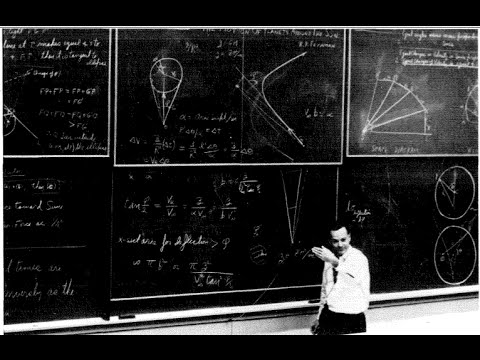
“So the orbits are ellipses: elementary but difficult.”Caltech freshman physics lecture, 1964 · 34:19
Simplicity and beauty are clues to law
One of Feynman’s strongest themes is that nature has a remarkable simplicity underneath complexity. A physical law can be mathematically exact and widely applicable at the same time, and that combination gives it beauty. For him, this beauty is not decoration; it is part of what makes a law intelligible and compelling.5
His treatment of planetary motion shows what he means. Starting from motion toward a center is not enough; one must add the specific inverse-square rule, and then the ellipse follows. The elegance lies in how a short statement about force organizes an entire orbit.678
He also likes showing that there can be more than one path to understanding the same law. A fresh proof or unusual point of view is valuable because it reveals the structure more clearly, not because history itself is sacred.9
“So the orbits are ellipses: elementary but difficult.”Caltech freshman physics lecture, 1964 · full transcript →
A real law earns its keep by predicting what comes next
For Feynman, a physical law is valuable because it does more than fit known facts. It should let us calculate what will happen under new conditions and sometimes reveal things not yet noticed. That predictive reach is part of the true understanding of nature.
This is why he has little patience for explanations that merely sound reasonable after the fact. A story about why nature ought to behave a certain way is weak if it cannot say what should happen next. Physics learned to give up that kind of philosophical comfort because it does not add predictive power.
He applies the same standard broadly. Whether the subject is gravitation or quantum electrodynamics, the point is to have a framework that works, calculates, and survives contact with experiment. That is what makes a theory one of physics’ proudest achievements.12
Experiment is the judge, and honesty is part of the method
Feynman’s view of law is inseparable from intellectual honesty. You do not protect a theory by oversimplifying it, pretending certainty, or telling a prettier story than nature allows. The first duty is not to fool yourself, because self-deception is the easiest route away from truth.13
That honesty includes living with degrees of certainty. He does not present physical law as final possession but as the best account available, held with confidence where it works and with doubt where it does not. This makes science stronger, not weaker, because it keeps inquiry open to correction.14
So the test of a law is not its age, authority, or the historical route by which it was discovered. What matters is whether experiment bears it out. Curiosity drives the search, but disciplined checking decides what survives.13
Physical law can be strange without becoming meaningless
Feynman insists that modern laws do not have to match everyday intuition to be true. Quantum theory is his central example: it is extraordinarily successful, yet it forces us to calculate in ways that do not resemble common-sense pictures. The right response is not to fake simplicity but to learn the new rules honestly.1215
That same attitude appears when he discusses relativity and antiparticles. Once different successful principles are combined, surprising consequences can become unavoidable. The job of physics is then to understand why such consequences must follow, not to reject them because they feel odd.1718
This preserves a key continuity in his thought: modern science is still in the same adventure of discovery as earlier science. The laws may become more abstract, but the pattern remains the same—guess structure, test consequences, and accept nature’s answer even when it is strange.

“…why there must be antiparticles if you try to put quantum mechanics with relativity.”Dirac Memorial Lecture, Cambridge, 1986 · full transcript →
Knowing the law deepens wonder rather than replacing it
Feynman does not think explanation drains beauty from the world. On the contrary, learning the law behind a phenomenon enlarges the sense of awe because it reveals how much can come from simple rules. The universe becomes more impressive when its order is understood, not less.5
That is why physical law matters beyond professional physics. It trains a person to see nature as intelligible without pretending it is exhausted by our current knowledge. There are always other things worth discovering, and each answer opens further mystery.22
His overall view is therefore double-sided in the best way: confidence that nature follows precise laws, and humility that our understanding is partial. That balance of exactness and wonder is the character of physical law as he presents it.14
Feynman on physical law, in his own words
“…why there must be antiparticles if you try to put quantum mechanics with relativity.”
Where to watch
 Richard Feynman on Physical Law: Simplicity, Symmetry, and Discovery1964 · 360 min · full transcriptBest single overview of how Feynman connects simplicity, beauty, discovery, and prediction in physical law.
 Richard Feynman on the Law of Gravitation: What Physics Explains1964 · 56 min · full transcriptShows his concrete way of introducing physical law through gravitation and the search for order in nature.
 Richard Feynman on Curiosity and the Scientific Method1981 · 26 min · full transcriptBest for his method: curiosity, honesty, uncertainty, and why scientific understanding increases awe.
 Richard Feynman on Planetary Orbits: A Geometric Proof of Ellipses1964 · 78 min · full transcriptDemonstrates how a precise force law leads to a definite orbit, making beauty and rigor visible.
 Richard Feynman on Quantum Electrodynamics: Light, Amplitudes, and Reality1979 · 369 min · full transcriptShows how Feynman extends his view of law into quantum physics, where success outruns common intuition.
 Richard Feynman on Antiparticles: Why They Must Exist1986 · 13 min · full transcriptA compact example of how combining basic principles forces surprising but necessary consequences.
Questions people ask
- What did Richard Feynman mean when he said he would not simplify the truth?
- What did Richard Feynman say about not understanding quantum mechanics?
- What did Richard Feynman say about probability in physics?
- What did Richard Feynman say about whether science needs a complete final answer?
- Why did Richard Feynman say the inverse-square law leads to an ellipse?
- What did Richard Feynman say about philosophical arguments in science?
Sources
Every quote above, word for word from the transcripts. Numbers match the text.
“…nature has a simplicity and therefore a great beauty…”
“All we've used so far is that the force is directed toward the center of the circle, toward the center of the sun. But it could be any force law whatsoever. So this law of equal areas only proves that the force is in the direction of the center. And therefore, no matter what you do, you'll never get the ellipse out of that because it could have been a different curve from a different force law. So we must insert the law inverse square somewhere. And the secret idea is that that's very simple to state. It means that equal change of velocity occur in equal angles. That's the inverse square law.”
“…the purpose of this lecture mainly to demonstrate, that therefore the orbit is an ellipse.”
“So the orbits are ellipses: elementary but difficult.”
“I would prefer—I prefer to give you a demonstration of the ellipse in a completely strange and unique, a different way than you're used to.”
“We have a theory which is called quantum electrodynamics, which is our pride and joy.”
“The first principle of physics is that you must not fool yourself. And you are the easiest person to fool.”
“I have approximate answers and possible beliefs and different degrees of certainty about different things, but I'm not absolutely sure of anything and I don't have to be.”
“I can't help it. Okay? If I'm going to tell you honestly what the world looks like to to the to human beings who have struggled as hard as they can to understand it, I can only tell you what it looks like, and I cannot make it any simple. I'm not going to do this. I'm not gonna simplify it. I'm not gonna fake it. I'm not gonna make... Tell you something like a ball bearing on a spring. It isn't. So I'm gonna tell you what it really is like. And if you don't like it, that's too bad. Okay?”
“…why there must be antiparticles if you try to put quantum mechanics with relativity.”
“I am adding nothing to what is known before; it's only exposition.”
“…there are some other things of interest in the world…”
How this guide was made: drafted with AI from the full transcripts of the recordings cited, then checked: every quotation must match a transcript word for word and be the speaker's own words, and an independent review gates accuracy. Methodology and corrections.