Richard Feynman on Teaching
Feynman treats teaching as helping people see how nature works for themselves, not drilling them in names, formulas, or fake pictures.
- Teaching should aim at understanding, not just vocabulary or formulas.
- Good teaching trains imagination so students can picture realities that are not obvious to the senses.
- A teacher should not fake explanations just to make things feel easy.
- Students should learn to test ideas, question authority, and judge by experiment.
- Real science teaching also includes intellectual honesty: do not fool yourself or hide what does not fit.

“I finally figured out a way to test whether you have taught an idea or you have only taught a definition. Test it this way: you say without using the new word which you have just learned, try to rephrase what you have just learned in your own language without using the word energy. Tell me what you know now about the dog's motion. You cannot. So you learn nothing about science. That may be all right; you may not want to learn something about science right away. You have to learn definitions, but for the very first lesson—is that not possibly destructive? I think for lesson number one, to learn a mystic formula for answering questions is very bad.”National Science Teachers Association convention, New York, 1966 · 16:05
Teaching fails when it substitutes names for understanding
Feynman draws a sharp line between knowing a word and understanding a thing. For him, a student has not learned much if they can repeat the official term but cannot describe what is happening in their own language.123
That is why he objects to early lessons that hand students a formulaic answer before they have any feel for the phenomenon. Definitions have a place, but when they come first and stand in for explanation, they train students to recite instead of think.23
He also wants learners to see that science is not received from authority. Understanding grows from asking how anyone found something out and whether the conclusion is justified by experiment.45
“I finally figured out a way to test whether you have taught an idea or you have only taught a definition. Test it this way: you say without using the new word which you have just learned, try to rephrase what you have just learned in your own language without using the word energy. Tell me what you know now about the dog's motion. You cannot. So you learn nothing about science. That may be all right; you may not want to learn something about science right away. You have to learn definitions, but for the very first lesson—is that not possibly destructive? I think for lesson number one, to learn a mystic formula for answering questions is very bad.”National Science Teachers Association convention, New York, 1966 · full transcript →
A great teacher helps students imagine what cannot be directly seen
Feynman thinks science is difficult partly because reality is stranger than ordinary experience suggests. To understand heat, atoms, or electricity, students have to imagine processes that are invisible and often unlike anything at human scale.6789
So teaching should make hidden reality vivid. His own style is to turn abstractions into mental motion: matter as restless movement, nature as active rather than static, and ordinary life as a clue to deeper structure.1011
This kind of imagination is not fantasy. It is disciplined by trying to picture how things really are, even when the result feels unfamiliar or difficult.1213
Do not fake clarity with bad analogies
Feynman refuses the kind of teaching that offers a familiar picture when the familiar picture is wrong. If an explanation works only by sneaking in a false image, it may comfort the learner for a moment but it leaves them with a misunderstanding.1415
He is especially firm about not pretending that strange physical behavior is really just ordinary machinery underneath. Some parts of nature resist our everyday intuitions, and honest teaching has to admit that.161718
That does not mean giving up on explanation. It means being exact about the difference between what we can calculate, what we can say, and what we can genuinely picture. A teacher should prefer truthful difficulty to easy distortion.1419
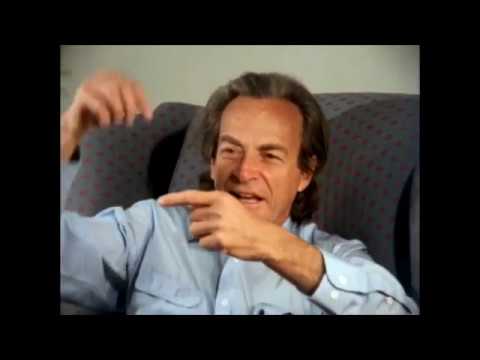
“I can't explain that attraction in terms of anything else that's familiar to you. For example, if we say the magnets attract like as if they were connected by rubber bands, I would be cheating you because they're not connected by rubber bands. I shouldn't be in trouble. You'd soon ask me about the nature of the bands. And secondly, if we were curious enough, you'd ask me why rubber bands tend to pull back together again and I would end up explaining that in terms of electrical forces, which are the very things that I'm trying to use the rubber bands to explain. So I have cheated very badly, you see. So I'm not going to be able to give you an answer to why magnets attract each other except to tell you that they do.”BBC documentary, 1983 · full transcript →
Teaching should train fresh ways of looking
For Feynman, one of the deepest habits in science is learning to look again from a new point of view. Teaching is not only passing on conclusions; it is helping students break the spell of the obvious and notice assumptions they did not know they were making.2021
This is why curiosity matters so much in his picture of learning. The student should be led to ask what is really going on, what would count as a better explanation, and what changes when you pose the question differently.2213
He also suggests that real conversation becomes possible when someone has pushed to the edge of a subject and met its mysteries directly. Good teaching points toward that edge instead of pretending everything important is already settled and simple.23
The moral core of teaching science is honesty
Feynman thinks science education should explicitly cultivate a habit many courses leave implicit: do not fool yourself. A student should learn that attractive ideas, elegant stories, and desired outcomes are not enough.2425
That honesty has practical consequences. When testing an idea, you do not hide the awkward results, publish only the favorable cases, or frame the evidence so your preferred answer wins by presentation.2627
This outlook also changes the classroom tone. Uncertainty is not a defect to conceal but part of serious thinking, and a teacher can model confidence without pretending to be absolutely sure.2829
Feynman on teaching, in his own words
“I finally figured out a way to test whether you have taught an idea or you have only taught a definition. Test it this way: you say without using the new word which you have just learned, try to rephrase what you have just learned in your own language without using the word energy. Tell me what you know now about the dog's motion. You cannot. So you learn nothing about science. That may be all right; you may not want to learn something about science right away. You have to learn definitions, but for the very first lesson—is that not possibly destructive? I think for lesson number one, to learn a mystic formula for answering questions is very bad.”
“I can't help it. Okay? If I'm going to tell you honestly what the world looks like to to the to human beings who have struggled as hard as they can to understand it, I can only tell you what it looks like, and I cannot make it any simple. I'm not going to do this. I'm not gonna simplify it. I'm not gonna fake it. I'm not gonna make... Tell you something like a ball bearing on a spring. It isn't. So I'm gonna tell you what it really is like. And if you don't like it, that's too bad. Okay?”
“I can't explain that attraction in terms of anything else that's familiar to you. For example, if we say the magnets attract like as if they were connected by rubber bands, I would be cheating you because they're not connected by rubber bands. I shouldn't be in trouble. You'd soon ask me about the nature of the bands. And secondly, if we were curious enough, you'd ask me why rubber bands tend to pull back together again and I would end up explaining that in terms of electrical forces, which are the very things that I'm trying to use the rubber bands to explain. So I have cheated very badly, you see. So I'm not going to be able to give you an answer to why magnets attract each other except to tell you that they do.”
Where to watch
 Richard Feynman on What Is Science: Why Names Aren’t Understanding1966 · 32 min · full transcriptBest single statement of his view that teaching science should build understanding rather than mere vocabulary.
 Richard Feynman on Imagining Atomic Reality: why things are really as they are1983 · 67 min · full transcriptShows how he teaches by making invisible physical reality imaginable through concrete examples.
 Richard Feynman on Scientific Integrity: How Not to Fool Yourself1975 · 21 min · full transcriptExplains the ethical side of teaching science: honesty, self-skepticism, and reporting what does not fit.
 Richard Feynman on Perspective in Science: Look From Another Point of View45 min · full transcriptUseful for seeing how perspective shifts and fresh questions help students think instead of repeat.
 Richard Feynman on Curiosity and the Scientific Method1981 · 26 min · full transcriptCaptures his sense that curiosity and wonder are not extras but central to learning science well.
 Richard Feynman on Quantum Electrodynamics: Light, Amplitudes, and Reality1979 · 369 min · full transcriptShows his refusal to oversimplify hard subjects and his effort to teach difficult ideas without faking them.
Questions people ask
- What did Richard Feynman mean when he said he would not simplify the truth?
- What did Richard Feynman say about fooling yourself in science?
- What did Richard Feynman say about names and real understanding?
- What did Richard Feynman say about not understanding quantum mechanics?
- What did Richard Feynman say about teaching science with definitions like energy?
- What did Richard Feynman say science really is?
Sources
Every quote above, word for word from the transcripts. Numbers match the text.
“The name doesn't tell me anything about the bird.”
“There is a difference between the name of the thing and what goes on. The result of this is that I cannot remember anybody's name, and when people discuss physics with me, they often are exasperated when they say the FitzCronin effect and I ask, "What is the effect?" and I can't remember the name. I would like to say a word or two. May I interrupt my little tale about words and definitions because it is necessary to learn the words? It is not science that—doesn't mean just because it is not science that we don't have to teach the words. We are not talking about what to teach. We are talking about what science is.”
“I finally figured out a way to test whether you have taught an idea or you have only taught a definition. Test it this way: you say without using the new word which you have just learned, try to rephrase what you have just learned in your own language without using the word energy. Tell me what you know now about the dog's motion. You cannot. So you learn nothing about science. That may be all right; you may not want to learn something about science right away. You have to learn definitions, but for the very first lesson—is that not possibly destructive? I think for lesson number one, to learn a mystic formula for answering questions is very bad.”
“…science is the belief in the ignorance of experts.”
“As a matter of fact, I can also define science another way: science is the belief in the ignorance of experts. When someone says science teaches such and such, he is using the word incorrectly. Science doesn't teach anything; experience teaches it. If they say to you, "Science has shown such and such," you might ask, "How does science show it? How did the scientists find out how, what, where?" It should not be "Science has shown," but "This experiment, this effect has shown." And you have as much right as anyone else upon hearing about the experiments, but be patient and listen to all the evidence to judge whether a sensible conclusion has been arrived at.”
“It's very hard to imagine all the crazy things that things really are like.”
“Nothing's really as it seems.”
“It's interesting that some people find science, so easy and others find it kind of dull and difficult, especially kids. You know? Some of them are just eat it up. And I don't know why it is. It's the same perhaps for all subjects. For instance, lots of people love music and I never could carry a tune. And it's... I lose a great deal of pleasure out of that. And I think people lose a lot of pleasure who find the science dull. In the case of science, I think that one of the things that make it very difficult is it takes a lot of imagination. It's very hard to imagine all the crazy things that things really are like. Nothing's really as it seems. We're used to get, you know, hot and cold and all that hot and cold is is the speeds that the atoms are jiggling.”
“So again, it turns out it's hard to understand and you do have to do a lot of imagining that the real world has its as its base, A force which acts at a long distance that we haven't got much experience with that force. We have peculiar phenomena here and there, but ordinarily, we don't have much experience with that force is simply because that's what requires explanation. That's what requires imagination. The long distance force, we have no other picture for. And then the example of the generator, what happens is that the electrons which are part of an atom, you have to... They're pushed by the motion of the copper wires. And it's it's wonderful to think that you push a few here and they get too close together so they push the others because they repel at a long distance.”
“The world is a dynamic mess of jiggling things if you look at it right.”
“Science knowledge only adds to the excitement and mystery, the awe of a flower.”
“I think we should just have fun imagining it, not worry about...”
“Find out not how nature could be, but how nature is. See, how what's right? Don't find it. You see, I don't think you ever find it a C. See, and your idea is to find out what nature could be—different possibilities. What I think is interesting. Yeah, even if it's wrong, common ground is enthusiastically explored. But is it only shared experience and knowledge that forms a bond between working scientists and separates them from us, the interested layman or even the artist? I mean, scientific fields are…”
“I can't help it. Okay? If I'm going to tell you honestly what the world looks like to to the to human beings who have struggled as hard as they can to understand it, I can only tell you what it looks like, and I cannot make it any simple. I'm not going to do this. I'm not gonna simplify it. I'm not gonna fake it. I'm not gonna make... Tell you something like a ball bearing on a spring. It isn't. So I'm gonna tell you what it really is like. And if you don't like it, that's too bad. Okay?”
“I can't explain that attraction in terms of anything else that's familiar to you. For example, if we say the magnets attract like as if they were connected by rubber bands, I would be cheating you because they're not connected by rubber bands. I shouldn't be in trouble. You'd soon ask me about the nature of the bands. And secondly, if we were curious enough, you'd ask me why rubber bands tend to pull back together again and I would end up explaining that in terms of electrical forces, which are the very things that I'm trying to use the rubber bands to explain. So I have cheated very badly, you see. So I'm not going to be able to give you an answer to why magnets attract each other except to tell you that they do.”
“As the generations develop, will they invent ways of teaching and where... So that the new people will learn the tricky ways of looking at things and be so trained, so well trained that they won't have our troubles with the atom picturing. There's still a school of thought that cannot believe that the atomic behavior is so different than large scale behavior. I think that's a deep prejudice. It's a prejudice from being so used to large scale behavior. And they're always seeking to find... To waiting for the day that we discover that underneath the quantum mechanics, there's some mundane ordinary balls hitting or particles moving inside. I think they're gonna be defeated. I think nature's imagination is so much greater than man's.”
“Then there would be some kind of difficulty in understanding and imagining reality. And that difficulty we are in. The behavior of things on a small scale is so fantastic. It's so wonderfully different, so marvelously different than anything that behaves on a large scale. You say, electrons act like waves. No. They don't exactly. They act like particles. No. They don't exactly. They act like a kind of a fog around the nucleus. No. They don't exactly. And if you would like to get a clear, sharp picture of an atom so that you can tell exactly how it's going to behave correctly. I have a good image, in other words, a really good image of reality. I don't know how to do it because that image has to be mathematical. We have a mathematical expression, strange as mathematics.”
“But if you ask more specific questions and you get down to questions like, how is it that when you cool helium down even to absolute zero where there's not supposed to be any motion, It's a perfect fluid that has many viscosity, has no resistance, flows perfectly, and isn't freezing. Well, if you want to get a picture of atoms that has all of that in it, I can't do it, you see. But I can explain why the helium bays as it does by taking my equations and sowing the consequences of them is that the helium will behave as it is observed to behave. We know we have the theory right, but we haven't got the pictures that will go with the theory.”
“I could tell you that the magnetic forces are related to the electrical forces very intimately. That our relationship between the gravity forces and electrical forces remains unknown and so on. But I really can't do a good job, any job of explaining magnetic force in terms of something else that you're more familiar with because I don't understand it in terms of anything else that you're more familiar with.”
“What I'm trying to argue for is to think about things from a new point of view.”
“There's a way of looking at something new as if you never saw it before for the first time.”
“A thing like the history of the idea is an accident of how turn the history around to try to get a new way of looking at it doesn't make any difference. I, I don't care. The only thing that the real test in physics experiment and history is fundamentally irrelevant. The most enduring legacy from his father was not just learning to question the physical world but an enthusiasm for the inquiry, which at 54 Street ill shares today. It has to do with curiosity. It has to do with people wondering what makes something do something, and then to discover that if you try to get answers.”
“If you give me the right man in any field, I can talk to him. I know what the condition is—that he did whatever he did as far as he can go, that he studied every aspect of it as far as he has stretched himself to the end. He's not had a dilettante in any way and so he talked deep as far as he can go, and he therefore he's up against mysteries all the way around the edge and that's what we have in common.”
“The first principle is that you must not fool yourself and you are the easiest person to fool.”
“Now it behooves me, of course, to tell you what they're missing, but it would be just about as difficult to explain to the South Sea Islanders how they have to arrange things so that they get some wealth in their system. It is not something simple like telling them how to improve the shapes of the earphones, But there is one feature I noticed that is generally missing in cargo cult science. That is the idea that we all hope you have learned in studying science in school. We never explicitly say what this is, but just hope that you catch on by all the examples of scientific investigation. It is interesting, therefore, to bring it out now and speak of it explicitly. It's a kind of scientific integrity, a principle of scientific thoughts that corresponds to a kind of utter honesty, a kind of leaning over backwards. For example, if you're doing an experiment, you should report everything that you think might make it invalid.”
“It's a kind of scientific integrity, a principle of scientific thoughts that corresponds to a kind of utter honesty, a kind of leaning over backwards.”
“One example of the principle is this, If you've made up your mind to test a theory or you want to explain some idea, you should always decide to publish it whichever way it comes out. If we only publish results of a certain kind, we can make the argument look good. We must publish both kinds of result. For example, let's take advertising again. Suppose some particular cigarette has some particular property like low nicotine. It's published widely by the company that this means it is good for you. They don't say, for instance, that the tars are a different proportion or that something else is the matter with the cigarette. In other words, publication probability depends upon the answer.”
“I have approximate answers and possible beliefs and different degrees of certainty about different things, but I'm not absolutely sure of anything and I don't have to be.”
“The first principle of physics is that you must not fool yourself. And you are the easiest person to fool.”
How this guide was made: drafted with AI from the full transcripts of the recordings cited, then checked: every quotation must match a transcript word for word and be the speaker's own words, and an independent review gates accuracy. Methodology and corrections.