Richard Feynman on Physics
For Feynman, physics is the imaginative and disciplined search for the simple patterns that nature actually obeys, tested always against experiment.
- Physics looks for hidden patterns beneath the world’s surface complexity.
- You understand nature by imagining realities you cannot directly see, like atoms, fields, and quarks.
- Good physical laws are simple, beautiful, and powerful enough to predict new facts.
- Physics requires honesty: do not force comforting pictures where none exist, and let experiment decide.
- The aim is not final certainty but steadily better understanding with measured doubt.

Physics is the search for nature’s underlying order
Feynman treats physics as a way of finding the regular patterns behind the apparent confusion of the world. He sees physical law not as a list of isolated facts, but as the deep structure that connects many phenomena at once. That is why he describes physics in terms of hidden order and even as the grammar of the universe.12
What attracts him is that nature’s order is both simple and beautiful when you finally see it clearly. Gravitation is a central example: one law reaches from falling bodies on Earth out across the universe, thinning gradually but following a precise rule. Physics matters because it discovers these broad rules rather than stopping at surface appearances.34
“…that's the fundamental level if you will…”Messenger lecture, 1964 · full transcript →
Real understanding begins when you imagine what the world is actually like
Feynman thinks many people struggle with physics because it demands imagination, not just memory. The world we meet in ordinary life is not the world as physics reveals it: beneath familiar appearances is a restless atomic world of motion, collision, and interaction. To understand heat, matter, electricity, or light, you have to picture processes you cannot directly see.567
This is why he keeps pushing past labels toward mechanism. It is not enough to say something is hot or solid; physics asks what the atoms are doing. Even in particle physics, where direct vision is impossible, the task is still to imagine what is there from the clues left behind.79
At the same time, he is careful about the limits of pictures. In the quantum world, ordinary images borrowed from everyday objects can mislead, because small-scale behavior is unlike large-scale behavior. Physics still explains successfully, but sometimes through equations and consequences more than through familiar visual analogies.11
A physical law earns its place by explaining and predicting
For Feynman, the greatness of a law is not only that it summarizes known facts, but that it leads to new discoveries. His favorite historical examples show a chain: precise observation makes a pattern visible, analysis expresses it as a law, and then the law reaches beyond the original data. That is the mark of genuine understanding in physics.1
Newton’s treatment of gravitation shows this style of thinking at its best. Starting from observed planetary regularities, physics connects equal areas, inverse-square force, and elliptical orbits into one coherent account. The law is valuable because it ties many facts together with a small number of ideas.1213
The same standard holds in modern theories. Feynman presents quantum electrodynamics with special admiration because it gives a workable, extremely successful account of light and electrons, even though its logic is far from everyday intuition. Physics advances when a theory survives contact with reality and keeps getting the answers right.14
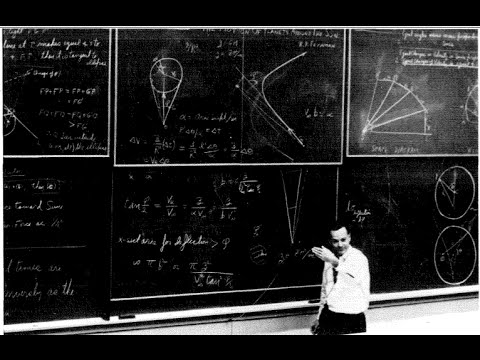
“…the purpose of this lecture mainly to demonstrate, that therefore the orbit is an ellipse.”Caltech freshman physics lecture, 1964 · full transcript →
Physics demands honesty about what you do and do not understand
One of Feynman’s strongest themes is intellectual honesty. You must not fool yourself, and the easiest trap is to replace a hard question with a comforting story. If you cannot explain one force in simpler familiar terms without sneaking the same mystery back in, then pretending otherwise is not understanding.151617
This is why he resists fake simplifications. He would rather admit that nature is strange than force it into pictures of springs, rubber bands, or little balls when those images distort what is going on. In his view, real physics is not about making the world sound comfortable; it is about telling the truth about how it behaves.18
He also rejects purely philosophical talk that does not help predict what happens next. Explanations in physics have to cash out in consequences that can be tested. If an idea adds no predictive power, it is not doing the work physics requires.20

“The first principle of physics is that you must not fool yourself. And you are the easiest person to fool.”BBC Horizon documentary, 1981 · full transcript →
Physics is an open-ended adventure, not a finished system
Feynman does not present physics as a march toward absolute finality. He is comfortable with partial answers, different degrees of confidence, and the possibility that deeper layers of structure remain to be found. What matters is learning more about how nature is put together.222324
Paradoxes and surprises are not failures for him; they are invitations. When a subject contains tensions, odd results, or phenomena that resist old pictures, that is exactly when physics becomes most alive, because something new can be learned.25
This attitude explains why he can move with equal excitement from atoms to gravitation to quantum electrodynamics to quarks and antiparticles. Physics is one continuing inquiry into how nature is, not a search for reassuring completeness. The right stance is curiosity disciplined by experiment and strengthened by a willingness to live with uncertainty.2622

“It's these paradoxes that makes the whole subject very interesting because we're bound to learn something new.”BBC/PBS NOVA documentary, 1993 · full transcript →
Feynman on physics, in his own words
“Physics is the grammar of the universe.”
“The first principle of physics is that you must not fool yourself. And you are the easiest person to fool.”
“…nature has a simplicity and therefore a great beauty…”
“It's these paradoxes that makes the whole subject very interesting because we're bound to learn something new.”
“We have a theory which is called quantum electrodynamics, which is our pride and joy.”
Where to watch
 Richard Feynman on Curiosity and the Scientific Method1981 · 26 min · full transcriptBest short overview of why physics is exciting: curiosity, simple rules, doubt, and wonder all together.
 Richard Feynman on Physical Law: Simplicity, Symmetry, and Discovery1964 · 360 min · full transcriptBest full statement of physics as the discovery of lawful patterns, using gravitation and scientific history.
 Richard Feynman on Imagining Atomic Reality: why things are really as they are1983 · 67 min · full transcriptBest for learning how Feynman turns everyday phenomena into atomic-level physical understanding.
 Richard Feynman on Quantum Electrodynamics: Light, Amplitudes, and Reality1979 · 369 min · full transcriptBest for seeing his view that successful physics can be strange, exact, and still deeply intelligible.
 Richard Feynman on Particle Physics: From Atoms to Quarks42 min · full transcriptBest for his open-ended view of physics as exploring deeper layers of matter without expecting final closure.
Questions people ask
- How does Richard Feynman describe the difference between theoretical physicists and experimenters?
- What did Richard Feynman mean when he said he would not simplify the truth?
- What did Richard Feynman say about whether science needs a complete final answer?
- What did Richard Feynman say about why atoms are hard to picture?
- What did Richard Feynman say about why magnets attract each other?
- What did Richard Feynman say he was interested in finding out?
Sources
Every quote above, word for word from the transcripts. Numbers match the text.
“This is the key of modern science and is the beginning of the true understanding of nature…”
“Physics is the grammar of the universe.”
“…nature has a simplicity and therefore a great beauty…”
“So the Earth's gravitational field never ends but peters out very slowly in a precise and careful law probably to the edges of the universe. The law of gravitation is different than many of the others. It is very important in the economy or in the machinery of the universe. There are many places where gravity has its practical applications as far as the universe is concerned but…”
“It's very hard to imagine all the crazy things that things really are like.”
“Nothing's really as it seems.”
“The world is a dynamic mess of jiggling things if you look at it right.”
“We have to imagine what's there.”
“But if you ask more specific questions and you get down to questions like, how is it that when you cool helium down even to absolute zero where there's not supposed to be any motion, It's a perfect fluid that has many viscosity, has no resistance, flows perfectly, and isn't freezing. Well, if you want to get a picture of atoms that has all of that in it, I can't do it, you see. But I can explain why the helium bays as it does by taking my equations and sowing the consequences of them is that the helium will behave as it is observed to behave. We know we have the theory right, but we haven't got the pictures that will go with the theory.”
“…the purpose of this lecture mainly to demonstrate, that therefore the orbit is an ellipse.”
“All we've used so far is that the force is directed toward the center of the circle, toward the center of the sun. But it could be any force law whatsoever. So this law of equal areas only proves that the force is in the direction of the center. And therefore, no matter what you do, you'll never get the ellipse out of that because it could have been a different curve from a different force law. So we must insert the law inverse square somewhere. And the secret idea is that that's very simple to state. It means that equal change of velocity occur in equal angles. That's the inverse square law.”
“We have a theory which is called quantum electrodynamics, which is our pride and joy.”
“The first principle of physics is that you must not fool yourself. And you are the easiest person to fool.”
“I can't explain that attraction in terms of anything else that's familiar to you. For example, if we say the magnets attract like as if they were connected by rubber bands, I would be cheating you because they're not connected by rubber bands. I shouldn't be in trouble. You'd soon ask me about the nature of the bands. And secondly, if we were curious enough, you'd ask me why rubber bands tend to pull back together again and I would end up explaining that in terms of electrical forces, which are the very things that I'm trying to use the rubber bands to explain. So I have cheated very badly, you see. So I'm not going to be able to give you an answer to why magnets attract each other except to tell you that they do.”
“I could tell you that the magnetic forces are related to the electrical forces very intimately. That our relationship between the gravity forces and electrical forces remains unknown and so on. But I really can't do a good job, any job of explaining magnetic force in terms of something else that you're more familiar with because I don't understand it in terms of anything else that you're more familiar with.”
“I can't help it. Okay? If I'm going to tell you honestly what the world looks like to to the to human beings who have struggled as hard as they can to understand it, I can only tell you what it looks like, and I cannot make it any simple. I'm not going to do this. I'm not gonna simplify it. I'm not gonna fake it. I'm not gonna make... Tell you something like a ball bearing on a spring. It isn't. So I'm gonna tell you what it really is like. And if you don't like it, that's too bad. Okay?”
“In the earliest days of science, we got confused arguing philosophically what was a reasonable reason for nature of hoard or vacuum or it seemed to be nice that gods were doing it. There are different kinds of psychological reasons for thinking it probably is alright after you discovered what it was. These things were never useful for predicting what should happen next, and we soon learned not to make these arguments. It's useless. It doesn't add anything.”
“I have approximate answers and possible beliefs and different degrees of certainty about different things, but I'm not absolutely sure of anything and I don't have to be.”
“The idea is not to find the complete... Necessary to find a complete answer, but to find out more and more information.”
“But the idea is not to find the complete... Necessary to find a complete answer, but to find out more and more information. It's like exploring. If you're exploring a country, the fact that when you went through the country, it may be that on the other side, you come across a river... Ocean that you'd have to pass and you couldn't pass, doesn't mean that it wouldn't be interesting to explore the new country that you discovered. So in the same way, the question as to whether this is a never ending search or that the search will end with the quark is not exactly relevant to our interest in finding out just more about the way matter is constructed.”
“It's these paradoxes that makes the whole subject very interesting because we're bound to learn something new.”
“…why there must be antiparticles if you try to put quantum mechanics with relativity.”
How this guide was made: drafted with AI from the full transcripts of the recordings cited, then checked: every quotation must match a transcript word for word and be the speaker's own words, and an independent review gates accuracy. Methodology and corrections.


