Richard Feynman on Light & Photons
Feynman treats light as a quantum phenomenon best understood not by everyday pictures but by rules for calculating amplitudes, probabilities, reflection, and interference.
- Light comes in discrete photons, especially obvious in counting experiments and detectors.
- You do not predict light by adding probabilities for different routes; you add amplitudes first, then square.
- Reflection and interference happen because a photon can have alternative ways to arrive, and those amplitudes can reinforce or cancel.
- Feynman does not think ordinary visual models capture what a photon really is like. The theory gives correct numbers even when the picture feels strange.
- The right attitude is honesty and imagination: do not force nature into familiar images if experiment requires stranger rules.
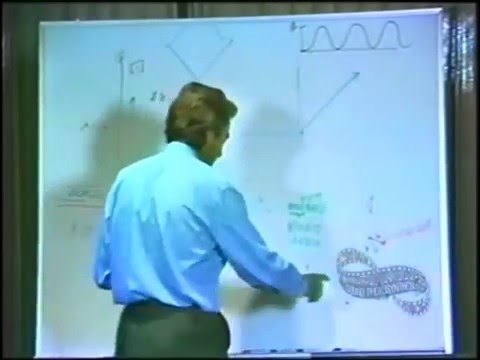
Light is quantum: photons arrive as whole events
Feynman treats light as fundamentally quantum, not just as a smooth classical glow. In experiments where light is weak and counted, what shows up are individual detection events, so the useful unit is the photon. He presents quantum electrodynamics as the theory that handles light and electrons with remarkable success.1
A photon is not a little fraction that partly arrives and partly does not. Each event ends up as a whole detection somewhere, which is why reflection and transmission must be described as chances for complete outcomes. That is the starting point for understanding light without forcing it into a classical picture.34
“…the chance or probability of reflection…”Auckland lectures, 1979 · full transcript →
The central rule is amplitudes first, probabilities second
For Feynman, the key move in quantum physics is to stop calculating directly with ordinary probabilities. Physics asks for the probability of an event, but that probability is obtained from another quantity first: the amplitude. Then the probability comes from the square of that final result.5678
When light can get from one place to another in more than one apparent way, you do not add the separate probabilities. You find an amplitude for each alternative, add those amplitudes, and only then square to get the observable chance. This is the rule behind interference, and Feynman treats it as the essential grammar of quantum behavior.91011
He stresses that this rule is not a story invented for comfort. It is the rule that works, even if it offends common sense trained by large-scale objects. The point is not to make light sound familiar but to calculate correctly what experiments will show.12
Reflection is a probability, and thin films reveal why
A simple mirror or glass surface already shows why ordinary particle stories fail. For Feynman, reflection is described as a chance that a photon is reflected rather than transmitted, not as a partial splitting of a single photon into smaller pieces.34
Thin films make the deeper rule visible. A photon can have alternative ways associated with different reflections, and those amplitudes can combine so that the final probability becomes larger, smaller, or even zero at some thicknesses or locations. That is why putting together two ways can sometimes produce less, not more.911
This is also why straight classical intuitions break down. If you start from the idea that one surface simply reflects a tiny pellet of light, Feynman argues you cannot make sense of how another possible route can cancel that outcome in the observed pattern. The phenomenon forces the amplitude method on you.410
“What I'm trying to say is a very simple idea that looks mathematical is the total that every photon either ends up here or here. Nobody has ever lost, okay? So, if you start out by supposing that the front surface reflects the particle, then you can't figure out how you can get the back surface to catch up with it and make it not do it so that you can get a zero here or at the next point and so on. And that's the most cogent argument. It says it can't be little spots because if it were little spots that would get reflected and you can catch it back. As a matter of fact, it's virtually impossible to explain this from the point of view of particles.”Auckland lectures, 1979 · full transcript →
A photon is not well captured by any ordinary picture
Feynman is blunt that quantum theory does not hand you a satisfying visual model of what a photon really looks like in space. Ask how big a photon is, exactly where it is, or how it is spread out before measurement, and familiar images begin to fail. He thinks disappointment here is inevitable if you demand a classical picture.15
That is not a weakness of the theory so much as a warning about our expectations. The theory gives the right numerical predictions, but it does not translate neatly into everyday imagery like waves in water or little balls in flight. He repeatedly says nature at small scales is more marvelous and different than those categories allow.1615
So his advice is to separate two goals: prediction and picturing. Quantum electrodynamics succeeds as a predictive framework for light, even when no simple mental photograph goes with it.116
Understanding light requires disciplined imagination
Feynman thinks science becomes hard exactly where imagination is required. Light and photons resist ordinary experience, so you must be willing to imagine a world that is not as it seems on human scales. He sees this as a demand for honesty, not mystification.1819
That is why he refuses fake analogies that merely replace one mystery with another. If an explanation borrows a familiar image that cannot actually do the job, it misleads more than it helps. Better to admit strangeness and follow rules that survive experiment.212223
This attitude also explains his emphasis on doubt and self-scrutiny. You must not fool yourself into thinking light has to behave like something already comfortable to you. The reward for that discipline is deeper wonder, not less: understanding light adds to the excitement of the world.2425
Where to watch
 Richard Feynman on Quantum Reality: Why probabilities come from arrows1979 · 119 min · full transcriptBest short route into photons, partial reflection, and why probabilities come from arrows.
 Richard Feynman on Probability and Uncertainty: Quantum Rules1964 · 115 min · full transcriptGives the cleanest statement of the amplitude rule: add amplitudes, then square.
 Richard Feynman on Quantum Electrodynamics: Light, Amplitudes, and Reality1979 · 369 min · full transcriptShows how Feynman places light and photons inside the larger framework of quantum electrodynamics.
 Richard Feynman on Imagining Atomic Reality: why things are really as they are1983 · 67 min · full transcriptHelps you adopt Feynman’s broader habit of imagining reality beyond everyday appearances.
 Richard Feynman on Curiosity and the Scientific Method1981 · 26 min · full transcriptClarifies the mindset behind his approach: curiosity, honesty, and refusal to fake understanding.
Questions people ask
- How did Richard Feynman explain why a particle model fails for thin-film reflection?
- How does Richard Feynman say to calculate amplitudes when there is more than one way something can happen?
- What did Richard Feynman mean when he said he would not simplify the truth?
- What did Richard Feynman say about not understanding quantum mechanics?
- What did Richard Feynman say about why probabilities come from arrows in quantum mechanics?
- Why did Richard Feynman say you can't picture a photon?
Sources
Every quote above, word for word from the transcripts. Numbers match the text.
“We have a theory which is called quantum electrodynamics, which is our pride and joy.”
“…the chance or probability of reflection…”
“What I'm trying to say is a very simple idea that looks mathematical is the total that every photon either ends up here or here. Nobody has ever lost, okay? So, if you start out by supposing that the front surface reflects the particle, then you can't figure out how you can get the back surface to catch up with it and make it not do it so that you can get a zero here or at the next point and so on. And that's the most cogent argument. It says it can't be little spots because if it were little spots that would get reflected and you can catch it back. As a matter of fact, it's virtually impossible to explain this from the point of view of particles.”
“The probability of event is what we're calculating in physics.”
“The probability... The problem of calculating the probability is the same as the problem of calculating the amplitude followed by one minor step…”
“…the square of the length, I mean.”
“The probability of event is what we're calculating in physics. That's the central question. We discovered that there's a framework in which it can be done. It can always be written as the square, what we call an absolute square, which means the square of the length. Absolute square. Well, I never mind saying the absolute. This line is supposed to say that. The square of another quantity, which we call our amplitude. And that's general. These things I'm telling you are general. I've only given you an examples of it. That's the first problem. The next... Therefore, the probability... The problem of calculating the probability is the same as the problem of calculating the amplitude followed by one minor step, which is after you have the final amplitude to find the square of it.”
“…you have to add the amplitudes first and then make the square…”
“Then in the next aspect of the theory, therefore, would be to calculate amplitudes, and I would like to tell you the nature of the rules or the formulas that have been found for computing amplitudes. And there are a number of steps and a number of principles, and they're not very many. We've already got two of them, and there may be four altogether. So we're halfway there. The first... One of the rules is that if a thing appears to be able to happen in more than one way, then we find the amplitude for each way and add. So if there... I summarize that idea in shorthand by saying alternative ways, apparently alternative way, amplitude, total amplitude or final amplitude or whatever, total amplitude, that means the final arrow, is equal to the sum of an amplitude or an arrow that's identical.”
“Either one is something, either one alone, but both is nothing. That works fine for the amplitudes, but to think logically about probabilities, it makes it very difficult, because you usually think if those that would do it, and the greens would do it, and you put them both there, they'll do it even better. So, uh, we can add amplitudes instead of adding probabilities. That is illegal, but adding probabilities is the wrong way. You have to add the amplitudes first and then make the square. Why? I don't know. Nature works that way.”
“I can't help it. Okay? If I'm going to tell you honestly what the world looks like to to the to human beings who have struggled as hard as they can to understand it, I can only tell you what it looks like, and I cannot make it any simple. I'm not going to do this. I'm not gonna simplify it. I'm not gonna fake it. I'm not gonna make... Tell you something like a ball bearing on a spring. It isn't. So I'm gonna tell you what it really is like. And if you don't like it, that's too bad. Okay?”
“Then there would be some kind of difficulty in understanding and imagining reality. And that difficulty we are in. The behavior of things on a small scale is so fantastic. It's so wonderfully different, so marvelously different than anything that behaves on a large scale. You say, electrons act like waves. No. They don't exactly. They act like particles. No. They don't exactly. They act like a kind of a fog around the nucleus. No. They don't exactly. And if you would like to get a clear, sharp picture of an atom so that you can tell exactly how it's going to behave correctly. I have a good image, in other words, a really good image of reality. I don't know how to do it because that image has to be mathematical. We have a mathematical expression, strange as mathematics.”
“It doesn't explain anything. It just gives you numbers…”
“It's very hard to imagine all the crazy things that things really are like.”
“Nothing's really as it seems.”
“I can't explain that attraction in terms of anything else that's familiar to you. For example, if we say the magnets attract like as if they were connected by rubber bands, I would be cheating you because they're not connected by rubber bands. I shouldn't be in trouble. You'd soon ask me about the nature of the bands. And secondly, if we were curious enough, you'd ask me why rubber bands tend to pull back together again and I would end up explaining that in terms of electrical forces, which are the very things that I'm trying to use the rubber bands to explain. So I have cheated very badly, you see. So I'm not going to be able to give you an answer to why magnets attract each other except to tell you that they do.”
“I could tell you that the magnetic forces are related to the electrical forces very intimately. That our relationship between the gravity forces and electrical forces remains unknown and so on. But I really can't do a good job, any job of explaining magnetic force in terms of something else that you're more familiar with because I don't understand it in terms of anything else that you're more familiar with.”
“In the earliest days of science, we got confused arguing philosophically what was a reasonable reason for nature of hoard or vacuum or it seemed to be nice that gods were doing it. There are different kinds of psychological reasons for thinking it probably is alright after you discovered what it was. These things were never useful for predicting what should happen next, and we soon learned not to make these arguments. It's useless. It doesn't add anything.”
“The first principle of physics is that you must not fool yourself. And you are the easiest person to fool.”
“Science knowledge only adds to the excitement and mystery, the awe of a flower.”
How this guide was made: drafted with AI from the full transcripts of the recordings cited, then checked: every quotation must match a transcript word for word and be the speaker's own words, and an independent review gates accuracy. Methodology and corrections.
