How did Richard Feynman explain why a particle model fails for thin-film reflection?
Feynman says a simple particle model cannot explain why a thin glass layer can make reflection disappear at some thicknesses and reappear at others. If photons were just little balls bouncing off surfaces, you could not get the later surface to “undo” the first reflection. The repeated rise and fall of reflection is what forces the interference picture instead.
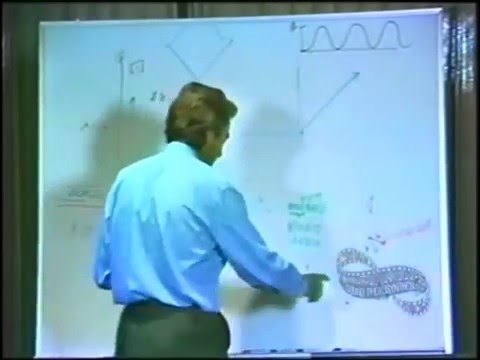
“What I'm trying to say is a very simple idea that looks mathematical is the total that every photon either ends up here or here. Nobody has ever lost, okay? So, if you start out by supposing that the front surface reflects the particle, then you can't figure out how you can get the back surface to catch up with it and make it not do it so that you can get a zero here or at the next point and so on. And that's the most cogent argument. It says it can't be little spots because if it were little spots that would get reflected and you can catch it back. As a matter of fact, it's virtually impossible to explain this from the point of view of particles.”
Key takeaways
- Check whether a model can explain all outcomes, not just one.
- Interference can cancel probabilities even when particles seem to choose one path.
- A good theory must account for repeating patterns, not just isolated cases.
Context
Feynman is concluding his glass-and-light example in an Auckland lecture on how quantum mechanics works. The quote above is taken word for word from the recording's transcript.
In the transcript
…other photo multiplier here and the one up here, this one is always getting the ones that don't go here. In other words, when this—if you'd ask how many come here and made a plot of that, you'll have a hundred percent of them with that thickness, and then at this thickness it would be down to 90, 84. And then we go up to 100 and down to 84.
What I'm trying to say is a very simple idea that looks mathematical is the total that every photon either ends up here or here. Nobody has ever lost, okay? So, if you start out by supposing that the front surface reflects the particle, then you can't figure out how you can get the back surface to catch up with it and make it not do it so that you can get a zero here or at the next point and so on. And that's the most cogent argument. It says it can't be little spots because if it were little spots that would get reflected and you can catch it back. As a matter of fact, it's virtually impossible to explain this from the point of view of particles.
—was insane. I mean, he had a very complicated theory for this. He said the following: since the reflection strength depends upon where the back surface is, as you see, it must be reflected from the back surface. But since the amount of reflection depends upon where the front surface is, the degree to which the back surface reflects must depend on where the front surface was. So, he proposed…
Topics
More questions about Richard Feynman
- Why did Richard Feynman say you can't picture a photon?
- What did Richard Feynman say about why probabilities come from arrows in quantum mechanics?
- What did Richard Feynman say about why atoms are hard to picture?
- What did Richard Feynman say about why helium behaves so strangely at absolute zero?
- What did Richard Feynman say about waves in quantum mechanics?
- What did Richard Feynman say about probability in physics?
All Richard Feynman answers · All Richard Feynman recordings
How this answer was made: the quote is checked word for word against the transcript of the recording and confirmed as the speaker's own words; the summary above it was drafted with AI from that transcript and quality-checked. Methodology and corrections.