Why did Richard Feynman say you can't picture a photon?
Feynman says you cannot reliably picture what a photon looks like, where it is, or how big it is. Different experiments force different descriptions, so any single model will eventually fail. Instead, physics gives rules for calculating what will happen and the chance of each outcome.
“As you've already learned from the previous discussion, we're going to have a lot of trouble in picturing anything that we haven't directly measured. If we try to say how big a photon is or how it's spread out or what it looks like, we're going to get into some difficulty, because with some experiment it isn't going to behave that way you'd expect. So you're going to be very disappointed, because it's going to be impossible for me to tell you how big a photon is, where it is, and so forth. Nevertheless, depending on your point of view, I'll tell you a series of crazy rules by which you can tell exactly what will happen in any experiment with photons—what's the chance that the photomultiplier will go off in this situation, in that situation—without ever having been able to say.”
Key takeaways
- Don’t over-trust mental pictures of unseen things.
- A model can work in one experiment and fail in another.
- Focus on predicting outcomes, not inventing a visual story.
Context
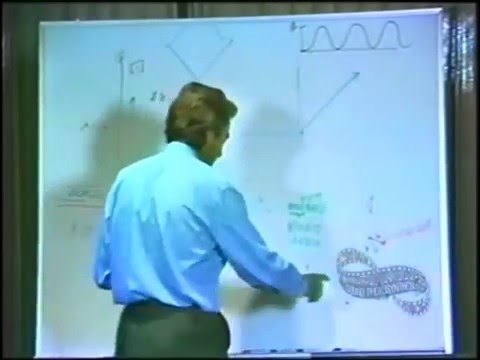
Feynman is explaining in 1979 why quantum theory describes photons through probabilities rather than a fixed image. The quote above is taken word for word from the recording's transcript.
In the transcript
…thicknesses varies by using particles. And yet when you measured it, it was particles, and that makes a problem which I want to describe now. Yes, would it be possible to describe photon—what in physical space what it would like? Specifically, I said no. All we know is we get a click and count where it is or what it looks like. We have to decide on the properties. Okay?
As you've already learned from the previous discussion, we're going to have a lot of trouble in picturing anything that we haven't directly measured. If we try to say how big a photon is or how it's spread out or what it looks like, we're going to get into some difficulty, because with some experiment it isn't going to behave that way you'd expect. So you're going to be very disappointed, because it's going to be impossible for me to tell you how big a photon is, where it is, and so forth. Nevertheless, depending on your point of view, I'll tell you a series of crazy rules by which you can tell exactly what will happen in any experiment with photons—what's the chance that the photomultiplier will go off in this situation, in that situation—without ever having been able to say.
what the photon looks like in a certain sense. Okay? In the sense of some sort of model of waves in space, that's just a reflection in another level of the same difficulty that we had with the boxes that we were talking about three, last three days, that there just isn't any way to say, "Well, what is behind those buttons? What is it that makes the buttons make…
Topics
More questions about Richard Feynman
- How did Richard Feynman explain why a particle model fails for thin-film reflection?
- What did Richard Feynman say about why probabilities come from arrows in quantum mechanics?
- What did Richard Feynman say about why atoms are hard to picture?
- What did Richard Feynman say about why helium behaves so strangely at absolute zero?
- What did Richard Feynman say about waves in quantum mechanics?
- What did Richard Feynman say about probability in physics?
All Richard Feynman answers · All Richard Feynman recordings
How this answer was made: the quote is checked word for word against the transcript of the recording and confirmed as the speaker's own words; the summary above it was drafted with AI from that transcript and quality-checked. Methodology and corrections.