Peter Thiel on Startups
Peter Thiel thinks the best startups create something genuinely new, begin in a small market they can dominate, and grow by escaping competition through strong distribution, network effects, and mission.
- A startup should be one of a kind, not a copycat.
- Great companies escape competition and aim for monopoly economics.
- Start with a small market you can dominate, then expand outward.
- Distribution matters as much as invention; products must reach users and build network effects.
- Founders win by thinking contrarily, finding secrets, and pursuing a clear mission.

“One of the critical things in starting businesses is this need to do something new, different, fresh, strange.”The James Altucher Show, 2014 · 2:22
A startup matters when it does something new
Thiel’s starting point is that strong startups are not built by following a standard recipe. He treats each great company as singular and argues that founders should build something genuinely new rather than reproduce what already exists123.
That is why he is dismissive of crowded categories and obvious copycat ideas. If you are launching the hundredth version of an existing business, you are probably entering a game where differentiation is weak from the start4.
For him, the practical question is not just whether a product is useful, but whether it creates new value in a way others have not. A startup should both create value for other people and keep enough of that value to become a durable business5.
“One of the critical things in starting businesses is this need to do something new, different, fresh, strange.”The James Altucher Show, 2014 · full transcript →
Competition is a trap; the goal is to escape it
Thiel’s most famous startup idea is that founders should not romanticize competition. He argues that business success comes from getting away from direct rivalry, because intense competition pushes companies toward sameness and weak profits678.
In his view, the best startup is not slightly better than many substitutes. It is so differentiated that it becomes its own category, a company of one rather than one more company in a crowded field9.
This is also why he separates capitalism from competition. A startup creates real economic value when it can build something distinctive enough to earn lasting profits instead of being forced into commodity pricing by rivals81112.
Start small so you can dominate a market
Even if the end goal is a very large business, Thiel thinks startups should begin by owning a small market. Since every startup begins small, the realistic way to build a monopoly is to find a narrow niche where you can become the clear leader13.
His examples follow the same pattern: Facebook began with Harvard, PayPal with eBay power sellers, and Amazon with books. The point is not to think small forever, but to establish control in one place and then expand in concentric circles13.
This view pushes founders away from huge top-down market slides and toward sharper strategy. Instead of claiming access to an enormous market on day one, identify the smallest market where your product is overwhelmingly better and can spread from there139.
Distribution and network effects are as important as the idea
Thiel is unusually direct that invention alone is not enough. For consumer internet companies especially, the crucial question is how a product gets out into the world, because a great idea with weak distribution often goes nowhere14.
His PayPal example shows how this works in practice. Tying money to email created a viral path for adoption, while the company also had to manage the tension between ease of use and fraud prevention as it scaled14.
He also points to Facebook as a startup that solved a specific problem in a way that mattered early: real identity online. Once a startup finds an initial market and a product people really want, network effects can strengthen the business and make expansion much more powerful1513.
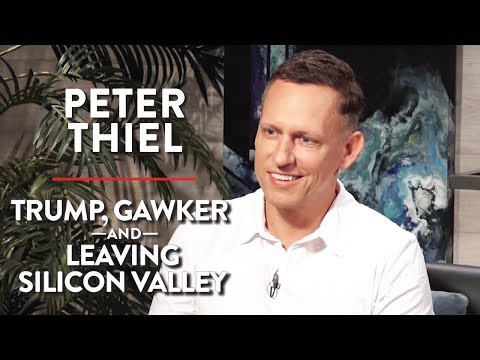
“The critical question for any consumer internet product is always not what the idea is but how do you get it out…”Rubin Report interview, 2017 · full transcript →
Founders need contrarian conviction and a mission
Thiel thinks startup formation begins with independent thinking. The key questions are what great company nobody is starting and what true belief you hold that few others share, because breakthrough companies usually come from insights the crowd misses1617.
This is hard because imitation is socially easier than originality. He warns that conformity often hides behind the language of openness or diversity, while real progress requires people who are willing to think differently rather than merely look different1819.
He also sees startups as mission-driven institutions, not just vehicles for quick optimization. Founders should pursue important problems, believe there are still secrets left to uncover, and build around a strong purpose that helps a team do hard things over time202116.
The biggest opportunities may be where progress has stalled
Thiel repeatedly contrasts rapid progress in software with slower progress in the physical world. He thinks there has been much more innovation in computers and the internet than in transportation, energy, health care, and other parts of everyday life2223.
For startup founders, that means some of the most important opportunities may lie outside pure software, especially where bits can reconnect with atoms. He sees economic growth as tied more to technology than to globalization, so startups matter most when they advance real capabilities2526.
He also links innovation to founder leadership. Companies led by founders are, in his view, better able to sustain the original period of invention that makes a startup valuable in the first place2829.
Thiel on startups, in his own words
“One of the critical things in starting businesses is this need to do something new, different, fresh, strange.”
“The critical question for any consumer internet product is always not what the idea is but how do you get it out…”
“…there are many great secrets left to be unlocked…”
Where to watch
 Peter Thiel on Zero to One: Why Startups Must Be Different2014 · 77 min · full transcriptBest single overview of his startup playbook: uniqueness, monopoly, small markets, and network effects.
 Peter Thiel on Contrarian Thinking: Why the Tracks Stop Working2017 · 131 min · full transcriptBest for practical lessons on distribution, network effects, PayPal, and Facebook.
 Peter Thiel on Zero to One: Why Progress Means Doing New Things2014 · 18 min · full transcriptBest for the core Zero to One framework: singular companies, secrets, and contrarian thinking.
 Peter Thiel on Contrarian Innovation: Why Crowds Miss Big Ideas2015 · 60 min · full transcriptBest for how founders should think: unpopular truths, mission, and courage against conformity.
 Peter Thiel on Monopoly and Competition: Why Great Businesses Avoid Rivalry2014 · 23 min · full transcriptBest short explanation of why great businesses avoid competition and seek monopoly.
 Peter Thiel on Technological Stagnation: Bits, Not Stuff2019 · 73 min · full transcriptBest for where he thinks the next startup opportunities may be: beyond software, into the world of stuff.
Questions people ask
- How did Peter Thiel decide to invest in Facebook?
- What did Peter Thiel say about starting a startup with a small market?
- What did Peter Thiel say founders should aim for?
- What does Peter Thiel think business is really about?
- Why does Peter Thiel say selling a company can stop innovation?
- What did Peter Thiel mean by secrets?
Sources
Every quote above, word for word from the transcripts. Numbers match the text.
“…every great company is one of a kind…”
“You want to aim to build a company that is one-of-a-kind…”
“One of the critical things in starting businesses is this need to do something new, different, fresh, strange.”
“You do not want to start the one hundredth online pet food company or the five thousandth restaurant in San Francisco.”
“The key thing when you start a new technology business is to create something that has value to other people and then to capture some fraction of the value you create.”
“…most people think that business is about competition, whereas I think business is about getting away from competition.”
“…successful businesses are monopolies of one sort or another.”
“I believe that capitalism and competition are antonyms.”
“I think that, um, all, if you're a founder or entrepreneur, what you want to aim for is monopoly. You want to aim to build a company that is one-of-a-kind, uh, and that it's so far, um, differentiated from the competition that it's not even competing.”
“…capitalism and competition are synonyms, I think they are antonyms…”
“Uh, and I think the opposite is true of business. I think all happy companies are different because they came up—they figured out some way to radically differentiate themselves and escape from competition. All unhappy companies are alike because they fail to escape the essential sameness that is competition. Uh, the chapter in my book entitled "All Happy Companies Are Different" got excerpted by The Wall Street Journal, and they retitled it, um, a little bit more provocatively, with a title, uh, "Competition Is for Losers.”
“And so again, was the great a good if you're trying to create a monopoly, you can define a monopoly as having a large market share. And so how do you get a large market share as a start up? Because every start up necessarily starts very small. The answer is that you have to start with a small market. Facebook started with Harvard. PayPal started with eBay power sellers. These are themselves quite small markets. Amazon started with books, so not that big a market either. And you sort of and then you can then ideally, can build the market out in concentric circles. When I see a PowerPoint presentation in a pitch where it starts with, this is a market that's measured in hundreds of billions or trillions of dollars, that's very bad because it means you will never get to a large share of the market.”
“The critical question for any consumer internet product is always not what the idea is but how do you get it out…”
“It turns out people aren't, weren't really interested in that. They weren't really interested in sense of a fictional, an online persona. It was much more about real identity. And somehow Facebook was the first one to crack the problem of real identity where, you know, even those always a little bit curated, certainly for the most part, people on Facebook are who they say they are. Yeah. For the most part at least. So am I mistaken, you're the only person who's been on the board of Facebook the entire way out except for Mark, right?”
“What great company is nobody starting?”
“…tell me something that's true that nobody agrees with you on.”
“Think Different. That's the Silicon Valley 2018: Think the Same.”
“…you don't have real diversity when you just have a group of people who look different and think alike…”
“…there are many great secrets left to be unlocked…”
“We're all gonna live in it, and we wanna make it a better future than the present, not a worse one.”
“We've had a lot of innovation in the world of bits, more limited in the world of atoms.”
“…we have seen progress in the world of bits but not in the world of stuff…”
“…technology is far more important in our world than globalization…”
“We need to find a way for there to be just more growth in our overall economy…”
“…the businesses that are led by founders are the ones that are able to innovate…”
“I tend to think it was the right decision in PayPal's case to sell. But I do think that whenever a decision gets made to sell a business, you are often making the decision to stop the innovation cycle in it. And one of the questions that I've spent a lot of time thinking about as a venture capitalist is how these companies get founded, how long does the founding period last. And I think the founding period is the period when you have innovation.”
How this guide was made: drafted with AI from the full transcripts of the recordings cited, then checked: every quotation must match a transcript word for word and be the speaker's own words, and an independent review gates accuracy. Methodology and corrections.