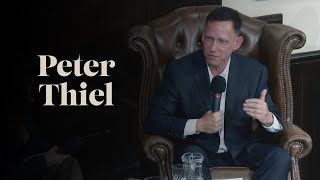
Peter Thiel on Politics & Government
Peter Thiel sees politics as the hard work of national self-government: rebuilding state capacity at home, resisting complacent globalization, and avoiding both chaos and centralized world control.
- Government should be judged by whether it actually serves the United States, not by slogans or abstractions.
- America’s core political problem is stagnation and institutional incompetence, not the culture-war issues that dominate attention.
- He favors rebuilding national capacity at home and reducing wasteful foreign adventurism.
- He is skeptical of naive globalization and warns that existential threats can be used to justify dangerous centralization.
- Technology matters politically, but it cannot replace politics; AI especially can strengthen surveillance and centralized power.

“…we're trying to accomplish, which is widening the Overton window for discourse…”Oxford Union speech and Q&A, 2023 · 1:48
Politics should start with the national interest
Thiel’s basic political test is practical: ask what actually benefits the United States. He treats nationalism less as emotional loyalty than as a willingness to compare performance, ask hard questions, and reject flattering myths about how well the country is doing.12
That is why he pushes against complacent consensus. He wants wider debate about trade, technology, higher education, and foreign policy because he thinks too much elite opinion has treated failed assumptions as settled truth.23
“…we're trying to accomplish, which is widening the Overton window for discourse…”Oxford Union speech and Q&A, 2023 · full transcript →
America’s main political failure is incompetence amid stagnation
Thiel returns again and again to the idea that the U.S. has made progress in narrow digital domains while failing in the physical world and in public institutions. His shorthand is that society got better computers without comparable gains in transportation, housing, infrastructure, or government delivery.456
This is why he treats culture-war spectacle as politically secondary. He argues that public attention is often diverted from more serious problems such as weak growth, high costs, housing scarcity, broken systems, and declining state capacity.789
He also thinks many people can describe the problems without solving them. In his view, political language about strategy or awareness often becomes a substitute for action, which deepens institutional drift.10

“We don't accept such incompetence in Silicon Valley, and we must not accept it from our government.”Republican National Convention speech, Cleveland, 2016 · full transcript →
Rebuild at home instead of wasting power abroad
Thiel’s support for Trump in 2016 was tied to a domestic rebuilding argument. He presented America as economically and institutionally weakened, and he framed the right priority as reconstruction at home rather than continued foreign-policy overreach.13147
This view is not isolationist in a simple sense. It is a demand to husband national resources, stop accepting obvious state failure, and direct political energy toward functioning systems, productive capacity, and competent government.61415
“It's time to end the era of stupid wars and rebuild our country.”Republican National Convention speech, Cleveland, 2016 · full transcript →
Globalization and one-world politics can become traps
Thiel is deeply skeptical of the idea that the world can simply integrate peacefully if leaders avoid hard questions. He thinks the habit of assuming that societies can muddle through has masked serious geopolitical failures, especially around China and the broader disappointments of globalization.163
At the far end of this concern is his warning about global governance. He argues that fear of nuclear war, pandemics, or AI can be used to sell centralization as the price of safety, creating a politics where the alternative to emergency rule is made to look like catastrophe.171819
His preferred path is neither reckless optimism nor surrender to centralized control. He wants human self-government strong enough to avoid destruction without creating a totalizing global authority.2019
Technology is political because it shifts power
Thiel does not treat technology as a neutral escape from politics. He explicitly argues that technology cannot substitute for politics, and he is especially concerned that AI naturally fits centralized control and surveillance more than liberty.92122
That concern shapes his view of China. He sees the competition less as a simple race for gadgets than as a contest over which political system can turn key technologies into power. That is why he favors tighter restrictions, tougher talk, and a more realistic approach to strategic dependence.23242526
He is also more pragmatic than doctrinaire in policy. Where free-market formulas do not fit a world of adversarial states and distorted trade, he is willing to support more restrictive or state-backed measures in the name of strategic competition.2728

“…technology is no alternative to politics.”Cambridge Union Q&A, 2024 · full transcript →
California shows how wealth can distort government
For Thiel, California is a warning about how a successful industry can coexist with political decay. Tech wealth keeps the state economically formidable, but he argues that governance, housing, and public services have deteriorated badly underneath the boom.2930
He calls this the tech curse: concentrated gains in one sector create misgovernance rather than broad prosperity. That matters politically because it suggests that even extraordinary innovation can feed asset inflation, conformity, and bad rule if institutions cannot translate wealth into general flourishing.293031
The broader lesson is that prosperity in software does not automatically mean sound government. Politics still has to solve distribution, infrastructure, housing, and social order, and those are exactly the areas where he thinks elite California has performed poorly.32339

“…we should think of tech as the oil of the 21st century…”NatCon 3 Miami speech, 2022 · full transcript →
Thiel on politics & government, in his own words
“…technology is no alternative to politics.”
“It's time to end the era of stupid wars and rebuild our country.”
“We don't accept such incompetence in Silicon Valley, and we must not accept it from our government.”
“We have human self-government or human self-destruction.”
“…we're promised flying cars and all we got was a 140 characters…”
Where to watch
 Peter Thiel on National Interest: From Stagnation to Exceptionalism2023 · 40 min · full transcriptBest overview of his national-interest test for politics and his critique of stagnation, trade, and elite consensus.
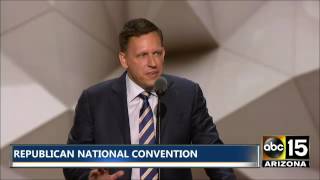 Peter Thiel on Economic Decline: Rebuild America2016 · 6 min · full transcriptShortest, clearest statement of his rebuild-America politics, support for Trump, and opposition to stupid wars.
 Peter Thiel on Antichrist and Global Governance: The one-world trap2025 · 41 min · full transcriptMost direct account of why he fears global governance and centralized power justified by existential threats.
 Peter Thiel on US-China Tech Competition: AI, Chips, and Surveillance2021 · 90 min · full transcriptShows how his politics applies to China, AI, semiconductors, surveillance, and industrial strategy.
 Peter Thiel on Tech Curse: Why California Distorts Politics2022 · 38 min · full transcriptExplains the tech curse and why California is, for him, a model of wealth paired with political dysfunction.
 Peter Thiel on AI and Technological Stagnation: Politics, Power, and the Future2024 · 211 min · full transcriptUseful for his views on deficits, entitlement pressure, state incapacity, and why talking about problems often replaces solving them.
Questions people ask
- What advice did Peter Thiel give young people about living a good life in a time of crisis?
- What did Peter Thiel say about AI and surveillance in China?
- What did Peter Thiel say about political correctness and conformity in Silicon Valley?
- What did Peter Thiel say about the tech curse?
- What did Peter Thiel say nationalism should mean in the United States?
- What does Peter Thiel think the U.S. should do about competition with China?
Sources
Every quote above, word for word from the transcripts. Numbers match the text.
“It costs 10 times as much to build a mile of subway as it does in socialist Western Europe. That is, in short, exceptionally unself aware, exceptionally unself critical. And what what I think we should always underscore on on the on the nationalist side for for The United States is that nationalism has nothing to do with this sort of exceptional unself awareness. That nationalism is not It's not blind patriotism. It's not my country right or wrong without any questions. Nationalism is going to be very... It's gonna ask hard questions. It's gonna ask how does our country stack up against other countries? How does it compare? And and and it may it may find it very wanting. It's going to be extremely critical.”
“…we're trying to accomplish, which is widening the Overton window for discourse…”
“There's going to be more movement of goods and people and ideas and money. And we're going to sort of become this more peaceful, better integrated world. And you don't need to sweat the details. We're just going to kind of muddle through. And then what in my telling, there are a lot of things around that story that went very haywire. One simple version is The US China thing hasn't quite worked the way people in Fukuyama and all these people envisioned it back in 1989. And I think one could have figured this out much earlier. And if we had not been told, you can just you're just going to muddle through, it would the alarm bells would have gone off much sooner.”
“…we maybe we've built the Star Trek computer, but we don't have anything else from the Star Trek universe…”
“…we're promised flying cars and all we got was a 140 characters…”
“We don't accept such incompetence in Silicon Valley, and we must not accept it from our government.”
“Every plank in our party's platform but fake culture wars only distract us from our economic decline, and nobody in this race is being honest about it except Donald Trump. While it is fitting to talk about who we are today, it's even more important to remember where we came from. For me, that is Cleveland and the bright future it promised. When Donald Trump asked us to make America great again, he's not suggesting a return to the past. He's running to lead us back to that bright.”
“War in Libya, and today it's a training ground for ISIS. On this most important issue, Donald Trump is right: it's time. It's time to end the era of stupid wars and rebuild our country. When I was a kid, the great debate was about how to defeat the Soviet Union, and we won. Now, we are told—now we are told that the great debate is about who gets to use which bathroom. This is a distraction from our real problems. Who…”
“…technology is no alternative to politics.”
“Strategy is often a euphemism for procrastination.”
“He is a builder, and it's time to rebuild America.”
“It's time to end the era of stupid wars and rebuild our country.”
“We need to somehow pull things back together. It's what the universities were supposed to do, don't think they will do it, but you have to figure- >> Peter Robinson: After years of deconstruction, you're calling for an act of reconstruction. >> Peter Thiel: Yeah, it may not happen, the progressive cult that is the university, but still it is really a time for reconstruction.”
“Whenever people think you can just muddle through, yeah, you're probably set up for some kind of disaster…”
“…the slogan of the Antichrist is peace and safety…”
“And this is sort of where my speculative thesis is that if the Antichrist were to come to power, it would be by talking about Armageddon all the time. And- >> Peter Robinson: Peter Thiel, the antichrist would talk about Armageddon all the time. He'll scare people and then offer to save them. >> Peter Thiel: Yes, it's the 1 Thessalonians 5:3. The slogan of the Antichrist is peace and safety, which is nothing wrong with peace and safety. But you have to sort of imagine that it resonates very differently in a world where the stakes are so absolute, where the stakes are so extreme, where the alternative to peace and safety is Armageddon and the destruction of all things.”
“And in my mind, one other existential risk is a one world totalitarian government. And I find that as least as scary as the others. And in sort of a biblical eschatological context, you're supposed to worry about Armageddon. You're also supposed to worry about the Antichrist. Maybe you're supposed to worry more about the Antichrist because the Antichrist comes first. And so if we're going to find a pathway through this apocalyptic age, you have to sort of navigate between the Scylla of all these existential risks that are... And and the chorebdas of the sort of political totalitarian catastrophe. If if I had to do sort of a more literary version on this, it's very hard to write sort of a literary account of the Antichrist.”
“We have human self-government or human self-destruction.”
“The thing that I would say that is tricky about AI is that there are alot of aspects about the technology that we don’t want to pursuing too much because – AI is what you need for a surveillance society. Right I’ve had this riff, where people often say “crypto” or Bitcoin is a vaguely libertarian technology it is. Technology is politically neutral, but can still be — if crypto is kind of libertarian, AI is kind of communist. And so, Even though we are ahead of basic science of AI, China is willing to apply it and turn the entire society into a face recognition surveillance state that is far more intrusive and totalitarian than even Stalinist Russia was.”
“…it's a centralizing AI that's controlled by communist China…”
“You want to be in the more restrictive zone.”
“We need to be unashamed about talking about that…”
“Well, I think I got the first part of the question. You know, I do think that seeing China in an adversarial way would be a helpful start. And Silicon Valley has not been that good on this. Although, in some ways, it’s structurally better than Wall Street or Hollywood, or the Universities, because Silicon Valley for the most part has been frozen out of China. And so it’s not — it doesn’t naturally believe it can get that much out of it. If you look at the big five tech companies, Google, Facebook, Amazon, Microsoft virtually very, very little presence in China. So they aren’t naturally pro-China constituency. Apple is probably the one that’s structurally a real problem, because the whole iPhone supply chain gets made from China. And Apple is one that has real synergies with China. But then, there’s something about the woke politics inside these companies, the way they think of themselves as not really American companies. And it’s somehow very, very difficult to, for them to have a sharp anti-China edge of any sort whatsoever.”
“You cut off the money. That's the only way democracy could beat dictatorships. Eventually, that's how America beat Soviet Union. Mhm. Progress. Well, this is why—and this is why the technology issues are again so important in ways that are not just economic but also have political, political angle.”
“Well, you know, I think it’s a multi-faceted thing. I don’t think — I don’t think we should be super dogmatic. So I’m probably always going to sort of be a free market Libertarian. And the dogmatic Libertarian thing would be is that you shouldn’t have an export import bank because it involves all these government subsidies of loans. In a world where we don’t have free trade and we don’t have a balanced playing field, it makes a lot of sense to have something like the Ex-Im bank and to actually expand it. So, yes, I think they’re sort of, we should be trying a lot of different things and a lot of different areas. And we should try to be practical and not dogmatic on it.”
“I think AI is a difficult one to benchmark. But I think one of the big flash points for the last few years has been the Huawei 5G piece. And that’s been fairly straightforward. You just go down list of countries and what are they doing? And you can sort of see how we’re doing, how successful we are at holding the line there. I think there’s going to be some questions about the semiconductor boycotts, how effective those are. And will China be able to ramp up its production to get around that. That will be benchmarked pretty straightforwardly as well. AI is always this crazy buzzword. It means all these different things.”
“…we should think of tech as the oil of the 21st century…”
“Tech curse, and then three variations on it as a problem for California, a problem for the Democrats, and a problem for the Republicans, and so very straightforward. Let's, uh, let's start by defining the tech curse. Um, it is, um, it's equivalent to the natural resource curse, the oil curse, where, uh, if you have a country with, uh, with, um, you know, sort of an enormous gusher of wealth, it often leads to sort of extraordinary social and political misgovernance. And basically, you know, the nutshell version of it is that we should think of tech as the oil of the 21st century, and you can sort of…”
“And so the the the way... My my read on on Silicon Valley is that it's much... It has much more the feel of a one party state where everything is regimented and everybody has to follow a particular party line. And, you know, the problem is is is not that, you know, the unanimity is not a sign that you've just converged on the truth. You know, if you got... If had... In a democracy, we believe, you know, 51% is generally right, 70 to 80% is even more right. But when you're at 99.99%, no. It's... You're in North Korea. And the problem is the problem is that it it is... There's some sort of soft totalitarianism that's creating an incredible conformity. So I think, yeah, think people have have short bullet point answers on things, but they have actually not thought about them.”
“…how does one, how do we do better than California?”
“So, perhaps that can work. I, I, I tend to think one has to take China more seriously, but, uh, the question, you know, the question we, we, uh, I would leave to the other panel is, how do you do better than California? How do you actually deal, uh, actually deal with China in a way that's, uh, that's likely to work? And, uh, it's not a high bar, but it's a bar we need to meet. Thank you very much. You…”
How this guide was made: drafted with AI from the full transcripts of the recordings cited, then checked: every quotation must match a transcript word for word and be the speaker's own words, and an independent review gates accuracy. Methodology and corrections.