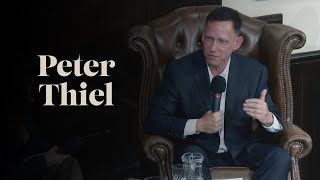
Peter Thiel on Economics
Peter Thiel sees economic decline as the visible result of a deeper failure of technological progress, institutional competence, and national focus.
- Economic decline comes from stagnation: too much progress in software, too little in the physical economy.
- Flat wages and rising costs signal that innovation is no longer delivering broad prosperity.
- Government failure, regulation, and misaligned politics have made it hard to build and fix big things.
- Asset inflation and narrow tech wealth can hide decline rather than solve it.
- The way out is real growth: new technologies, better institutions, and rebuilding at home.
Economic decline is a symptom of technological stagnation
Thiel’s basic claim is that economic decline is not mainly a story about bad quarterly policy choices. It is the long-run consequence of too little real technological progress across the economy. He argues that civilization has moved through an unusually slow period of development and that technology is the central question for whether living standards rise or stall.1
He repeatedly contrasts progress in computers with weakness everywhere else. In his view, society built impressive digital tools, but failed to produce comparable advances in transport, energy, medicine, and other parts of everyday material life. That is why modern life can feel technologically sophisticated on a screen while disappointing in the physical world.234
For Thiel, the only genuinely hopeful path is renewed growth through real innovation. He ties optimism directly to technological progress rather than to spending more money or redistributing stagnation.56
When growth slows, wages stall and basic costs outrun people
Thiel treats stagnant wages as one of the clearest signs that the economy is not progressing in the way it once did. He points to the contrast between an earlier era of rapid income gains and the much weaker performance of recent decades as evidence that innovation has not been translating into broad prosperity.7
He connects that stagnation to rising burdens in sectors that matter most to ordinary life, especially education and other major household costs. In his account, college increasingly looks less like a reliable escalator and more like a debt-heavy system that leaves younger generations squeezed.8
That is why he can say the country has Silicon Valley success alongside national disappointment. A narrow zone of innovation is not enough if most people experience flat earnings, mounting debt, and higher costs in the sectors that shape family life.11
The problem is not just markets but broken institutions and blocked building
Thiel argues that the economy declines when institutions become unable to execute basic tasks well. He is especially harsh on public incompetence, saying citizens should not accept government systems that perform worse than well-run technology companies would tolerate.11
He also thinks the U.S. has made much of the physical economy harder to improve. His recurring view is that regulation, caution, and political barriers have effectively shut down innovation in the world of tangible things, even while software remained comparatively free to advance.1213
This helps explain why he talks about infrastructure, energy, drugs, and transportation rather than only apps or finance. Economic decline, for him, is what happens when a country loses the capacity to build, test, and scale important physical innovations.141516
Tech wealth can mask decline by flowing into politics and assets
Thiel does not think booming tech valuations automatically mean the broader economy is healthy. He compares tech to a resource windfall: it can generate enormous wealth while also distorting politics and governance.1718
His California example is central here. A narrow concentration of software wealth can keep a place rich even as housing, public services, and government performance deteriorate. In that situation, the headline prosperity is real, but it is not broad-based and may even intensify underlying dysfunction.
This is one reason he worries about asset inflation and misdirected gains. If the rewards of innovation mostly capitalize into real estate or protected sectors instead of lowering costs and raising productivity for the whole country, apparent wealth can coexist with real decline.182
Recovery requires rebuilding, realism, and action instead of distraction
Thiel’s political conclusion is that the country should stop avoiding the core issue. He says cultural sideshows and elite talking points can distract from the deeper problem of economic decline.
He also warns that diagnosing problems is not enough. Talking, strategy, and analysis can become substitutes for acting, which is one reason obvious national problems persist for so long.
What he wants instead is a rebuilding agenda: focus national attention on competence, real growth, and domestic renewal rather than endless foreign misadventures or symbolic fights. In economic terms, that means restoring the conditions for new invention, sound money, and productive investment in the future.252627
Where to watch
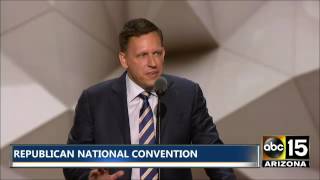 Peter Thiel on Economic Decline: Rebuild America2016 · 6 min · full transcriptThe shortest, clearest statement of his diagnosis: flat wages, rising costs, broken government, and the need to rebuild.
 Peter Thiel on Innovation and Stagnation: Why America Stopped Progressing2012 · 37 min · full transcriptBest for understanding why he thinks stagnation in energy, transport, and the physical economy drives broad economic decline.
 Peter Thiel on Technological Stagnation: Man Plus Machine2011 · 52 min · full transcriptLays out the deep framework linking technology, growth, sound money, and civilization-wide optimism or decline.
 Peter Thiel on Technological Stagnation: Bits, Not Stuff2019 · 73 min · full transcriptExplains his core bits-versus-stuff distinction and why digital progress has not been enough for the whole economy.
 Peter Thiel on Tech Curse: Why California Distorts Politics2022 · 38 min · full transcriptShows how narrow tech wealth can coexist with misgovernance, housing problems, and asset inflation.
 Peter Thiel on National Interest: From Stagnation to Exceptionalism2023 · 40 min · full transcriptUseful for seeing how he turns the stagnation argument into a national-interest critique of policy and priorities.
Questions people ask
- How did Peter Thiel define technology in this conversation?
- What did Peter Thiel say about college debt for millennials?
- What did Peter Thiel say about sound money and the economy?
- What did Peter Thiel say about technological progress and stagnant wages?
- Why did Peter Thiel think government was blocking innovation?
- What did Peter Thiel say about college and student debt?
Sources
Every quote above, word for word from the transcripts. Numbers match the text.
“…the question of technology is this incredibly important question for our whole civilization…”
“…we have seen progress in the world of bits but not in the world of stuff…”
“…we maybe we've built the Star Trek computer, but we don't have anything else from the Star Trek universe…”
“…we're promised flying cars and all we got was a 140 characters…”
“The optimistic scenario is that, you know, the world has growth in the world and you have technological progress.”
“The optimistic scenario is that, you know, the world has growth in the world and you have technological progress. That's the optimistic scenario. That's—that's—that's the optimistic—that's the only optimistic scenario.”
“I think that but I think that think that when you look at this question of how much technological progress has been happening, we get into all these complicated measurement issues. The one that I cite as the big data point is that if you look at The US, say, in the last forty years, 1973 to today, median wages have been stagnant. Maybe the mean wages have gone up maybe a small amount, not very much. The forty years before that, you know, 1932 to 1972, they went up by a factor of six. So people if you looked at how people did from '32 to '72, you had a six fold improvement. And it was matched by incredible technological progress.”
“Since 2000, it's actually been better to finish after high school than after college on a relative basis. So college was a good investment, was an increasingly good investment through 2000. Since 2000, you know, there's been basically a roughly consistent gap between college and high school education because the debt has kept going up to people in mass. It has actually become relatively it's still better, but by a lesser degree since 2000. So we have an enormous amount of money that's being spent on education. And basically, I think the crazy cultural shift that's happening is that people who are in the younger generation, millennials, are getting completely screwed. They're basically being turned into something like indentured servants where they have to pay off their college loans. Bush rewrote the bankruptcy laws in 2005 to make it impossible to get out of college debt even if you go personally bankrupt.”
“We don't accept such incompetence in Silicon Valley, and we must not accept it from our government.”
“We've basically outlawed everything having to do with the world of stuff.”
“Well, the why questions always get immediately ideological. So I'm libertarian. I think it's because the government's outlawed technology. We're not allowed to develop new drugs with the FDA charging $1,300,000,000 per new drug. You're not allowed to fly super sonic jets because they're too noisy. You're not allowed to build nuclear power plants or say nothing of fusion or thorium or any of these other new technologies that might really work. So I think we've basically outlawed everything having to do with the world of stuff. And the only thing you're allowed to do is in the world of bits. And that's why we've had a lot of progress in computers and finance. Those were the two areas where there was enormous innovation in the last forty years. It looks like finance is in the process of getting outlawed. So the only thing left will be the only thing left at this point will be computers.”
“…we've had basically no progress on energy…”
“What I'm interested in is vertical growth, intensive growth, doing fundamentally new things.”
“It costs 10 times as much to build a mile of subway as it does in socialist Western Europe. That is, in short, exceptionally unself aware, exceptionally unself critical. And what what I think we should always underscore on on the on the nationalist side for for The United States is that nationalism has nothing to do with this sort of exceptional unself awareness. That nationalism is not It's not blind patriotism. It's not my country right or wrong without any questions. Nationalism is going to be very... It's gonna ask hard questions. It's gonna ask how does our country stack up against other countries? How does it compare? And and and it may it may find it very wanting. It's going to be extremely critical.”
“…we should think of tech as the oil of the 21st century…”
“Tech curse, and then three variations on it as a problem for California, a problem for the Democrats, and a problem for the Republicans, and so very straightforward. Let's, uh, let's start by defining the tech curse. Um, it is, um, it's equivalent to the natural resource curse, the oil curse, where, uh, if you have a country with, uh, with, um, you know, sort of an enormous gusher of wealth, it often leads to sort of extraordinary social and political misgovernance. And basically, you know, the nutshell version of it is that we should think of tech as the oil of the 21st century, and you can sort of…”
“It's time to end the era of stupid wars and rebuild our country.”
“You have to go back to sound money…”
“Until it goes into, you know, and until you can't print any more money. So, because I think eventually, you know, it just—the only way out is to—to work with sound money. If money—if money doesn't have any value, mhm, so the whole system doesn't work.”
How this guide was made: drafted with AI from the full transcripts of the recordings cited, then checked: every quotation must match a transcript word for word and be the speaker's own words, and an independent review gates accuracy. Methodology and corrections.