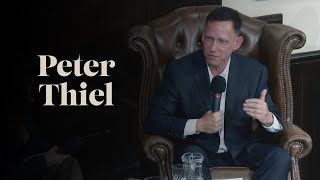
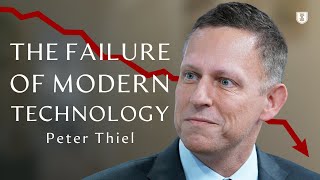
Peter Thiel on Technological Stagnation
Peter Thiel argues that real progress has slowed outside software, leaving the developed world richer in screens than in transformative advances in energy, transport, medicine, and other physical industries.
- Thiel says progress has continued in bits, but stalled in the world of stuff.
- He ties stagnation to weak wages, low growth, and a loss of confidence about the future.
- His main explanations are regulation, risk aversion, incrementalism, and conformity.
- He distinguishes copying existing ideas from creating genuinely new ones, and says the West has relied too much on copying.
- He thinks the answer is renewed ambition: more vertical innovation, especially in energy, medicine, transport, and human-machine systems.

“We wanted flying cars. Instead, we got 140 characters.”Richard Nixon Foundation seminar, 2021 · 12:23
Stagnation means too much progress in software and too little in the physical world
Thiel’s basic claim is that the modern economy looks more innovative than it really is because computing has advanced rapidly while many other sectors have not. He returns again and again to the contrast between bits and stuff: computers, internet, and software improved dramatically, but transportation, energy, health care, education, and other parts of everyday life did not improve at the same pace.12
That is why his most famous shorthand contrasts glamorous digital products with missing physical breakthroughs. In his view, society got better communication tools without getting the broader technological transformation people expected in the twentieth century.456
He treats this not as a minor imbalance but as the defining economic story of recent decades. On his account, the developed world especially needed real technological progress, yet ended up with innovation concentrated in too narrow a slice of the economy.7
“We wanted flying cars. Instead, we got 140 characters.”Richard Nixon Foundation seminar, 2021 · full transcript →
Why Thiel thinks stagnation is real, not just nostalgia
Thiel does not frame stagnation as a vague feeling that the past was more exciting. He points to broad outcomes: weak productivity-style gains, stagnant median wages, and the absence of major breakthroughs across physical industries. His argument is that when technology is truly advancing in ways that matter, ordinary living standards should rise much more visibly.9
He also argues that people often confuse globalization with innovation. Spreading existing technologies to more places can create growth, but that is different from inventing fundamentally new things. For him, much of the last few decades has been horizontal expansion rather than vertical breakthrough.101112
This is why he pushes people to judge progress concretely. He prefers asking what changed in travel speeds, energy systems, medicine, food production, or urban building capacity rather than assuming that more apps or faster phones mean civilization as a whole is moving quickly.13
The causes are cultural and political: regulation, fear, and conformity
Thiel’s strongest causal claim is that the slowdown is not inevitable. He says it is a choice made through culture and policy: societies became risk-averse, heavily regulated, and satisfied with incremental gains. In his telling, the problem is less that hard science ran out of discoveries and more that institutions stopped backing bold attempts.151617
He is especially critical of how innovation in the physical world gets blocked. He argues that drugs, nuclear power, supersonic flight, and other areas face barriers so high that entrepreneurs and scientists are pushed toward software, where permission is easier to obtain. That helps explain why bits raced ahead while atoms lagged.1819
He also thinks conformity weakens discovery before it starts. Universities, peer-reviewed science, and elite professional cultures can reward safety, grant-writing, and consensus over truth-seeking and contrarian thought. In that environment, courage becomes scarcer than intelligence, and the result is fewer genuinely new ideas.202122
“I think it is not a fact of nature that the slowdown has happened. It's a cultural decision: we've become risk-averse; we've been regulated to death; we've become, um, incrementalist; and we're not willing to, uh, really, uh, take the bold steps. We've talked ourselves into thinking that, uh, that throwing, um, throwing Angry Birds at pigs is the best we can do. And that's, and I think we can do better.”Richard Nixon Foundation seminar, 2021 · full transcript →
Stagnation changes politics, economics, and public mood
For Thiel, technological stagnation is not just a sector issue. It changes the whole political economy. If growth is weak, distribution fights get harsher, debt becomes harder to sustain, and institutions become more brittle because they can no longer rely on a richer future to ease conflict.2324
He also insists that technology is no alternative to politics: even a society with ambitious technology still has to deal directly with money, debt, and institutions.27
This helps explain why he treats technology as a civilizational question rather than a consumer one. Progress matters because it affects national strength, democratic confidence, and whether societies believe the future can be better than the present.3132

“…the question of technology is this incredibly important question for our whole civilization…”Singularity Summit 2011, New York · full transcript →
What progress should look like: vertical invention and ambitious rebuilding
Thiel’s alternative is not anti-tech skepticism but a broader and more ambitious idea of progress. He wants more vertical growth: doing fundamentally new things rather than mainly copying or scaling what already exists. That means breakthroughs in energy, medicine, transportation, and other fields where progress would materially change life.11910
He is notably interested in areas where digital tools reconnect with the physical world. He sees promise in systems that combine software with real-world transformation, and he often presents human-machine collaboration as more realistic and more powerful than fantasies of total automation.3334
At the personal and institutional level, his advice points toward contrarian ambition. Ask what important company or project is not being built, and look for places where fear, bureaucracy, or consensus are suppressing possibility. His view of stagnation is bleak only if people accept it as natural. He does not.353637

“What great company is nobody building?”TechCrunch Disrupt SF 2014 fireside chat · full transcript →
Thiel on technological stagnation, in his own words
“We wanted flying cars. Instead, we got 140 characters.”
“…we have seen progress in the world of bits but not in the world of stuff…”
“We've basically outlawed everything having to do with the world of stuff.”
“What I'm interested in is vertical growth, intensive growth, doing fundamentally new things.”
“…courage is in far shorter supply than genius…”
“…the question of technology is this incredibly important question for our whole civilization…”
Where to watch
 Peter Thiel on Technological Stagnation: Flying Cars vs. 140 Characters2021 · 57 min · full transcriptBest single overview of his stagnation thesis: the slowdown since the 1970s, the bits-versus-stuff split, and the cultural causes.
 Peter Thiel on Technological Stagnation: Why Progress Slowed2020 · 77 min · full transcriptBest for understanding his distinction between copying and invention, and why institutions drifted away from real discovery.
 Peter Thiel on Innovation and Stagnation: Why America Stopped Progressing2012 · 37 min · full transcriptBest for the economic case: stagnant wages, blocked innovation in physical industries, and the importance of vertical growth.
 Peter Thiel on Technological Stagnation: Man Plus Machine2011 · 52 min · full transcriptBest for how stagnation connects to civilization-level optimism, growth, and the human-plus-machine alternative.
 Peter Thiel on Technological Stagnation: Bits, Not Stuff2019 · 73 min · full transcriptBest concise discussion of bits versus stuff and why founder-led innovation matters.
 Peter Thiel on Death and Technological Progress: Stagnation vs. Hope2023 · 103 min · full transcriptBest for seeing how his stagnation argument extends into medicine, aging, and the critique of timid science.
Questions people ask
- How did Peter Thiel define technology in this conversation?
- How does Peter Thiel decide what to work on?
- What did Peter Thiel say about man plus machine and artificial intelligence?
- What did Peter Thiel say about technological progress and stagnant wages?
- Why did Peter Thiel think government was blocking innovation?
- Why is Peter Thiel hopeful about the future despite technological stagnation?
Sources
Every quote above, word for word from the transcripts. Numbers match the text.
“…we have seen progress in the world of bits but not in the world of stuff…”
“I think that we have seen progress in the world of bits but not in the world of stuff.”
“We wanted flying cars. Instead, we got 140 characters.”
“…we maybe we've built the Star Trek computer, but we don't have anything else from the Star Trek universe…”
“…we're promised flying cars and all we got was a 140 characters…”
“…the part of the world where technology is really necessary for things to get better is the developed world…”
“…we've had basically no progress on energy…”
“Horizontal or extensive growth, which involves copying things that work…”
“What I'm interested in is vertical growth, intensive growth, doing fundamentally new things.”
“Everything is horizontal. It's all global. It's copying. It's taking things that work and sort of giving them to people who don't have them. And there's very little that's vertical that involves doing new things. And the government biases is incredibly powerful in that respect. And this is both Democrat and Republican.”
“I often think it's worth looking at quantity, not quality, and we're not going faster. The Concorde was decommissioned in 2003. And if you include low tech airport security mechanisms, we're back to about nineteen sixty type travel speeds today in The U. S. But let's take another area that's much, you know, that's probably much more basic, something like agriculture. We had a green revolution in the '50s and '60s that basically doubled world food production in line with population growth. It's decelerated dramatically over the last forty years, and that's reflected in this incredible rise in food prices that we've seen over the last decade.”
“…it's a cultural decision: we've become risk-averse; we've been regulated to death…”
“I think it is not a fact of nature that the slowdown has happened. It's a cultural decision: we've become risk-averse; we've been regulated to death; we've become, um, incrementalist; and we're not willing to, uh, really, uh, take the bold steps. We've talked ourselves into thinking that, uh, that throwing, um, throwing Angry Birds at pigs is the best we can do. And that's, and I think we can do better.”
“Well, I, I think, I don't think we're at the end of history. I don't think we know everything. I certainly refuse to believe that everything has been discovered that's going to be discovered. And I think there are all sorts of contexts where we can still come to understand new things.”
“We've basically outlawed everything having to do with the world of stuff.”
“Well, the why questions always get immediately ideological. So I'm libertarian. I think it's because the government's outlawed technology. We're not allowed to develop new drugs with the FDA charging $1,300,000,000 per new drug. You're not allowed to fly super sonic jets because they're too noisy. You're not allowed to build nuclear power plants or say nothing of fusion or thorium or any of these other new technologies that might really work. So I think we've basically outlawed everything having to do with the world of stuff. And the only thing you're allowed to do is in the world of bits. And that's why we've had a lot of progress in computers and finance. Those were the two areas where there was enormous innovation in the last forty years. It looks like finance is in the process of getting outlawed. So the only thing left will be the only thing left at this point will be computers.”
“…courage is in far shorter supply than genius…”
“…we've been wandering in a desert for the last 40 years…”
“And so the the the way... My my read on on Silicon Valley is that it's much... It has much more the feel of a one party state where everything is regimented and everybody has to follow a particular party line. And, you know, the problem is is is not that, you know, the unanimity is not a sign that you've just converged on the truth. You know, if you got... If had... In a democracy, we believe, you know, 51% is generally right, 70 to 80% is even more right. But when you're at 99.99%, no. It's... You're in North Korea. And the problem is the problem is that it it is... There's some sort of soft totalitarianism that's creating an incredible conformity. So I think, yeah, think people have have short bullet point answers on things, but they have actually not thought about them.”
“…the question of technology is this incredibly important question for our whole civilization…”
“The optimistic scenario is that, you know, the world has growth in the world and you have technological progress.”
“…technology is no alternative to politics.”
“The optimistic scenario is that, you know, the world has growth in the world and you have technological progress. That's the optimistic scenario. That's—that's—that's the optimistic—that's the only optimistic scenario.”
“You cut off the money. That's the only way democracy could beat dictatorships. Eventually, that's how America beat Soviet Union. Mhm. Progress. Well, this is why—and this is why the technology issues are again so important in ways that are not just economic but also have political, political angle.”
“…man plus machine is a solution…”
“Something that machines are bad at and vice versa. Well, it was, you know, it was the case at PayPal that we found that you needed this human-computer combination to solve the fraud problems. And this is sort of, um, and so, I think it has been very underexplored as an approach. Oh, yeah, absolutely. And it's just, it's, it's, it and, and, and, it, it, it, the example I brought to Google versus it was very natural. So, why not maximize the effect of the search by adding, you know, the tiny element of human, of human into not intuition, but visualization. Great reservations. The Google ideology is that computers will replace humans in the next 20 years, 30 years. A bit odd because certain things you can do very quickly.”
“What great company is nobody building?”
“And so I like to sort of get at this escape from competition, this move to Monopoly, this move towards doing something where, counterfactually, if you were not doing it, it wouldn't happen—something that's, through these sort of contrarian questions. The business one I like to always ask is, "What great company is nobody building?" The more intellectual one, which I like to ask and think is a fantastic interview question, is, "Tell me something that's true that almost nobody agrees with you on." And this is a shockingly hard question for people to answer, even when they can read on the internet that I always ask the question. And I think it's—…”
“I think we can be doing a lot better.”
How this guide was made: drafted with AI from the full transcripts of the recordings cited, then checked: every quotation must match a transcript word for word and be the speaker's own words, and an independent review gates accuracy. Methodology and corrections.