Peter Thiel on Business Strategy
Peter Thiel’s business strategy is to build a one-of-a-kind company that starts small, wins through differentiation and distribution, and escapes direct competition.
- Strategy starts with building something genuinely different, not joining a crowded market.
- The goal is monopoly-like advantage, because intense competition destroys profits and turns firms into commodities.
- Start with a small market you can dominate, then expand outward.
- Distribution matters as much as invention; a great idea still has to reach users.
- Strong strategy comes from contrarian thinking: find truths and opportunities others miss.

“…most people think that business is about competition, whereas I think business is about getting away from competition.”TechCrunch Disrupt SF interview, 2014 · 2:41
A great strategy creates a unique company, not a better version of the same thing
Thiel’s starting point is that strong strategy is about uniqueness. In his view, the best companies are singular rather than interchangeable, which means they are built around something genuinely new instead of copying an established template.123
That is why he pushes founders away from crowded categories. If you are entering a market as just another participant, you are already giving up the strategic position that matters most: being meaningfully different from everyone else.4
He frames this as a practical business question, not just a philosophical one: what great company is nobody starting, and what true but unpopular belief lets you see that opportunity before others do.67
The point of strategy is to escape competition
Thiel’s most distinctive claim is that business is not mainly about competing harder; it is about getting away from competition. In his view, when many firms chase the same customers with similar offerings, profits get competed away and the market starts to look commoditized.8
He therefore treats monopoly-like positioning as the strategic objective. By monopoly, he means having such a strong and differentiated position that customers do not see close substitutes and rivals cannot easily force you into price-driven combat.101112
This is also why he says capitalism and competition pull in different directions. A business creates value by offering something useful, but it captures value only if it has enough uniqueness and market power to avoid being treated as replaceable.131415
Start with a small market you can dominate
Thiel does not think startups should begin by claiming a giant total addressable market. His view is that every startup begins small, so the realistic way to build a dominant position is to begin in a narrow market where you can quickly become the leader.16
His examples follow the same pattern: Facebook began with Harvard, PayPal with eBay power sellers, and Amazon with books. The logic is strategic: dominance in a small market creates the base from which a company can expand step by step into adjacent markets.16
This approach matters because monopoly is not something a startup can claim at the scale of the whole economy on day one. It has to be built through focused initial control and then widened through expansion in concentric circles.1617
Distribution is as important as the idea
Thiel argues that many founders overvalue invention and undervalue distribution. For consumer internet businesses especially, the decisive question is often not whether the idea sounds clever, but whether the product can actually get to users and spread.18
His PayPal and Facebook examples point to the same lesson. PayPal linked money to email and grew through a viral use case, while Facebook solved a concrete identity problem and expanded from an initial community that made adoption meaningful.1819
This makes strategy operational. You need a product that creates value, but you also need a path to adoption, whether through network effects, a specific wedge market, or a distribution mechanism that solves the cold-start problem.1418
Think to the endgame and build for lasting advantage
Thiel prefers a strategy that begins with the end state in mind. He likes the chess idea that the first move may offer only a small edge, while the last move is what decides the game, so businesses should think less about being first and more about reaching a durable winning position.
That is the core of his last-mover view: the best company is not merely early, but built to remain the category leader at maturity. A strategy is strong when it points toward an endpoint where the company is still distinctive, still hard to copy, and still able to capture value.17
He also connects durable advantage with founder-led innovation. Founding periods are often the periods of real innovation, which is one reason he sees founder-driven companies as unusually capable of sustaining a differentiated strategy over time.2122
Look where others are not looking
For Thiel, strategy is inseparable from contrarian judgment. If everyone agrees on where value lies, the opportunity is usually already crowded, copied, or overpriced.723
That is why he emphasizes secrets, unpopular truths, and independent thinking. The strategic edge comes from seeing something important that others miss and then acting on it before consensus forms.246
He extends this beyond software. He thinks there has been far more progress in bits than in stuff, which implies that some of the biggest underexplored opportunities may come from bringing innovation into slower-moving physical sectors.252627
Thiel on business strategy, in his own words
“…most people think that business is about competition, whereas I think business is about getting away from competition.”
“If you want to succeed in business as a founder, early investor, early employee, as an entrepreneur, you always aim for monopoly.”
Where to watch
 Peter Thiel on Zero to One: Why Startups Must Be Different2014 · 77 min · full transcriptBest single overview of Thiel’s strategy framework: differentiation, small markets, network effects, and value capture.
 Peter Thiel on Monopoly and Competition: Why Great Businesses Avoid Rivalry2014 · 23 min · full transcriptSharpest explanation of why he thinks great businesses avoid competition and build monopoly-like positions.
 Peter Thiel on Contrarian Thinking: Why the Tracks Stop Working2017 · 131 min · full transcriptBest on distribution, network effects, and how products actually get adopted.
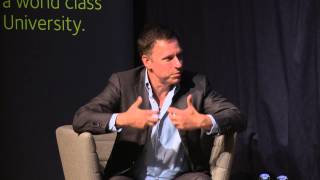 Peter Thiel on Contrarian Innovation: Why Crowds Miss Big Ideas2015 · 60 min · full transcriptBest for understanding the contrarian mindset behind his strategic thinking.
 Peter Thiel on Zero to One: Why Progress Means Doing New Things2014 · 18 min · full transcriptConcise statement of the Zero to One view that every great company is one of a kind.
Questions people ask
- How did Peter Thiel decide to invest in Facebook?
- What did Peter Thiel say about competition and happy companies?
- What did Peter Thiel say about starting a startup with a small market?
- What did Peter Thiel say founders should aim for?
- What does Peter Thiel think business is really about?
- What does Peter Thiel mean by being a first mover versus a last mover?
Sources
Every quote above, word for word from the transcripts. Numbers match the text.
“…every great company is one of a kind…”
“You want to aim to build a company that is one-of-a-kind…”
“One of the critical things in starting businesses is this need to do something new, different, fresh, strange.”
“You do not want to start the one hundredth online pet food company or the five thousandth restaurant in San Francisco.”
“What great company is nobody starting?”
“…tell me something that's true that nobody agrees with you on.”
“…most people think that business is about competition, whereas I think business is about getting away from competition.”
“…successful businesses are monopolies of one sort or another.”
“I think from the inside, the goal of every company should be to achieve a monopoly.”
“If you want to succeed in business as a founder, early investor, early employee, as an entrepreneur, you always aim for monopoly.”
“I believe that capitalism and competition are antonyms.”
“The key thing when you start a new technology business is to create something that has value to other people and then to capture some fraction of the value you create.”
“…monopolies are good because they are the reward you get for innovating…”
“And so again, was the great a good if you're trying to create a monopoly, you can define a monopoly as having a large market share. And so how do you get a large market share as a start up? Because every start up necessarily starts very small. The answer is that you have to start with a small market. Facebook started with Harvard. PayPal started with eBay power sellers. These are themselves quite small markets. Amazon started with books, so not that big a market either. And you sort of and then you can then ideally, can build the market out in concentric circles. When I see a PowerPoint presentation in a pitch where it starts with, this is a market that's measured in hundreds of billions or trillions of dollars, that's very bad because it means you will never get to a large share of the market.”
“I think that, um, all, if you're a founder or entrepreneur, what you want to aim for is monopoly. You want to aim to build a company that is one-of-a-kind, uh, and that it's so far, um, differentiated from the competition that it's not even competing.”
“The critical question for any consumer internet product is always not what the idea is but how do you get it out…”
“It turns out people aren't, weren't really interested in that. They weren't really interested in sense of a fictional, an online persona. It was much more about real identity. And somehow Facebook was the first one to crack the problem of real identity where, you know, even those always a little bit curated, certainly for the most part, people on Facebook are who they say they are. Yeah. For the most part at least. So am I mistaken, you're the only person who's been on the board of Facebook the entire way out except for Mark, right?”
“…the businesses that are led by founders are the ones that are able to innovate…”
“I tend to think it was the right decision in PayPal's case to sell. But I do think that whenever a decision gets made to sell a business, you are often making the decision to stop the innovation cycle in it. And one of the questions that I've spent a lot of time thinking about as a venture capitalist is how these companies get founded, how long does the founding period last. And I think the founding period is the period when you have innovation.”
“Think Different. That's the Silicon Valley 2018: Think the Same.”
“And there are things that are in between that are hard; it takes a lot of work, but if you apply yourself, you could figure those out, and I call those secrets. And I think there are many, uh, secrets left. Now, there's certain areas where it's not that promising to look. So, you know, if you were growing up in the 17th or 18th century, there were some empty spaces on the map and you could become an explorer and discover some more secrets about geography. Or in the 19th century, there were still some empty spaces left on the periodic table of elements, and you could go into chemistry and discover some, some…”
“We've had a lot of innovation in the world of bits, more limited in the world of atoms.”
“…we have seen progress in the world of bits but not in the world of stuff…”
“Well, think that the story of the last forty years has been one of enormous innovation in computers, Internet, mobile Internet, but not that much in the world of atoms. We've had a lot of innovation in the world of bits, more limited in the world of atoms. And I think you're right that we're at a point where people are talking more about innovating outside of computers again in the last two years, but I think it's still little bit too early to know whether we're really starting to see a new trend. But certainly, if you were to get a self driving car to work, if you were to figure out all these different ways to get the world of bits and the world of atoms to reconnect, that could be that could be a very powerful boost in the decade ahead.”
How this guide was made: drafted with AI from the full transcripts of the recordings cited, then checked: every quotation must match a transcript word for word and be the speaker's own words, and an independent review gates accuracy. Methodology and corrections.

