Peter Thiel on Contrarian Innovation: Why Crowds Miss Big Ideas

What Thiel talks about
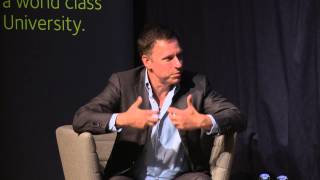
Peter Thiel gave this talk at Saïd Business School, University of Oxford, in 2015, discussing contrarian thinking, entrepreneurship, investing, and the importance of individual conviction.
Also known as: PayPal, politics & the importance of being individual; Oxford talk with Peter Tufano; University of Oxford talk.
Peter Thiel argues that the best entrepreneurs ask contrarian questions: what great company is nobody starting, what investment does nobody like, and what truth does nobody agree with you on. He says courage is scarcer than genius, and that original ideas are often crushed by social pressure before they fully form.
He also makes a case for mission-driven companies, sharp role differentiation, and higher-conviction investing. Across startups, venture capital, and education, he warns against imitation, crowd mania, and treating business as a lottery ticket.
Peter Tufano introduces the event, an interviewer guides the Q&A, and Thiel answers throughout.
In his words
“What great company is nobody starting?”
“Tell me something that's true that nobody agrees with you on.”
“The crowd is untruth.”
“I always have a preference to push back on making luck too all-powerful.”
“I think from the inside, the goal of every company should be to achieve a monopoly.”
Key points
- Great entrepreneurs pursue questions that are both true and unpopular.
- Crowds often create false consensus; imitation drives bubbles and bad decisions.
- Startups should unite around a shared mission, while individual roles stay sharply differentiated.
- Minimum-viable, customer-led testing has limits when the search space is too large.
- Thiel favors high-conviction investing over treating deals like lottery tickets.
- Innovation has concentrated in bits, while atoms-based progress has lagged.
- A strong team, technology, and a path to monopoly are distinct and all matter.
Full transcript: Peter Thiel, Saïd Business School talk (2015)
So good afternoon. I'm Peter Tufano. I'm the Dean of the school. Peter was asking how many of you are from various places. How many of you from the business school? Okay. For those of you who are not from the business school, shout out where you're from. Okay, you can get a sense. So we're thrilled to have up here Peter Thiel here today. We're also thrilled to have you here today, all of you. I was trying to think of why you might be here. You might be here because you think PayPal is really cool and you wanted to hear about how it was founded, or maybe you learned a little bit more about it, about how, you know, putting a couple of rival firms together and then kind of trying to capture a new market was
exciting. Or maybe some of you like big data and you think that Palantir is a really fascinating firm and you want to learn more about that. Or maybe some of you are would-be investors and you think that, well, somebody who is able to get in on the ground floor of Facebook, you know, you can learn something from it. And maybe some of you had the good sense to read Peter's book Zero to One, and you found it provocative. For example, I particularly like the line that says, you know, I think I'm going to paraphrase, but it's not about entrepreneurs; it's about founders, and picking a big, important, hard problem and then trying to solve that. So for whatever reason you came, I think we're all going to be benefitting today by having Peter join us. For those of you who are kind of out there in the ether, welcome to you as well. Peter is going to be in discussion today
with my colleague Tempo Fleeing. Tempo joined us a few years ago, and he says is a strategy expert. He's, for some of you, your professor studies networks and entrepreneurship and innovation. He's also, before becoming a professor, was a venture capitalist, so I think this is going to be a great conversation. Peter, thank you for coming. Tap, you thank you for hosting, and everybody, thank you for coming. And on with the discussion. Thank you so much. So Peter, welcome to Oxford. Fulfills the heavy. So I was telling some students ahead of time. They were asking me what
books to read, and I hate to sort of pitch anything, any best-selling popular press books because it feels like sort of selling snake oil. But the one exception, and there's going to be a little bit of love fest, is Zero to One. So here's the pitch. And so I love this book and that's the reason I invited Peter to come to Oxford because I think this is sort of a great place for Peter both to see Oxford and us to learn from him. And so we're absolutely thrilled to have you here and to talk about the book. Well, thanks for, thanks for, thanks for, yeah, thank you for having here. Absolutely. In terms of the format, so we, we wanted to make this participatory in the sense that a few weeks ago, we sent out sort of an email started off to students and we told them, we said, what would you ask Peter Thiel? He's coming to Oxford. What questions
would you ask him? And we used all our ideas and people submitted questions, and there was a ranking system, and so I've got a set of questions that you've provided for me, and so I'm actually sort of a channel here and oh, you know, filter a little bit, but there's also a chance for you to live engage with this discussion, and we will try to be savvy about that by using the hashtag #AskPeterThiel on Twitter. And so as you're listening to this, to this discussion, as you have questions, we'll try to react to some of those, and pick them up and go into, and all the nasty. Okay, without any, any further time here. So one of the things I love about the book, and it's right at the beginning,
and it's the question that you asked every entrepreneur, and the reason I like the book is most books have solutions. So yours, yours has questions that people need to think about basically. But can you sort of summarize what that question is and why it why it's important for entrepreneurs to think about? Well, there's a, there's sort of it's actually sort of an ensemble of contrarian questions, and I think you always wanted to be doing something that's both that has certain sort of fundamentally true but that other people are not doing. I think that combination always very powerful. So you know, the business version of the question is, what great company is nobody starting? The investor version is, what great
investment does nobody like? The nonprofit version is, what worthwhile but unpopular cause is not being funded? And then the more intellectual version of it is, tell me something that's true that nobody agrees with you on. Yeah, and this is always a, this is one of those interview questions that's a shockingly hard question, not because a people, because it requires some incredible amount of genius to answer. I think we all actually have answers to this question, but because it's a very uncomfortable question to answer. A good answer is not a conventional answer. It's not that our education system is broken or that our politicians are clowns or things like this. These are answers everybody already knows to be true. The answers are ones that the interviewer is
likely to powerfully disagree with. And I think we live in a world in which courage is in much shorter supply than not than genius. Yeah. So where do these types of questions come from? I mean, educational and other systems sort of reinforce, you know, their sort of known facts out there that we can all agree on and that's what we sort of disseminate. And in part, and the question is, how do you get stuff sort of contrary and things from left field? And is there any way to, is there any way to nurture that in some fashion? Yes, always. This is always the paradox of teaching entrepreneurship or teaching innovation, because on some level, you know, there's something paradoxical about trying to offer a formula for how to do to do new
Things, you know, there's a sense in which science—you can sort of say that science always starts with a number two. It starts with experiments that you can repeat and do over and over again. But I believe that every moment in the history of technology, perhaps in the history of business generally, happens only once. The next Bill Gates will not start an operating system. The next Larry Page will not start a search engine. The next Mark Zuckerberg will not be starting a social network. And so if you're sort of slavishly copying these people, there's some sense in which you're not learning from them. And so I do have a—I don't necessarily have a precise formula for how to answer it, but I want to—I always like to maybe start by at least engaging with how problematic it is and how much we
should just try to avoid these clichés of trying to find some formula or mechanism for innovation when that probably does not exist at all. Interesting fine line between it being delusion and maybe truth, you know. And so, you know, the question: Do you believe something that almost no one else believes? That could be sort of the seeds of bias and delusion in some ways. So it's an interesting balance, and I don't know if you can—at what point do you tell which is which when you're, you know, say, talking to an entrepreneur? Yes, always. It's, um, it's a very fine—it certainly is a very fine line. And I think, you know, if you have to sort of give a constellation of traits that make
up a lot of the great entrepreneurs, I think a lot of them have these nearly diametrically opposed qualities. They're obviously not precisely A and not A; that would be contradictory. But they're, you know, so you have people who are very stubborn but still quite open-minded. So, you know, there's sort of—there's their way in which the people who are somehow, you know, very sort of both inside the system and outside the system at the same time. So you have a lot of these, like, paradoxes. Interesting. Yeah. One thing that I was—I was revisiting the book again yesterday, and one thing that struck me: The philosopher Kierkegaard has this essay that I absolutely love, and I've had students read it. It's called "The Crowd Is Untruth."
And as I read your book, you have that sense where there's something about the crowd where it's going after things that might already be overvalued. It's going after things that might not be true. And you could sort of think about it in different ways, but it almost kind of links to that nicely because you have this nice tension between individuals and society. And, and, and so that how we sometimes move in herd-like fashion in terms of how we value things. Yes, yes. So I'm, I tend to be quite, quite skeptical of sort of psychosocial crowd manias as a—I think it is, you know, it's done. You don't necessarily want to simply go against the crowd. Sometimes maybe a little
bit too formulaic, right? But certainly if we think about the history of recent decades or the last few centuries, we've had, you know, crazy financial bubbles of one sort or another that were driven by the insanity of crowds. You've had, you know, dangerous and really bad totalitarian movements and politics that had this sort of powerful crowd dynamic. And, and, you know, there's—and so, yeah, perhaps the antithesis of my book is the clichéd version of Malcolm Gladwell's "The Wisdom of Crowds," which—and I think people always know—if you had to give credit to Malcolm Gladwell, the way the argument actually works in "The Wisdom of Crowds" is that if you have a crowd of people and they independently make a
judgment, and they all independently think something through, you can sort of average it out. You'll get to a pretty good idea. Sort of you had like a bag of marbles and asked every single person how many marbles were in there. Everyone thought about it independently of one another. Yeah, the average answer would be pretty good. But the problem is that in most cases the decisions don't end up getting made individually. People are influenced by one another as they make them. And when you have a crowd dynamic in which people are out drawing conclusions because they're looking to one another, that's where—that's where the crowd is untruth. Right? You know, already in the time of Shakespeare, the word "primate" meant both "to eat" and "to imitate." And I think it was Aristotle who
said that man differs from the other animals in his greater aptitude for imitation. So this is a very, very deep part of human nature. It's how, you know, kids learn parts of language by copying kids learning language by copying their parents. It's how culture is transmitted in our society. But it's also how very many things go wrong. And diving on, you know, the slightly extreme formulation I have of this is that there's a strange phenomenon in Silicon Valley, which so many of the successful entrepreneurs seem to be suffering from a mild form of Asperger's or something like this. And I think, I think we always, we always need to flip this around and ask the question: Why is it that the people who are not suffering from Asperger's are at a disadvantage in our society
where they are, in fact, talked out of their interesting original ideas before they're even fully formed. And you sort of pick up on all these subtle cues from people: "Oh, that's a little bit too strange. That's too weird. I better just go ahead and open that restaurant or do something in a sort of super conventional way, which lots of other people are doing and probably is, at the end of the day, weirdly not going to be that effective." You know, and with my apologies to the audience here, they've done these—you can often—I often think of the business school demographic as the anti-Asperger's demographic, where it's sort of—there's—I’m not sure exactly what the word for who's the anti-Asperger's, but maybe it's like a business school student.
Or something. And so the sort of people who are hyper-socialized, they are perhaps, perhaps can be criticized for having been somewhat low on the conviction level. And if you want, and you put all these people in a hothouse environment for a few years, and they sort of look to one another and try to figure out what to do with their lives, you know, it's not clear at all that that sort of process gets you to the right answer. They've done these studies at Harvard Business School where they found that the largest cohort of people ends up doing... They sort of all conclude after two years, "We're gonna try to catch the last wave." And so, you know, in '89, they all wanted to work for Michael Milken, one or two years before he went to jail for junk bonds, and they
never really interested in tech except '99, 2000, when they timed the, you know, dot-com bubble ending perfectly. And so I think this is something to be aware of. I mean, again, I think it's unfair to just criticize business school students because we're all—and we're all subject to this. And it's, you know, it's disturbing how powerful something like advertising is. We always think of advertising: who are all these stupid people who watch these TV ads? And do these ads work? And the disturbing answer is that it's all of us, to a much larger degree than it should be. Yeah, I think you just broke Twitter. I think a few MBA students, about some of those comments, but that's okay. At Oxford, we're different, right? The UFL would be carefully different.
Exact same way. That's right. Very good. The question of sort of difference... I mean, there's this discussion about sort of how much kind of heterogeneity or how many different—how much differences, you know—do you know, diverse ideas are good, having heterogeneity on a team, founding team, for example, is important. But it actually, in your book, you have this quote and you say, just see if I can find it, "People should be personally as similar as possible." You're talking about the founding team, and you talk specifically about sort of PayPal and how they're sort of similar interests around certain domains that you guys had on the team. There, can you talk about sort of on what dimensions do you want that
similarity and when do you want the difference and when does it win, which trump? Well, I again, I frame it as a paradox, and I'm never quite sure where the difference is, how constructive a metric it is. But if we were to go with this as a metric, I think you want to have sort of very big differences inside the team, but then from the outside, you want to be seen as very different from the rest of the world. And so, okay, so if you—on—so let me take sort of, if you take a company like Elon Musk's SpaceX business, one of my PayPal colleagues started a rocket company. Their mission is to go to Mars, and so everybody at the company thinks, "We're the only place in the world where people are going to go to Mars." And that one
idea separates it and demarcates, and that everyone there has in common separates it very sharply from the rest of the world. So, so you want to have this commonality that everybody intensely shares that differentiates you from the rest of the world. And then I think within the company, you want the roles to be as differentiated as possible. And one of the, you know, one of the challenges in an early-stage business and a start-up is that there's a certain fluidity to it. The roles tend to fluctuate a lot, and I think this is sort of—this is sort of the way I think conflicts tend to arise and things tend to go wrong. You know, the sort of a, sort of a conventional
Marxist theory of conflict is that conflicts happen when people want different things. And I tend to think it's more the other way around: conflicts happen when people want the same thing. And if you were, if you were a sociopathic boss who wanted to just create conflicts among your employees for no reason at all, the formula for creating conflicts is to tell two people to do the exact same thing. So you say, "The two of you are going to work on the website. I'm not going to figure out who has which responsibilities; you figure it out amongst yourselves." But you have the exact same job. It doesn't really matter who those people were—that would be a recipe for conflict. And so I think one of the key management things to always try to do is to
differentiate as sharply as you possibly can. And I think that's—and so you want to have roles differentiated sharply within companies. You want to have the mission of the company differentiated sharply from the rest of the world. So I'm gonna differentiate a sort of mission that the company has. There, it feels like there's sort of two sort of schools of thought, kind of an entrepreneurship around us. If you look at kind of entrepreneurship centers and other types of things in terms of how people think about this, one of them is sort of "listen to your customer," kind of minimal viable, you know, lean—that type of thing. You seem to be suggesting kind of the antithesis of it, basically. You argue in your book later on about, you know, sort of about secrets and things like that. And so one
Is sort of ideas based on, I'm caricature in care, but ideas based on sort of customer survey in some way or consumer or user survey. And sort of that way will validate what we're doing. And the other is, is, is, is, you're building something. And so in the book, you have the quote about sort of, you know, Steve Jobs was about designed, but he was about designing a great company. And that was what was central. And so can you talk about, do you see those two sort of divergent approaches to thinking about startups? One is again sort of the Minimum Viable type approach versus the other you briefly mention in their book. But just if you could talk a little bit more about. Yes, well, there's obviously, you know, there's obviously versions of both approaches that work, you know, having a
Minimum Viable Product by definition is probably the minimum what you need. And it's, and then it's probably on some level you don't need more than a Minimum Viable Product. So there's almost an analytic sense in which that is, that's tautologically true. At the same time, I do think, I do think we, we sort of tend to be dominated by a somewhat nihilistic bias where we, we claim not to know anything. And when you don't know anything, you end up defaulting too much to this sort of experimental search, A/B testing approach. What do we do, A or B? Let's figure it out, let's ask the customers. And in the abstract, I would say the problem with that is that the search space is simply way too
big, and you don't have enough time, you know. It's quite enough to enough time, the history of the universe, much less before your venture capital funding runs out to do a thorough A/B testing and go through the full search space. So I think in practice, the problems are not as, as sort of purely empirical as people like to make them. I think it's often much better to have a good analytic framework: This is an important problem that needs to be solved, this is the set of things we have to combine in just this way to do it. And then once you've done that, there obviously are a lot of ways to sort of fine-tune that. And that's where I think the A/B testing approaches are very useful. So I think that there's definitely room for
both, right? I would say, I would say we live in a world where it's, it's part who skewed to to the to the first, and not enough to the to the sort of vision-driven, mission-driven vision-driven company. Yeah, so maybe practically have you invested in companies who had that big vision but then, to use, I hate the word, but sort of pivoted, and then nonetheless were successful? And so they had something that they went after, and at some point there's a tweak, I guess any company, there's always sort of tweaks on the margin in terms of what they're doing. But have you invested in companies where you've seen that sort of play out? Any examples come to mind? Or, you know, there definitely are come Bennies where it's again, it's a bit of a tremor, our coat counts as a pivot - what counts as a tweak? You know, so all these
we sort of lost the terminology. They're definitely, and there definitely are points where things changed quite a bit, right? I think PayPal, you know, we have merged regional business plan was to have payments on on Palm Pilots. Then it was wireless payments, then it was payments linked to email. So we had a few fairly, fairly big pivots in the first year. I'm not sure there's anything especially virtuous about that. I think that, you know, if you, if you have a dumb idea it's important to change it, but, but, but it's not virtuous to have a really a bad idea in the first place, right? In the book, you have this sort of subsection
that talks about recruiting co-conspirators essentially into two, to two what you're doing, what, and you actually have this interesting discussion about, you know, you've got all these Silicon Valley and other companies that are competing on perks, basically competing on lots of, you know, will offer the foosball table and the ping pong and so forth. And you say that's, that's not the right way to think about it. What's, what's the right way to think about that recruitment? And you have this interesting discussion also about the sort of thing about the 20th engineer, right? Can you talk about that? Yes, well, well, there's always this question about corporate culture, and if you define the culture of a company the way an HR person would, that's probably evidence that you have no culture at all, and that there's
there's an S. And so they're all, they're all, they're often are these sort of buzzwords that indicate the opposite of what they say. Would be sort of interesting to list all the words that mean the opposite, sort of like, I'm joking, or frankly, honestly, my friend. So all sorts of things that when you say them, they sort of connote the opposite. There's probably something like this with, with, with corporate culture in general. And so I think that, you know, you shouldn't think of a culture as having foosball tables or sort of lava lamps in an office or any sort of generic things like that. It's much better, I think, to always again define it around this common mission of the company. You know, I don't, I don't think businesses, I don't think
they work best when they're just about making money. At the same time, I'm also somewhat skeptical of the sort of social entrepreneurship as a category. And I differentiate that very sharply from mission-oriented businesses. A mission-oriented business is one where you're working on a problem that if you don't work on it, nobody else in the world will. And I think that that sort of tends to imbue things with a very deep sense of purpose. You know, we have this novel approach for solving, for curing cancer. No one else believes it makes any sense. If we don't do it, nobody will. That's, yeah, that's sort of there's something very powerful about that. Whereas I think, um, social entrepreneurship where you
Sort of have this idea that we will do well by doing good. You often end up doing neither, and it ends up undone. And I think one of those sort of things people get tripped up on is that the word social is a very ambiguous word, and it can mean, Simon number one, good for society, which I think is a good—it's a good thing. But it can also mean, number two, good as seen by society, where we get back to the character guard thing. The crowd is wrong. And when it's good as seen by society, you end up with sort of copycat me-too, you know, the hundredth microlending company, the tenth—um—the tenth online pet.
Food company, you know, and whenever you're in the tenth company of a category that's not a place you want to be. Yeah, I've wondered about your sort of calling for more big ideas, less copying, and I always wonder, do we have sort of a counterfactual? Like, is there another world where that could be happening? I mean, in some ways, your book is a call for like, no, think bigger, but then in some ways, there's always a worry that, you know, we have lots of entrepreneurs trying many things, and entrepreneurship inherently, it's an uncertain environment. Inherently, we're going to have lots of failure as well. But I've always wondered, so the counterfactual here, what do you think? Well, it's... counterfactual questions are hard. They are hard to answer, but, you know, certainly if we sort of telescoped out...
Somewhat bigger picture, it is, you know, it is my claim that over the last forty to fifty years, the story of innovation has been this very true-tracked story where we've had a lot of innovation in the world of bits—computers, software, internet, mobile internet, that whole ensemble—and we've had much less innovation in the world of atoms, which would be everything from energy, medical devices, biotech, you know, supersonic aviation, underwater cities, all these sorts of things that people would have talked about in the '50s and '60s as the picture of the future. And, and I think this—I think the sort of our many different reasons for these, for these, for these, these parallel tracks for these.
Different tracks, but I think this sense in which the cone of progress has been a sort of narrow cone around IT, where the word technology has a much narrower definition from what it had in the 50s and 60s. Technology basically means information technology, and not, say, nuclear power or supersonic aviation or any of the other things people would have used it to mean 40 or 50 years ago. That does suggest to me that there has been this narrowing, and it's been more of a cultural decision, a political, cultural, social decision, than a law of nature—that we've simply run out of ideas and these other spaces did not make sense. One of the sort of related to this, one of the discussions that's quite
Interesting in your book is about luck, and what's the role of luck in all of this? There's sort of a school of thought. The mathematician Emile Borel has this thought experiment: if you have enough people sort of flipping coins, there's gonna be somebody who's gonna flip heads over and over and over. And we can sort of talk to them and say, "Well, what was your strategy? Why did you win?" What are your thoughts on luck versus skill? What are your thoughts on that sort of argument about success? Well, it is probably the, you know, the most important philosophical question. A business, in a way, is how much one should attribute to luck or to skill. I think, if we're honest about it, it's a very hard question to answer.
Because, um, again, you don't get to actually do this experiment multiple times. It's not like we get to run the history of 2004 a thousand times and see if Facebook would have succeeded every time or just this one time. And so, actually, we can't even— we can't even run the "between coin toss" experiment. Now, what I always like to differentiate are these sort of two different ways that I think luck gets used. One, one is sort of as this deep metaphysical statement about reality, where it's just in the nature of reality that luck or chance ultimately are the ultimate forces in our universe.
And sorry, the soundbite version of you is that luck is just an atheistic word for God, and it's sort of this metaphysical statement about reality. And then the other way to describe luck is that we use the word luck when we're just lazy and we don't want to think about things. And so that the assertion of luck is not a statement about the nature of reality, but about our personal laziness. We don't really want to think things through. And for that reason, I always have a preference to push back on making luck too all-powerful. And, you know, I found that as a venture capitalist, you know, one of the temptations you always have is to treat
Every investment as a lottery ticket, which I—I don't think is a great way to treat people. It's not even a—it's not a particularly good way to invest. You know, if you set up a table here at Oxford and said, "You know, I have no idea what's gonna work, I'm just gonna start writing checks to everybody who comes along," it might work, it might not work. You try small checks to everybody. Once you think of it as a lottery ticket, you've already, I think, psyched yourself into losing money. And when you multiply—when you think that you're multiplying a very small probability by a big payoff, the answer's normally just zero. And so my preference is always to try to ask you more in the direction of higher conviction, more concentration, and against the sort of conventional bias.
That it's all luck. There's sort of an interesting self-fulfilling almost prophecy in this: if you think it's luck, you're not going to take action, versus if you don't think it's luck, you're going to do something. And so there's almost a self-fulfilling where the beliefs themselves sort of get reinforced in your actions and so forth. Yeah, that a good language for it. Or the other probably are all these ways the beliefs and the actions feed on one another. I would say certainly one bias that happens if you think luck is very big is to treat everything as a portfolio. So there's sort of this financialization bias people have where you end up having a portfolio of lots of different lottery.
Tickets. If you think that's less the case, you would end up doing less of that. You know, we've looked at our venture investing over the last, you know, 10, 10, 12 years on, it's generally been our higher conviction investments have done better, and a lot of the smaller investments have done worse. And so when I look back on the thinking it was off and, you know, we weren't, we didn't have that high conviction, instead of really working and figuring things out, we sort of compromised by saying, "Well, can't really figure it out, let's just write a smaller check." And I think often there was a sort of laziness that crept in that one should always resist. Yeah, so a lot of the questions here on
Twitter, and some of them that were sort of voted in the system there as well, did focus on characters. Do you have any thoughts on, as you're looking at startups, say you've got a startup with three, four people, it's very early stage, it sounds like you're looking for sort of, you know, well, you're looking for a big idea basically, but anything else that's conviction? Not extroverted, that sounds like introverted? Well, you want, you know, getting you don't. It okay, so let me just, if I had to reduce it to a formula, let's try to. Yeah, people are in contradiction everything I've said so far. Okay, I reduce it to a formula. I say the three-part formula would be that you have a great team; number two, you have some great technologies. I'm focused on technology investing, and I'm number three, you have a good business strategy. The business strategy, in my book, is always that you have a story of how to get to monopoly.
So you can have a great team and a great technology and no business at all. And most technologies in the history of the world didn't make money. You know, you make money when you create X dollars of value. You capture Y% of X. In most cases, people forget that X and Y are independent variables, and that in most cases, Y equals 0 percent. That the Wright brothers didn't make a fortune in aviation. There were lots of other people who built airplanes. The cumulative profits in the history of the airline industry have been approximately zero, even though the world is much better off
with airplanes. They were a very big innovation, and you might have had some great teams. So I do think we want to keep these three things very separate: the team, the technology, and the business strategy. I tend to put a lot of focus in recent years on the business strategy, the monopoly question, because I think this is a taboo question people are not allowed to talk about. You know, I think from the inside, the goal of every company should be to achieve a monopoly. We can debate when this is good or bad for society on the outside, but on the inside this is always the goal. This is not the goal that's discussed. So if you're the CEO of Google, you don't go around saying, "We have the greatest monopoly in the world, much more robust than anything Microsoft
ever had in the 1990s." You instead say, "We have this fantastic technology, and we have these really, really smart people." So you focus on the talent and the technology. You downplay the business strategy because that's the strategy not to talk about the strategy itself, because of the context we're in. Because if you talk too much about what's really working, some people from the government will show up very quickly. And so I'm not going to, I'm not even going to say that it's morally bad what they're doing. We should at least be aware that that's simply what's going on. So I do think the business strategy part of it is one that often gets downplayed. To the extent, to the extent we focus on the team
question, I would say the, you know, one critical variable is that it is in fact 18. And it's, it's very, you know, there are many, there are many kinds of things that one can do very well as an individual. You can be a great writer, a great university professor, where it's sort of a very much of a solo kind of an effort. Most of these business startups are things where, you know, it's a little bit too much for just one person to do, and so you want very talented people who can work very well together. And this is actually not a skill that's generally taught in our society. You learn in sort of these weird, you know, team sports context, which I think have nothing to do
with life whatsoever. And outside of that you never, you know, group projects—normally things that don't really matter in academia. And so this is something I think tends to get very underdeveloped. A good prehistory question I like to always ask is: When did people need—how long have they been working together? You know, a bad answer to the question is, "We met at a business networking event a week ago and we decided to start a company because we all wanted to be entrepreneurs." That's sort of, you know, a good answer is, "You know, we've been friends at university for a number of years. One of us is more on the business side, one's more on the technical side." And so I think the prehistory question—you don't want to get married to the first person you meet.
At the slot machines in Las Vegas. Okay, one of the questions, account is both here on Twitter, and it came up in the set of questions that were submitted, was around—so you wrote this piece in The Wall Street Journal titled "Competition Is for Losers," and one of the, you know, what you're engaging in in terms of investing. Money is a relatively sort of homogeneous sort of resource, and the question is: can you have a monopoly in investing? In terms of, say, you find a good team—is this something that's visible to other investors out there as well, or is it somehow that there's some way of sort of developing some unique insights about?
What it is about that team that will then, you know, make you savvy or sort of a venture capitalist? Because there are others that are, you know, I have the trough also, sort of looking to invest in these companies, then there's competition in there. Yeah, so this is a question I always, I always do push us on internally. You know, we're always preaching you shouldn't compete, and do we practice what we preach? We're, you know, and or is it just endemic to venture capital or finance that it's structurally quite competitive? I think that, I think the questions I always try to fix it. So again, I'm a contrarian investor. Question is: is this a great company and is there a reason?
Other people don't see it, and so, so I—I'm always very interested in pushing variants of that second question, like what is it that we understand that other people don't? And if you don't have a good answer to that, then, then it's, um, maybe it's an okay investment. I think it's unlikely to be a really great investment. Certainly, are there some cases where you can be sort of contrarian in a bullish way? You understand something that anybody else doesn't, and there's something about, you know, the exponential compounding of growth that's gonna keep going for longer than anyone thinks. One can certainly wonder how much about that people no longer understand today, since we've had—that's been sort...
Of a something that's worked really well for the last decade or so, I think there always are variations like this. And I do think, I do think there are some consistent systemic blind spots that people have on a surprisingly recurring basis. So I don't think it's, I don't think it's just this super unusual thing. And I think capital ends up getting deployed in surprisingly inefficient ways because you, again, have the sort of madness of crowds dynamics in the background. You know, one simplistic way to describe this is that there's a very big difference between investing your own money and investing other people's money.
When you invest your own money, you're simply trying to generate good returns. When you invest other people's money, you typically have to have two objectives. Number one is to get good returns. Number two is to look like you're going to get good returns. And the disconnect between those two is much greater than people think. Well, I want to make sure I take a question from Twitter, and this came up in a few other questions as well. There's lots of these incubators around in various forms in terms of how involved they get, how large they are, and what gets sort of offered in terms of coaching and things like that. What do you think about incubators? Well, it's always sort of a very, very—
Fact-specific question: you know, what do they help you with that you can't do on your own? That there certainly are. You know, I'm fairly bullish on Y Combinator in Silicon Valley. I think they have succeeded at this point, you know, powerfully differentiating themselves from all the others. So, it sort of—they've sort of been able to pull off the sort of elite unit. It's like an elite university where it doesn't really matter whether you learn anything; the fact you've gotten in is enough of a signal. And so, if you get into a place like Oxford, you should go even if you're not going to learn anything there because, you know, so it's hopefully on the way. But, but, but, you know, so, so I think, I think, so I think if it's a selective incubator like Y Combinator, you can get...
That, on the other hand, if it's one of, you know, the 50 other incubators in the UK, you have to always worry whether the signaling is the opposite; that maybe there was something wrong with your company, you couldn't have done it anyway. And so these things, these things can sort of cut very much, very much the opposite direction. I, I think that the temptation one has as an entrepreneur is always that there are a lot of things as a founder you don't know the answers to, you don't know how to fix, and the temptation is always someone else will fix and solve these problems for you. And I think, I think this is, this is a bit misleading, you know, and, you know, an acquaintance of mine in Silicon Valley...
Very careful. I can tell a story, as long as I'm very careful not to name any names. Said that, you know, his comparative advantage over other venture capitalists was that he was better at lying to people, and he was better at telling people how much he'd be able to help them. And everyone's life feels "I need help." If you can get help, if you're—if you're someone who's unusually good at doing this to people, that's some sort of advantage. And I think, and I think the disturbing reality is that, you know, there are some places where people can incubate as venture capitalists. Accelerators can help you. There are a lot of places where you have to figure this out on your own. And there's, you know, if you're counting on someone to show up with who's seven.
Feet tall and is wearing a large capital S emblazoned on their chest to help you out. You're not gonna get Superman; you're gonna get an impostor. Very good. Are you sure you don't want to make news and tell us through that venture capitalist is no? You know it's, it's... I don't think that's all right. You mentioned education early. So, year here at the University of Oxford, you got a degree in philosophy. At Stanford, you went to Stanford Law School. Did that influence, you know? And of course, I learned, I learned a fair bit. I made a lot of really good friends at both undergrad and law school. I think I, I...
Think, you know, I think that if I had to do it over again, I probably would still do the same thing. I would, I would ask more questions. Why did it? You know, I was on, I was just on this sort of super tracked career trajectory and read my eighth-grade junior high school yearbook when my friends wrote in, you know, I know you're gonna get into Stanford four years from now. I got into Stanford four years later. I went to Stanford Law School, sort of, you saw when all these tracked things. I ended up at an elite law firm in Manhattan. It was one of these places where on the outside everybody tried to get in; on the inside everybody tried to get out. When I, when I, when I left after I sort of had this
Rolling quarter-life crisis. I never had a midlife crisis, but I got a rolling quarter-life crisis when I left after seven months and three days. You know, one of the people down the hall from me said, you know, it's really reassuring to see that you're able to escape from Alcatraz and all you had to do was go out the front door and not come back. But psychologically, this was very hard for people to do because so much of our identity gets wrapped up in these academic competitions that we win. And so, I think, I think learning is a good thing. I think, I think the education system becomes problematic to the extent that it becomes a substitute for us thinking about our future. If we say, you know,
We're gonna get a degree, then we will have options. We have no idea what those options are. That feels to me, again, like a sort of a luck-related cop-out that we should be trying to avoid. This is, this is completely unfair here, but, you know, you've mentioned that the university system is broken. Is there, is there any way to fix it from your perspective? Well, any, any thoughts on that? I mean, you're famous for the Thiel Fellowship, but in general, is there, is there a way to fix the system? Well, I, um, you know, I think it's, it's sort of a... I think the extent there's something broken about it, it is the, it is the, is the one-size-fits-all approach. And so if I were to, you know, if I were to come up
With some alternative system, I'm not sure that would, that would make things any better. I, you know, there's sort of a lot of education-related startups that have gotten pitched on over the last few years, and one of the things that I think many of them systematically get wrong is there's always a question: what education? And what are people actually trying to get with education? Is it about learning? Is it like an investment in the future, which is the way people often talk about it in education? A consumption decision, which is sort of like a four-year party to go to college? Or is it maybe it's an insurance product where you're getting education to avoid falling through the cracks in our, in our
Society? I think that's actually the way a lot of parents and young people think about it today: as an insurance product. Or is it in reality a zero-sum tournament in which it's fundamentally not a positive? I'm learning, where I know something and I can teach it to you and then the body of knowledge is increased. But is it sort of this crazy zero-sum tournament dynamic, and I think it's a disturb—that it's a disturbing amount of it fits the, fits the latter category. And some of the thought experiment that I always suggest to people is that, you know, if you were the president of a university of an elite university and you wanted to get lynched for some
Strange reason, the very easy way that you could get all these students and alumni and faculty to come after you: say, President Hartley, use a U.S. contact. One talk about Oxford, say president of Harvard University, and you want to get lynched, you would, you would say, you know, we have a great education, everyone benefits from it tremendously, so we're just gonna triple enrollment in the next decade. You know, obviously the world is much bigger than it was, you know, fifty years ago, so three times as many people shouldn't be, shouldn't be remotely controversial. And it's a very strange question: what sort of an economic good is it where you don't grow the business? It's sort of like, maybe it's like a Studio 54 nightclub where you have a, you know, big velvet rope, long line outside, very few people on the
Inside. And I think, and again, it's not a critique of the people who go to these places. If you get into an elite university, you know, I don't, I don't, I'm not criticizing people for going. I think it in many cases makes sense to go. But we have to realize that something, you know, something very different is at work from, from, from what's advertised, right? One of the things that's great here at Oxford is almost taking the opposite of—so you've got these MOOCs that are doing things on a massive scale, and here we have things like tutoring which is on a one-on-one basis, which is almost sort of completely different. It's going the opposite direction. And so it's a refreshing sort of model here, and it has been for, you know, four thousand years for a long time anyway. Okay, so one of the other questions that...
Popped up here, you're libertarian, but what if anything can governments do about sort of startup activities? So, is there any role for government in sort of enabling technology-related things? Yeah, what's the role of government in innovation, basically? Well, I mean, I'll give sort of both a libertarian and a non-libertarian answer, although the second one will be libertarian in the sky. So, I'll give. So, I certainly think the sort of the sort of limited government critique is always that that less regulation is sort of critical.
And that, you know, if I had to give one explanation for why we've had a lot of innovation in bits and not much in atoms is that we live in a world in which bits are unregulated and atoms are heavily regulated. And so if the Food and Drug Administration in the U.S. got to regulate video games and you only got to manufacture a video game if we determined that it wasn't bad for your brain, didn't do brain damage, and we had to do double-blind, 10-year long double-blind tests and drug studies like for a pharmaceutical drug, you'd have a lot less innovation in video games. So, I do think—I do think there's been this very heavy regulation of many sectors of
technology to the point where there's very little happening in them, to the point that they're no longer even defined as technology anymore at all. And so, I do think—I do think less heavy regulation would be would be a good thing. Obviously people will disagree about this for all sorts of things, but I think if you want to have more innovation, that seems to me to be a very straightforward way to go bring it about. Now, if I had to make sort of a pro-government, for more government being more active case, it is that there are, you know, there are certain aspects of science and technology that that don't quite fit into a for-profit business model, and we already alluded to this with the—you create X dollars of value,
you capture Y percent of X. There are many kinds of things, there's basic research, there are many other areas where it doesn't naturally fit into a business, and so it has, which seemingly has the characters of a public good, where you want government funding, nonprofit funding of one sort or another, to really drive, to really drive the the innovation. And I think the, the, the challenge for that at this point is that I think our governments have become much less good at doing this than they used to be. You know, we did have a Manhattan Project, the Apollo space program in the U.S. You know, if you, if you had a letter from Einstein to the White House, I mean, get lost in
the mail room today and it would be inconceivable to do to do anything up anything like this. And so, I think if you want a government to have a more proactive role in science or technology, I would say the starting point has to be that the government has to be made up of people who actually understand science and technology and are able to use their insights in this. And this is, this is a world away from the government dominated by law and finance type people that we have today. And so they gave sort of a case in point with something like the the clean tech debacle in the U.S. of the last decade where, you know, the goods have innovation energy, maybe the business models don't quite work, and then the others question, you know, how do
you fund it? How do you decide which which technologies support? There was this—it was a very high-profile bankruptcy of a U.S. company called Solyndra, and you had, and because of governments dominated by finance and law, it was sort of rationalized in financial or legal terms. So the Republican critics of the Obama administration said, "Well, there were—it was corrupt campaign spending, there were all these processes that were violated." The defense was all the processes were followed, we had a portfolio approach, it was a financial portfolio versus sort of a corrupt process. And the question that I think needs to be asked much more is a substantive question: do you actually think the science would work? And there's a very straightforward case that
it would never have worked because if you have a cylindrical shaped solar panel, it's it's one over pi as efficient as a flat panel. You know, the surface area is 2 pi r times the height versus versus 2 for a flat panel to get the same amount of sunlight. So, setting aside even the complexities of 3D manufacturing, you know, it's high school geometry tells you this would have been 1 over pi as efficient. The person who ran the energy department, Steve Chu, in the Obama administration, had a Nobel Prize in Physics, is not allowed to use high school geometry to veto spending. And so, as long as we have a government in which, in which you're not allowed to use high school math to make judgments on what to
do, it's probably not going to be one that we'll be able to really foster science and technology in a meaningful way. Just briefly on—you mentioned the importance of basic research, and I still wonder about, so how do you evaluate the kind of the importance of that? There's this Oxford mathematician G. H. Hardy, he, well, he's here at Oxford, also Cambridge, to that other school, but he had this sort of, he was famous for saying, "I don't want to work on anything practical, I only want to work on beautiful things," and he had this "Apollo," you know, he apology of a mathematician or something like that. It ends up that his mathematics in number theory became central for cryptography, and so it's very hard to sort of anticipate sort of the uses that might come out of.
Basic research, which is very hard to evaluate, you sort of have to, I guess, just fund it and have people working at it. And so, you know, and I guess you already mentioned there's some role for it. The question is, how big is that role, and how does that then feed into technology and startups? Let's see. Well, it's, it's, it's, you know, I think there's some role. I think the concern I would have is that it somehow works less well than it used to. And so, you know, in a, you know, there was another mathematician, Hilbert, I'm not sure whether who's Oxford or Cambridge—I think he was one of those two places—who, in 1900, set out these uh
a series of math problems for the 20th century that were sort of unsolved, and it sort of set the agenda for mathematics. And, and so I think if you have a, you know, in the nineteenth, early twentieth century, we still had a world in which the really great mathematicians or great scientists understood the whole of their fields. And one of the really deep challenges we have in the early 21st century is these fields have become vastly more specialized. And so the people who are, we who were counting on to evaluate and make these political funding decisions are much more narrowly self-interested. And the worries that we've had
sort of this agglomeration law at work where people who are nimble in the art of applying for government grants have somehow replaced the interdisciplinary polymath type people who've pushed a lot of the progress. And I think the specialization is very tricky in, and this is when we look at a lot of these science areas, if you look at superstring theory, you have sort of a community of people doing superstring research. They claim it as the be-all and end-all. No one can question them. You know, as a matter of the science, math, super hard for an outsider to evaluate. As a matter of the politics of it, I end up being somewhat suspicious something's gone very wrong. And you can sort of replicate that across many
different fields. I think, I think I don't have a great answer to this problem of specialization, but I think this is, uh, this is a very deep problem in the 21st century that's that sort of resulted in a much greater degree of politicization than would have had 100 or 200 years ago. Great. So we've got a lot of students from the developing world here at the university and lots of folks working on trying to solve problems in the developing world as well. You've provocatively said that we need to develop the developed world. What, what, what of your insights here might be applicable in the developing world specifically? Well, um, you know, might I—let me, Frank, let me just sort of give a
little general—my book, I, I sort of, um, differentiate these two different modalities of progress. I saw that on the x-axis I draw globalization, copying things that work; on the y-axis I draw technology, doing new things. And I do think that in a successful 21st century we need both. Globals and, and technological progress. So this certainly part of it is for the developing world to continue copying the developed world and to make, to make, to progress. And another part of it is also for us to have a future in Western Europe and Japan and the United States where we can say that the younger generation will actually be better off than the current generation, will actually continue to progress from where
we are. So I think the question of technology is clearly a problem for the developed world. Without technological progress, it's hard to imagine how things will, will, will not get better. With respect to the developing world, I think it's a bit more of an open question: is globalization alone going to be enough, or do you hit some sort of limits? And I think of China as the paradigm case of globalization where, you know, for many decades it's simply been just copy the West, copy what's working. We can skip a few steps so we can do it really, really quickly. And there is probably some limit to it. And I, I suspect that China cannot even catch up to the West
based on globalization alone. I think you will run into environmental constraints. You'll run into resource constraints. If, you know, everybody in China, if every second person in China had a car like in the United States, there probably is not enough oil or not enough conventional resources in the world to power that. And so I think for living standards in China to simply catch up with the Western world, globalization alone is probably not enough. And you probably also, also need technological innovation. So I think it's, it's a more complicated question in the developing world and the developed world, but I end up coming down on the, I, on the side that we need some of both in both contexts. And I think if you, if you
telescope out and survey the history, we've had periods of both globalization and technology in recent centuries. The 20th century, you know, the 19th century, I think you had sort of both from 1815 to 1914. You know, 1913 was sort of a high point of globalization, with World War One, you know, nationalism etcetera. It went very much in reverse for many decades. And in 1913-14 to '71, there was a period of technology but no globalization. And sort of, date '71, Kissinger reopening China as the date when globalization starts in earnest. And we've had sort of more limited technological progress in recent decades, mostly focused on computers and
And my, my suspicion, Elisa, probably this is hard to prove or or say, but I sort of wonder whether, in retrospect, the year 2007 will be seen as a high watermark for globalization—much like the year 1913—where we pushed globalization too hard, we'd not pushed technology enough, and the system sort of just had some natural limits. And certainly, the hope is that it doesn't end as catastrophically as it did in 1913. But I think pushing the accelerator on globalization without anything on technology, I suspect, will not work that well in the decades ahead. Fantastic. Is there any sense in which it might not be as much these developing...
Countries catching up as potentially doing things differently, where it might actually lead to new innovation. And so it might not be that you'll have as many cars, but you'll have new modes of transportation that might then diffuse, in fact, back to the developed world. Certainly, that's possible, in theory. There's no reason this, you know, shouldn't be happening, couldn't be happening. In practice, I think there's still a fairly limited amount. If you look at most of the venture capital firms that are investing in China or India, they're heavily focused on these sort of clone companies, these copycat business models. They're generally not focused on a sort of technological innovations where you do something that's maybe a...
Little bit worse but much cheaper, which would be the kind of innovation we'd like to see more of. Well, Peter, thanks for coming to the University of Oxford. This has been a fantastic discussion. You've provoked a lot of people in here, I think, and so we'll continue discussion online, but appreciate your time. Thank you. Thanks. I'll just briefly mention Peter Thiel will be at the Oxford Union giving a talk at 6:00, 6:00 p.m. tonight, which you can attend, and he'll also do a book signing right after. And so, please.
Feel free to join us there. So, thank you. That's great. You...
From YouTube captions, lightly punctuated for readability. Timestamps link to the video above. Errors are possible.
Cite this recording
Peter Thiel, “Saïd Business School talk (2015)”, 2015. Transcript and video: Thinkers Archive, https://thinkersarchive.com/peter-thiel/contrarian-innovation-oxford-talk-2015/
Quoting a passage? Link to its exact moment: every timestamp above has its own anchor (for example https://thinkersarchive.com/peter-thiel/contrarian-innovation-oxford-talk-2015/#t-141).