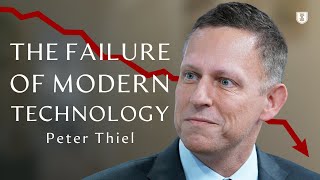
Peter Thiel on Technological Stagnation: The Failure of Modern Technology

What Thiel talks about
Peter Thiel gave this fireside chat interview at TechCrunch Disrupt SF in September 2014 about Zero to One, monopoly, startups, and the broader stagnation of modern technology.
Also known as: The Failure of Modern Technology; TechCrunch Disrupt SF 2014 fireside chat.
Peter Thiel argues that modern society has become too conformist to produce bold new ideas, and he links that problem to political correctness, academia, and venture culture. He frames entrepreneurship as a contrarian act that should aim at creating something singular, not merely competing in crowded markets.
He says technological progress has become lopsided: software and the internet have advanced, but areas like energy, medicine, transport, and atom-based innovation have stalled. Thiel connects that stagnation to regulation, institutional incentives, and a broader cultural loss of confidence in the future.
Thiel speaks throughout, with an interviewer moderating and asking audience questions near the end.
In his words
“Courage is in far shorter supply than genius”
“All happy companies are different”
“Competition is for losers”
“What great company is nobody building?”
“We've been wandering in a desert for the last 40 years”
Key points
- Courage is scarcer than genius, and social pressure discourages heterodox ideas before they form.
- Great companies are different; the goal of a founder should be monopoly, not competition.
- Modern universities and peer review reward conformity, grant-writing, and safe research over truth-seeking.
- Technological progress has been strong in bits but weak in atoms: energy, transportation, medicine, and food innovation have stagnated.
- Regulation makes atom-based innovation far harder than software, skewing talent toward easier, less impactful work.
- The 1970s marked a turning point when cultural and institutional stagnation set in.
- Contrarian thinking requires asking uncomfortable questions and rejecting formulaic life paths.
Full transcript: Peter Thiel, TechCrunch Disrupt fireside chat (2014)
We live in a world in which I think courage is in far shorter supply than genius. There is this, uh, you know, there is this very strange phenomenon in Silicon Valley where, uh, so many of these successful companies were started by people who seem to be suffering from something like Aspergers or something, something like this. And, and, um, and I think we need to always flip this around, um, and, and, and see this as somewhat of an indictment of our, of our society where, um, if you are not suffering from Aspergers, if you're actually socially relatively well adapted, um, you will somehow be talked out of or discouraged, um, of any of the heterodox ideas you might have before
they're even, uh, even fully formed. And so, uh, you will sense the ideas are too weird, they don't fit in, people will not like you, they won't be your friends, and, uh, and so you should, uh, you should not pursue them. Chris, thank you so much for that, uh, phenomenal introduction, and, uh, it's a, it's really a tremendous honor and privilege to, um, um, be here tonight to, to speak to you. I, I, uh, you know, I was, uh, when I, when I started the Stanford Review back in, um, in 1987, we, uh, we sort of got this invitation to go to DC. We met with all
the, uh, other editors of these college newspapers and we sort of realized that even though we were kind of on our own, we were not totally on our own. And that's, uh, and so it's, you know, it's, it's, it's really tough to be a contrarian just by yourself and it's, it's always good to know that, uh, that we're not completely, completely isolated and, uh, it gave us a a lot of stamina as we, uh, as we went through the years, uh, to come. The debates over Western culture and political correctness and campus speech codes in, in one form, in one form or another, and, uh, you know, over the years, I've, I've, I, I've really come to believe that the, the greatest, uh, political problem that we have is this problem of political correctness, uh, properly
understood. And it is, it is, um, an unwillingness, uh, to think for oneself, uh, a fear of, um, of stepping outside of the bounds of, uh, the sort of this incredible pressure to conform in, in one way or another. And this is, I think, the, the, the core problem in our universities and the, uh, the core problem in our, um, in our society at large, um, and I'll, I'll talk about it a little bit tonight from a somewhat different perspective, from the perspective of science, technology, entrepreneurship, innovation, where I think many of these, uh, themes, um, are, are also reflected and, um, and, uh, there's some parallels that are, I think, very, uh, very important. So, you know, one of, one of the challenges in teaching about
entrepreneurship or teaching about how to, uh, start new businesses is that there is, there is actually no formula whatsoever. Uh, you know, science starts with the number two. Science starts with things that are repeatable, that are experimentally verifiable in one way or another, but, uh, but I think that, um, that all the really important things in our universe are singular and that, uh, um, every moment in the history of business, every moment in the history of technology, every moment in the history of our world happens only once. And, uh, and so, uh, and so that if you try to, uh, turn history or, uh, technology or business into some sort of a formula, um,
um, that will, that will not be a science. That will be a pseudoscience, um. And, uh, and so it is this sort of non-repeatability, this non—it's non—this non-mechanistic nature of, uh, of it that that is, is the starting point of, of, uh, of U of, of my book Zero to One, which is the question about how do, how does one create these singular fantastic new businesses, fantastic new ventures that will, um, that will change the world. The, um, you know, the opening, uh, sentence of, uh, Tolstoy's Anna Karenina is, uh, "All happy families are alike; all unhappy families are unhappy in their own special way," and I think, uh, I think the opposite is true of, of business. I think
all happy companies are different because they, uh, they came up with something that was, um, different and unique from the rest of the world. They differentiated themselves from everybody else, um, and, uh, and the, and the sort of politically incorrect word that I use to describe, um, really great businesses is that they are monopolies, and this is what you want to aim for. You don't want to be doing something that's interchangeable where you could be replaced, um, by, by lots of other people, um, and so as a founder, as an entrepreneur, you're always aiming for monopoly. Uh, on the other hand, on the other hand, um, all unhappy companies are alike because they fail to escape, escape the essential sameness that is
competition, um, and, uh, and I think this is, and so you do not want to be starting the fourth online pet food company or the 10th thin film solar panel company or the, uh, and I'm always nervous about even raising this one in this context, but, or the 10,000th restaurant in Manhattan, um, and, uh, and so if you want to, if you want a Darwinian competition, if you want nature, beard, dread and tooth and claw, you should always open a restaurant. If you want to make money, you should do something, something very different, um. The, uh, the Wall Street Journal excerpt of the chapter in my book, uh, "All Happy Companies Are Different," uh, and sort of gets to re—they sort of retitled it as "Competition Is for Losers," which is this, uh, sort of has a sort of much punchier
Ring to it, and it's extremely punchy because we always think of the losers as the people who are not good at competing. The losers are the people who somehow are not quite as good on the high school swim team or who don't get quite the high enough grades or test scores to get into the right college. But I think it is actually important to rethink this in some very, very deep ways. And when I, if I had to sort of give advice to my younger self—my teenage years, when I was in my 20s—there was a way in which I was insanely tracked. I was not completely conformist since I did start one of these student newspapers, and I did—you
know, break from the herd in all sorts of ways, but it was still enormously tracked. My 8th grade yearbook, one of my friends wrote, "In junior high school, I know you're going to make it to Stanford in four years." I got into Stanford four years later. I went to Stanford Law School. I ended up at a big law firm here in Manhattan. It was, on the outside, a place where everyone wanted to get in. On the inside, it was a place where everybody wanted to leave. And when I left after seven months and three days, one of the people down the hall from me said, "You know, I had no idea it was possible to escape from
Alcatraz," which of course was not literally true since all you had to do was go out the front door and not come back. But psychologically, this was not what people were capable of because when their identity was defined by competing so intensely with other people, they could not imagine leaving. And this is, I think, the big problem with competition: it focuses us on the people around us, and while we get better at the things we're competing on, we lose sight of anything that's important or transcendent or truly meaningful in our world. And I think that's what we need to always, always come back to.
And so I like to sort of get at this escape from competition, this move to Monopoly, this move towards doing something where, counterfactually, if you were not doing it, it wouldn't happen—something that's, through these sort of contrarian questions. The business one I like to always ask is, "What great company is nobody building?" The more intellectual one, which I like to ask and think is a fantastic interview question, is, "Tell me something that's true that almost nobody agrees with you on." And this is a shockingly hard question for people to answer, even when they can read on the internet that I always ask the question. And I think it's—
It's shockingly hard because people think it's shockingly hard. You sort of hear the question and you think, "Well, you know, it's just about—you have to come with something really brilliant and incredibly smart and esoteric. Maybe you've had to spend 10 years in some post-doctoral program before you can find out something idiosyncratic that no one has ever thought of." But if we were really honest about it, most of us have some answers to this question. And the actual reason that it's hard to answer is because, in an interview context, the correct answer is one that the person asking the question is unlikely to agree with. And so the correct and so, you know—
Answers like "God does not exist," or, you know, even answers like "The education system is screwed up." You know, the first one's untrue, the second one is true. These are very sort of conventional answers. And good answers are actually ones that are really uncomfortable. And we live in a world in which I think courage is in far shorter supply than genius. There is this very strange phenomenon in Silicon Valley where so many of these successful companies were started by people who seem to be suffering from something like Asperger's or something like this. And I think we need to always flip this around and see this as somewhat of an indictment of—
Our society where, if you are not suffering from Asperger's, if you're actually socially relatively well adapted, you will somehow be talked out of or discouraged from any of the heterodox ideas you might have before they're even fully formed. And so you will sense the ideas are too weird, they don't fit in, people will not like you, they won't be your friends, and so you should not pursue them. And, you know, with apologies to people who went to business school, if you—you know, I often think of the business school demographic as people who are sort of the anti-Asperger's demographic. They're sort of socially very well adapted. They're often sort of low conviction in one way or another. And you sort of put these—
People in a hot house environment for two years, and they've done studies on this. At the end of the two years, they always go into the wrong fields. They always sort of convince one another to sort of try to catch the last wave. And so at Harvard Business School in '89, everyone tried to work for Michael Milken, you know, sort of a year or two before he went to jail. They were never really interested in technology or Silicon Valley, except for '99, 2000, when they all flocked to Silicon Valley at the very end of the dot-com bubble, and on and on. And so I do think this problem of conformity is a very deep problem. You know, it's already in the time of Shakespeare the word "ape" meant both primate and to
imitate. And I would sort of then add the pre, the other Aristotelian concept of biology would be that man differs from the other animals in his greater aptitude for imitation. And so that—and this is how we, you know, this is how we learn language as children: we imitate. This is how culture gets transmitted. But then there are also all these ways that imitation can go very badly wrong, and it leads to crazed peer pressures, leads to the various insane bubbles that we've experienced as a society. And I think that, I think that if there are going to—if there is going to be progress, if there is going to be new
thinking in any direction, it often requires something that's very different in nature. And there is—there is this worry, of course, that our society has lost, has lost sort of the transcendent reference points. As we've lost these reference points, we've come to look more and more to one another, and we've become somehow more sheeplike, more herd-like, more lemming-like. And I think this is a very deep problem that one needs to think about. One needs to think about quite a bit. Now, you know, on this question of technology and science, I think one of the
big miscon—you know, one of the big misconceptions, I think it is, I'm not a techno-utopian. I don't think technology is the panacea or the solution for all the world's problems. I do think that it is one of the great achievements of the West. I think science and technology started in the West. There was something about Western civilization that enabled them to happen. We can have debates as to exactly what parts of the Western tradition really opened it up to scientific and technological innovation, but I think it has something to do with the freedom of individuals to think for themselves and
a way in which social conformity was not quite so overwhelming. And I worry that we are not actually living in as much of a scientific and technological age as is often advertised. If you, and you know, you can look at this from the perspective of Washington, D.C. You can look at this from the perspective of Hollywood. Certainly, in the world of Washington, D.C., there are 535 congressmen and senators. I once did a study on this. By a generous count, maybe 35 of them had a background in science, engineering, or technology. The rest of them do not know that windmills do not work when the wind is not blowing or that solar panels do not work at night. And you're basically stuck in the Middle Ages in one way or another. And then
from the perspective of Hollywood, when we sort of think about what does the technological future look like, we are told it will be just catastrophic and dystopian in every way imaginable, and that technology will destroy the world. And you can choose a future that looks at some combination of a Terminator movie or The Matrix or Avatar or Elysium. I watched the Gravity movie about a year ago, and it was sort of this disaster in outer space, and you watch the movie, you never want to go into outer space. You would be very happy to be back on some muddy tropical island. And, you know, I don't think it's—I'm not even, you know, blaming Hollywood or D.C. altogether. I think they both, in
many ways, more reflect our society than they created. They do both—they both reflect and create, but I think it's often more a reflection of this sort of technological inertia in one way or another. I think there's been, if we sort of look at the last few decades, 40, 50, you know, since the '70s, I think there has been enormous progress in the world of computers, internet, mobile internet, the world of information technology. But there are many other areas where I think things have stalled rather badly, if we were to be honest about it. So, and I think everything in the world of atoms rather than bits has seen
Much less progress, and so, uh, so things that—and, and we don't even consider these to be technology anymore, but the categories people would have talked about in the 1950s and 1960s: nuclear power, electricity too cheap to meter, uh, in Eisenhower's "Atoms for Peace" speech, 1954, um, that's sort of, uh, is off the agenda; uh, supersonic travel, space, uh, travel, underwater cities, uh, turning deserts into farmland or forests, uh, um, the Green Revolution in food innovation, um, all these sorts of things have sort of, uh, petered out in various ways, uh, the, um, and as, as we've, as, as, um, biotechnology, medical technology still progressing but probably at a somewhat diminished rate, and, uh, and as these
areas have failed, uh, they sort of, there's certain hysteresis that kicks in where failure begets failure. And so, when Nixon declared war on cancer in 1970 and promised we were defeated by the bicentennial by 1976—44 years later, um, maybe we're 44 years closer to the goal by definition, but there's a sense we're more than six years away, um, um. It would be inconceivable to declare war on Alzheimer's or dementia, even if, you know, one out of three people at age 85 suffer from it, uh, and so there is sort of, um, much less of a, of an impetus for, uh, for these kinds of things in, in the society, uh, we, we now live in. Um, people often ask, you know, why this is, why, why has this, why has this happened? I always am nervous about answering questions that
start with why, but I'll give, um, let me give both a Libertarian and a, a, a conservative answer. You know, I think the, the Libertarian answer is that we've basically outlawed everything in the world of atoms. We've left the world of bits relatively unregulated. It costs $100,000 to start a computer software company; it costs you a billion dollars to get a new drug approved through the FDA, and therefore, um, it's not surprising that we live in a world where people start more, um, video game companies, and, uh, they don't actually work on drugs that would save people's lives. Um, and so I think there is sort of this, uh, this, there's sort of this, um, there's sort of this, uh, this extraordinary, uh, um, regulatory double standard, um, and then I
think, um, and then I think from a, uh, I think from a, um, from a more, uh, conservative perspective there is, um, there is sort of the sense that we've, um, we've, you know, we've become a more risk-averse society. We, we, we don't, um, we, we, uh, we've lost, we've lost, uh, we've lost, uh, hope for the future in all these, all these different ways, and, uh, and I think this, um, and I think this is sort of seeped in in all these, uh, subtle different ways. You know, it's, it's, it's, uh, it's, uh, we, we, there's, there's a Libertarian or conservative bias that the government can't do things, but, uh, but I don't think this is absolutely true. You know, the government did succeed in, um, the Manhattan Project in the
1940s, um, it did succeed in Apollo, there was the SDI effort in the '80s, which I think would have actually succeeded had it been continued. You know, we would actually have lasers that could shoot down ICBMs today had we actually kept working on it, and, um, and, uh, and, uh, we're now at a point where you can't even get a website for, uh, for, for Obamacare, and, um, and I, I think that, um, and, you know, um, whatever, whatever you, you know, whatever you think of the morality of nuclear weapons, I, I want to suggest that, uh, that, uh, that building an atomic bomb is a far harder, uh, undertaking than building, you know, building a, uh, building an internet website. And so, um, and so we should not
let our ideological biases, um, obscure the sort of objective decline that has happened. And I think, I think the universities have played a, a big role in this decline where, where, um, where, uh, you know, one of the ways that science happens is that it requires people to be, um, somewhat idiosyncratic, eccentric thinkers of one sort or another. And I think we've had sort of this Gresham's Law at work, sort of where the bad currency drives out the good, and, and the, um, the real scientists have been replaced by people who are nimble in the art of writing government grants, um, and sort of these politicians disguised as scientists who are good at, uh, at collecting money from the government. I think it's like this problem that already exists in the time of Plato. You
know, can the philosopher be a king? And philosopher is interested in the truth, the king is interested in power. And I think, uh, the, the sort of modern analog to that is can a scientist be a good politician? And I think the answer is almost always no, because a scientist is interested in truth and a politician is interested in getting money and lying about the truth. And, uh, and these two things are, are quite at odds. And so, as science has become politicized, and as you have sort of these grant writing, uh, processes where you, um, you sort of apply for grants, uh, and you'll get a grant if everyone thinks your experiment will succeed, you end up only doing experiments that everyone thinks will work. The experiments always—they mostly work, um, but, uh, but you never really push the envelope. You never really ask tough
questions, and, uh, and so I think, you know, it's always easiest for us to see a lot of the conformity and political correctness in the humanities. The sciences are always sort of hard and esoteric, and so, you know, who's really to say that there's no progress in, you know, quantum computing or in string theory—that that's all just sort of a fraud or that, you know, all these other areas, genomics, all these other areas are kind of, um, way overhyped. And it's, it's very hard because the, uh, progress in all these areas is evaluated by this peer review methodology where people sort of, um, sort of, uh, tell one another that all is well and everything is fantastic, and the public at large, um, is told that it's too stupid to possibly understand what is going on there. Occasionally there are some chinks in the armor. There's this very
You know, a disturbing set of studies where about half the articles printed in Science and Nature magazines, the two leading publications, involve experiments that cannot be repeated by anybody. And I do think, and I do think there's sort of an ideological version where there are certain areas of science that are just taboo. And so, if you're questioning Darwinism or if you're questioning climate change, you always get in trouble. And so, there are all these areas where there's conformity. One of my, one of the people I know at Stanford was a guy, Bob Laughlin, who is a professor in physics. He got a Nobel Prize in physics in the late '90s, and after he received his Nobel Prize, he suffered.
From the supreme delusion that he now had perfect academic freedom and he could look into any subject matter whatsoever, and this, uh, this turned out to be a very, very big mistake, and, uh, he decided to look into something far more controversial than questioning climate change or questioning Darwinism or, you know, any of any sort of, uh, uh, conventionally tabooed topics. And he decided to look into the question of how many scientists, or so-called scientists, were fraudulently ripping the government off. Um, and, um, and, uh, needless to say, this was a movie that did not end well for, for, for him. Um, one of my—one of my, uh, I sort of got the story from one of my good friends who was a PhD student of
Laughlin, at the time, and he'd come into their office once a week, and it would be... And of course, he was like a somewhat stubborn, somewhat eccentric person. Tell his grad students, you know, "I'm so proud of you. You're on the front lines of science, and we're battling all the frauds and imposters, and we're like—we're at war with the whole world to defend science from, uh, from all these fraudulent people stealing money from the government." They sort of had a public hearing where they denounced some of the offending scientists. It sort of all went rather haywire. He was quite promptly defunded by the peer review process. His grad students could no longer get PhDs because you can only get a PhD if you get some committee to approve of it. And, um, and that's—that's sort of that is.
Sort of what happens. And so I think this, uh, you know, I do think this problem of political correctness is this, this very, very broad problem that has, you know, that has many, uh, that has many different facets to it, and that we, we need to, uh, think through, uh, really, really hard. Um, there is, you know, there's always a question. Um, so the questions: how, you know, how we, how we got here, there questions, um, you know, how one, how one can sort of get out of this zone. Um, I think the, I think the, uh, the, the, the, the sort of the, the core framework I want to leave you with, and maybe open up some, some questions, is that, uh, I think the, you know, I think we are, we are in a world where, you know, a letter from an Einstein would get lost in the White House mailroom. There, all these things.
You could no longer— you could no longer do, uh, you know, we— we, and I think, you know, the history about the stagnation, sclerosis of, of the United States, the conservative versus liberal debate has always: When did this start? And, um, and I think the, you know, the liberals always say it started in the '80s with Reagan; the conservatives say it started in the '70s. And I think the conservatives are really right about that. And this is—this is why I think the 1970s were somehow an incredibly, uh, pivotal decade in the history of this country, and we should never, um, we— we always have to insist on, on going back to the history of the '70s as a, as a key point of, uh, departure of thinking through what, uh, what has gone, uh, wrong or why, why things have sort of flattened out not just in science and technology.
But in so many other fields, um, you know, it's, it's—we landed on the moon in July of 1969. Woodstock started three weeks later, and I think, with the benefit of hindsight, we can say that that's when the hippies took over the country and when the true sort of cultural war over this question of progress was somehow, was somehow lost. And the stagnation of the 70s, uh, 70s really set in. And I think that, uh, you know, if we are going to find a way back to the future, I think the first step, um, the first step, um, is to realize that we've been wandering in a desert for the last 40 years. Uh, and the first step to get out of the desert is to realize that we're in a desert and not in some sort
Of Enchanted Forest, thank you very much. Well, thank you very much, Peter, that was a terrific talk, and I've got about 65 questions, so it might be a long night. Uh, well, the first question—you don't have to answer this—but, uh, would you invest in a startup founded by ISIS students? There might be some folks here.
Soliciting contributions. Tonight, the first question is: how do students in the humanities go zero to one if they're unlikely to become entrepreneurs? Wow, that's always... that's always a really, really tough question because, um, because I do think, um, I do think there are many different kinds of things one can do. So I don't think the frontier is just around computers. I mean, I think there's sort of many different kinds of new things one can do. One has to think through really hard where to do it. Uh, I do think, um, I do think you have to be very... think really hard about whether to pursue a track within the university context and, you know.
I've spoken at great length in different contexts about the corruption of the university system. It's, uh, and, uh, and sort of, you know, if you pursue a degree in the humanities, you get a PhD in the humanities with the goal of getting a position at a university. I think this was a bad idea for conservatives already in the 80s. I suspect at this point it's even a bad idea for most liberals because I think most of the money is just being stolen by the administration. You know, even the, you know, there's sort of a certain sense of poetic justice where all the left-wing college professors are on minimum wage. But, um, but there is this, uh, there is this shocking generational decline that has happened, and so I think, you know, I...
I think there is, um, in general, there is no formula that we have anymore, and this is very disturbing because we've been brought up in a set of formulas. I think the millennial generation in the U.S. has been taught to be tracked and to be formul-, uh, in a formulaic way at a precise point when these formulas are breaking down. The analogy that I've used — and my apologies for repeating from earlier today — is that I think the universities face a crisis today comparable to the crisis the Catholic Church faced 500 years ago. And, um, it's a single uniform system, uh, in a way, the universities that we succeed — it's, I think it's an atheist — you can sort of think of the...
universities as the atheist Church. Um, there's less diversity than there was in the Catholic Church in 1514, so you had debates between the Dominicans and the Franciscans. At this point, you have much smaller debates between, you know, the Harvard and the Princeton political science faculty. But, um, but, we have sort of this idea, just like people had in 1514, that the secular salvation requires you to be involved in these universities, that you go to Yale or you go to jail; that, uh, that you have to pay more and more in indulgences to this sort of priestly or professorial or really administrative class of people; and that...
uh, um, and that, you know, if you get a diploma you'll be saved. If you do not get a diploma, you will sort of go to the secular equivalent of hell. And, um, and I think that I think the future is going to look somehow very different, and, uh, you know, we all have to think. You know, this is the disturbing message. I have a similar thought to that of the 16th-century reformers: you have to actually figure out how to save yourself to some extent because the institutions no longer are working. So the next question is, how was your contrarian attitude formed? What were the biggest influences on your...
thinking? This is always — I always, I'm always, um, I'm always hard-bad at answering these autobiographical questions. I think certainly, um, there was, you know, there was certainly grew up in an Evangelical Christian family. There was, there was certainly some of the political views I had didn't quite fit into the prevailing liberal orthodoxy; and so, um, and so there was, um, there was an openness even as an undergraduate to thinking that not everything that I'd been told was being told; not all the conventional truths were simply the truth. I think this is always a very important starting point to, to, to not sort of think...
that everything that we're being taught is absolutely sacred in this University context, and to realize that there are, um, there sort of are many ways in which even though we may have professors or people who are sort of much smarter or have higher IQs, they have themselves — they're themselves subject to the sort of social vortex where maybe, um, maybe they're not as objective about things as they might be. So, I think there were sort of a whole bunch of different factors like this that came together. There's a number of questions about Bitcoin and Apple Pay, so given your PayPal experience, and I don't know if you have any other investments in kind of the new currency areas, but, uh...
just thoughts on alternatives to the U.S. dollar? Well, there's, there's, you know, there is sort of a, um, there are lots of problems with fiat money. Uh, the challenge with creating alternatives to the U.S. dollar is that most of the other currencies in the world today are probably even worse. So the Euro seems worse, the Yen seems worse, um, the Ruble seems somewhat worse. Um, and then the question is whether you can, um, you know, whether you can create some new currencies where the government cannot simply inflate them away. And we certainly had, as an idea at PayPal, we had these t-shirts back in 2000 where PayPal was going to be the new world currency. Uh, we didn't succeed at building a new currency. Um, we...
succeeded at a new payment system, sort of a much lesser, lesser goal. Uh, the Bitcoin phenomenon is very, um, is very interesting, and it has at least succeeded in creating a currency on the level of speculation. Uh, it's still, uh, the critical challenge is to figure out ways to integrate that with, uh, with an actual payment system; and until that happens, you know, it's, it's very hard for things to change. Now, you know, one of the reasons I think the dollar money is always this super mysterious thing: when I was, you know, when I was, um, you know, one of the props I used at PayPal when I ran it was to always hold up a $100 bill, and it was sort of like this almost hypnotic thing you could get people's attention if you hold up money you sort of...
Ask, "Why does this have value? What is it about this that actually has value?" It's, you know, it's just a piece of paper. It's not very hygienic; it's dirty. It has no use value. You wouldn't use it as wallpaper; you wouldn't want to use it as toilet paper. Um, and, um, and I think, um, I think there's sort of all sorts of different... um, it's very... it's, you know, the more you think about it, the more mysterious it actually gets, uh, what money really is. Uh, one thought on why it's quite hard to simply replace the dollar, though, is that, uh, you know, it's, um, you know, it says, you know, this note is legal tender for all debts, public and private. And so you have public debts like taxes, and you need dollars to pay taxes. You can't have Bitcoins to pay taxes. And if you don't
use dollars to pay taxes, there will be people who will come with guns after you to make sure you pay your taxes in dollars and so on. Some level, you know, the U.S. dollar as the reserve currency in the world, as imperfect as it is with fiat money and all and all such, is, you know, it is driven by the supremacy of American military power. And, uh, and until, until you, um, you know, I know if we should change that, but that is sort of what it's, uh, what it's linked on some deep level. And the last question we'll have to end with, if you could assign—it's also kind of one of these personal questions—but if you could assign one required great book for undergraduates, what would it be and why? You know, I think that's almost
that's almost a self-contradictory question since, uh, since, uh, you know, I'd probably just go with the Bible. You go with the Bible, but, but, but if you, if you went—if you went with sort of the University of Chicago "Great Books," it's always a great books tradition in the plural, and so somehow you're supposed to study these books in connection to one another. Uh, and so, uh, there is some sense in which, um, you're not—the great books tradition is one where you try to read a whole number of them and see them as, you know, as connected to one another. And so, uh, so it's probably—it's probably a mistake in that context to, to just read one, any one book.
From YouTube captions, lightly punctuated for readability. Timestamps link to the video above. Errors are possible.
Cite this recording
Peter Thiel, “TechCrunch Disrupt fireside chat (2014)”, TechCrunch Disrupt SF 2014, September 2014. Transcript and video: Thinkers Archive, https://thinkersarchive.com/peter-thiel/technological-stagnation-techcrunch-disrupt-2014/
Quoting a passage? Link to its exact moment: every timestamp above has its own anchor (for example https://thinkersarchive.com/peter-thiel/technological-stagnation-techcrunch-disrupt-2014/#t-129).