Peter Thiel on Silicon Valley
Peter Thiel sees Silicon Valley as a place of real software innovation and wealth creation that has also become conformist, politically distorting, and too disconnected from broader national progress.
- Silicon Valley is powerful because tech products scale through distribution and network effects, not just good ideas.
- It still produces real progress in software, but far less in the physical world than people hoped.
- Thiel thinks the Valley has become highly conformist while presenting itself as diverse and open-minded.
- California shows the downside of tech wealth: political capture, bad governance, and asset inflation without broad prosperity.
- He judges Silicon Valley by whether it helps rebuild American strength, not by prestige or ideology alone.
“Think Different. That's the Silicon Valley 2018: Think the Same.”Rubin Report interview, 2017 · 15:20
Silicon Valley works because technology can scale fast
Thiel’s view starts with a practical strength: Silicon Valley is unusually good at turning software into products that spread quickly. In consumer tech, he stresses that success depends less on the raw idea than on getting distribution right and building something that can ride network effects.1
That helps explain why he has long taken Silicon Valley seriously as an engine of wealth and influence. Products that solve a coordination problem early can become dominant because scale compounds, which is why the Valley matters so much economically and culturally.12
Its achievement is real, but too narrow
Thiel does not dismiss Silicon Valley as fake progress. He thinks it delivered something meaningful in computing and information technology, but he also argues that this success has been far narrower than the culture around it admits. The basic pattern is strong progress in bits and weak progress in the physical world.345
That is why his criticism of Silicon Valley is not that it failed at everything. It is that one sector advanced while energy, transportation, and other material domains lagged, creating a misleading sense that society as a whole was innovating rapidly.345
The Valley talks originality but rewards conformity
One of Thiel’s sharpest complaints is that Silicon Valley became intellectually narrower as it became more successful. He argues that the culture celebrates dissent in slogan form while punishing it in practice, so apparent diversity can coexist with strong pressure to stay inside a shared orthodoxy.678
For Thiel, this matters because real breakthroughs require social courage, not just intelligence. If people are afraid to pursue unpopular views or ask unfashionable questions, then even a rich and technically sophisticated ecosystem will drift toward imitation and safe consensus.910
That is why he keeps returning to contrarian questions. He sees the founder’s job not as joining crowded competition but as building something singular that others are missing because the environment discourages independent judgment.1011
California reveals the political downside of tech wealth
Thiel treats California as the clearest case of Silicon Valley’s contradictions. Tech can generate immense wealth, but that very success can distort politics, inflate assets, and coexist with poor public performance. He describes this as a modern resource curse, where a narrow boom masks deeper dysfunction.1213
In this view, Silicon Valley did not simply enrich California; it also made failure easier to tolerate. The state can remain economically formidable even while housing, governance, and public services deteriorate, because tech wealth and network concentration keep pulling talent and capital back in.141213
So Thiel’s criticism is not anti-technology. It is that concentrated tech success can hide institutional weakness and redirect gains into real estate and political power instead of broader prosperity.1213
Silicon Valley is not enough to solve national problems
Thiel does not think America can rely on Silicon Valley to compensate for failing institutions. He argues that technology cannot substitute for politics, and he contrasts the standards of competence expected in tech with the failures tolerated in government.1516
This is why he links Silicon Valley to a broader national question: does it actually help rebuild the country? If the Valley produces fortunes and software tools while wages stagnate, public systems decay, and policy remains distracted, then its success is incomplete on his terms.171819
He also suggests that talking about obvious problems is easier than fixing them. So even clear diagnosis, including his own, is not enough unless it turns into institutional change beyond the tech sector.202122
Thiel on silicon valley, in his own words
“Think Different. That's the Silicon Valley 2018: Think the Same.”
“…you don't have real diversity when you just have a group of people who look different and think alike…”
Where to watch
 Peter Thiel on Tech Curse: Why California Distorts Politics2022 · 38 min · full transcriptBest single treatment of how Silicon Valley wealth distorts California politics, housing, and governance.
 Peter Thiel on Contrarian Thinking: Why the Tracks Stop Working2017 · 131 min · full transcriptBest for Thiel’s inside view of Silicon Valley business mechanics, groupthink, and contrarian thinking.
 Peter Thiel on National Interest: From Stagnation to Exceptionalism2023 · 40 min · full transcriptBest for his national-interest test: what Silicon Valley delivered, and what it failed to deliver.
 Peter Thiel on Technological Stagnation: The Failure of Modern Technology2014 · 36 min · full transcriptBest for his core critique of stagnation, conformity, and the need for courage in tech.
 Peter Thiel on AI and Technological Stagnation: Politics, Power, and the Future2024 · 211 min · full transcriptBest for his recent view of California’s resilience, AI centralization, and why obvious problems persist.
Questions people ask
- How does Peter Thiel decide what to work on?
- What did Peter Thiel say about political correctness and conformity in Silicon Valley?
- What did Peter Thiel say about the tech curse?
- What did Peter Thiel say about Silicon Valley and China?
- Why did Peter Thiel say China should be taken more seriously?
- Why did Peter Thiel say fake culture wars are a distraction?
Sources
Every quote above, word for word from the transcripts. Numbers match the text.
“The critical question for any consumer internet product is always not what the idea is but how do you get it out…”
“It turns out people aren't, weren't really interested in that. They weren't really interested in sense of a fictional, an online persona. It was much more about real identity. And somehow Facebook was the first one to crack the problem of real identity where, you know, even those always a little bit curated, certainly for the most part, people on Facebook are who they say they are. Yeah. For the most part at least. So am I mistaken, you're the only person who's been on the board of Facebook the entire way out except for Mark, right?”
“…we maybe we've built the Star Trek computer, but we don't have anything else from the Star Trek universe…”
“…we're promised flying cars and all we got was a 140 characters…”
“…we've been wandering in a desert for the last 40 years…”
“Think Different. That's the Silicon Valley 2018: Think the Same.”
“…you don't have real diversity when you just have a group of people who look different and think alike…”
“And so the the the way... My my read on on Silicon Valley is that it's much... It has much more the feel of a one party state where everything is regimented and everybody has to follow a particular party line. And, you know, the problem is is is not that, you know, the unanimity is not a sign that you've just converged on the truth. You know, if you got... If had... In a democracy, we believe, you know, 51% is generally right, 70 to 80% is even more right. But when you're at 99.99%, no. It's... You're in North Korea. And the problem is the problem is that it it is... There's some sort of soft totalitarianism that's creating an incredible conformity. So I think, yeah, think people have have short bullet point answers on things, but they have actually not thought about them.”
“…courage is in far shorter supply than genius…”
“What great company is nobody building?”
“And so I like to sort of get at this escape from competition, this move to Monopoly, this move towards doing something where, counterfactually, if you were not doing it, it wouldn't happen—something that's, through these sort of contrarian questions. The business one I like to always ask is, "What great company is nobody building?" The more intellectual one, which I like to ask and think is a fantastic interview question, is, "Tell me something that's true that almost nobody agrees with you on." And this is a shockingly hard question for people to answer, even when they can read on the internet that I always ask the question. And I think it's—…”
“…we should think of tech as the oil of the 21st century…”
“Tech curse, and then three variations on it as a problem for California, a problem for the Democrats, and a problem for the Republicans, and so very straightforward. Let's, uh, let's start by defining the tech curse. Um, it is, um, it's equivalent to the natural resource curse, the oil curse, where, uh, if you have a country with, uh, with, um, you know, sort of an enormous gusher of wealth, it often leads to sort of extraordinary social and political misgovernance. And basically, you know, the nutshell version of it is that we should think of tech as the oil of the 21st century, and you can sort of…”
“…how does one, how do we do better than California?”
“…technology is no alternative to politics.”
“We don't accept such incompetence in Silicon Valley, and we must not accept it from our government.”
“It's time to end the era of stupid wars and rebuild our country.”
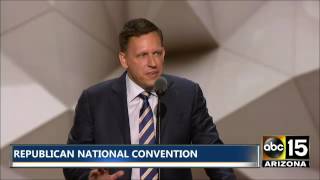
“Every plank in our party's platform but fake culture wars only distract us from our economic decline, and nobody in this race is being honest about it except Donald Trump. While it is fitting to talk about who we are today, it's even more important to remember where we came from. For me, that is Cleveland and the bright future it promised. When Donald Trump asked us to make America great again, he's not suggesting a return to the past. He's running to lead us back to that bright.”
“War in Libya, and today it's a training ground for ISIS. On this most important issue, Donald Trump is right: it's time. It's time to end the era of stupid wars and rebuild our country. When I was a kid, the great debate was about how to defeat the Soviet Union, and we won. Now, we are told—now we are told that the great debate is about who gets to use which bathroom. This is a distraction from our real problems. Who…”
“Strategy is often a euphemism for procrastination.”
“I don't know what to do about these things, but my facile answer is always the first step is to talk about them.”
“Because, you know, I I I I think I think there there... It is always this strange thing where there's so many of these things where we can... You know, where somehow talking about things is the first step, but then it also becomes the excuse for for not doing not doing more, not not really solving them. You know, there's all this... There probably are all these dietary things where you sort of know what you're supposed to do. And then if you know what you're supposed to do, maybe that's that's good enough, and you can still have one piece of chocolate cake before you go on the diet tomorrow or whatever. And and so it sort of becomes this... You know? And so somehow figuring out a way to turn this knowledge into something actionable is always always the thing that's that's tricky.”
How this guide was made: drafted with AI from the full transcripts of the recordings cited, then checked: every quotation must match a transcript word for word and be the speaker's own words, and an independent review gates accuracy. Methodology and corrections.