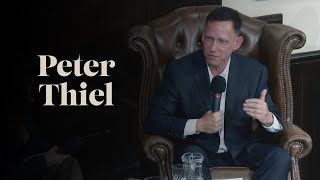
Peter Thiel on Death And Aging
Peter Thiel sees death and aging as problems to fight, and he thinks the real barrier is a culture of scientific and technological stagnation rather than natural necessity.
- Thiel treats death as an enemy, not a source of meaning.
- He thinks science has become too timid and incremental, especially in medicine and biotech.
- He links slow progress on aging to a broader pattern of stagnation outside computers.
- He believes we do not know the limits of science and should keep pushing for real breakthroughs.
Death is a problem to solve, not a limit to romanticize
Thiel’s starting point is stark: death is bad, and he rejects the idea that it carries some deep built-in value or wisdom. He does not frame mortality as something to make peace with so much as something human beings should resist.1
That view matters because it changes the moral posture of medicine and technology. If death is an enemy, then work on aging, disease, and decline is not vanity or distraction; it is one of the most serious things civilization can do.1
The real obstacle is stagnation, not reckless ambition
Thiel argues that the biggest problem in science today is not excessive boldness. In his view, the culture has become too cautious, too bureaucratic, and too willing to settle for small steps.23
He extends this beyond one field. Again and again, he says modern society has become risk-averse, overregulated, and incrementalist, which blocks breakthroughs in the physical world. Aging research sits inside that broader pattern.345
This is why he pushes back against the idea that we have already reached the frontier of what is possible. He thinks the deeper failure is a lack of ambition and courage to pursue discoveries that would change the human condition.67
Slow progress on aging reflects a wider failure in medicine and the 'world of stuff'
Thiel’s view on death and aging is part of his larger diagnosis of lopsided progress. Computers moved fast, but many areas that affect the body and material life did not. He uses the contrast between glamorous digital change and missing breakthroughs in the physical world to show how far expectations have fallen.89
He repeatedly argues that medicine, energy, transportation, and biotech have underperformed for decades. So when he talks about aging, he is not isolating one neglected cause; he is pointing to a civilization-wide slowdown in fields where progress would matter most.10911
For Thiel, this failure is especially costly in developed countries, where further improvement depends less on copying old solutions and more on genuine invention. Extending healthy life would be one of the clearest examples of that kind of real progress.121314
He wants vertical breakthroughs, not just more management of decline
A core distinction in Thiel’s thinking is between copying what already works and creating something fundamentally new. Applied to death and aging, that means he is not mainly interested in making an unsatisfying system slightly more efficient. He wants step-change advances that alter what medicine can do.1413
He is drawn to concrete visions of the future rather than vague optimism. In this frame, success would not mean nicer language about wellness or better administration of old age. It would mean actual capabilities that reduce disease, frailty, and mortality.1516
That also explains why he asks contrarian questions. Progress on aging will likely come from people willing to pursue truths and projects that established institutions neglect or dismiss.17186
What this means in practice: refuse resignation and back bold science
The practical lesson from Thiel’s view is to treat aging as an open scientific frontier, not a closed philosophical issue. He explicitly rejects the belief that everything important has already been discovered or that current limits define permanent limits.7
At the cultural level, his message is to stop mistaking caution for wisdom. If society wants better outcomes on aging, it needs more tolerance for risk, more appetite for breakthrough research, and less acceptance of systems that default to delay and incrementalism.342
At the personal and institutional level, the question becomes where genuinely new progress could happen if someone decided to pursue it seriously. That is the same pattern behind his broader approach to innovation: look for the important thing nobody is building and build it.1718

“Well, I, I think, I don't think we're at the end of history. I don't think we know everything. I certainly refuse to believe that everything has been discovered that's going to be discovered. And I think there are all sorts of contexts where we can still come to understand new things.”Socrates in the City interview, 2020 · full transcript →
Thiel on death and aging, in his own words
“Well, I, I think, I don't think we're at the end of history. I don't think we know everything. I certainly refuse to believe that everything has been discovered that's going to be discovered. And I think there are all sorts of contexts where we can still come to understand new things.”
Where to watch
 Peter Thiel on Death and Technological Progress: Stagnation vs. Hope2023 · 103 min · full transcriptHis clearest and most direct statement that death should be fought and that scientific culture has become too timid.
 Peter Thiel on Technological Stagnation: Flying Cars vs. 140 Characters2021 · 57 min · full transcriptBest short overview of his stagnation thesis and why he thinks culture and regulation have slowed real-world progress.
 Peter Thiel on Innovation and Stagnation: Why America Stopped Progressing2012 · 37 min · full transcriptShows how he connects weak progress in medicine and other physical industries to broader economic and social stagnation.
 Peter Thiel on Technological Stagnation: Why Progress Slowed2020 · 77 min · full transcriptUseful for understanding his distinction between copying existing solutions and making real breakthroughs.
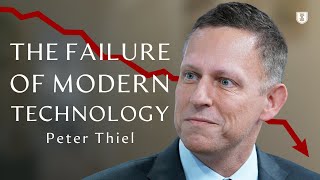 Peter Thiel on Technological Stagnation: The Failure of Modern Technology2014 · 36 min · full transcriptExplains why courage, contrarian thinking, and nonconformity matter for breakthrough science.
Questions people ask
- How does Peter Thiel decide what to work on?
- Why did Peter Thiel think government was blocking innovation?
- Why does Peter Thiel think innovation has slowed down?
- Why is Peter Thiel hopeful about the future despite technological stagnation?
- What did Peter Thiel say is the only optimistic scenario for the world?
Sources
Every quote above, word for word from the transcripts. Numbers match the text.
“…there is no meaning in death…”
“…the problem with the culture of science today is not Promethean hubris…”
“…it's a cultural decision: we've become risk-averse; we've been regulated to death…”
“I think it is not a fact of nature that the slowdown has happened. It's a cultural decision: we've become risk-averse; we've been regulated to death; we've become, um, incrementalist; and we're not willing to, uh, really, uh, take the bold steps. We've talked ourselves into thinking that, uh, that throwing, um, throwing Angry Birds at pigs is the best we can do. And that's, and I think we can do better.”
“A culture of accelerating progress is rare.”
“…courage is in far shorter supply than genius…”
“Well, I, I think, I don't think we're at the end of history. I don't think we know everything. I certainly refuse to believe that everything has been discovered that's going to be discovered. And I think there are all sorts of contexts where we can still come to understand new things.”
“We wanted flying cars. Instead, we got 140 characters.”
“We've basically outlawed everything having to do with the world of stuff.”
“…we've had basically no progress on energy…”
“…we've been wandering in a desert for the last 40 years…”
“…the part of the world where technology is really necessary for things to get better is the developed world…”
“What I'm interested in is vertical growth, intensive growth, doing fundamentally new things.”
“Horizontal or extensive growth, which involves copying things that work…”
“The powerful images of the future are concrete, they're specific…”
“I think we can be doing a lot better.”
“What great company is nobody building?”
“And so I like to sort of get at this escape from competition, this move to Monopoly, this move towards doing something where, counterfactually, if you were not doing it, it wouldn't happen—something that's, through these sort of contrarian questions. The business one I like to always ask is, "What great company is nobody building?" The more intellectual one, which I like to ask and think is a fantastic interview question, is, "Tell me something that's true that almost nobody agrees with you on." And this is a shockingly hard question for people to answer, even when they can read on the internet that I always ask the question. And I think it's—…”
How this guide was made: drafted with AI from the full transcripts of the recordings cited, then checked: every quotation must match a transcript word for word and be the speaker's own words, and an independent review gates accuracy. Methodology and corrections.