Peter Thiel on Thinking For Yourself: Q&A on The Tim Ferriss Show

What Thiel talks about
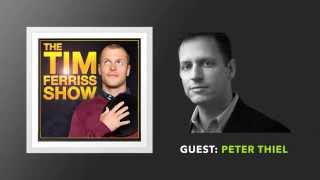
Peter Thiel joined this Q&A podcast on The Tim Ferriss Show in 2014 to discuss independent thinking, technology versus globalization, investing, entrepreneurship, education, and acting with conviction.
Also known as: How to Think for Yourself; Peter Thiel Interview Full Episode; The Tim Ferriss Show podcast interview.
Peter Thiel uses this Q&A to make the case for independent thinking: question convention, avoid trends, and look for truths that few people accept. He repeatedly argues that technology, not globalization, is the main engine of progress.
He also discusses investing, entrepreneurship, education, and the limits of learning from failure. Across those topics, Thiel emphasizes conviction, unique missions, and doing things sooner rather than waiting for the “right” moment.
Tim Ferriss introduces the episode, Blake Masters reads the questions, and Thiel answers throughout.
In his words
“Technology is far more important in our world than globalization”
“Capitalism and competition are synonyms, I think they are antonyms”
“Failure is massively overrated”
“We need to find a way for there to be just more growth in our overall economy”
“There are many great secrets left to be unlocked”
Key points
- Technology matters more than globalization for progress in the twenty-first century.
- Competition and capitalism are not the same; true capitalism depends on profits and differentiation.
- Investors should avoid “spray and pray” portfolios and concentrate on companies they deeply believe in.
- Failure is overrated; most business failures are overdetermined and teach little.
- Thiel prefers unique missions over following popular tech trends.
- He criticizes one-size-fits-all education and favors learning over credentialing.
- He wants more active progress against aging and death.
Full transcript: Peter Thiel, Tim Ferriss Show Q&A on thinking for yourself (2014)
Tim FerrissHello, ladies and gentlemen. This is Tim Ferriss, and welcome to the Tim Ferriss Show. This episode is an exciting one, and I will start with a quote. And the quote is from Robert Frost. It is freedom lies and being bold. If anything, our guest, this episode is about being bold. His name is Peter Thiel, and he is a serial tech founder, PayPal, Palantir, billionaire investor, and author of the new book, Zero to One. I'll come back to all of those things. But whether you want to be a better investor, I've certainly modeled Peter and have him to thank, I think, for many of my best decisions in the world of investing. A better entrepreneur or simply a free thinker who wants to do great things, create more value, I highly recommend not only this interview, but certainly that you read Zero to One, which is a collection of many of his teachings on differentiation, value creation, competition.
It is a treasure trove. Now, Peter. Who is Peter? And if you're not familiar with him, I'll give you a quick snapshot. He co founded in 1998 PayPal. That was the beginning, which was sold to eBay in 2002 for $1,500,000,000. But more notable, I think, is the team that he helped to assemble. And these individuals known now as the PayPal mafia, that's what they're referred to as, went on to launch a raft of companies that have become household names, including at least seven now valued at more than $1,000,000,000. I mean, literally, almost every single person on the founding team, if not every person, has gone on to create multibillion dollar companies. You have Tesla and SpaceX, co founded by Elon Musk, LinkedIn, of course, Reid Hoffman, YouTube, Steve Chen, Chad Hurley, Jawed, Yelp, Jeremy Stopperman, Russell Simmons, Yammer, David Sachs, and the data mining company Palantir, which Thiel himself, cofounded in 2004.
He was also the first outside investor in Facebook and has invested in more than 100 startups. He has done a lot. He has learned a lot. And perhaps most important, he consistently questions assumptions and thinks differently. So I don't want to delay this any further, but I will say this interview was an experiment. I was on sick leave, so we did it asynchronously. What you will hear is Blake Masters, who's a co author on zero to one, reading the questions, Peter answering them because I was unable to be there in person, although I have met Peter on a few occasions before. There are also written questions and answers, and you can find those written questions and answers on the blog. Go to 4hourworkweek.com/podcast. Click on this episode, and it'll take you to the right place.
So without further ado, I hope you enjoy this interview. Please share your thoughts on Twitter at t ferris. That is me, two r's, two s's, or on Facebook at slash tim ferris, two r's, two s's. And thank you so much for listening.
Peter ThielOptimal minimal. At this altitude, I can run flat out for a half mile before my hands start to shake.
Podcast outroCan I answer your personal question?
Peter ThielNow we're just seeing a birthday
Podcast outrocoming in.
Peter ThielWhat it's like to be I'm a cybernetic organism, living tissue over metal endoskeleton. Hello, this is Peter Thiel. I'm happy to be here on the Tim Ferris Show. Thank you for having me. Since Tim is out, my co author Blake Masters is the voice you hear asking questions that came from Tim and his audience. Let's get started.
Blake MastersWhat do you believe that very few others do?
Peter ThielWell, for starters, I think this is a much harder question to answer than it sounds. I give a number of different answers in my book. One high level answer is that I think technology is far more important in our world than globalization, even though we're in a world where people are very focused on globalization, on copying things that work, and much less on technology, on doing new things. And I think we need to shift that hierarchy around, and we need to see technology as the main driver for progress in the twenty first century. A second answer that I come to on the business side, that I think is quite contrarian, is that whereas most people believe that capitalism and competition are synonyms, I think they are antonyms. A capitalist is someone who's in the business of accumulating capital. In a world of perfect competition, all the capital is competed away.
And so, for example, the restaurant industry in San Francisco is incredibly competitive, but not very capitalistic, because no one ever makes any money at it. Whereas Google is a very capitalistic company, which has made enormous profits for the last dozen years, but has had no real competition ever since it's definitively distanced itself from Yahoo! And Microsoft around 2002. What do you wish you had known about business twenty years ago? If you go back twenty, twenty five years, I wish I would have known that there was no need to wait. I went to college, I went to law school, I worked in law and banking, though not for terribly long. But not until I really started PayPal did I fully realize that you don't have to wait to start something. So if you're planning to do something with your life, if you have a ten year plan of how to get there, you should ask, why can't you do this in six months?
Sometimes you have to actually go through the ten year, complex ten year trajectory, but it's at least worth asking whether that's just a story you're telling yourself, or whether that's the reality.
Blake MastersHow important is failure in business?
Peter ThielWell, think failure is massively overrated. Most businesses fail for more than one reason, and so when a business fails, you often don't learn anything at all, because the failure was overdetermined. You will think it failed for reason number one, but it failed for reasons numbers one through five, and so the next business you start will fail for reason number two, and then for three, and so on. And so I think people actually do not learn very much from failure, and I think it ends up being quite damaging and demoralising to people in the long run. My sense is that the death of every business is a tragedy. It's not some sort of beautiful aesthetic, where there's a lot of carnage, but that's how progress happens, and it's not some sort of educational imperative. So I think failure is neither a Darwinian nor an educational imperative.
Failure is always simply a tragedy.
Blake MastersWhen you hear the word
Peter Thielsuccessful, who's the first person
Blake Mastersyou think of, and why?
Peter ThielMark Zuckerberg. The why seems silly. He's done tremendously well. Or someone like Elon Musk, where you've had a serial entrepreneur who's created multiple mega billion dollar companies in the last few decades. What I think people like Zuckerberg or Musk, or Jeff Bezos at Amazon have in common is that they're relentless, they don't stop. Every day they start over, do more, and get better at it. People often ask whether Facebook was just a fluke in the right place at the right time, but I think the more you get to know Mark or founders like him, the less plausible it becomes, and that's in part because you can see how hard he works, how much planning there was, how much of a vision there was from the very beginning.
Blake MastersWhere do you see Bitcoin going or not going in the future?
Peter ThielBitcoin is trying to struggle with many of the same issues PayPal encountered when we started it in the late '90s. We too tried to create a new currency, and we started by creating a new payment system. PayPal worked by linking money and email, and became very powerful on that score, although it never quite achieved its goal of creating a completely new currency. I think bitcoin in some ways is the opposite configuration of PayPal. It has succeeded in creating a new currency, but perhaps not yet a new payment system. And so people are speculating in bitcoin as a store of value, but they're not yet using Bitcoin that extensively to transact. For Bitcoin to really succeed, I think it will have to be not just a currency, but also a payment system.
What are the biggest tech trends that you see defining the future? I don't like talking in terms of tech trends, because I think once you have a trend, you have many people doing it, and once you have many people doing something, you have lots of competition and little differentiation. You generally never want to be part of a popular trend. You do not want to be the fourth online pet food company in the late nineties, you do not want to be the twelfth thin panel solar company in the last decade, and you don't want to be the nth company of any particular trend. So I think trends are often things to avoid. What I prefer over trends is a sense of mission, that you're working on a unique problem that people are not solving elsewhere. When Elon Musk started SpaceX, they set out the mission to go to Mars. You may agree or disagree with that as a mission statement, but it was a problem that was not gonna be solved outside of SpaceX, and all the people working there knew that, and it motivated them tremendously.
So I think unique missions are much to be preferred over trends. It is because every moment in technology happens only once, and it's always a unique constellation of technologies and people and the world where the time is right, right now, for a new kind of thing to come about. Why do so many investors spray and pray instead of focusing on just five to seven companies in each fund like you
Blake Mastersdo at Founders Fund? And, second part of the question, do you have any rules that you follow, or tips for those who want to invest in early stage ventures more intelligently?
Peter ThielI think people would say that they spray and pray because of some sort of portfolio theory, some sort of diversification theory. And if that's true, that might work. I don't actually believe that to be true. I think the real reason people spray and pray in their investing is that they are lacking in any conviction, and perhaps because they're too lazy to really spend the time to try to figure out what companies are ultimately going to work. One of the reasons I do not like that sort of approach to investing is that I don't think it's good to treat companies as lottery tickets. I think it's terrible to treat the founders of companies as lottery tickets. And I think it's actually not just sort of a bad thing morally to treat people as lottery tickets, I also think it's really bad as an investor. As an investor, you know, once you say that there's a small probability of a big payoff, small number times big number normally equals a small number.
And so once you're thinking in lottery ticket terms, you've already psyched yourself into writing checks without thinking and therefore losing money. And so I think the anti lottery ticket approach is to try to be concentrated, because that forces you to have high levels of conviction before you write a check of any size, and then I think you'll do much better. What problem do you face every day that nobody has solved yet? Well, the problem that I remain the most passionate about is for us to make some real and continued progress in the fight against aging and death. This is not just a problem I face, it's a problem everybody on this planet faces. We have about one hundred thousand people a day who die, mostly from diseases linked to old age. So what I always find extraordinary is how little we're doing about this problem.
It seems that people are either in a mode of denial or acceptance, which are in some ways opposite extremes, but they both have the effect of stopping you from doing anything. If you are in denial and say this is not a problem, or you accept it, say there's nothing you can do about it, both of these are sort of passive modes, and what I think we need is a much more active mode, and instead of being in denial or acceptance, I would like us to be spending a lot more time fighting death. There are people who say that death is natural, to which I think the response always has to be that there is nothing more natural for us than to fight death.
Blake MastersWhat would you say to the 9,700,000 unemployed people in America?
Peter ThielLet me give both a micro and a macro answer to this. On a micro answer, I don't think there's any sort of one size fits all approach. I think there are very different kinds of facts and circumstances in which people find themselves in, and I think that a reasonable approach would involve very careful looking at why people are there. Are they in a long term unemployed situation where they were working a rust belt factory with a job that no longer exists, Or are they a 20 college student who studied a major that was poorly advised and has accumulated a mountain of debt? And so I think we always wanna approach this with far more granularity, and that there's no sort of one size fits all approach. The macro answer though that I think is critical is that we need to find a way for there to be just more growth in our overall economy.
If The US economy was growing at a rate of 4% a year, I think these problems would broadly get solved. And the challenge has been that we've been having growth of one or 2% for the last seven, eight years, and that sort of growth rate is not enough to overcome structural unemployment. It's my view that technology is the key driver for growth, especially in a developed nation like The US, and therefore anything we can do to accelerate technological progress and technological innovation will increase growth and ultimately will increase opportunities for people throughout our society. How would you reply to someone who says that your position on college and higher education is hypocritical, since you yourself went to Stanford for both undergraduate and law school. Well, know, I think some people will always find objections of one sort or another.
Had I not gone to Stanford or law school, people would object and say that I had no idea what I was missing. So I think they're likely to complain in any event. But I would say my view is not hypocritical because I've never made the claim that there's a one size fits all. So if I said that nobody should go to college, that might be hypocritical, but what I have said is that not everybody should do the same thing, that there is something very odd about a society where the most talented people all get tracked towards the same elite colleges where they end up studying the same small number of subjects and going to the same small number of careers. And that strikes me as sort of a lack of diversity in our thinking about the kinds of things people should be doing that's very limiting for our society, as well as for those students. I certainly think I was guilty of very much of this myself.
If I look back on my Stanford undergraduate and law school years, it's possible I would do it again, but if I had to do something over, I would think about it much harder. I would ask questions, why am I doing this? Am I doing this just because I have good grades and test scores, and because I think it's prestigious, or am I doing this because I'm extremely passionate about practising law? So I think there are good answers, and there are bad answers, and my sort of retrospective on my early 20s is that I was way too focused on the wrong answers at the time. You studied philosophy as an undergraduate. What does philosophy have to
Blake Mastersdo with business, and how has your study of philosophy helped you in your investing and career today?
Peter ThielI'm not sure how much the formal study of philosophy matters, but I think the fundamental philosophical question is one that's important for all of us, and it's always this question of what do people agree merely by convention, and what is the truth? And this is always the fundamental distinction in a society, is there's a consensus of things that people believe to be true, and maybe the conventions are right, and maybe they're not. We never want to let a convention be a shortcut for truth. We always need to ask, is this true? And this is always where I get at with this indirect question, tell me something that's true that very few people agree with you on. Silicon Valley is a place that is laden with conventional thinking, and one of the reasons that it may afflict Silicon Valley even more than the rest of our society is that there are so few markers.
One of the things we're focused on in Silicon Valley is the future. And the future is not always a clear thing, people can be uncertain about it, and when they're uncertain about the future, they will try to find shortcuts involved looking at what other people say about the future, and when everybody simply is listening to everybody else, that's the definition of a bubble or of a mass psychosocial insanity. So I think this question of trying to think for yourself, trying to break through convention, is always important, but perhaps even more in Silicon Valley than most places.
Blake MastersWhat do you think the future of education looks like?
Peter ThielI don't like the word education because it is such an extraordinary abstraction. I'm very much in favor of learning. I'm much more skeptical of credentialing, or the abstraction called education. And so, there are all these granular questions, like what is it that you're learning, why are you learning it, are you going to college because it's a four year party, is it a consumption decision, is it an investment decision where you're investing in your future, is it insurance, Or is it a tournament where you're just beating other people? And our elite universities really like Studio fifty four, where it's like an exclusive nightclub. I think if we move beyond the education bubble that we're living in today, the future will be one in which people can speak about these things more clearly, and we will talk about, is it an investment decision, is it a tournament, is it a trade or vocational skill that you're developing?
I think engineering is the opposite of education, because it is actually a specific skill that people are learning. And it's sort of, engineering as a discipline cuts the most against the banality that we're always told that you're just learning how to learn, or you're not learning anything in particular, you don't know why you're learning things, engineering is sort of the anti education in that sense. And I think is in some ways a paradigm for the way I think it will be more in the future. I think we will have much less of a one size fits all approach. I think the big tracked institutions are delivering less and less, and charging more and more. And so I think we are sort of at a point where things will look very different. One of my friends suggested that we are at a point in education that's like the place where the Catholic church was on the eve of the Reformation, had become sort of a very corrupt institution, it was charging more and more for indulgences, people thought they could only get saved by going to the Catholic church, just like people today believe that salvation involves getting a college diploma, and if you don't get a college diploma, that you're gonna go to hell.
I think my answer is in some ways like that of the reformers in the sixteenth century. It is the same disturbing answer, that you're gonna have to figure out your salvation on your own.
Blake MastersWhat are your daily habits and routines?
Peter ThielI always feel I'm a terrible person answering that question, since things are very unstructured on many ways. But I'd say one thing that I try to do every day is to have a conversation with some of the smartest people I know and continue to develop my thinking. So I'm trying to learn new things. I find that I learn them from other people, and it's often people with whom I've had conversations for a long time. So it's not an MTV approach where you talk to a new smart person every day, it's one where you have sustained conversations with a group of friends or people you've been working with for a long time, and you come back to thinking about some of these questions. And that's how I find I really continue to learn every day and expand my thinking about the world.
Blake MastersWhat one thing would you most like to change about yourself or improve on?
Peter ThielIt's always hard to answer this since it sort of begs the question of why I haven't already improved on it. But I would say that when I look back on my younger self, was insanely tracked, insanely competitive, and when you're very competitive, you get good at the thing you're competing with people on, but it comes at the expense of losing out on many other things. So if you're a competitive chess player, you might get very good at chess, but neglect to develop other things, because you're focused on beating your competitors, rather than on doing something that's important or valuable. And so I've become, I think, much more self aware over the years about the problematic nature of a lot of the competitions and rivalries that we get caught up in, and I would not pretend to have extricated myself from this altogether.
So I think every day it's something to reflect on and think about, how do I become less competitive in order that I can become more successful?
Blake MastersWhat did you want to achieve by writing Zero to One?
Peter ThielWhen you write a book like this, you're trying to reach as broad an audience as possible. There's much that I've learned in the last fifteen years as both an entrepreneur and investor in the technology industry, and I wanted to share some of these lessons, not just at Stanford, but also in Silicon Valley, and with the wider world. I think this question of technology is critical to our society and building a better future in the twenty first century, and I think there's both sort of a alarmist and hopeful part of this book. The alarmist part is that if we do not get our act together and innovate more, we will have a bleak and stagnant century ahead of us. And on the other hand, the positive side is that there's absolutely nothing about all the great ideas have been found. It's not the case that all the low hanging fruit has been picked. There's a great deal of things that can be done, that people can achieve.
There are many great secrets left to be unlocked in decades ahead. And so I think it is primarily a cultural question of what we need to do to get back to the future. Most business books take a 30 page essay and expand it into 300 pages of writing. I try to do the opposite with zero to one. I try to take everything I've learned in the last fifteen years and distill it into 200 disciplined pages so that you can read it in one afternoon. Writing this book helped me organize and advance my thinking tremendously, and I hope it does the same for its readers.
Podcast outroIf you want more of the Tim Ferriss Show, you can subscribe to the podcast on iTunes or go to 4hourblog.com. Fourhourblot.com. Where you'll find an award winning blog, tons of audio and video interview stories with people like Warren Buffett and Mike Scienota from Lincoln Park. The books plus much, much more. Follow Tim on Twitter at twitter.com/tferris. That's t f e r r I s s. Or on Facebook at facebook.com/timferris. Until next time. Thanks for listening.
Transcribed from the podcast audio (The Tim Ferriss Show) by speech recognition (Deepgram); speaker labels are automatic. Timestamps follow the podcast episode and can differ slightly from the video. Errors are possible.
Cite this recording
Peter Thiel, “Tim Ferriss Show Q&A on thinking for yourself (2014)”, The Tim Ferriss Show, 2014. Transcript and video: Thinkers Archive, https://thinkersarchive.com/peter-thiel/thinking-for-yourself-tim-ferriss-show-2014/
Quoting a passage? Link to its exact moment: every timestamp above has its own anchor (for example https://thinkersarchive.com/peter-thiel/thinking-for-yourself-tim-ferriss-show-2014/#t-162).