Lead for Hard Things
Huang’s management style is built for long horizons, shared context, public learning, and pain tolerance.
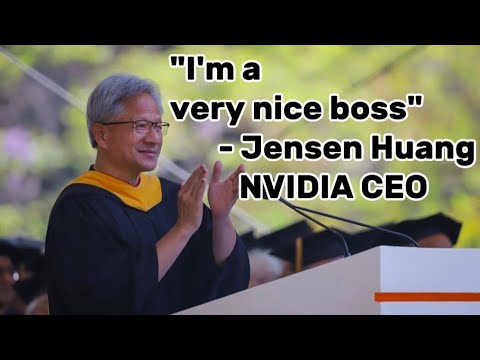
“Your pain and suffering will strengthen your character, your resilience, and agility, and they are the ultimate superpowers.”Caltech commencement address, 2024 · 30:08
The lesson
Huang’s leadership starts with a long horizon and a willingness to endure difficulty instead of optimizing for comfort. He treats pain, setbacks, and sustained effort as part of building something important, not as signs that the work is wrong. That mindset only works if it is attached to a real craft and a durable mission, so people can keep going through long periods before results are obvious.1234
That same long-term view shapes how he decides what to build. Rather than projecting forward from today’s constraints, he describes starting from a belief about the future and working backward from the contribution the company wants to make. This lets a team pursue hard opportunities early, including cases where the market is not fully formed yet, as long as the conviction is grounded in first principles rather than fashion.5678
Huang’s organization design follows the same logic: if you want people to solve hard problems, you have to give them context. He favors broad information sharing and explicitly trusts people with more of what leaders know, instead of relying on narrow chains of communication or many private one-on-ones. Public feedback matters in that model because mistakes become shared learning for the whole organization, not isolated corrections for one person.91011
He also leads with a platform view of the company’s role. NVIDIA is not just trying to make one component; it takes responsibility for the hardest parts of the system while still partnering broadly, which is why ecosystem depth matters as much as product performance. In practice, that means doing the essential hard work, building tools and software around the hardware, and helping create the market and installed base that make the platform useful.12131415
Finally, enduring platforms depend on serving the ecosystem well, not just defending your own boundary. Serving the ecosystem well means stable values, flexible support, and a serious response to customer pain. For a leader, this means resilience is not only personal toughness; it is also building institutions that others can rely on for years.
4 principles from Jensen Huang
Treat pain as part of meaningful work
Do not assume hard periods mean you chose the wrong problem. If the work is tied to a real craft and a mission you believe in, difficulty can build the resilience and staying power needed for long-horizon projects.
“Your pain and suffering will strengthen your character, your resilience, and agility, and they are the ultimate superpowers.”
Lead from a belief about the future, then work backward
Start with the outcome or contribution you think should exist, then reason backward to what must be built now. This helps you act before a market is obvious, as long as your conviction is grounded in first principles.
“I go forward in time, and I look backwards. So you asked me a question that's exactly from a computer vision pose perspective, exactly the opposite of how I think. I never look forward from where I am. I go forward in time and look backwards. And the reason for that is it's easier. I would look backwards and kind of read my history. We did this and we did that way and we broke that problem down. Does that make sense? And so it's a little bit like how you guys solve problems. You figure out what is the end result that you're looking for and you work backwards to achieve it. And so I imagine NVIDIA making a unique contribution to advancing the future of computing, which is the single most important instrument of all humanity.”
Give people context, not just instructions
Hard problems are solved better when more people understand the real situation. Share information broadly and reduce dependence on private channels so teams can think and act with judgment.
“I believe that I can trust you with the information.”
Own the hardest necessary layer and partner on the rest
A strong platform does not do everything itself, but it does take responsibility for the parts that are uniquely difficult and decisive. Build the ecosystem around that core so your value compounds across customers and developers.
“…we try to do as little as possible, but the part that we have to do, as it turns out, is insanely hard…”
In his own words
The quotes behind the lesson, word for word from the transcripts. Numbers match the lesson above.
“I wish upon you plenty of pain and suffering.”
“Your pain and suffering will strengthen your character, your resilience, and agility, and they are the ultimate superpowers.”
“I hope you find a craft.”
“I have cared for my garden for 25 years. I have plenty of time.”
“It's not a word, but have a core belief.”
“I go forward in time, and I look backwards. So you asked me a question that's exactly from a computer vision pose perspective, exactly the opposite of how I think. I never look forward from where I am. I go forward in time and look backwards. And the reason for that is it's easier. I would look backwards and kind of read my history. We did this and we did that way and we broke that problem down. Does that make sense? And so it's a little bit like how you guys solve problems. You figure out what is the end result that you're looking for and you work backwards to achieve it. And so I imagine NVIDIA making a unique contribution to advancing the future of computing, which is the single most important instrument of all humanity.”
“And so if you believe in that future and you don't do anything about it, you're gonna regret it for your life. And so we always... You know, I always tell the team, do you believe what... Do we believe this or not? And if you believe it and start grounded on first principles, not random, you know, hearsay. And we believe it. We've gotta... We owe it to ourselves to go pursue it. If we're the right people to go do it, if it's really, really hard to do, it's worth doing, and we believe it. Let's go pursue it. When we pursued it, we we launched the product. Nobody knew.”
“We had to go invent this new market.”
“I believe that I can trust you with the information.”
“I really discourage one-on-ones.”
“You start from first principles. Remember what an organization is designed to do. The organizations of the past where there's a king, you know, CEO, and then then you have all these, you know, the royal subjects, you know, the royal court and then e staff. And then you keep working your way down. Eventually, they're employees. Well, the reason why it was designed that way is because they they wanted the employees to have as little information as possible because their fundamental purpose of the soldiers is to die in the field of battle, to die without asking questions. You guys know this. I don't... I only have 30,000 employees. I would like them none of them to die. I would like them to question everything. Does that make sense? And so the way you organize in the past and the way you organize today is very different.”
“…something has to transform electrons to tokens…”
“…we try to do as little as possible, but the part that we have to do, as it turns out, is insanely hard…”
“CUDA is is a rich ecosystem…”
“Our job is to do as much as necessary, as little as possible…”
Reflect
- What hard project in your work are you tempted to abandon because it feels painful, and how would your behavior change if you treated that pain as part of the craft rather than as a warning sign?
- Where are you managing through private updates and one-on-ones when shared context would help the wider team make better decisions?
- In your current role, what is the hardest necessary layer you should own directly, and what should you deliberately leave to partners or the ecosystem?
Check your understanding
Go deeper
 Jensen Huang on Leadership and Craft: Pain, Tenure, and AI2024 · 65 min · full transcript
 Jensen Huang on First Principles: Build the Future Backwards2024 · 56 min · full transcript
 Jensen Huang on AI and Resilience: Find Your Craft2024 · 32 min · full transcript
 Jensen Huang on Founding TSMC: Customer Service, Innovation, Growth2013 · 92 min · full transcript
 Jensen Huang on NVIDIA Moat: Why It Won't Commoditize2024 · 103 min · full transcript
 Jensen Huang on AI Factories: Chips, Data Centers, and Physical AI2025 · 66 min · full transcript