Jensen Huang on AI and Resilience: Find Your Craft
What Huang talks about
Jensen Huang gave this commencement address at Caltech on June 14, 2024, speaking to the Class of 2024 about AI, accelerated computing, resilience, and focusing on your craft over the long run.
Also known as: Caltech 2024 Commencement Speech; Caltech commencement speech; Jensen Huang Caltech 2024.
Jensen Huang tells Caltech’s Class of 2024 that the world is entering a profound computing shift: accelerated computing and AI are changing how software, industries, and data centers are built. He frames NVIDIA’s journey as a lesson in first-principles thinking, long-term commitment, and betting early on deep learning.
He also uses stories from NVIDIA’s history and his own life to argue that setbacks can become advantages. From failed market pivots to the Japanese moss gardener who has “plenty of time,” Huang emphasizes resilience, discipline, and focusing on your craft over the long run.
Huang speaks throughout; the only other audio is applause.
In his words
“Run, don't walk, and engage the AI revolution”
“We are now creating software that no humans can write.”
“I have cared for my garden for 25 years. I have plenty of time.”
“Your pain and suffering will strengthen your character, your resilience, and agility, and they are the ultimate superpowers.”
“I hope you find a craft.”
Key points
- AI is the most consequential technology of our time, and graduates should engage with it now.
- Accelerated computing and GPUs are solving computing inflation by delivering major gains in speed, cost, and energy efficiency.
- NVIDIA’s deep learning investment transformed the company and helped spark the modern AI revolution.
- Future software will be intention-driven, not instruction-driven, with AI systems reasoning and orchestrating tasks.
- AI factories and AI token generation will define a new industrial model.
- Setbacks are opportunities; resilience and endurance matter more than raw intelligence.
- Find a craft, dedicate yourself to it, and prioritize what matters most in life.
Full transcript: Jensen Huang, Caltech commencement address (2024)
(Applause) It really makes me cringe listening to all that. Thank you for that kind introduction, but, um, I hate hearing about myself and, uh, just to—as a show—well, maybe you could just applaud. How many of you know who Nvidia is? And how many of you know what a GPU is? Okay, good. I don't have to change my
speech. Ladies and gentlemen, President Rosenbaum, esteemed faculty members, distinguished guests, proud parents, and above all, the 2024 graduating class of Caltech, this is a really happy day for you guys. You got—look more excited! You know you're graduating from Caltech. This is the school of the great Richard Feynman, Linus Pauling, and someone who is very influential to me and our industry, Carver Mead. Yeah, this is a very big deal. Today is a day of immense pride and joy.
It is a dream come true for all of you, but not just for you because your parents and families have made countless sacrifices to see you reach this milestone. So let's take this moment and congratulate them, thank them, and let them know you love them. You don't want to forget that because you don't know how long you're going to be living at home. You want to be super grateful. Today, as a proud parent, I really loved
it when my par—my kids didn't move out, and it was great to see them every day. But now they've moved out. It makes me sad, so hopefully you guys get to spend some time with your parents. Your journey here is a testament of your character, determination, willingness to make sacrifices for your dreams, and you should be proud. The ability to make sacrifices, endure pain and suffering, you will need these qualities in life. You and I share some things in common: first, both chief scientists of Nvidia were from Caltech, and one of the reasons why I'm
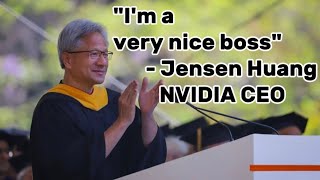
giving the speech today is because I'm recruiting. And so, I want to tell you that Nvidia is a really great company. I'm a very nice boss, universally loved. Come work at Nvidia. You and I share a passion for science and engineering, and although we're separated by about 40 years, we are both at the peaks of our careers. For all of you who've been paying attention to Nvidia and myself, you know what I mean. It's just that, in your
case, you'll have many, many more peaks to go. I just hope that today is not my peak—not the peak—and so I'm working as hard as ever to make sure that I have many, many more peaks ahead. Last year, I was honored to give the commencement address at Taiwan University, and I shared several stories about Nvidia's journey and the lessons that we learned that might be valuable for graduates. I have to admit that I don't love giving advice, especially to other people's children, and so, uh, my advice today will
largely be disguised in some stories that I've enjoyed and some life experiences that I've enjoyed. I'm the longest-running tech CEO in the world today, I believe, and I, over the course of 31 years, managed not to go out of business, not get bored, and not get fired. And so I have the great privilege of enjoying a lot of life's experiences—starting from creating Nvidia from nothing to what it is today. And so I spoke about the long road
of creating CUDA, a programming model—the programming model that we dedicated over 20 years to invent and that is revolutionizing computing today. I spoke about a very quite public cancelled Sega game console project we worked on, and where intellectual honesty, something that I know Richard Feynman cares very deeply about and spoke quite often about, where intellectual honesty and humility saved our company and how a retreat, a strategic retreat, was one of our best strategies. All of these are counterintuitive lessons that I
spoke about at the commencement. But I encouraged the graduates to engage with AI, the most consequential technology of our time, and I'll speak a little bit more about that later. But all of you know about AI—it's hard not to be immersed in it and surrounded by it and a great deal of discussion about it. And, of course, I hope that all of you are using it and playing with it, with surprising results—some magical, some disappointing, and some surprising. But you have to enjoy it; you have to engage it because it's advancing so quickly. It is the only technology that I've known that has that is advancing on multiple exponentials at
the same time. And so, the technology is changing very, very quickly. So I advised—I advised the students at the Taiwan University to run, don't walk, and engage the AI revolution. And yet, one year later, it's incredible how much has changed. And so, today, what I wanted to do is share with you my perspective, my view—from my vantage point—of some of the important things that are happening that you're graduating into. And these are extraordinary things that are happening that you should have an intuitive understanding for, because it's going to matter to you; it's going
to matter to the industry. And hopefully, you take advantage of the opportunity ahead of you. The computer industry is transforming from its foundations—literally from studs. Everything is changing from studs on up and across every layer, and soon every industry will also be transformed. And the reason for that is quite obvious, because computers today are the single most important instrument of knowledge, and it's foundational to every single industry in every field of science. If we are transforming the computer so profoundly, it will, of course, have implications in every industry, and I'll talk about that in just a little bit. And as you enter industry, it's important you know what's
Happening modern computing traces back to the IBM System 360. That was the architecture manual that I learned from. It's an architecture manual that you don't need to learn from. A lot has a lot better documentation and better descriptions of computers and architecture has been presented since. But the System 360 was incredibly important of its time, and in fact, the basic ideas of the System 360, the architecture of it, the principled ideas and architecture and strategy of the System 360 are still governing the computer industry today. And it was introduced a
year after my birth in the '60s. I was among the first generation of VLSI engineers who learned to design chips from Mealy and Conway's landmark textbook. I'm not sure if it's still being taught here. It should be in the introduction of VLSI systems based on Carver Mead's pioneering work here at Caltech on chip design methodologies and textbook that revolutionized IC design. And it enabled our generation to design super giant chips and ultimately the CPU. The CPU led to exponential growth in computing, the performance, the incredible technology
advances that's called Moore's law fueled the information technology revolution, the industrial revolution that we are part of, that my generation was part of. Saw the mass production of something the world had never seen before: the mass production of something that was invisible, easy to copy, the mass production of software. And it led to a $3 trillion industry when I sat where you said the IT industry was minuscule, and the concept that you could make money selling software was a fantasy. And yet today, it's one of the most important commodities, most
important technologies and product creations that our industry produces. However, the limits of DARPA scaling, of transistor scaling, and instruction level parallelism have slowed CPU performance. And the slowed CPU performance gains is happening at a time when computing demand continues to grow exponentially. This exponentially growing gap between demand of computing and the capabilities of computers, if not addressed, computing energy consumption and cost inflation
would eventually stifle every industry. We see very clear signs of computing inflation as we speak. And after two decades of advancing NVIDIA's CUDA, NVIDIA's accelerated computing offers a path forward. That's the reason why I'm here, because finally the industry realized the incredibly incredible effectiveness of accelerated computing at precisely the time that we're witnessing computing inflation. After several decades, by offloading time-consuming algorithms to a GPU that specializes in parallel processing, we routinely achieve
10, 100, sometimes a thousandfold speedups, saving money, cost, and energy. We now accelerate application domains from computer graphics, ray tracing of course, to gene sequencing, scientific computing, astronomy, quantum circuit simulations, SQL data processing, and even pandas data science. Accelerated computing has reached a tipping point. That is our first great contribution to the computer industry, our first great compute contribution to society: accelerated computing. It now gives us a path forward for sustainable computing, where cost will continue to decline as computing requirement
continues to grow 100-fold. 100-fold of anything in time, or cost, or energy savings that accelerated computing opened surely would trigger a new development somewhere else. We just didn't know what it was until deep learning came to our consciousness. A whole new world of computing emerged. Jeff Hinton, Ali's CV, and Alex Suseder used NVIDIA CUDA GPUs to train AlexNet and shocked the computer vision community by winning the 2012 ImageNet challenge. This was the big
moment, the Big Bang of deep learning, a pivotal moment that marked the beginning of the AI revolution. Our decisions after AlexNet transformed our company. It's something that's worth taking note of. Our decisions after AlexNet transformed our company and likely everything else. We saw the potential of deep learning and believed, just believed through principle thinking, believed through our own analysis of the scalability of deep learning. We believe the approach could learn other valuable functions, that maybe deep learning is a universal function
learner. And how many problems are difficult or impossible to express using fundamental first principles? And so, when we saw this, when we saw this, we thought this is a technology we really have to pay attention to because its limits are potentially only limited by model and data scale. However, there were challenges at the time. This is 2012, shortly after 2012. How could we explore the limits of deep learning without having to build these massive GPU clusters? At the time, we were a rather small company. Building these massive GPU clusters could cost hundreds and hundreds of millions of dollars, and
if we didn't, though, there was no assurance that it would be effective if we scaled. However, no one knew how far deep learning could scale, and if we didn't build it, we'd never know. This is one of those, "If you build it, will they come?" Our logic is if we don't build it, they can't come. And so we dedicated ourselves based on our first principled beliefs and our analysis. And we got ourselves to the point where we believe this was going to be so effective, and when the company believes something, we should go act on it. So, we dove deep into deep learning and over the next decade systematically reinvented everything. We reinvented every computing layer,
starting with the GPU itself; the invention of the modern GPU, which is very different than the GPU of the past that we invented in the first place. And we went on to invent just about every other aspect of computing: the interconnects, the systems, the networking, and of course software. We invested billions. We invested billions into the unknown. Thousands of engineers for a decade worked on deep learning and advancing and scaling deep learning without really knowing how far we could really take the technology. We invested billions and we designed and built supercomputers to explore the limits of learning of
Deep learning in AI. Then in 2016, we announced DGX-1, our first AI supercomputer, and I delivered the first one to a startup in San Francisco, a startup nobody knew anything about, a group of friends of mine who are working on artificial intelligence, a company called OpenAI. In 2022, 10 years after AlexNet and about a millionfold increase in computing later—a millionfold. If you could just imagine, what would it be like if your laptop was a
millionfold more capable? A millionfold later, OpenAI launched ChatGPT, and AI went mainstream. During this decade, NVIDIA transformed ourselves from a graphics company that many of you probably first knew us as—that builds GPUs—to now an AI company that builds massive data center scale supercomputers. We transformed our company completely. We also transformed computing completely. The fundamental way of doing computing today has been radically changed. The computing stack now uses GPUs to process large language
models that are trained on supercomputers rather than CPUs that are processing instructions written by programmers. We are now creating software that no humans can write. We are now creating software that does things that no humans can imagine even just 10 years ago. Computers are now intention-driven rather than instruction-driven. Tell a computer what you want, and it will figure it out. It will figure out how, and like humans, AI applications will understand the mission, reason, plan, and orchestrate
a team of large language models to perform tasks. Future applications will do and perform very similar to the way we do things: assemble teams of experts, use tools, reason and plan, and execute our mission. Software and what software can do has been completely changed. Even our industry as it's being changed and transformed created yet another industry, an industry the world's never seen before. An industry is forming right in front of our—right in front of our eyes. AI's input and output are tokens. For all the engineers in the room,
you know what I mean. These are floating point numbers that embed intelligence. Companies are now building a new type, a new type of data center that didn't exist before, that specialized in producing intelligence tokens—essentially AI factories like AC generators that Nikola Tesla invented of the past Industrial Revolution. We now have AI token generators, and they will be the factories of a new Industrial Revolution. There's large industries producing energy,
electricity. We now have a large industry producing something invisible called software. In the future, in the very near future, we'll have industries that are producing, manufacturing intelligence tokens—AI generators. A new computing model has emerged, and a new industry has emerged, all because we reasoned from first principles, formed our belief about the future, and we acted on them. The next wave of AI is robotics, where AI, in addition to a language model, also has a physical world
model. We work with hundreds of companies building robots, robotic vehicles, pick and place arms, humanoid robots, and even entire gigantic warehouses that are robotic. But unlike our AI factory strategy and our experience there, which was really formed through reasoning and deliberate action, our robotics journey resulted from a series of setbacks. As you know, NVIDIA invented the GPU. This was before we invented AI factories. Our first great contribution to the computer industry was reinventing computer graphics through programmable shaders. We invented the GPU and programmable shading in
2000. We wanted to integrate GPUs into every computer and so we started to combine our GPUs with motherboard chips and we launched a fabulous integrated graphics chip at the time for AMD CPUs. Our chipset business was an instant success. I think it went from zero to a billion dollars practically overnight. But then, all of a sudden, AMD wanted to control all of the technology in the PC and we wanted to stay independent, so they purchased ATI and no longer needed us. We turned to Intel. That probably wasn't a great idea, but we
turned to Intel and negotiated a license to connect to Intel CPUs. Apple was excited about what we were building and asked us to work on a new computer with them, which became the first MacBook Air. Well, Intel saw what happened and decided they didn't want us to do that anymore, and so they terminated our agreement. Well, we pivoted again, and this time we went and licensed ARM, and we built a low-power SoC, a mobile SoC, the world's first SoC that
was essentially a computer, a full operating computer, and it was incredible. Our chip excited Google and they asked us to work on a new device, which turned out to have been the Android mobile device. Well, Qualcomm decided they didn't want us to do that, and so they didn't want us to connect to their modems, and it's hard to build a modem mobile device without being connected to a modem. And there were no other LTE modem companies, so we had to exit the mobile device market. Well, this happened practically on a year rhythm, and we would build something that would be incredibly
successful, generate enormous amounts of excitement, and then one year later, we were kicked out of those markets. Well, with no more markets to turn to, we decided to build something where we are sure there are no customers. Because one of the things you can definitely guarantee is where there are no customers, there are also no competitors and nobody cares about you. And so we chose a market with no customers, a $2 billion dollar market, and it was robotics. We built the
world's first robotics computer, processing an algorithm nobody understood at the time called deep learning. This was over 10 years ago. Now, 10 years later, I can't be happier with what we've built and the opportunity continues to create the next wave of AI. More importantly, we developed agility and a culture of resilience: one setback after another, we shook it off and skated to the next opportunity. Each time, we gain skills and strengthen our character. We strengthen our corporate character. Our company is really hard to distract and really hard to
Discourage and no setback. No setback that comes our way doesn't look like an opportunity these days. Ironically, the robotics computer that we build today doesn't even need graphics, which is why our journey started in the first place. So, where we are today tells us something and teaches us something: the world is uncertain, as Richard Feynman would say, and the world can be unfair and deal you tough cards. Swiftly shake it. (applause)
Off, you've apparently been paying too much attention to your books. Swiftly, shake it off. Come on, that's pretty clever. I made myself laugh. I made myself laugh. There's another opportunity out there or create one. Let me tell you one more story. I used to work from one of our international sites for one month each summer. When our kids were in their teens, we spent a summer in Japan. Over a weekend, we visited Koto and the Silver Temple. If you haven't had a chance to go, you must. It's renowned for its exquisite.
Moss Garden. The day we visited was a quintessential Kyoto summer day: suffing, suffocatingly hot and humid. Sticky heat is radiating from the ground. The air was thick, still. Along with the other tourists, we wandered through the meticulously groomed moss garden, and I noticed the lone gardener. Now, remember the Moss Garden, this is the Silver Temple. The moss garden is gigantic. It's about, it's about the size of this courtyard, and it has the collection, the largest collection of just about apparently every species of moss and oral and just.
Exquisitely maintained. I noticed the lone gardener squatting carefully, picking at the moss with a bamboo tweezer and putting it in the bamboo basket. And I... you have to; it's a bamboo tweezer, you know. And there's... it's just this one gardener, and the basket looked empty. Um, well, for a moment there, I thought he was picking imaginary moss, uh, into a pile of imaginary dead.
Moss. And so, I walked up to him and I said, "What are you doing?" And in his English, he said, "I'm picking dead moss. I'm taking care of my garden." And I said, "But your garden is so big." And he responded, "I have cared for my garden for 25 years. I have plenty of time." Well, that was one of the, one of the most profound learnings in my life, and it really taught me something. This gardener has dedicated himself to his craft and doing his life's...
Work. And when you do that, you have plenty of time. I begin each morning—I do, I do every single morning exactly the same way. I begin each morning by doing my highest priority work first. I have a very clear priority list, and I start from the highest priority work first. Before I even get to work, my day is already a success. I've already completed my most important work and can dedicate my day to helping others. And when people apologize for interrupting me, I always say, "I have plenty of time." And I do. Graduates of the class of
2024. I can hardly imagine anyone more prepared for the future than you. You dedicated yourself, you worked hard, you earned a world-class education from one of the most prestigious schools in the world. And as you commence into the next stage, take my learnings, and hopefully they'll help you along the way. I hope you believe in something, something unconventional, something unexplored, but let it be informed and let it be reasoned. Then dedicate yourself to making it happen. You may find your GPU.
You may find your CUDA. You may find your generative AI. You may find your Nvidia. I hope you will see setbacks as new opportunities. Your pain and suffering will strengthen your character, your resilience, and agility, and they are the ultimate superpowers. Of all of the things that I value most about my abilities, intelligence is not at the top of that list. My ability to endure pain and suffering, my ability to work on something for a very, very long period of time, my ability to handle setbacks and see the opportunity just around the corner, I consider to be my superpowers, and I hope.
They're yours, and I hope you find a craft. (applause) I hope you find a craft. It's not important to decide on day one. It's not even important to decide anytime soon. But I hope you do find a craft that you want to dedicate your lifetime to, perfecting, to hone the skills of, and let it be your life's work. And then lastly, prioritize your life. There are so many things going on, there's so many things to do, but prioritize your life, and you will have
Plenty of time to do the important things. Congratulations, Class of 2024. Go get them!
From YouTube captions, lightly punctuated for readability. Timestamps link to the video above. Errors are possible.
Cite this recording
Jensen Huang, “Caltech commencement address (2024)”, June 14, 2024. Transcript and video: Thinkers Archive, https://thinkersarchive.com/jensen-huang/ai-resilience-caltech-commencement-2024/
Quoting a passage? Link to its exact moment: every timestamp above has its own anchor (for example https://thinkersarchive.com/jensen-huang/ai-resilience-caltech-commencement-2024/#t-142).