Jensen Huang on Leadership
Jensen Huang’s leadership centers on long-term conviction, broad trust, public learning, and building resilient teams that can tackle hard problems together.
- Lead with a clear belief about the future, then work backward from it.
- Trust people with context instead of tightly controlling information.
- Make feedback visible so the whole organization learns, not just one person.
- Expect hardship; resilience and craft are part of doing great work.
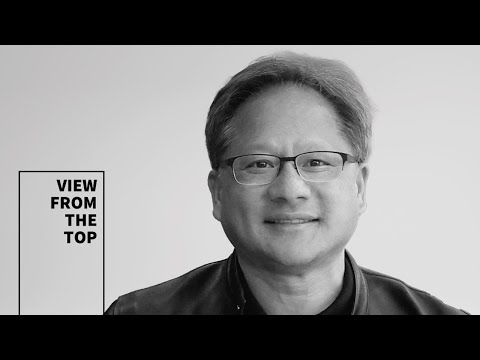
“I believe that I can trust you with the information.”Stanford Graduate School of Business interview, 2024 · 35:31
Leadership starts with conviction about the future
Huang leads by beginning with a strong point of view about what matters, not by waiting for certainty. He stresses having a core belief, then using that belief to guide difficult choices over long periods of time. That is why his version of leadership is tightly connected to strategy: a leader must decide what future is worth building.12
He also prefers to picture the end state first and then work backward. Instead of projecting forward from current constraints, he imagines the contribution the company should make and reverse-engineers the steps to get there. That approach gives teams a clearer sense of purpose and helps them endure ambiguity.34
Trust people with information, not just instructions
A central part of Huang’s leadership is unusually broad information sharing. His default view is that people do better work when they understand what is happening and why, which is why he says he trusts people with the information. In his model, leadership is not protecting knowledge at the top; it is distributing context so more people can make good decisions.56
This is also why he resists old command-and-control structures. He contrasts modern organizations with hierarchies designed to keep people uninformed and unquestioning, and he wants the opposite: teams that can think, question, and act with judgment. For Huang, giving people context is both a sign of respect and a practical way to scale intelligence across the company.67
“I believe that I can trust you with the information.”Stanford Graduate School of Business interview, 2024 · full transcript →
Public feedback creates collective learning
Huang’s management style is famous for discouraging one-on-ones, and the reason is broader than personal preference. He wants learning to happen in the open so that when one person receives feedback, many others benefit too. In his view, private conversations are often inefficient because they keep useful context trapped between two people.87
This style fits his larger belief that leaders should pass on knowledge constantly. If the future of a company depends on what happens after any one leader, then information and judgment have to spread widely. Public feedback can feel intense, but Huang treats it as an organizational learning system, not just a managerial habit.75

“I really discourage one-on-ones.”Stripe Sessions fireside chat, San Francisco, 2024 · full transcript →
Great leadership does not remove pain from hard work
Huang is unusually blunt that meaningful work is supposed to be hard. He associates growth, achievement, and even character formation with pain and suffering, not with comfort. So his leadership is not built around making difficulty disappear; it is built around helping people become strong enough to face it.910
That perspective shapes what he values in people and in culture. He wants resilience, agility, and commitment to a craft over time. Leadership, in this frame, means preparing people for setbacks and helping them turn adversity into capability.101112
Build teams that can solve complexity without losing simplicity
Huang leads in domains where problems span chips, software, networking, systems, and data centers, so he values organizations that can integrate many disciplines at once. He describes the company as doing extreme co-design all the time because modern problems no longer fit inside one machine or one narrow function. Leadership here means aligning specialists around a shared system outcome.1314
At the same time, he does not celebrate complexity for its own sake. His standard is to make things as complex as necessary, but as simple as possible. For leaders, that means absorbing technical and organizational complexity while still giving teams clear principles and understandable decisions.1514
Huang on leadership, in his own words
“I really discourage one-on-ones.”
“I believe that I can trust you with the information.”
“The most important thing you should do today, if you care about the future of your company, post you, is to pass on knowledge…”
“Your pain and suffering will strengthen your character, your resilience, and agility, and they are the ultimate superpowers.”
Where to watch
 Jensen Huang on Leadership and Craft: Pain, Tenure, and AI2024 · 65 min · full transcriptBest single source on Huang’s management style: pain, resilience, many direct reports, and public feedback.
 Jensen Huang on First Principles: Build the Future Backwards2024 · 56 min · full transcriptShows how his leadership begins with core beliefs, first principles, trust, and working backward from the future.
 Jensen Huang on Extreme Code Design: Building the AI Factory2025 · 146 min · full transcriptExplains how he leads through complexity by spreading knowledge and coordinating across the full stack.
 Jensen Huang on AI and Resilience: Find Your Craft2024 · 32 min · full transcriptBest for understanding his emphasis on craft, long time horizons, and resilience under adversity.
Questions people ask
- What did Jensen Huang say NVIDIA was built to do?
- What did Jensen Huang say about believing in a future before the market does?
- What did Jensen Huang say about how to organize a company?
- What did Jensen Huang say about putting CUDA on GeForce?
- Why does Jensen Huang say he thinks about the future backwards?
Sources
Every quote above, word for word from the transcripts. Numbers match the text.
“It's not a word, but have a core belief.”
“And so if you believe in that future and you don't do anything about it, you're gonna regret it for your life. And so we always... You know, I always tell the team, do you believe what... Do we believe this or not? And if you believe it and start grounded on first principles, not random, you know, hearsay. And we believe it. We've gotta... We owe it to ourselves to go pursue it. If we're the right people to go do it, if it's really, really hard to do, it's worth doing, and we believe it. Let's go pursue it. When we pursued it, we we launched the product. Nobody knew.”
“I go forward in time, and I look backwards. So you asked me a question that's exactly from a computer vision pose perspective, exactly the opposite of how I think. I never look forward from where I am. I go forward in time and look backwards. And the reason for that is it's easier. I would look backwards and kind of read my history. We did this and we did that way and we broke that problem down. Does that make sense? And so it's a little bit like how you guys solve problems. You figure out what is the end result that you're looking for and you work backwards to achieve it. And so I imagine NVIDIA making a unique contribution to advancing the future of computing, which is the single most important instrument of all humanity.”
“And so that became the company's mission, to go build a computer, the type of computers, and solve problems that normal computers can't. And to this day, we're focused on that. And if you look at all the the problems that that, in the markets that we opened up as a result, it's, you know, things like computational drug design, weather simulation, materials design. These are all things that we're really, really proud of. Robotics, self driving cars, software, we call artificial intelligence. And then, course, we, we drove the technology so hard that eventually the computational cost went to approximately zero and then enabled enabled a whole new way of developing software where the computer wrote the software itself, artificial intelligence as we know it today.”
“I believe that I can trust you with the information.”
“You start from first principles. Remember what an organization is designed to do. The organizations of the past where there's a king, you know, CEO, and then then you have all these, you know, the royal subjects, you know, the royal court and then e staff. And then you keep working your way down. Eventually, they're employees. Well, the reason why it was designed that way is because they they wanted the employees to have as little information as possible because their fundamental purpose of the soldiers is to die in the field of battle, to die without asking questions. You guys know this. I don't... I only have 30,000 employees. I would like them none of them to die. I would like them to question everything. Does that make sense? And so the way you organize in the past and the way you organize today is very different.”
“The most important thing you should do today, if you care about the future of your company, post you, is to pass on knowledge…”
“I really discourage one-on-ones.”
“I wish upon you plenty of pain and suffering.”
“Your pain and suffering will strengthen your character, your resilience, and agility, and they are the ultimate superpowers.”
“I hope you find a craft.”
“I have cared for my garden for 25 years. I have plenty of time.”
“The problem no longer fits inside one computer to be accelerated by one GPU.”
“The company is doing extreme co design all the time.”
“We need things to be as complex as necessary, but as simple as possible.”
How this guide was made: drafted with AI from the full transcripts of the recordings cited, then checked: every quotation must match a transcript word for word and be the speaker's own words, and an independent review gates accuracy. Methodology and corrections.

