Jensen Huang on AI Factories
Jensen Huang sees AI factories as a new kind of core infrastructure: data centers redesigned to manufacture tokens and intelligence as an economic output.
- AI factories are data centers whose job is to produce tokens and intelligence, not just store or retrieve data.
- Huang argues reasoning and agentic AI sharply raise compute demand, making inference the central operational and business problem.
- He treats AI factories as new infrastructure for companies and countries, similar in importance to electricity and the internet.
- NVIDIA’s role, in his framing, is to provide the full stack for these factories: accelerated computing, systems, networking, software, and operating software like Dynamo.
- The payoff is economic: AI is not just a tool but productive work, so better AI factories create more output, revenue potential, and new industries.

“It has one job and one job only: to produce intelligent tokens, the generation of AI.”GTC Paris keynote at VivaTech, 2025 · 39:30
An AI factory is a data center with one job: produce intelligence
Huang’s basic reframing is that modern AI infrastructure should not be described as ordinary data centers. He says these systems are better understood as factories because their output is not files or webpages but generated tokens that become useful intelligence.123
That factory analogy is not rhetorical decoration; it defines the purpose of the system. In his description, an AI factory has a single mission: generate intelligent tokens efficiently and at scale, which makes the production process itself the center of attention.456
He also treats tokens as economically meaningful output. The point of the factory is to turn compute into something valuable that can be used in software, knowledge work, and downstream applications.78
“It has one job and one job only: to produce intelligent tokens, the generation of AI.”GTC Paris keynote at VivaTech, 2025 · full transcript →
Why Huang thinks AI factories are necessary now
Huang argues that computing has entered a platform shift. The old model of general-purpose computing is no longer enough because AI workloads, especially newer ones, require a different architecture and a different way to think about production.910
His key reason is that AI has moved beyond simple pattern completion into reasoning and agentic behavior. Once models reason step by step and generate far more tokens, the amount of computation needed rises dramatically, which makes the factory model unavoidable.1213
He presents this as part of a broader industrial change, not a niche technical update. In his framing, AI is creating a new industry and a new kind of productive system at the same time.141516

“The computation requirement, the scaling law of AI is more resilient and in fact hyper accelerated. The amount of computation we need at this point as a result of a gigantic AI as a result of reasoning, is easily 100 times more than we thought we needed. This time last year. And let's reason about why that's true. The first part is let's just go from what the AI can do. Let me work backwards. Agentic AI, as I mentioned at this foundation, is reasoning. We now have eyes that can reason, which is fundamentally about breaking a problem down step by step.”NVIDIA GTC keynote, 2025 · full transcript →
Inference becomes the factory floor
If AI factories manufacture tokens, then inference is the production process. Huang says this directly: inference is token generation by a factory, which turns what used to sound like a backend software task into the main source of output.5
This changes what matters operationally. Throughput, communication between GPUs, and token-generation efficiency become core concerns because they determine how much useful intelligence a system can produce.18
That is why he introduces software such as Dynamo as factory operating infrastructure. The point is to manage token production as an end-to-end system rather than treat model serving as a minor add-on.19
“Inference is token generation by a factory…”NVIDIA GTC keynote, 2025 · full transcript →
AI factories are becoming national and enterprise infrastructure
Huang does not frame AI factories as optional upgrades for a few tech companies. He argues they are becoming part of a country’s infrastructure, because every region, industry, company, and government will need an intelligence-producing base of its own.202122
That is why he repeatedly compares AI infrastructure to earlier foundational systems like electricity and the internet. In his view, once intelligence becomes embedded everywhere, the facilities that produce it take on the same strategic importance as other essential infrastructure.218
This also explains why he links AI factories to sovereignty and economic growth. Producing AI is more important than merely consuming it, because the factory creates domestic capability, industrial output, and a place in the next computing economy.2216

“Well, there's a new infrastructure now. This new infrastructure is built on top of the first two, and this new infrastructure is an infrastructure of intelligence. I know that right now, when we say there's an intelligence infrastructure, it makes no sense. But I promise you, in ten years' time, you will look back and you will realize that AI has now integrated into everything. And in fact, we need AI everywhere. And every region, every industry, every country, every company, all needs AI. AI has now part of infrastructure. And this infrastructure, just like the Internet, just like electricity, needs factories. And these factories are essentially what we build today.”Computex keynote, Taipei, 2025 · full transcript →
The broader implication: AI factories feed agents, robots, and physical industry
Huang’s concept of the AI factory reaches beyond chatbots. He connects these factories to agents that do work and to physical AI, where robots, vehicles, and industrial systems need training, simulation, and deployment infrastructure.232425
That is why he talks about a stack that includes simulation, digital twins, and robotics alongside model training and inference. The same factory logic extends into virtual factories and physical factories, where AI output coordinates design, planning, and machine behavior.2527
In practice, this means AI factories are upstream from many future applications. They are the production base for enterprise agents, autonomous systems, and software-defined industry, which is why Huang treats them as the foundation of the next industrial era.282716
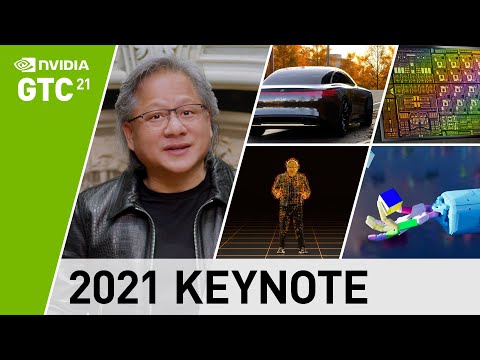
“They'll come in all sizes and shapes - box movers, pick and place arms, forklifts, cars, trucks. In the future, a factory will be a robot, orchestrating many robots inside, building cars that are robots themselves. We can use Omniverse to create a virtual factory, train and simulate the factory and its robotic workers inside. The AI and software that run the virtual factory are exactly the same as what will run the actual one. The virtual and physical factories and their robots will operate in a loop. They are digital twins. Connecting to ERP systems, simulating the throughput of the factory, simulating new plant layouts, and becoming the dashboard of the operator - even uplinking into a robot to teleoperate it.”GTC Spring 2021 keynote, virtual · full transcript →
Huang on ai factories, in his own words
“These AI data centers, if you will, are improperly described. They are, in fact, AI factories.”
“It has one job and one job only: to produce intelligent tokens, the generation of AI.”
“Inference is token generation by a factory…”
“AI is not a tool. AI is work.”
“Well, there's a new infrastructure now. This new infrastructure is built on top of the first two, and this new infrastructure is an infrastructure of intelligence. I know that right now, when we say there's an intelligence infrastructure, it makes no sense. But I promise you, in ten years' time, you will look back and you will realize that AI has now integrated into everything. And in fact, we need AI everywhere. And every region, every industry, every country, every company, all needs AI. AI has now part of infrastructure. And this infrastructure, just like the Internet, just like electricity, needs factories. And these factories are essentially what we build today.”
Where to watch
 Jensen Huang on AI Factories: Reasoning, Robotics, and Dynamo2025 · 154 min · full transcriptBest for understanding why reasoning AI makes inference explode and why Dynamo is framed as the operating system of AI factories.
 Jensen Huang on AI Factories: Europe’s Next Industrial Revolution2025 · 97 min · full transcriptBest concise statement of the AI factory idea as infrastructure built to produce intelligent tokens.
 Jensen Huang on Blackwell And Generative AI: GTC 2024 Keynote2024 · 123 min · full transcriptBest for seeing when Huang fully reframed the future data center as an AI factory in the generative AI era.
 Jensen Huang on AI Factories: America’s Next Industrial Revolution2025 · 103 min · full transcriptBest for the industrial argument that AI is work, not just a tool, and that AI factories are a new economic engine.
 Jensen Huang on AI Factories: Taiwan Builds the Future2025 · 103 min · full transcriptBest for the infrastructure framing and the claim that AI data centers are misnamed unless you call them factories.
 Jensen Huang on AI Factories: Europe’s New Industrial Revolution2026 · 92 min · full transcriptBest for the cleanest explanation that tokens are the building blocks of AI and that intelligence is something manufactured.
Questions people ask
- What did Jensen Huang say AI factories are producing?
- What did Jensen Huang say about AI as infrastructure?
- What did Jensen Huang say about AI replacing software tools?
- What did Jensen Huang say about CUDA and NVIDIA's software stack?
- What did Jensen Huang say about pre-training and post-training?
- What did Jensen Huang say about the computers needed for physical AI?
Sources
Every quote above, word for word from the transcripts. Numbers match the text.
“In the future, data centers are gonna be thought of, as I mentioned earlier, as an AI factory.”
“These AI data centers, if you will, are improperly described. They are, in fact, AI factories.”
“I call it an AI factory.”
“It has one job and one job only: to produce intelligent tokens, the generation of AI.”
“Inference is token generation by a factory…”
“This AI factory is generating, creating, producing something of great value, a new commodity.”
“This is how intelligence is made. A new kind of factory, generator of tokens, the building blocks of AI. Tokens have opened a new frontier, turning data into knowledge and knowledge into action.”
“We are now producing software, using computers to write software, producing software that never existed before. It is a brand new category. It took share from nothing. It's a brand new category. And the way you produce this software is unlike anything we've ever done before. In data centers, generating tokens, producing floating point numbers at very large scale. As if in the beginning of this last industrial revolution when people realized that you would set up factories, apply energy to it. And this invisible valuable thing called electricity came out. AC generators. And a hundred years later, two hundred years later, we are now creating new types of electrons, tokens using infrastructure we call factories, AI factories, to generate this new incredibly valuable thing called artificial intelligence.”
“The world is going through a platform shift…”
“Remember at the core of this is two or two platform transitions from general purpose computing to accelerated computing. NVIDIA CUDA and those suite of libraries called CUDA-X has enabled us to address practically every industry and we're at the inflection point. It is now growing as a virtual cycle would suggest. The second inflection point is now upon us. The second platform transition AI from classical handwritten software to artificial intelligence. two platform transitioning happening at the same time which is the reason why we're feeling such incredible growth.”
“The computation requirement, the scaling law of AI is more resilient and in fact hyper accelerated. The amount of computation we need at this point as a result of a gigantic AI as a result of reasoning, is easily 100 times more than we thought we needed. This time last year. And let's reason about why that's true. The first part is let's just go from what the AI can do. Let me work backwards. Agentic AI, as I mentioned at this foundation, is reasoning. We now have eyes that can reason, which is fundamentally about breaking a problem down step by step.”
“Now we have eyes that can reason…”
“Artificial intelligence, the new industrial revolution.”
“We have now arrived not at the AI era, but a generative AI era.”
“For the very first time in all of our time together, not only are we creating the next generation of IT, we've done that several times. From PC to Internet to cloud to mobile cloud, we've done that several times. But this time, not only are we creating the next generation of IT, we are in fact creating a whole new industry. This whole new industry is gonna expose us to giant opportunities ahead. I look forward to partnering with all of you on building AI factories, agents for enterprises, robots, all of you amazing partners, building the ecosystem with us around one architecture. And so I wanna thank all of you for coming today. Have a great Computex, everybody. Thank you.”
“The amount of energy we save, the amount of networking bandwidth we save, the amount of waste of time we save will be tremendous. The future is generative, which is the reason why we call it generative AI, which is the reason why this is a brand new industry. The way we compute is fundamentally different. We created a processor for the generative AI era. And one of the most important parts of it is content token generation. We call it... This format is FP four. Well, that's a lot of computation. Five x, the token generation. Five x, the inference capability of Hopper seems like enough. But why stop there?”
“Today we're announcing the Nvidia dynamo…”
“AI factories are now part of a country's infrastructure…”
“Well, there's a new infrastructure now. This new infrastructure is built on top of the first two, and this new infrastructure is an infrastructure of intelligence. I know that right now, when we say there's an intelligence infrastructure, it makes no sense. But I promise you, in ten years' time, you will look back and you will realize that AI has now integrated into everything. And in fact, we need AI everywhere. And every region, every industry, every country, every company, all needs AI. AI has now part of infrastructure. And this infrastructure, just like the Internet, just like electricity, needs factories. And these factories are essentially what we build today.”
“And these tokens can be reformulated into productive intelligence for so many industries that AI factories are now part of a country's infrastructure which is the reason why you see me running around the world talking to heads of state, because they all want to have AI factories. They all want AI to be part of their infrastructure. They want AI to be a growth manufacturing industry for them. And this is genuinely profound. And I think we're talking about, as a result of all that, a new industrial revolution because every single industry is affected, and a new industry. Just as electricity became a new industry. At first when it was described as a technology and demonstrated as a technology. It was understood as a technology, but then we understood that it's also a large industry. Then there's the information in industry.”
“AI is not a tool. AI is work.”
“Everything that moves in the future will be robotic.”
“Let's talk about physical AI. Physical AI requires three computers just as it takes two computers to train a language model. One that's to train it, evaluate it, and then inference it. Okay, so that's the large GB 200 that you see. In order to do it for physical AI, you need three computers. You need the computer to train it. This is GB the Grace Blackwell Invink 72. We need a computer that does all of the simulations that I showed you earlier with Omniverse DSX. It basically is a digital twin for the robot to learn how to be a good robot and for the factory to essentially be a digital twin. That computer is the second computer, the omniverse computer. This computer has to be incredibly good at generative AI and it has to be good at computer graphics, sensor simulation, ray tracing, signal processing, this computer is called the omniverse computer. And once we train the model, simulate that AI inside a digital twin and that digital twin could be a digital twin of a factory as long as well as a whole bunch of digital twins of robots. Then you need to operate that robot. And this is the robotic computer. This is this one goes into a self-driving car. Half of it could go into a robot. Okay? Or you could actually have, you know, robots that are quite agile and quite quite fast in operations. And it might take two of these computers. And so this is the Thor Jetson Thor robotics computer. These three computers all run CUDA. And it makes it possible for us to advance physical AI.”
“They'll come in all sizes and shapes - box movers, pick and place arms, forklifts, cars, trucks. In the future, a factory will be a robot, orchestrating many robots inside, building cars that are robots themselves. We can use Omniverse to create a virtual factory, train and simulate the factory and its robotic workers inside. The AI and software that run the virtual factory are exactly the same as what will run the actual one. The virtual and physical factories and their robots will operate in a loop. They are digital twins. Connecting to ERP systems, simulating the throughput of the factory, simulating new plant layouts, and becoming the dashboard of the operator - even uplinking into a robot to teleoperate it.”
“Robotics is here. Physical AI is here. This is not science fiction, and it's being used all over Taiwan. It's just really, really exciting. And that's the factory, the robots inside, and of course, all the products are gonna be robotics. So there are two very high volume robotics products. One, of course, is the self driving car or cars that have a great deal of autonomous capability. NVIDIA, again, builds the entire stack. Next year, we're gonna go to production with the Mercedes fleet, and after that, in 2026, the JLR fleet fleet. We offer the full stack to the world. However, you're welcome to take whichever parts, which whichever layer of our stack just as the entire the entire drive stack is open. The next high volume robotics product that's going to be manufactured by robotic factories with robots inside will likely be humanoid robots.”
How this guide was made: drafted with AI from the full transcripts of the recordings cited, then checked: every quotation must match a transcript word for word and be the speaker's own words, and an independent review gates accuracy. Methodology and corrections.


