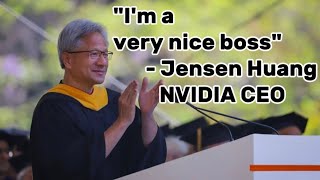
Jensen Huang on Agentic AI
Jensen Huang sees agentic AI as the shift from software that responds to prompts to AI systems that reason, use tools, and carry out real work across every industry.
- Agentic AI means AI that can reason, plan, research, and use tools to do work, not just answer prompts.
- Huang treats this as a platform shift in software: applications will be built on top of AI, and software is increasingly trained rather than hand-programmed.
- He argues agentic AI raises demand for tokens, compute, networking, memory, and full-stack infrastructure because reasoning is much more computationally intensive.
- He sees the biggest payoff in productivity: AI is not merely another IT tool, but a new class of workers that can use tools on our behalf.
- To make agents useful in practice, they need more than a model: they need grounding, knowledge, tools, runtime systems, and a safe way to act.

Agentic AI is useful AI that can do work
Huang’s core idea is that AI is moving beyond one-shot generation into systems that can carry out tasks. He describes agents as able to reason, look up information, do research, use tools, plan futures, and simulate outcomes, which is why he sees them solving much more important problems than a simple chatbot can.
That is also why he draws a sharp distinction between ordinary software tools and AI. In his framing, tools are things people operate directly, while AI is becoming a worker that can itself operate tools and produce output on its own.
He presents this shift as already underway, not a distant possibility. In his words, the age of agentic AI has arrived for every organization, which signals that he thinks companies should treat it as a practical operating model now rather than an experiment for later.
“The age of robotics starts here.”GTC Taiwan keynote, 2024 · full transcript →
The software model is changing from programmed instructions to trained systems
Huang thinks agentic AI changes the basic way software is built. Instead of treating AI as just another application, he says future applications will be built on top of AI, and this remakes the whole computing stack4.
That is why he repeatedly says the old model of explicitly programming behavior is giving way to training behavior. His short version is that you no longer program the software; you train it, and that means software becomes probabilistic, adaptive, and capable of handling tasks humans could not fully specify in advance54.
He connects this directly to the emergence of software beyond what humans can write line by line. The importance of agentic AI, in his view, is not just better interfaces but a new method of producing software capabilities that were previously out of reach6.
Reasoning and tool use are what make agents more capable
Huang’s view of agency is concrete: an agent has to decide when it lacks enough information, when it should research, which tools it should invoke, and how to break a problem into steps. He treats that chain of reasoning as the breakthrough that turns AI from memorization into problem solving.
He also argues that pretraining alone was never the endpoint. Pretraining gives the base skills of intelligence, but agentic performance comes from going beyond recall into stepwise reasoning and action, which is why he talks about AI becoming much smarter in the last couple of years8.
This helps explain why he is excited by examples like coding agents and search-driven systems. They demonstrate his main point: once an AI can reason, fetch knowledge, and use tools, it can perform tasks it was never explicitly trained to do end to end.
Agentic AI increases demand for infrastructure, not just models
Huang does not present agentic AI as a lightweight software feature. He argues that once AI starts reasoning and acting, data centers become factories whose job is to produce intelligent tokens, because useful AI requires huge amounts of generation and orchestration910.
This is why he links agentic AI to a surge in compute, memory, and networking demand. If systems are generating many more tokens, holding context, moving KV cache, and coordinating tool use across distributed components, then throughput and connectivity become central bottlenecks1112.
He therefore frames AI infrastructure as economic infrastructure. AI factories are becoming part of national infrastructure because they manufacture intelligence that can be turned into productive work across industries1314.
The real application is productivity across every industry
Huang believes agentic AI matters because it changes economics, not only technology. If AI can perform work rather than merely assist with a narrow tool, then software output rises, more tasks become automatable, and organizations will want far more intelligence on demand15.
He often describes intelligence as an asset and token production as the means of manufacturing it. That framing shows why he thinks the opportunity is so large: agentic AI converts data into knowledge and knowledge into action, making intelligence something that can be produced, deployed, and scaled1610.
His advice follows from that view. People and organizations should move quickly to engage the AI shift, because he sees it as the new way of computing and the new way of doing software, not a side trend171819.
Huang on agentic ai, in his own words
“…what makes it possible is connectivity…”
“This is how intelligence is made. A new kind of factory, generator of tokens, the building blocks of AI. Tokens have opened a new frontier, turning data into knowledge and knowledge into action.”
Where to watch
 Jensen Huang on Agentic AI: Useful AI Has Arrived2024 · 119 min · full transcriptBest single talk for Huang’s direct case that useful AI has become agentic AI that reasons, plans, uses tools, and does work.
 Jensen Huang on AI Platform Shift: From Models to Agents2025 · 92 min · full transcriptShows how he connects agents to a platform shift in software, applications, and the full computing stack.
 Jensen Huang on Artificial Intelligence: The Future Is Here2025 · 116 min · full transcriptExplains why he thinks every organization is entering the age of agentic AI and what that means for deployment.
 Jensen Huang on AI Scaling: Compute, Agents, and Superintelligence2024 · 100 min · full transcriptUseful for understanding why reasoning agents sharply increase compute demand and infrastructure needs.
 Jensen Huang on AI Factories: Europe’s New Industrial Revolution2026 · 92 min · full transcriptBest for his five-part practical view of what an agentic AI system needs beyond a base model.
 Jensen Huang on AI Connectivity: Copper, Optics, and Agents2026 · 187 min · full transcriptShows why distributed agentic computing makes connectivity a first-order issue.
Questions people ask
- How does Jensen Huang say NVIDIA is helping companies build agentic AI?
- How does Jensen Huang say autonomous vehicles are trained?
- What did Jensen Huang say AI factories are producing?
- What did Jensen Huang say about AI replacing software tools?
- What did Jensen Huang say about DGX and AI supercomputers?
- What did Jensen Huang say about agentic AI?
Sources
Every quote above, word for word from the transcripts. Numbers match the text.
“Except this time, there are two simultaneous platform shifts, in fact, happening at the same time. While we now move to AI, applications are now going to be built on top of AI. At first, people thought AIs are applications. And in fact, AIs are applications, but you're gonna build applications on top of AIs. But in addition to that, how you run the software, how you develop the software fundamentally changed. The entire five layer stack of the computer industry is being reinvented. You no longer program the software. You train the software.”
“You no longer program the software. You train the software.”
“We are now creating software that no humans can write.”
“The first is that we in the last couple years have figured out how to make AI much much smarter. Rather than just pre-training, pre-training basically says let's take all of the all of the information that humans have ever created. Let's give it to the AI to learn from. It's essentially memorization and generalization. It's no it's not unlike going to school back when we were kids. the first stage of learning. Pre-training was never meant just as preschool was never meant to be the end of education. Pre-training, preschool was simply teaching you the basic skills of intelligence so that you can understand how to learn everything else. Without vocabulary, without understanding of language and how to communicate, how to think, it's impossible to learn everything else. The next is post-training. Post-training after pre-training is teaching you skills. Skills to solve problem. Break down problems. Reason about it. How to solve math problems. How to code. How to think about these problems step by step.”
“It has one job and one job only: to produce intelligent tokens, the generation of AI.”
“This is how intelligence is made. A new kind of factory, generator of tokens, the building blocks of AI. Tokens have opened a new frontier, turning data into knowledge and knowledge into action.”
“And the industry is so excited because this is a pain point for just about everybody who does a lot of token generation today, the AI labs, the cloud service providers. They're really suffering from the amount of network traffic that's causing... Being caused by KV cash moving around. And so the idea that we would create a new platform, a new processor to run the entire Dynamo KV cache context memory management system and to put it very close to the rest of the rack is completely revolutionary. So this is it.”
“…what makes it possible is connectivity…”
“AI factories are now part of a country's infrastructure…”
“And these tokens can be reformulated into productive intelligence for so many industries that AI factories are now part of a country's infrastructure which is the reason why you see me running around the world talking to heads of state, because they all want to have AI factories. They all want AI to be part of their infrastructure. They want AI to be a growth manufacturing industry for them. And this is genuinely profound. And I think we're talking about, as a result of all that, a new industrial revolution because every single industry is affected, and a new industry. Just as electricity became a new industry. At first when it was described as a technology and demonstrated as a technology. It was understood as a technology, but then we understood that it's also a large industry. Then there's the information in industry.”
“…when token production is profitable, everybody wants to make more tokens…”
“Intelligence, of course, is the most valuable asset that we have…”
“The best way to get to the future is take action quickly.”
“…run, don't walk, and engage the AI revolution…”
“I delivered the first one to a startup company in 2016 called OpenAI, And Elon was there and and Ilya Suskover was there and many of the NVIDIA engineers were there. And and we we celebrated the arrival of d g x one, and, obviously, it revolutionized artificial intelligence computing. But now artificial intelligence is everywhere. It's not just in researchers and and start up labs. You know, we want artificial intelligence, as I mentioned in the beginning of our talk, this is now the new way of doing computing. This is the new way of doing software. Every software engineer, every engineer, every creative artist, everybody who uses computers today as a tool will need a AI supercomputer.”
How this guide was made: drafted with AI from the full transcripts of the recordings cited, then checked: every quotation must match a transcript word for word and be the speaker's own words, and an independent review gates accuracy. Methodology and corrections.