Jensen Huang on Artificial Intelligence
Jensen Huang sees artificial intelligence as a new computing platform that changes how software is made, how data centers are built, and how work gets done across digital and physical systems.
- AI is a platform shift on the scale of mobile or cloud, not just another feature wave.
- The key change is that software is increasingly trained, not hand-coded, and built on top of AI systems.
- AI is moving from chat to agents that reason, use tools, and plan, which raises compute demand sharply.
- Data centers are turning into AI factories that generate tokens and intelligence, so infrastructure becomes strategic.
- The next frontier is physical AI: robotics, autonomy, simulation, and synthetic data for systems that act in the world.

AI is a new computing platform, not just a software upgrade
Huang treats AI as a full platform shift comparable to the biggest resets in computing. His core point is that generative AI is not simply a new app category; it changes what a computer is and how people interact with it. He describes this shift as having already begun and as urgent for companies building products and strategies around software.123
He extends that view beyond generative chat into a broader claim: AI is becoming the new general-purpose way to compute. In his framing, applications will increasingly sit on top of AI systems rather than merely include AI as a feature. That is why he talks about simultaneous changes in both the application layer and the full computing stack underneath it.4
“The iPhone moment of AI has started.”NVIDIA GTC 2023 keynote · full transcript →
The big change is that software is trained in human language
Huang's most repeated idea is that the method of building software is changing. Instead of specifying every instruction directly, developers increasingly train models, steer them with data, and interact with them through natural language. That is a basic shift in the craft of programming, not a small workflow improvement.627
He argues that this lets computers produce software and capabilities that people could not practically write by hand. In that sense, AI expands what software can be, while also changing the role of engineers from explicit coders toward builders of systems, tools, models, and workflows. He even frames this as the new way of doing software for nearly everyone who uses computers seriously.78

“You no longer program the software. You train the software.”CES keynote, Las Vegas, 2025 · full transcript →
AI is moving from generation to reasoning and agents
For Huang, the next step after basic generation is agentic AI. He means systems that can reason through a problem, look up information, use tools, break work into steps, and plan toward an outcome. That makes AI less like autocomplete and more like a working system that can carry out tasks.10
He sees this as the reason inference demand will explode. If models reason step by step and use tools repeatedly, each useful answer requires far more computation than a simple response. In Huang's view, better models do not reduce infrastructure needs; they increase adoption and create more demand because they become useful for more jobs.13

“The age of AgenTic AI is here for every organization.”NVIDIA CES 2025 keynote · full transcript →
Data centers become AI factories that produce intelligence
Huang's infrastructure view follows directly from his software view. If AI systems are trained and run at scale, then the data center stops being mainly a place to store and retrieve information and becomes a production system for intelligence. He repeatedly describes this future with the language of factories.143
That metaphor matters because it changes the economics. These facilities are judged by how efficiently they generate tokens, reasoning, and useful output, not just by how many servers they contain. Huang therefore focuses on throughput, networking, energy efficiency, and the full stack from chips to systems to software as the way to lower the cost of intelligence and make AI widely deployable.8151617
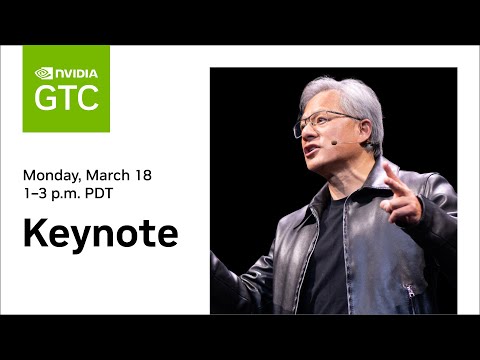
“In the future, data centers are gonna be thought of, as I mentioned earlier, as an AI factory.”NVIDIA GTC keynote, San Jose, 2024 · full transcript →
The endgame is physical AI: robots, cars, and digital worlds
Huang does not stop at language models. He argues that AI will move into physical systems, where models must understand the world, act safely, and learn from simulation as well as real data. In his framing, robotics and autonomy are a natural continuation of the current AI platform shift.18
That is why he emphasizes simulation, digital twins, and synthetic data. Physical AI cannot learn only from scarce real-world examples, especially for rare or dangerous edge cases, so virtual environments become part of the training pipeline. He presents this as a practical recipe for building autonomous vehicles and robots: train models, test them in simulation, and deploy them into machines that operate in the real world.1920
“Everything that moves in the future will be robotic.”NVIDIA GTC keynote, San Jose, 2024 · full transcript →
Huang's practical advice: move early, build the stack, and engage now
Huang's stance on AI is not cautious waiting; it is fast engagement. He argues that when a platform shift is grounded in first principles, delaying action is the bigger risk. That is why he urges people and organizations to move quickly and to treat AI as a capability they must learn by doing.212223
At the same time, he does not describe AI as a single model or product. He sees it as a full stack challenge involving chips, systems, networking, models, tools, and application frameworks. The practical implication is that winning with AI means integrating the whole pipeline, from infrastructure and safety guardrails to deployment in domain-specific workflows.242526
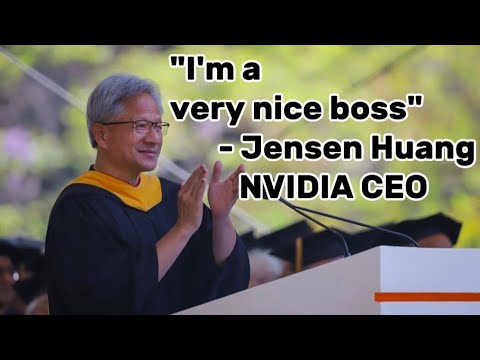
“…run, don't walk, and engage the AI revolution…”Caltech commencement address, 2024 · full transcript →
Huang on artificial intelligence, in his own words
“You no longer program the software. You train the software.”
“The iPhone moment of AI has started.”
“Generative AI is a new kind of computer, one that we program in human language.”
“In the future, data centers are gonna be thought of, as I mentioned earlier, as an AI factory.”
“The age of AgenTic AI is here for every organization.”
“We are now creating software that no humans can write.”
Where to watch
 Jensen Huang on AI Platform Shift: From Models to Agents2025 · 92 min · full transcriptBest single overview of Huang's platform-shift view: AI becomes the base layer for software, agents, and physical systems.
 Jensen Huang on Generative AI Platform: The iPhone Moment of AI2023 · 78 min · full transcriptBest short-form statement of why Huang thinks generative AI marks a new computing era.
 Jensen Huang on Blackwell And Generative AI: GTC 2024 Keynote2024 · 123 min · full transcriptBest for understanding AI factories, Blackwell, and why infrastructure is central to Huang's idea of AI.
 Jensen Huang on Artificial Intelligence: The Future Is Here2025 · 116 min · full transcriptBest for Huang's current thinking on scaling laws, reasoning, inference demand, and agentic AI for organizations.
 Jensen Huang on Artificial Intelligence: How AI Became Real2025 · 148 min · full transcriptBest for how Huang explains how AI became real and why he sees progress and safety as matters of capability and engineering.
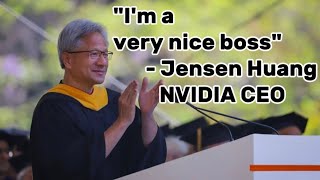 Jensen Huang on AI and Resilience: Find Your Craft2024 · 32 min · full transcriptBest concise talk on why Huang thinks people should engage AI now and how he connects it to long-term career thinking.
Questions people ask
- How does Jensen Huang say NVIDIA is helping companies build agentic AI?
- How does Jensen Huang say autonomous vehicles are trained?
- What did Jensen Huang say about DGX and AI supercomputers?
- What did Jensen Huang say about NVIDIA building the full AI stack?
- What did Jensen Huang say about agentic AI?
- Why did Jensen Huang say companies need custom large language models?
Sources
Every quote above, word for word from the transcripts. Numbers match the text.
“The iPhone moment of AI has started.”
“Generative AI is a new kind of computer, one that we program in human language.”
“DGX supercomputers are modern AI factories. We are at the iPhone moment of AI. Startups are racing to build disruptive products and business models, while incumbents are looking to respond. Generative AI has triggered a sense of urgency in enterprises worldwide to develop AI strategies. Customers need to access NVIDIA AI easier and faster. We are announcing NVIDIA DGX Cloud through partnerships with Microsoft Azure, Google GCP, and Oracle OCI to bring NVIDIA DGX AI supercomputers to every company instantly from a browser. DGX Cloud is optimized to run NVIDIA AI enterprise, the world's leading acceleration library suite for end to end development and deployment of AI.”
“Except this time, there are two simultaneous platform shifts, in fact, happening at the same time. While we now move to AI, applications are now going to be built on top of AI. At first, people thought AIs are applications. And in fact, AIs are applications, but you're gonna build applications on top of AIs. But in addition to that, how you run the software, how you develop the software fundamentally changed. The entire five layer stack of the computer industry is being reinvented. You no longer program the software. You train the software.”
“You no longer program the software. You train the software.”
“We are now creating software that no humans can write.”
“We are now producing software, using computers to write software, producing software that never existed before. It is a brand new category. It took share from nothing. It's a brand new category. And the way you produce this software is unlike anything we've ever done before. In data centers, generating tokens, producing floating point numbers at very large scale. As if in the beginning of this last industrial revolution when people realized that you would set up factories, apply energy to it. And this invisible valuable thing called electricity came out. AC generators. And a hundred years later, two hundred years later, we are now creating new types of electrons, tokens using infrastructure we call factories, AI factories, to generate this new incredibly valuable thing called artificial intelligence.”
“The age of AgenTic AI is here for every organization.”
“We need an enormous amount of computation because we want to train larger and larger models.”
“In the future, data centers are gonna be thought of, as I mentioned earlier, as an AI factory.”
“The cost of intelligence would fall fairly, fairly quickly.”
“A daunting challenge is net zero. Every company must accelerate every workload to reclaim power. Accelerated computing is a full stack data center scale computing challenge. GRACE, Grace Hopper, and BlueField three are new chips for super energy efficient accelerated data centers. Acceleration libraries solve new challenges and open new markets.”
“The second part is your factory throughput. Blackwell is green again, And factory throughput is important because your factory is, in the case of a gigawatt, is $50,000,000,000 A $50,000,000,000 data center can only consume one gigawatt of power. And so if your performance, your throughput per watt is very good versus quite poor, that directly translates to your revenues. Your revenues of your data center is directly related to the second second column. And in the case of Blackwell, it was about 10 times over Hopper. In the case of Rubin, it's going to be about 10 times higher again. Okay? And in the case of now the, the cost of the tokens, how cost effectively it is to generate the token, this is Rubin about one tenth.”
“Everything that moves in the future will be robotic.”
“Building autonomous vehicles like all robots requires three computers, NVIDIA DGX to train AI models, Omniverse to test drive and generate synthetic data, and drive AGX, a supercomputer in the car. Building safe autonomous vehicles means addressing edge scenarios, but real world data is limited, So synthetic data is essential for training. The autonomous vehicle data factory powered by NVIDIA Omniverse, AI models, and Cosmos generates synthetic driving scenarios that enhance training data by orders of magnitude.”
“Once you get Omniverse connected into your workflow, your ecosystem, from the beginning of your design to engineering to manufacturing planning, all the way to digital twin operations, Once you connect everything together, it's insane how much productivity you can get. And it's just really, really wonderful. All of a sudden, everybody's operating on the same ground truth. You don't have to exchange data and convert data, make mistakes. Everybody is working on the same ground truth.”
“The best way to get to the future is take action quickly.”
“And so if you believe in that future and you don't do anything about it, you're gonna regret it for your life. And so we always... You know, I always tell the team, do you believe what... Do we believe this or not? And if you believe it and start grounded on first principles, not random, you know, hearsay. And we believe it. We've gotta... We owe it to ourselves to go pursue it. If we're the right people to go do it, if it's really, really hard to do, it's worth doing, and we believe it. Let's go pursue it. When we pursued it, we we launched the product. Nobody knew.”
“…run, don't walk, and engage the AI revolution…”
“Well, to help the industry build AgenTeq AI, our go to market is not direct to enterprise customers. Our go to market is is we work with software developers in the IT ecosystem to integrate our technology to make possible new capabilities just like we did with CUDA libraries. We now want to do that with AI libraries. And just as the computing model of the past has APIs that are doing computer graphics or doing linear algebra or doing fluid dynamics, in the future, on top of those acceleration libraries, CUDA acceleration libraries, we'll have AI libraries. We've created three things for helping the ecosystem build agentic AI. NVIDIA NIMS, which are essentially AI microservices all packaged up. It takes all of this really complicated CUDA software, CUDA DNN, Cutlass or TensorRTLM or Triton or all of these different really complicated software and the model itself, we package it up, we optimize it, we put it into a container, and you could take it wherever you like.”
“They need to set up usage guardrails and refine their models to align with their company's safety, privacy, and security requirements. The industry needs a foundry, a TSMC for custom large language models. Today, we announced the NVIDIA AI Foundations, a cloud service for customers needing to build, refine, and operate custom large language models and generative AI trained with their proprietary data and for their domain specific tasks.”
“Artificial intelligence is the most important technology force of our time, and is creating capabilities never before possible. In just a few years, AI has delivered breakthroughs in computer vision, speech recognition, natural language understanding, and recommender systems. These AI models still have to be built into applications— like self-driving cars, customer service chatbots, and e-commerce sites— and workflows that adapt the AIs to specific use-cases and help the models learn from experience. To make AI accessible to industries, we've developed domain-specific frameworks that companies can use to make AI applications.”
How this guide was made: drafted with AI from the full transcripts of the recordings cited, then checked: every quotation must match a transcript word for word and be the speaker's own words, and an independent review gates accuracy. Methodology and corrections.