Agentic Software
The next software stack is built around models that plan, use tools, remember, and act.

“Excel is a tool. Word is a tool. A web browser is a tool. The reason why I know these are tools is because you use them. The tools industry, just as screwdrivers and hammers, the tools industry is only so large. In the case of IT tools, they could be database tools. These IT tools is about a trillion dollars or so. But AI is not a tool. AI is work. That is the profound difference. AI is in fact workers that can actually use tools. One of the things I'm really excited about is the work that Irvin's doing at Perplexity. Perplexity using web browsers to book vacations or do shopping basically an AI using tools. Cursor is an AI anantic AI system that we use at NVIDIA. Every single software engineer at NVIDIA uses cursor has improved our productivity tremendously. It's basically a partner for every one of our software engineers to generate code and it uses a tool and the tool it uses is called VS code. So cursor is an AI agentic AI system that uses VS code.”NVIDIA GTC Washington, D.C. keynote, 2025 · 35:54
The lesson
Huang presents agentic AI as a software shift, not just a better chatbot. In his framing, applications will increasingly be built on top of AI systems, while the way software is created also changes from explicit programming toward training and adaptation12. The key new capability is that models do not just answer; they can reason, break work into steps, look up information, use tools, and plan actions to solve problems they were not directly trained to complete34.
This matters because agentic systems change software economics. Huang argues that useful AI can do productive work rather than merely serve as a passive tool, and that these systems can themselves use software tools such as browsers and coding environments5. As a result, better models create more demand, not less: once intelligence becomes cheaper, organizations apply it to more jobs and produce more tokens, which raises infrastructure demand across the stack67.
To deploy agentic AI, enterprises need more than a base model. Across these talks, Huang describes a broader architecture: the model itself, a harness or runtime to manage execution, memory or knowledge to ground answers, and tool access so the system can act in external software and data sources4. This is why he emphasizes packaged AI microservices and libraries that let the software ecosystem integrate agentic capabilities into real products instead of asking every company to build everything from scratch9.
Agentic AI also changes infrastructure requirements. Reasoning, retrieval, tool use, and working memory create much more computation and data movement than simple one-shot responses, which is why Huang ties agents to rising token volume and more complex inference systems10. Once workloads become distributed and disaggregated, connectivity becomes a core part of the design, because the system only works at scale if compute, memory, and bandwidth are linked efficiently1112.
The practical implication for enterprises is to move quickly, but with structure. Huang argues organizations should act now because the capability is already useful, while also putting guardrails around safety, privacy, and security and refining models with proprietary data for domain-specific work131415. In other words, the winning pattern is not generic AI adoption alone; it is building a grounded, controlled, tool-using system that fits real company workflows.
5 principles from Jensen Huang
Design AI as a worker, not just a feature
Treat the model as something that can carry out multi-step work, not merely generate text on request. When planning products, ask what tasks the system can complete end-to-end by reasoning, researching, and using software tools.
“Excel is a tool. Word is a tool. A web browser is a tool. The reason why I know these are tools is because you use them. The tools industry, just as screwdrivers and hammers, the tools industry is only so large. In the case of IT tools, they could be database tools. These IT tools is about a trillion dollars or so. But AI is not a tool. AI is work. That is the profound difference. AI is in fact workers that can actually use tools. One of the things I'm really excited about is the work that Irvin's doing at Perplexity. Perplexity using web browsers to book vacations or do shopping basically an AI using tools. Cursor is an AI anantic AI system that we use at NVIDIA. Every single software engineer at NVIDIA uses cursor has improved our productivity tremendously. It's basically a partner for every one of our software engineers to generate code and it uses a tool and the tool it uses is called VS code. So cursor is an AI agentic AI system that uses VS code.”
Build applications on top of AI systems
The model is becoming part of the platform layer, not just an app component. That means product design should start from what the AI can do natively and then add workflow, interfaces, and controls around it.
“Except this time, there are two simultaneous platform shifts, in fact, happening at the same time. While we now move to AI, applications are now going to be built on top of AI. At first, people thought AIs are applications. And in fact, AIs are applications, but you're gonna build applications on top of AIs. But in addition to that, how you run the software, how you develop the software fundamentally changed. The entire five layer stack of the computer industry is being reinvented. You no longer program the software. You train the software.”
Give agents grounding, memory, and tools
A useful agent needs access to knowledge and external actions, plus a runtime that can coordinate steps. If your system only has a model and a prompt, it will fall short on accuracy, reliability, and real work execution.
Expect agentic AI to increase compute demand
Reasoning and tool use add many more steps than direct response generation, so infrastructure planning must account for higher token volume and more data movement. Budgeting for agents means thinking about throughput, memory, and networking together.
“…when token production is profitable, everybody wants to make more tokens…”
Adopt fast, but with enterprise guardrails
Move early enough to learn where agents create value, but do not deploy them as uncontrolled general systems. Refine models for your domain and set safety, privacy, and security constraints before connecting them to important workflows.
“The best way to get to the future is take action quickly.”
In his own words
The quotes behind the lesson, word for word from the transcripts. Numbers match the lesson above.
“You no longer program the software. You train the software.”
“Except this time, there are two simultaneous platform shifts, in fact, happening at the same time. While we now move to AI, applications are now going to be built on top of AI. At first, people thought AIs are applications. And in fact, AIs are applications, but you're gonna build applications on top of AIs. But in addition to that, how you run the software, how you develop the software fundamentally changed. The entire five layer stack of the computer industry is being reinvented. You no longer program the software. You train the software.”
“Meanwhile, another breakthrough happened, and this breakthrough happened in 2024. Agenic systems started to emerge. In 2025, it started to pervace... To to, proliferate just about everywhere. Agenic models that have the ability to reason, look up information, do research, use tools, plan futures, simulate outcomes, all of a sudden started to solve very, very important problems. One of my favorite agentic models is called Cursor, which revolutionized the way we do software programming at NVIDIA. Agenic systems are going to really take off from here.”
“And the reason why it hallucinated, of course, it could memorize everything in the past, but it can't memorize everything in the future and the current. And so it needs to be grounded in research. It has to do fundamental research before it answers a question. The ability to reason about, do I have to do research? Do I have to use tools? How do I break up a problem into steps? Each one of these steps, something that that the AI model knows how to do, and together, it is able to compose it into a sequence of steps to perform something it's never done before, never been trained to do. This is the wonderful capability of reasoning.”
“Excel is a tool. Word is a tool. A web browser is a tool. The reason why I know these are tools is because you use them. The tools industry, just as screwdrivers and hammers, the tools industry is only so large. In the case of IT tools, they could be database tools. These IT tools is about a trillion dollars or so. But AI is not a tool. AI is work. That is the profound difference. AI is in fact workers that can actually use tools. One of the things I'm really excited about is the work that Irvin's doing at Perplexity. Perplexity using web browsers to book vacations or do shopping basically an AI using tools. Cursor is an AI anantic AI system that we use at NVIDIA. Every single software engineer at NVIDIA uses cursor has improved our productivity tremendously. It's basically a partner for every one of our software engineers to generate code and it uses a tool and the tool it uses is called VS code. So cursor is an AI agentic AI system that uses VS code.”
“The cost of intelligence would fall fairly, fairly quickly.”
“…when token production is profitable, everybody wants to make more tokens…”
“Just as in the case of yep. So that's how... This is how we're gonna get everybody to the next frontier to push AI to the next level, and, of course, to build these data centers energy efficiently and cost efficiently. So this is it. This is NVIDIA today. You know, we mentioned that we build chips, but as you know, NVIDIA builds entire systems now. And AI is a full stack. We were reinventing AI across everything from chips to infrastructure to models to applications. And our job is to create the entire stack so that all of you could create incredible applications, for the rest of the world.”
“And the industry is so excited because this is a pain point for just about everybody who does a lot of token generation today, the AI labs, the cloud service providers. They're really suffering from the amount of network traffic that's causing... Being caused by KV cash moving around. And so the idea that we would create a new platform, a new processor to run the entire Dynamo KV cache context memory management system and to put it very close to the rest of the rack is completely revolutionary. So this is it.”
“…what makes it possible is connectivity…”
“…use optics wherever you must. You use copper wherever you can.”
“The age of AgenTic AI is here for every organization.”
“The best way to get to the future is take action quickly.”
“They need to set up usage guardrails and refine their models to align with their company's safety, privacy, and security requirements. The industry needs a foundry, a TSMC for custom large language models. Today, we announced the NVIDIA AI Foundations, a cloud service for customers needing to build, refine, and operate custom large language models and generative AI trained with their proprietary data and for their domain specific tasks.”
Reflect
- Pick one recurring task in your work. What would change if an AI system could plan the steps, look up missing information, and use your existing tools to complete it?
- Where would an agent in your organization need grounding from proprietary knowledge or live data to be trustworthy enough for real use?
- If you deployed an agent tomorrow, what guardrails around safety, privacy, or approval would you require before letting it act?
Check your understanding
Go deeper
 Jensen Huang on AI Platform Shift: From Models to Agents2025 · 92 min · full transcript
 Jensen Huang on AI Factories: Europe’s New Industrial Revolution2026 · 92 min · full transcript
 Jensen Huang on Artificial Intelligence: The Future Is Here2025 · 116 min · full transcript
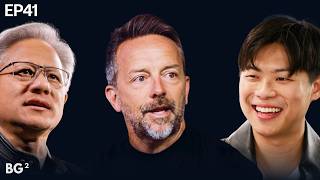 Jensen Huang on AI Scaling: Compute, Agents, and Superintelligence2024 · 100 min · full transcript
 Jensen Huang on Agentic AI: Useful AI Has Arrived2024 · 119 min · full transcript
 Jensen Huang on AI Connectivity: Copper, Optics, and Agents2026 · 187 min · full transcript
 Jensen Huang on NVIDIA Moat: Why It Won't Commoditize2024 · 103 min · full transcript