Charlie Munger on Decision Making
Charlie Munger treats decision making as the disciplined work of avoiding self-deception, respecting reality, and waiting patiently for the few moments when action is truly justified.
- Good decisions start with stopping your own brain from fooling you.
- Most bad decisions come from predictable forces like incentives, denial, commitment, and social proof.
- Use inversion, checklists, and disconfirming evidence to avoid error before acting.
- Know the edge of your competence and prefer being roughly right to precisely wrong.
- Be patient: don’t force action, don’t try to outguess macro cycles, and be ready for the few big opportunities that matter.

“…the whole trick in life is to get so that your own brain doesn't mislead you…”University of Michigan Ross conversation, 2017 · 8:36
The first job is to stop your own mind from misleading you
Munger’s starting point is that decision making is not mainly about brilliance. It is about preventing error. He says the central challenge in life is keeping your own brain from tricking you, which makes self-control and self-awareness more important than cleverness alone.12
That is why he spent so much time studying human misjudgment. He saw irrationality not as a rare exception but as a regular feature of life, including in talented people. Better judgment begins when you assume you are vulnerable to the same patterns.34
He also treats rationality as an obligation, not just a useful skill. For Munger, trying to see things clearly is part of living well, not merely a way to win arguments or make money.25
“…the whole trick in life is to get so that your own brain doesn't mislead you…”University of Michigan Ross conversation, 2017 · full transcript →
Bad decisions are usually caused by a few recurring psychological forces
Munger argues that mistakes are systematic. People do not fail randomly; they fail in patterns. Among the strongest forces he highlights are incentives, which he says are so powerful that even someone who studied them closely can still underestimate them.6
He also points to denial as a dominant cause of bad decisions. When reality becomes too unpleasant, people avoid seeing what is in front of them and keep committing resources to paths that no longer work. That turns ordinary error into lasting destruction.
Other forces pile on. Commitment can harden beliefs after action has already begun, social proof can make crowds feel convincing, and several biases can combine into what he calls a lollapalooza effect. In practice, this means many terrible decisions feel emotionally justified at the moment they are made.8910
This is also why he warns so strongly about easy money and bad systems. If the incentives are corrupt, decision quality will usually deteriorate no matter how intelligent the people are.11

“First, under recognition of the power of what psychologists call reinforcement and economists call incentives. Well, you say everybody knows that. Well, I think I've been in the top 5% of my age cohort all my life in understanding the power of incentives. And all my life, I underestimated it. And never a year passes, but will I get some surprise that pushes my limit a little farther.”Harvard lecture, 1995 · full transcript →
Respect reality, use simple tools, and invert the problem
Munger’s decision method is grounded in reality-testing. He insists that reality must fit together, which is why he dislikes theories or plans that ignore how the world actually works. He would rather have a simple, workable understanding than a sophisticated but false one.1213
One of his favorite tools is inversion: instead of asking only how to succeed, ask what will cause failure and then avoid it. He thinks many hard problems become easier when turned around this way. For decision making, that means error-avoidance is often more reliable than ambitious forecasting.14
He also recommends objectivity routines. Pay special attention to disconfirming evidence, and use checklists so that important considerations are not forgotten in the heat of judgment. He presents this as a practical discipline, not an academic exercise.15
This approach fits his preference for understanding a problem thoroughly before trying to solve it. Once the problem is clear, better decisions become much easier.16
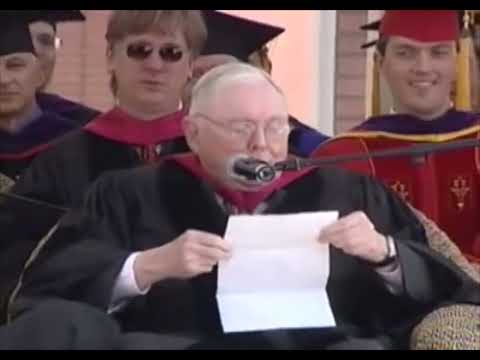
“What? Go there? That rustic who had that idea had a profound truth, in his hand. The way complex adaptive systems work and the way mental constructs work, problems frequently get easy. I... I'd even say usually are easier to solve if you turn them around in reverse. In other words, if you wanna help India, the question you should ask is now how can I help India? You think, what's doing the worst damage in India? What will automatically do the worst damage, and how do I avoid? You'd think they're logically the same thing. They're not. Those of you who have mastered algebra know that inversion frequently will solve problems which nothing else will solve.”USC Gould School of Law commencement address, 2007 · full transcript →
Know the edge of your competence and avoid false precision
A major part of good judgment, for Munger, is humility. You need to know where your competence ends. If you do not know that boundary, you become dangerous to yourself because you will act with confidence in places where your understanding is weak.1718
That humility shows up in his preference for rough accuracy over exact-looking error. He does not admire decision making that hides ignorance behind formulas, jargon, or overconfident prediction. Better to make a sound judgment with simple arithmetic and owner-like common sense than to pretend to precision you do not have.1319
It also explains his respect for harder evidence over charming impressions. He says the paper record predicts better than the impression interview, which is a warning against trusting the vivid, the recent, and the emotionally persuasive over the tested and documented.20

“Humility means that you know the edge of your own competency…”Caltech DuBridge Distinguished Visitor Lecture, 2008 · full transcript →
Act less, wait more, and move hard when the right opportunity appears
Munger does not believe good decision makers should be in constant motion. He warns that trying to outguess macroeconomic cycles is a delusion and a snare. Instead of spending energy on prediction, he prefers disciplined work, patience, and readiness.21
His model is to endure hardship without self-pity and to keep going until conditions improve. Resilience matters because many decisions are made under stress, and stress tempts people into envy, complaint, and desperate action. He thinks soldiering through is often the right answer when no clever shortcut exists.2223
At the same time, patience is not passivity. Munger says the big results often come from a few major opportunities, so the decision maker must be prepared to recognize them and act when they arrive. This is one reason he values broad learning and mental models: they improve recognition when something unusual but important appears.2425
His practical standard is simple: avoid crazy, avoid needless activity, and do not chase every exciting idea. If you can stay rational, patient, and dependable, he thinks the odds move heavily in your favor.2728

“It's kind of a snare and a delusion to outguess macroeconomic cycles.”University of Michigan Ross conversation with Charlie Munger, 2017 · full transcript →
Character is part of decision quality, not separate from it
For Munger, decision making is inseparable from character. He repeatedly connects good judgment with deserving trust, keeping commitments, and choosing the high road. A person who lies, resents, or exploits others will usually make worse decisions because moral weakness distorts perception and incentives.293031
That is why he treats lifelong learning as a duty. Better decisions require a steadily improving latticework of ideas, freedom from heavy ideology, and a willingness to learn more than you talk.32333435
His ideal environment is one built on deserved trust rather than manipulation and procedural theater. In that world, people can make cleaner decisions because they are not constantly defending against hidden motives.36
“Wisdom acquisition is a moral duty.”USC Gould School of Law commencement address, 2007 · full transcript →
Munger on decision making, in his own words
“…the whole trick in life is to get so that your own brain doesn't mislead you…”
“It's kind of a snare and a delusion to outguess macroeconomic cycles.”
“If you're capable of understanding the world, you have a moral obligation to become rational.”
“It's better to be roughly right than precisely wrong.”
“Humility means that you know the edge of your own competency…”
Where to watch
 Charlie Munger on Human Misjudgment: 24 Causes of Error1995 · 91 min · full transcriptBest for Munger’s full map of the recurring psychological causes of bad decisions, especially incentives, denial, commitment, and social proof.
 Charlie Munger on Decision Making: Rationality, Incentives, and Life2017 · 120 min · full transcriptBest for his practical rules on rationality, patience, macro humility, and the corrupting power of easy money.
 Charlie Munger on Common Sense: Thinking Across Disciplines2008 · 107 min · full transcriptBest for his operating tools: inversion, competence boundaries, common sense, and cross-disciplinary thinking.
 Charlie Munger on Worldly Wisdom: Learning, Inversion, and Trust2007 · 44 min · full transcriptBest for the moral side of judgment: lifelong learning, anti-ideology, checklists, and deserved trust.
 Charlie Munger on Life Lessons: Omaha, Judgment, and Berkshire2017 · 56 min · full transcriptBest for the personal core of his approach: don’t let your brain mislead you, think like an owner, and favor records over impressions.
Questions people ask
- What did Charlie Munger say about Bitcoin and crypto?
- What did Charlie Munger say about avoiding crazy decisions?
- What did Charlie Munger say about consistency and commitment?
- What did Charlie Munger say about denial and bad decisions?
- What did Charlie Munger say about objectivity and checklists?
- What did Charlie Munger say are the simple lessons of life?
Sources
Every quote above, word for word from the transcripts. Numbers match the text.
“…the whole trick in life is to get so that your own brain doesn't mislead you…”
“If you're capable of understanding the world, you have a moral obligation to become rational.”
“Well, I am very interested in the subject of human misjudgment…”
“I was able to learn from my dead grandfather, great grandfather when I was a little boy. What I learned at a very young age when I was just a kid, I could see some of the adults around me were nuts and yet they were very talented. I could see how much irrationality there was in very talented people. And so I got interested in seeking out the patterns and understanding why it happened and learning tricks to cope and so on. And I did that when I was a little kid. And of course it helped me. Who is not helped by an early start in a promising activity? And what activity could be more promising than diagnosing stupidity?”
“…more important than being rich, more important than being important — an absolute moral duty…”
“First, under recognition of the power of what psychologists call reinforcement and economists call incentives. Well, you say everybody knows that. Well, I think I've been in the top 5% of my age cohort all my life in understanding the power of incentives. And all my life, I underestimated it. And never a year passes, but will I get some surprise that pushes my limit a little farther.”
“It's not just reciprocation tendency and role theory that caused that. It's consistency and commitment tendency. Each person as he acted as a guard or a prisoner, the action itself was pounding in the idea. Wherever you turn this consistency and commitment tendency is affecting you. In other words, what you think may change what you do, but perhaps even more important, what you do will change what you think. And you can say everybody knows that. I want to tell you I didn't know it well enough or early enough.”
“I would say the one thing that causes the most trouble is when you combine a bunch of these together, you get this Lollapalooza effect. And again, if you read the psychology textbooks, they don't discuss how these things combine, at least not very much. Do they multiply? Do they add? How does it work? I think it would be just an automatic subject for research, but it doesn't seem to turn the psychology establishment on. I think this is a man for Mars approach to psychology. I just reached in and took what I thought I had to have.”
“If you think about the doctrines I've talked about, namely, one, the power of reinforcement. After all, you do something and the market goes up and you get paid and rewarded and applauded and what have you. You're getting a lot of reinforcement if you make a bet in a market and the market goes with you. Also, there's social proof. I mean, the prices in the market are the ultimate form of social proof, reflecting what other people think. And so the combination is very powerful. Why would you expect general market levels to always be totally efficient, say even in 1973, at the pit or in 1972 or whatever it was when the Nifty fifty were in their heyday, if these psychological motions are correct, you would expect some waves of irrationality which carry general levels to...”
“Easy money corrupts, and really easy money tends to corrupt absolutely.”
“…all reality has to respect all other reality…”
“It's better to be roughly right than precisely wrong.”
“What? Go there? That rustic who had that idea had a profound truth, in his hand. The way complex adaptive systems work and the way mental constructs work, problems frequently get easy. I... I'd even say usually are easier to solve if you turn them around in reverse. In other words, if you wanna help India, the question you should ask is now how can I help India? You think, what's doing the worst damage in India? What will automatically do the worst damage, and how do I avoid? You'd think they're logically the same thing. They're not. Those of you who have mastered algebra know that inversion frequently will solve problems which nothing else will solve.”
“Well, objectivity maintenance routines are totally required in life if you're going to be a correct thinker. And, there, we're talking about Darwin's attitude, special attention to the disconfirming evidence, and also to checklist routines. Checklist routines avoid a lot of errors. You should have all this elementary wisdom, and then you should go through a mental checklist in order to use it. There is no other procedure that will work as well.”
“A problem thoroughly understood is half solved.”
“Humility means that you know the edge of your own competency…”
“You are a disaster if you don't know the edge of your own competency.”
“Coming to business not as business school graduates but as people who had owned portfolios or securities. We thought like capitalists because we were always in the shareholder mindset. A lot of people running the businesses think like careerists, and believe me you got to think like a capitalist to some extent if you're in a career. But it also helps to look at the business strategy problems as though you're an owner. And so my advice to you is you don't be never get to be a career so much you don't see it from the owner's point of view.”
“The paper record has about three times the predictive value of your impression interview…”
“It's kind of a snare and a delusion to outguess macroeconomic cycles.”
“If you soldier through, you can get through almost anything.”
“We all know how to get through them. Through you... The great philosophers of realism are also the great philosophers of of what I call soldiering through. If you soldier through, you can get through almost anything. And it's your only option. You can't bring a very good dad. You can't cure the dying child. You can't do all kinds of things. You have to soldier through, and you just... Somehow, you soldier through. If you have to walk through the streets crying for a few hours a day as part of the soldiering, go ahead and cry away, but you have to You can't squint.”
“You gotta learn how to recognize them when they come…”
“Sure. I I basically believe in the in the soldier on system. Mhmm. Lots of hardship will come, and and you're... You gotta handle it well by soldiering through. And lots of... A few where our opportunities will come. You gotta learn how to recognize them when they come and not to make too minor a trip to the bike counter when the opportunity is available. And those are the simple lessons.”
“Yes. Avoid crazy at all costs. Crazy is way more common than you think. It's easy to slip into crazy. Just avoid it. Avoid it. Avoid it. Of course. Of course. Of course.”
“Well, that's the easy rationality. If you're just not crazy, you have a big advantage over 95% of the people because most people have all kinds of crazy patches. And if you just are consistently not crazy, you had a you had a big advantage in life. And if you're patient and a gratification defer in addition to being not crazy, then it's practically a cinch. And then if you're exceptionally good at satisfying your commitments to other people, then you got... You you just automatically improved your resources and your chances in life enormously. And it's so simple. And why don't more people do it?”
“…the safest way to try and get what you want is to try and deserve what you want…”
“The highest form that civilization can reach is a seamless web of deserved trust…”
“…you should take the high road in life because it's less crowded…”
“Wisdom acquisition is a moral duty.”
“…you're hooked for lifetime learning…”
“…if you wanna have more correct knowledge and be wiser than other people, the heavy ideology is very likely to do you in…”
“I think young people should learn more and shout less.”
“The last idea that I wanna give to you as you go out into a profession that is... Frequently puts a lot of procedure and a lot of precautions and a lot of mumbo jumbo into what it does, This is not the highest form which civilization can reach. The highest form that civilization can reach is a seamless web of deserved trust. Not much procedure, just totally reliable people correctly trusting one another.”
How this guide was made: drafted with AI from the full transcripts of the recordings cited, then checked: every quotation must match a transcript word for word and be the speaker's own words, and an independent review gates accuracy. Methodology and corrections.