Charlie Munger on Worldly Wisdom: Learning, Inversion, and Trust

What Munger talks about
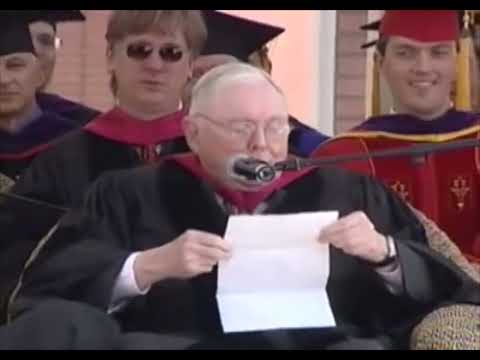
Charlie Munger gave this commencement address at the USC Gould School of Law on May 13, 2007, speaking about lifelong learning, worldly wisdom, inversion, self-discipline, and avoiding common failures.
Also known as: USC Gould School of Law commencement address; Commencement Address Speech USC.
Charlie Munger gives a broad commencement talk about the habits and attitudes that helped him succeed: lifelong learning, reading, thinking, and building a multidisciplinary latticework of ideas. He argues that wisdom is a moral duty, not just a career advantage.
He also stresses inversion and self-discipline as practical tools for avoiding failure. Across the speech, he warns against sloth, unreliability, ideology, self-pity, bad incentives, and vanity, while praising objectivity, admiration-based relationships, and deserved trust.
A dean or host introduces Munger and closes the ceremony; Munger gives the main address.
In his words
“The safest way to try and get what you want is to try and deserve what you want”
“Wisdom acquisition is a moral duty.”
“You're hooked for lifetime learning”
“If you wanna have more correct knowledge and be wiser than other people, the heavy ideology is very likely to do you in”
“The highest form that civilization can reach is a seamless web of deserved trust”
Key points
- The safest way to get what you want is to deserve it.
- Wisdom acquisition is a moral duty, which means lifelong learning never stops.
- Big ideas from many disciplines should become a mental latticework, not exam facts.
- Use inversion: ask what causes failure and avoid that path.
- Beware of self-serving bias, envy, resentment, self-pity, and rigid ideology.
- Choose admired partners and work in systems built on deserved trust.
- Life improves when responsibility and opportunity go to the people with real knowledge.
Full transcript: Charlie Munger, USC Law commencement speech (2007)
Dean/hostOkay. Thank you, Rosemary, and congratulations to all of our, global law students. It's now my honor to, introduce our keynote speaker. And I and I suspect there are, some of you way back there who were here just for this reason. I had the great privilege of being in Pasadena on Wednesday afternoon of this week at the Westco board meeting where Charlie Munger spoke for three hours. A lot of it was Q and A. And there were about 1,000 people there who had come from all over the world, from New Delhi and Delhi and Australia and various parts just to hear Charlie talk. So it's a tremendous honor and a privilege that we're here presenting Charlie right here on the USC campus. Charlie, as many of you may know, is the Vice Chairman of Berkshire Hathaway. That is the legendary investment company headed by Warren Buffett.
Like Warren, Charlie grew up in Omaha. Charlie is also the Chairman of Wesco, which is a subsidiary of Berkshire Hathaway, and he holds an annual meeting every year, and it's open to the public. So hopefully,
Charlie MungerI'll see some of you
Dean/hostthere next year. It's a lot of fun. Charlie, like Warren, is a native of Omaha. He studied at the University of Michigan and served in the United States Navy before entering Harvard Law School, a little bit of a theme here. Charlie founded and worked as a real estate attorney. He actually did some real estate development as well. But he founded and worked as a real estate attorney at the very prestigious prominent firm of Munger, Tolls, and Olson until 1965 when he left the practice of law and became an investment manager. Now here's a sentence that's kind of standard in Charlie Mungert law. Leaving the law was probably the best decision he ever made. So just repeat, leaving the law was probably the best decision Charlie ever made. He took his legal education, the kind of skills that he learned in law school, and applied it to investing.
And today, is listed by Forbes as one of the wealthiest people in the world. So there... There's hope, if not for you, but for your parents and all those people who worked so hard to support you for the last three years. Charlie credits much of his success to his favorite pastimes, reading and thinking. One of the lines that Charlie developed in dispensing his wisdom at the WESCO meeting was if it's wisdom you're after if it's wisdom you're after, you're going to spend a lot of time sitting on your ass and reading. That's a quote from Charlie. So read, read, read. Think, think, think. Question, question, question. This is what Charlie is really about. His observations about wealth, business, and life have inspired a near cult of fans. It's true. They wear Charlie Munger shirts, and they come to these meetings. It's a spectacular thing to see.
Lots of these are gathered up in his book, Poor Charlie's Almanac, which was edited by Peter Coffin, who's over here, CEO of Plan Air, another USC Trojan graduate of our business and accounting schools. And get that book. It's a wonderful thing. You can't get I can't get a discount. Nobody can get a discount because it's a Charlie Munger book. But it's called Poor Charlie's Almanac, and it's a collection of speeches and witticisms and thoughts that's tremendously powerful. Here's just an example and one of my favorite mongerisms. Quote, all I want to know, the only thing I want to know, is where I'm going to die, so I will never go there. That's that's just Charlie. Another thing we heard both at West Coast and again this morning, we had breakfast with Charlie, which was a lot a lot of fun. But a saying attributed... I I think I think this is from Warren. But take the high road, you'll find it less crowded.
So that's the way Charlie thinks. He's a brilliant man. He's been a friend, a mentor throughout the past year. And I'm delighted that we're going to get him to dispense his wisdom as our keynote speaker. So Charlie Munger.
Charlie MungerWell, no doubt many of you are wondering why the speaker is so old. Well, the answer is obvious. He hasn't died yet. And why was the speaker chosen? Well, I don't know that either. I like to think that the development department had nothing to do with it. Whatever the reason, I think it's very fitting that I'm sitting here because I see one crowd of faces in the rear not wearing robes, and I know from having educated an army of descendants who does really deserves a lot of the honors that are being given to the people up here in front. The sacrifice and the wisdom and the value transfer that comes from one generation to the next can never be underrated, And that gave me enormous pleasure as I looked at this sea of Asian faces to my left.
All my life, I've admired Confucius. I like the idea of filial piety, the idea that there are values that are taught and duties that come naturally and that all that should be passed on to the next generation. And you people who don't think there's anything in this idea, please note how fast these Asian faces are rising in American life. I think they have something. Alright. The... I scratched out a few notes, and I'm going to try and just give an account of some ideas and attitudes that have worked well for me. I don't claim that they're perfect for everybody, although I think many of them are pretty close to universal values, and many of them are are can't fail ideas.
What are the core ideas that have helped me? Well, luckily, I got at a very early age the idea that the safest way to try and get what you want is to try and deserve what you want. It's such a simple idea. It's the golden rule, so to speak. You you wanna deliver to the world what you would buy if you were on the other end. There is no ethos, in my opinion, that is better for any lawyer or any other person to have. By and large, the people who've had this ethos win in life, and they don't win just money, just honors, and emollient... Months. They win the respect, the deserved trust of the people they deal with. And there is huge pleasure in life to be obtained from getting deserved trust.
And so... And the way to get it is to deliver what you'd wanna buy if the circumstances were reversed. Occasionally, you'll find a perfect rogue of a person who dies rich and with... And widely known. But mostly, these people are fully understood by the surrounding civilization. And when the cathedral is full of people at the funeral ceremony, most of them are are there to celebrate the fact that the person is dead. And that reminds me of the story of the time when one of these people died and the minister said, it's now time for someone to say something nice about the deceased.
And nobody came forward. And nobody came forward. And nobody came forward. And finally, one man came up, and he said, well, his brother was worse. That is not where you wanna go. That's not the kind of funeral you wanna have. You'll leave entirely the wrong example. A second idea that I got very early was that there's no love that's so right as admiration based love, and that love should include the instructive dead. Somehow, I got that idea, and I've lived with it all my life, and it's been very, very useful to me.
A love like that celebrated by Somerset Maugham in his book of human bondage, that's a sick kind of love. It's a disease. And if you find yourself in a disease like that, my advice to you is turn around and fix it. Eliminate it. Another idea that I got, and this may remind you of Confucius too, is that wisdom acquisition was a moral duty. It's not something you do just to advance in life. Wisdom acquisition is a moral duty. And and as a corollary to that proposition, which is very important, it means that you're hooked for lifetime learning.
And without lifetime learning, you people are not gonna do very well. You are not going to get very far in life based on what you already know. You're going to advance in life by what you're going to learn after you leave here. If you take Berkshire Hathaway, which is certainly one of the best regarded corporations in the world, and it may have the best invest... Long term investment record in the entire history of civilization, the skill that got Percher through one decade would not have sufficed to get it through the next decade with the, achievements made. Without Warren Buffett being a learning machine, continuous learning machine, the record would have been absolutely impossible.
The same is true at lower walks of life. I constantly see people rise in life who were not the smartest, sometimes not even the most diligent, but they are learning machines. They go to bed every night a little wiser than they were when they got up. And, boy, does that habit help particularly when you have a long run ahead of you. Alfred North Whitehead said at one time that the rapid advance of civilization came only when man invented the method of invention. And, of course, he was referring to the huge growth in GB... GDP per capita and all the other good things that we now take for granted, which happened just...
Started a few hundred years ago. And when before that, all was stasis. And so if if civilization can progress only when it invents the method of invention, you can progress only when you learn the method of learning. I was very lucky. I came to law school having learned the method of learning, And, and nothing has served me better in my long life than continuous learning. And if you take Warren Buffett, if you watched him with a time clock, I would say half of all the time that he spends is just sitting on his ass and reading.
And a big chunk of the rest of the time is spent talking one on one, either on the telephone or personally, with highly gifted people whom he trusts and who trust him. In other words, it looks quite academic, all this worldly success. Academia has many wonderful values in it. I came across such a value not too long ago. It was several years ago. When I... In my capacity as a hospital board chairman, I was dealing with a medical school academic. And this man, over years of hard work, had made himself know more about bone tumor pathology than almost anybody else in the world, and he wanted to pass this knowledge on to the rest of us and and particularly the people that treat cancer, bone cancer.
And how was he going to do it? Well, he decided to write a textbook that would be very useful to other people. Now I don't think a textbook like this sells 2,000 copies, but those 2,000 copies are in all the major cancer centers of the world. He took a year's sabbatical, and he sat down at his computer. And he had all the slides because he'd saved them and organized them and filed them. And he worked seventeen hours a day, seven days a week for a year. That was his sabbatical. At the end of the year, he had one of the great bone tumor pathology textbooks of the world. When you're around values like that, you wanna pick up as much as you can. The other...
Another idea that was hugely useful to me was that I listened in law school when some wag said, a legal mind is a mind that when two things are all twisted up together and interacting, it's feasible to think responsibly about one thing and not the other. Well, I could see from that one sentence that that was perfectly ridiculous, and it pushed me further into my natural drift, which was into learning all the big ideas and all the big disciplines. So I wouldn't be a perfect damn fool who was trying to think about one aspect of something that couldn't be removed from the totality of the situation in a constructive fashion.
And what I noted since the really big ideas carry 95% of the freight, that it wasn't at all hard for me to pick up all the big ideas in all the disciplines and make them a standard part of my mental routines. Once you have the ideas, of course, they're no good if you don't practice. If you don't practice, you lose it. So I went through life constantly practicing this multidisciplinary approach. Well, I can't tell you what that's done for me. It's it's it's made life more fun. It's made me more constructive. It's made me more helpful to others. It's made me enormously rich. You name it. That attitude really helps. Now there are dangers of it because it works so well that if you do it, you will frequently find you're sitting in the presence of some other expert, maybe even an expert that's superior to you supervising you, and you will know more than he does about his own specialty.
A lot more. You'll see the correct answer when he's missed. That is a very dangerous position to be in. You can cause enormous offense by helpfully being right in a way that causes somebody else to lose face. And I never found a perfect way to to solve that problem. I was a great poker player when I was young, but I wasn't a good enough poker player. So the people failed to sense that I thought I knew more than they did about their subjects, and it gave a lot of offense. Now I'm just regarded as eccentric, but there was a difficult period to go through. And my advice to you is to learn sometimes to keep your life under a bushel.
One of my colleagues, also number one in his class in law school, a great success in life, clerk for the supreme court, etcetera. But he knew a lot, and he tended to show it as a very young lawyer. And one day, the senior partner he was working under called him in and said, listen, Chuck. He He says, wanna explain something to you. He said you. He said, your duty under any circumstances is to behave in such a way that the client thinks he's the smartest person in the world. You got little... Any little energy or insight available after that. Use it to make your senior partner look like the smartest person in the world. And only after you've satisfied those two obligations do you want your light to shine at all. Well, that may have been very good advice for rising in a large firm.
It wasn't what I did. I always obeyed the drift of my nature, and if other people didn't like it, well, I didn't need to be adored by everybody. Another idea... And by the way, when I talk about this multidisciplinary attitude, I'm really following a very key idea of the greatest lawyer of antiquity, Marcus Tullus Cicero. And Cicero is famous for saying, a man who doesn't know what happened before he's born goes through life like a child. That is a very correct idea of Cicero's, and he's right to ridicule somebody so foolish as not to know what happened before he was born. But if you generalize Cicero, as I think one should, there are all these other things that you should know in addition to history.
And those other things are the big ideas in all the other disciplines. And it doesn't help you just to know them enough so you could prattle them back on an exam and get an a. You have to learn these things in such a way that they're in a mental latticework in your head, and you automatically use them for the rest of your life. If you do that, I solemnly promise you that one day you'll be walking down the street and you look to your right and left, and you'll think, my heavenly days. I'm now one of the few most competent people of my whole age cohort. If you don't do it, many of the brightest of you will live in the middle ranks or in the shallows. Another idea that I got, and it was encapsulated by that story that Dean recounted about the man who wanted to know where he was gonna die, and he wouldn't go that...
What? Go there? That rustic who had that idea had a profound truth, in his hand. The way complex adaptive systems work and the way mental constructs work, problems frequently get easy. I... I'd even say usually are easier to solve if you turn them around in reverse. In other words, if you wanna help India, the question you should ask is now how can I help India? You think, what's doing the worst damage in India? What will automatically do the worst damage, and how do I avoid? You'd think they're logically the same thing. They're not. Those of you who have mastered algebra know that inversion frequently will solve problems which nothing else will solve.
And in life, unless you're more gifted than Einstein, inversion will help you solve problems that you can't solve another way. Let me use a little inversion now. What will really fail in life? What do we want to avoid? Such an easy answer. Sloth and unreliability. If you're unreliable, it doesn't matter what your virtues are. You're going to creator immediately. So doing what you are faithfully engaged to do should be an automatic part of your conduct. You want to avoid sloth and unreliability. Another thing I think should be avoided is extremely intense ideology because it cabbages up one's mind. You've seen that, and you see a lot of it, you know, in TV preachers, for instance.
You know, they've all got different ideas about theology, and and and a lot of them have minds that are made of cabbage. And and... But that can happen with political ideology. And if you're young, it's easy to drift into loyalties. And when you announce that you're a loyal member and you start shouting the orthodox ideology out, what you're doing is pounding it in, pounding it in, and you're gradually ruining your mind. So you wanna be very, very careful with this ideology I've had with you. It... It's a big danger. In my mind, I've got a little example I use whenever I think about ideology, and that's the Scandinavian canoeists who've succeeded in taming all the rapids of Scandinavia.
And they thought they would tackle the whirlpools of the Aran Rapids here in The United States, the death rate was a hundred percent. A big whirlpool is not something you wanna go into. And I think the same is true about a really deep ideology. I have what I call an iron prescription that helps me keep sane when I naturally drift toward referring one ideology over another. And that is, I say, I'm not entitled to have an opinion on this subject unless I can state the arguments against my position better than the people do who are supporting. I think only when I reach that state am I qualified to speak. Now you can say that's too much of an iron discipline. It's not too much of an iron discipline.
It isn't even that hard to do. It sounds a lot like the iron prescription of Ferdinand the Great. It's not necessary to hope in order to persevere. That probably is too tough for most people. I don't think it's too tough for me, but it's too tough for most people. But this business of not drifting into the extreme ideology is a very, very important thing in life. If you wanna have more correct knowledge and be wiser than other people, the heavy ideology is very likely to do you in. Another thing, of course, that does one end is the self serving bias to which we're all subject. You think the true little me is entitled to do what it wants to do. And for instance, why shouldn't the true little me overspend my income?
Well, there once was a man who became the most famous composer in the world, but he was utterly miserable most of the time. And one of the reasons was he always overspend his income. That was Mozart. If Mozart can't get by with this kind of asinine conduct, I don't think you should try it. Generally speaking, envy, resentment, revenge, and self pity are disastrous modes of thoughts. Self pity gets pretty close to paranoia, and paranoia is one of the very hardest things to reverse. You do not wanna drift into self pity. I have a friend who carried a big stack of linen cards about this thick. And when somebody would make a comment that reflected self pity, he would take out one of the cards, take the top one off the stack, and hand it to the person.
And the card said, your story has touched my heart. Never have I heard of anyone with as many misfortunes as you. Well, you can say that's waggery, But I suggest that every time you find you're drifting into self pity, and I don't care what the cause, your child can be dying of cancer. Self pity is not gonna improve the situation. Just give yourself one of those cards. It's a ridiculous way to behave. And when you avoid it, you get a great advantage over everybody else, almost everybody else, because self pity is a standard condition. And yet you can train yourself out of it. And, of course, the self serving bias serving bias, you wanna get out of yourself, thinking that what's good for you is good for the wider civilization and rationalizing all these ridiculous conclusions based on this this subconscious tendency to serve oneself is a...
It's a it's a terribly inaccurate way to think. And and, of course, you wanna drive that out of yourself because you wanna be wise, not foolish. You also have to allow for the self serving bias of everybody else because most people are not gonna remove it all that successfully, the human condition being what it is. If you don't allow for self serving bias in your conduct, again, you're a fool. You just aren't confident. I watched the brilliant Harvard Law Review trained general counsel of Solomon lose his career. And what he did was when the CEO was aware that some underling had done something wrong, the general counsel said, gee, we don't have any legal duty to report this, but I think it's what you... We should do. It's our moral duty. And the general counsel was totally correct.
But, of course, it didn't work. It was a very unpleasant thing for the CEO to do, and he put it off and put it off and put it on. In due course, other thing eroded into a major scandal and down went the CEO and the general counsel with him. The correct answer in situations like that was given by Ben Franklin. He says, if you would persuade, appeal to interest, not to reason. The self serving bias is so extreme. If a general counsel said, look. This can erupt in something that will destroy you, take away your money, take away your status. It's a perfect disaster. It would've worked. You want to appeal to interest. You wanna do it with lofty motives, but but you you you should not avoid appealing to interest. Another thing, perverse incentives.
You don't wanna be in a perverse incentive system that's causing you to behave more and more foolishly or worse and worse. Incentives are too powerful a controller of human cognition and human behavior. And one of the things you're going to find in some modern law firms is billable hour quotas. And I could not have lived under a billable hour quota of twenty four hundred hours a year. That would have caused huge problems for me. I wouldn't have done it. And, I don't have a solution for that for you. You'll have to figure it out for yourself. But it's a significant problem. Perverse associations also to be avoided. And you particularly want to avoid working directly under somebody you really don't admire and don't wanna be like.
It's very dangerous. We're all subject to control to some extent by authority figures, strictly authority figures that are rewarding us, And that requires some talent. The way I solved that is I figured out the people I did admire, and I maneuvered cleverly without criticizing anybody. So I was working entirely under people I admired. And a lot of law firms will permit that if you're shrewd enough to to, work it out. And your outcome in life will be more... Way more satisfactory and way better if you work under people you really admire. The alternative is not a good idea. Objectivity maintenance. Well, we all remember that Darwin paid special attention to disconfirming evidence, particularly when it disconfirms something he believed and loved.
Well, objectivity maintenance routines are totally required in life if you're going to be a correct thinker. And, there, we're talking about Darwin's attitude, special attention to the disconfirming evidence, and also to checklist routines. Checklist routines avoid a lot of errors. You should have all this elementary wisdom, and then you should go through a mental checklist in order to use it. There is no other procedure that will work as well. A last idea that I found very important is I realized very early that non egality would work better in the parts of the world I wanted to inhabit.
What do I mean by nonegality? I mean, John Wooden, when he was the number one basketball coach in the world, he just said to the bottom five players, you don't get to play your sparring your sparring partners. The top seven did all the playing. Well, the top seven learned more. Remember the learning machine? Because they were doing all the playing. And when he got to that system, why wouldn't one more than he'd ever won before? I think the game of life, in many respects, is getting a lot of practice into the hands of the people that have the most aptitude to learn and the most tendency to be learning machines. And if you want the very highest reaches of human civilization, that's where you have to go. You do not want to choose a brain surgeon from your child among 50 applicants, all of whom just take turns doing the procedure.
You know, it's... That's not the way to get the really important... You don't want your airplanes designed that way. You don't want your Berkshire Hathaways run that way. You wanna get the power into the right people. I frequently tell the story of of Max Planck when he won the Nobel Prize and went around Germany giving lectures on quantum mechanics. And the chauffeur gradually memorized the lecture. And he said, would you mind, professor Plank, just because it's so boring to stay in our routines, would you mind if I gave the lecture this time and you just sat in front of my chauffeur sat? And Plank said, sure. And the chauffeur got up and he gave this long lecture on quantum mechanics, and after which a physics professor stood up in the rear and asked a perfectly ghastly question.
And the chauffeur said, well, he says, I'm surprised that in an advanced city like Munich, I get such an elementary question. I'm gonna ask my chauffeur to reply. Well, the reason I tell that story is not entirely to celebrate the quick... Quick wittedness of the protagonist. In this world, we have two kinds of knowledge. One is plank knowledge, the people who really know. They paid the dues. They have the aptitude. Then we got chauffeur knowledge. They have learned to prattle the talk. And they have a big head of hair. They may have fine timber in the voice. They really make a hell of an impression. But in the end, they've got chauffeur knowledge. I think I've just described practically every politician in The United States. And this... And you're gonna have the problem in your life of getting the responsibility into the people with the blank knowledge in a way for the people who have the chauffeur knowledge, and there are huge forces working against you.
My generation has failed you to some extent. We are delivering to you in California a legislature where only the certified nuts from the left and the certified nuts from the right are allowed to serve and none of them are removable. That's what my generation has done for you. But you wouldn't like it to be too easy, would you? Another thing that I found is that an intense interest in the subject is indispensable if you're really gonna excel in it. I could force myself to be fairly good in a lot of things, but I couldn't be really good in anything where I didn't have an intense interest. So to some extent, you're going to have to follow me in in in...
If at all feasible, you wanna drift into doing something in which you have a natural interest. Another thing you have to do, of course, is is to do, of course, is is have a lot of aciduity. I like that word because it means sit down on your ass until you do it. And I once... I've had marvelous partners all my life. I think I got them partly because I tried to deserve them and partly because I was wise enough to select them and partly... Maybe it was maybe it was some luck. But two partners that I chose for one little phase of my life had the following rule when they created a little design build construction team. They sat down and said, two man partnership is that... Divide everything equally.
Here's the rule. Whenever we're behind in our commitments to other people, we will both work fourteen hours a day until we're caught up. Well, needless to say, that firm didn't fail. The people died honored and rich. It's such a simple idea. Yeah. Just... It's such a simple idea. Be happy. Another thing, of course, is the life will have terrible blows in it. Horrible blows, unfair blows. Doesn't matter. And some people recover and others don't. And and there, I think the attitude of Epictetus is the best. He thought that every missed chance in life was an opportunity to behave well.
Every missed chance in life was an opportunity to learn something, and that your duty was not to be submerged in self pity, but to utilize the terrible blow in a constructive fashion. That is a very good idea. And you may remember the epitaph which Epochedus left for himself. So here lies Epictetus, a slave, maimed in body, and the ultimate in poverty and favored of the gods. Well, that's the way Epictetus is now remembered. He said big consequences, and he was favored of the gods. He was favored because he became wise, and he became manly. Very good idea. I've got a final little idea because I'm all for prudence as well as opportunism.
My grandfather was the only federal judge in his city for nearly forty years, and I really admired it. I'm his namesake. And I'm Confucian enough that even now, I sit here and I'm saying, well, judge Munger would be pleased to see me here. So I'm Confucian enough all these years after my grandfather is dead to carry the torch for my grandfather's values. And grandmother Munger was a federal judge at that time, and there were no pensions for for widows of federal judges. So he didn't save from his income why my grandmother would have been in penury. And being the kind of man it was, he underspent his income all his life and left her uncomfortable circumstances. Along the way, in the thirties, my uncle's bank failed and couldn't reopen.
And my grandfather saved the bank by taking over a third of his assets, good assets, and putting them into the bank and taking horrible assets in exchange. And, of course, it did save the bank. And and while my grandfather took a loss, he got most of his money back eventually. But I've always remembered the example. And so when I got to college and I came across Hausman, I remembered a little poem from Hausman, and it went something like this. The thoughts of others were light and fleeting, of lovers meeting luck or fame. Mine were of trouble and mine were steady, and I was ready when trouble came. You can say, who wants to go through a life anticipating trouble? Well, I did. All my life, I've gone through life anticipating trouble.
Here I am well along in my 80 year, and like Epictetus, I've had a favored life. It didn't make me unhappy to anticipate trouble all the time and be ready to perform adequately if trouble came. It didn't hurt me at all. In fact, it helped me. So I quitclaim to you, Hausman and judge Munger. The last idea that I wanna give to you as you go out into a profession that is... Frequently puts a lot of procedure and a lot of precautions and a lot of mumbo jumbo into what it does, This is not the highest form which civilization can reach. The highest form that civilization can reach is a seamless web of deserved trust. Not much procedure, just totally reliable people correctly trusting one another.
That's the way an operating room works at the Mayo Clinic. If a bunch of lawyers were introduced, a lot of process, the patients would all die. So never forget when you're a lawyer. You may be sold for selling this stuff, but you don't have to buy it. You you may be rewarded for selling it. You don't have to buy it. In your own life, what you want is a seamless web of deserved trust. And if your proposed marriage contract has 47 pages, my suggestion is you not enter. Well, that's enough for one graduation. I hope these ruminations of an old man are useful to you. In the end, I'm like, old valiant for truth in Pilgrim's Progress. My sword I leave to him who can wear it.
Dean/hostAll right. Thank you. Thank you, Charlie, for sharing your insights with all of us, certainly for helping me throughout the year. Again, a little shout out, poor Charlie's Almanac. You can get it online, not at a discount. Now Charlie is a hard man. I've really gotten to know and love him throughout the year. He's a hard man to get things for that he doesn't already have, but I did it. We did it here today because we're giving him something we know he doesn't have. The Order of the for those of you who don't know, is an elite national honor society that encourages excellence in legal education. Only the top 10% of our graduating class is eligible for election to the Order of the Cloak, Harvard Law School, Charlie and I and Dean Keeney went, doesn't actually have an Order of the Cloak.
We found out that here at USC Gould School of Law, we're able to elect honorary members who have contributed in extraordinary ways to the legal profession. And as far as we know, we've never done it. So, this is the first time we're conferring, an honorary degree and we're Charlie to Charlie Munger in recognition of his extraordinary achievements and the honor he brings to our profession because one of the things I think you all learned is Charlie never really stopped being a lawyer. He stopped working in the law firm. He still has an office, by the way. This is great Charlie Munger story. You kinda have to know Charlie to get this one. But he has an office at Munger Tolls and Olson because they gave it to him. He's the founder of the firm. He he he... No. No. No. No. No. You're gonna stand. You're gonna sit corrected. Because they gave him this, and he actually sublets part of it because he doesn't need all of it.
So he's a man who flies coach except when he's with Nancy. He... He's a jewel. He's a wonderful guy. And, we're very pleased and honored to give him this overly large, well calligraphy order of the COIV certificate.
Charlie MungerI want to point out how wise SC is. Caltech offered to give me a master's of science if I would send them $15. I completed the program. And, of course, I never sent the $15. I get this one without having to pay for it.
Dean/hostNot yet, Charlie. Bill's in the mail.
Transcribed from the audio by speech recognition (Deepgram); speaker labels are automatic. Timestamps link to the video above. Errors are possible.
Cite this recording
Charlie Munger, “USC Law commencement speech (2007)”, USC Gould School of Law, May 13, 2007. Transcript and video: Thinkers Archive, https://thinkersarchive.com/charlie-munger/worldly-wisdom-usc-law-2007/
Quoting a passage? Link to its exact moment: every timestamp above has its own anchor (for example https://thinkersarchive.com/charlie-munger/worldly-wisdom-usc-law-2007/#t-70).