Charlie Munger on Worldly Wisdom
Charlie Munger’s worldly wisdom is a practical habit of lifelong learning: build a latticework of big ideas across disciplines, use it to avoid error, and pair it with character, humility, and trust.
- Worldly wisdom starts with models in your head, not isolated facts.
- The models should come from many disciplines and be used to avoid stupid mistakes.
- Lifelong learning is not optional; Munger treats wisdom acquisition as a moral duty.
- Humility matters because good judgment begins with knowing the edge of your competence.
- Worldly wisdom is inseparable from character: deserve trust, keep commitments, and avoid ideology and irrationality.

“Sure. I I basically believe in the in the soldier on system. Mhmm. Lots of hardship will come, and and you're... You gotta handle it well by soldiering through. And lots of... A few where our opportunities will come. You gotta learn how to recognize them when they come and not to make too minor a trip to the bike counter when the opportunity is available. And those are the simple lessons.”CNBC interview with Becky Quick, 2023 · 1:41:40
Worldly wisdom means having a usable map of reality
Munger’s starting point is simple: you need models in your head. He does not treat knowledge as a pile of disconnected facts, because facts only become useful when they fit together into an organized framework you can apply in real decisions.12
That is why he talks about a latticework. For Munger, worldly wisdom is practical understanding of how the world actually works, so you can recognize what matters, what does not, and what is likely to go wrong.23
This view also explains why he values broad judgment over narrow cleverness. He wants knowledge in a form that can travel from one problem to another, not exam knowledge that stays trapped in one silo.24
The best judgment comes from combining ideas across disciplines
Munger’s most distinctive claim is that no single discipline is enough. The world is too messy for one-tool thinking, so better judgment comes from combining the big ideas from different fields into one mental toolkit.12
He especially emphasizes models that help in real life: ways of thinking that clarify incentives, human error, approximation, and practical tradeoffs. His warning is that if your facts do not fit a broader theory, they are not yet in a usable form.25
This is why worldly wisdom is broader than investing. It is a general method for navigating business, institutions, and everyday life with more common sense and fewer avoidable mistakes.54
A lot of wisdom is just learning how not to be stupid
Munger often frames wisdom negatively: instead of asking how to be brilliant, ask how to avoid the standard ways people fail. He repeatedly returns to irrationality, avoidable error, and the human tendency to fool itself.657
That is where inversion comes in. Instead of only asking how to succeed, ask what reliably causes failure, stupidity, corruption, delusion, or ruin, then stay away from those paths.9
He also thinks objectivity requires active discipline. It is not enough to mean well; you need routines that force you to notice disconfirming evidence and check your own reasoning before your mind runs away with you.105
Humility is essential because competence has edges
For Munger, one of the deepest parts of worldly wisdom is knowing what you do not know. He treats the edge of your competence as a hard reality, not a vague attitude.114
This matters because overconfidence is one of the most dangerous human errors. If you do not know where your competence ends, you will make decisions with false certainty and walk into avoidable disasters.1213
Humility in Munger’s sense is practical, not timid. It means staying realistic about your knowledge, waiting when you lack an edge, and acting hard when something falls clearly within your competence.111415
Worldly wisdom is a lifelong moral duty, not a career trick
Munger does not present wisdom as a hack for getting rich. He says wisdom acquisition is a moral duty, which raises the standard: learning is part of how a serious person should live.1617
That idea naturally leads to lifelong learning. Once you accept the duty, you are never finished, because reality keeps changing and your own judgment must keep improving.1817
He ties this intellectual duty to conduct. The safest way to get what you want is to deserve it, and the highest social form is deserved trust among reliable people. In his view, wisdom without character is incomplete and often dangerous.192021
In practice, worldly wisdom means patience, resilience, and recognizing rare opportunities
Munger’s framework is not about constant motion. Good results come from avoiding craziness, deferring gratification, and being ready for the few moments when a genuine opportunity appears.72215
That requires temperament as much as intellect. He favors patience, realism, and the ability to soldier through hardship without self-pity, because bad stretches are inevitable and emotional instability wrecks judgment.2324
So the applied lesson is two-sided: be consistently rational in ordinary times, and be decisive when your preparation meets a rare, high-quality opportunity. That is how broad wisdom turns into action.221426
“Sure. I I basically believe in the in the soldier on system. Mhmm. Lots of hardship will come, and and you're... You gotta handle it well by soldiering through. And lots of... A few where our opportunities will come. You gotta learn how to recognize them when they come and not to make too minor a trip to the bike counter when the opportunity is available. And those are the simple lessons.”CNBC interview with Becky Quick, 2023 · full transcript →
Munger on worldly wisdom, in his own words
“The highest form that civilization can reach is a seamless web of deserved trust…”
Where to watch
 Charlie Munger on Worldly Wisdom: Mental Models for Investing1995 · 82 min · full transcriptHis classic statement of worldly wisdom: mental models, latticework thinking, and why facts need theory to become usable.
 Charlie Munger on Worldly Wisdom: Learning, Inversion, and Trust2007 · 44 min · full transcriptBest concise overview of wisdom as lifelong learning, inversion, anti-ideology, and deserved trust.
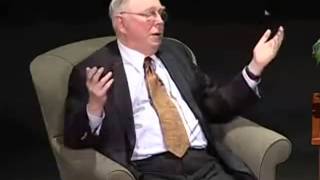 Charlie Munger on Common Sense: Thinking Across Disciplines2008 · 107 min · full transcriptShows how Munger applies cross-disciplinary common sense, inversion, and humility in real-world problem solving.
 Charlie Munger on Multidisciplinary Thinking: Avoiding Stupid Mistakes2008 · 59 min · full transcriptStrong on avoiding stupid mistakes, staying within your competence, and the temperament behind good judgment.
 Charlie Munger on Life Lessons: Soldier On, Avoid Crazy2023 · 102 min · full transcriptA late-life distillation of his practical wisdom: resilience, recognizing opportunities, and learning from experience.
Questions people ask
- What did Charlie Munger say about inversion?
- What did Charlie Munger say about knowing your limits?
- What did Charlie Munger say about lifelong learning?
- What did Charlie Munger say about objectivity and checklists?
- What did Charlie Munger say about rationality and success in life?
- What did Charlie Munger say are the simple lessons of life?
Sources
Every quote above, word for word from the transcripts. Numbers match the text.
“You've got to have models in your head.”
“If the facts don't hang together on a latticework of theory, you don't have them in a usable form.”
“Of course. I could see the power of it.”
“Humility means that you know the edge of your own competency…”
“The human mind has enormous power but it also has standard misfunctions.”
“I don't like irrationality, and I've worked to try and avoid it in my life.”
“Well, that's the easy rationality. If you're just not crazy, you have a big advantage over 95% of the people because most people have all kinds of crazy patches. And if you just are consistently not crazy, you had a you had a big advantage in life. And if you're patient and a gratification defer in addition to being not crazy, then it's practically a cinch. And then if you're exceptionally good at satisfying your commitments to other people, then you got... You you just automatically improved your resources and your chances in life enormously. And it's so simple. And why don't more people do it?”
“…if you wanna have more correct knowledge and be wiser than other people, the heavy ideology is very likely to do you in…”
“Well, objectivity maintenance routines are totally required in life if you're going to be a correct thinker. And, there, we're talking about Darwin's attitude, special attention to the disconfirming evidence, and also to checklist routines. Checklist routines avoid a lot of errors. You should have all this elementary wisdom, and then you should go through a mental checklist in order to use it. There is no other procedure that will work as well.”
“The single most important thing if you want to avoid all the stupid errors is knowing where you're competent and where you aren't.”
“You are a disaster if you don't know the edge of your own competency.”
“What I would say is the single most important thing if you want to avoid all the stupid errors is knowing where you're competent and where you aren't. Knowing the edge of your own competency and that's very hard to do because the human mind naturally tries to make you think you're way smarter than you are.”
“Obviously you have to know a lot, but partly it's temperament, partly it's deferred gratification. You got to be willing to wait, and it's a weird—good investing requires a weird combination of patience and aggression, and not many people have it. It also has to—it requires a big amount of self-awareness and how much you know and how much you don't know.”
“You gotta learn how to recognize them when they come…”
“Wisdom acquisition is a moral duty.”
“Another idea that I got, and this may remind you of Confucius too, is that wisdom acquisition was a moral duty. It's not something you do just to advance in life. Wisdom acquisition is a moral duty. And and as a corollary to that proposition, which is very important, it means that you're hooked for lifetime learning.”
“…you're hooked for lifetime learning…”
“…the safest way to try and get what you want is to try and deserve what you want…”
“The highest form that civilization can reach is a seamless web of deserved trust…”
“The last idea that I wanna give to you as you go out into a profession that is... Frequently puts a lot of procedure and a lot of precautions and a lot of mumbo jumbo into what it does, This is not the highest form which civilization can reach. The highest form that civilization can reach is a seamless web of deserved trust. Not much procedure, just totally reliable people correctly trusting one another.”
“Sure. I I basically believe in the in the soldier on system. Mhmm. Lots of hardship will come, and and you're... You gotta handle it well by soldiering through. And lots of... A few where our opportunities will come. You gotta learn how to recognize them when they come and not to make too minor a trip to the bike counter when the opportunity is available. And those are the simple lessons.”
“If you soldier through, you can get through almost anything.”
“We all know how to get through them. Through you... The great philosophers of realism are also the great philosophers of of what I call soldiering through. If you soldier through, you can get through almost anything. And it's your only option. You can't bring a very good dad. You can't cure the dying child. You can't do all kinds of things. You have to soldier through, and you just... Somehow, you soldier through. If you have to walk through the streets crying for a few hours a day as part of the soldiering, go ahead and cry away, but you have to You can't squint.”
“Well, I like it that way. Yeah. That's my idea of a proper old age for me. And I didn't plan it. It just happened. And and when it happened, I welcomed it. I I am very good at recognizing unfair advantages. And I got unfair advantages in old age the way I got unfair advantages in nonold age. And when they came, I just grabbed them. Boom. Boom. Boom. The one grab I never made was for a third wife. Too late.”
How this guide was made: drafted with AI from the full transcripts of the recordings cited, then checked: every quotation must match a transcript word for word and be the speaker's own words, and an independent review gates accuracy. Methodology and corrections.