Character and Service
Public life is a test of humility, discipline, and moral imagination.

“I will never forget who this victory truly belongs to. It belongs to you. It belongs to you. I was never the likeliest candidate for this office. We didn't start with much money or many endorsements. Our campaign was not hatched in the halls of Washington. It began in the backyards of Des Moines, in the living rooms of Concord, in the front porches of Charleston. It was built by working men and women who dug into what little savings they had to give $5, $10, and $20 to the cause. It drew strength from the young people…”Election Night Chicago Remarks, Grant Park, 2008 · 6:10
The lesson
Obama treats public leadership first as service, not self-display. In his victory speeches, he insists that political success is built by ordinary people who organize, give, and work together, which means a leader should stay aware of who actually creates change123. That view creates humility: the office may be visible, but the work is shared.
From there, he links character to responsibility. In the inaugural address, national renewal is not automatic or guaranteed; it depends on citizens and leaders accepting discipline, sacrifice, and adult seriousness in the face of crisis456. Leadership, then, is measured less by inspiration alone than by whether someone can help people face hard conditions honestly and still act together7.
Obama also argues that service requires moral imagination: the ability to see your fate as connected to other people's freedom and dignity. In Charleston, he presents grace not as passivity, but as the power to answer hatred with truth, mercy, and a deeper commitment to justice89. That widens the meaning of public life, because it asks leaders to heal communities while also confronting the structures that wound them.
Nelson Mandela becomes Obama's clearest example of this kind of character. He admires Mandela not as a flawless icon, but as a human being whose greatness came from discipline, courage, and the ability to join action with ideas and institutions1011. Mandela matters here because he shows that humility and strength are not opposites: admitting doubt, persuading opponents, and building durable democratic rules are part of moral leadership.
Finally, Obama's model of service is practical, not abstract. Democracy stays healthy when leaders and parties show up, listen, and build trust beyond moments of spectacle or scandal. Character in public life therefore means both inner qualities and repeated habits: unity over contempt, presence over distance, and steady work on behalf of a shared future1314.
4 principles from Barack Obama
Treat leadership as service, not possession
Obama repeatedly redirects credit away from himself and toward the people who did the work. Apply this by asking, in any leadership role, who is being served and who deserves recognition for progress.
“I will never forget who this victory truly belongs to. It belongs to you. It belongs to you. I was never the likeliest candidate for this office. We didn't start with much money or many endorsements. Our campaign was not hatched in the halls of Washington. It began in the backyards of Des Moines, in the living rooms of Concord, in the front porches of Charleston. It was built by working men and women who dug into what little savings they had to give $5, $10, and $20 to the cause. It drew strength from the young people…”
Earn trust through discipline and sacrifice
For Obama, greatness in public life is not inherited with office; it is earned through responsibility, seriousness, and follow-through. In practice, that means matching hopeful language with hard choices, steady work, and accountability.
“Greatness is never a given; it must be earned.”
Practice moral imagination
Service requires seeing your own freedom and well-being as tied to other people's. Use this by testing decisions against a wider circle: who is excluded, harmed, or left unseen if you think only about your own side.
“That my liberty depends on you being free, too.”
Learn from imperfect exemplars
Obama values Mandela not because he was superhuman, but because he turned doubt, struggle, and judgment into constructive leadership. Look for models whose humanity makes their discipline and courage usable, not merely admirable.
“He was not a bust made of marble; he was a man of flesh and blood…”
In his own words
The quotes behind the lesson, word for word from the transcripts. Numbers match the lesson above.
“I will never forget who this victory truly belongs to. It belongs to you. It belongs to you. I was never the likeliest candidate for this office. We didn't start with much money or many endorsements. Our campaign was not hatched in the halls of Washington. It began in the backyards of Des Moines, in the living rooms of Concord, in the front porches of Charleston. It was built by working men and women who dug into what little savings they had to give $5, $10, and $20 to the cause. It drew strength from the young people…”
“Block by block. Brick by brick. Calloused hand by calloused hand.”
“That's why we do this. That's what politics can be.”
“Greatness is never a given; it must be earned.”
“The time has come to set aside childish things.”
“This is the price and the promise of citizenship.”
“All this we can do. All this we will do.”
“That my liberty depends on you being free, too.”
“If we can find that grace, anything is possible.”
“He was not a bust made of marble; he was a man of flesh and blood…”
“Mandela taught us the power of action, but he also taught us the power of ideas…”
“…we are not enemies, but friends.”
“The belief that our destiny is shared, that this country only works when we accept certain obligations to one another and the future generations; so that the freedom which so many Americans have fought for and died for comes with responsibilities as well as rights. And among those are love and charity and duty and patriotism. That's what makes America great.”
Reflect
- Where in your work or community are you acting as if success belongs to the visible leader rather than the people doing the real building?
- What obligation of citizenship, service, or sacrifice are you tempted to avoid because it is less rewarding than symbolic gestures?
- Who do you need to understand more deeply in order to lead with the kind of moral imagination Obama describes?
Check your understanding
Go deeper
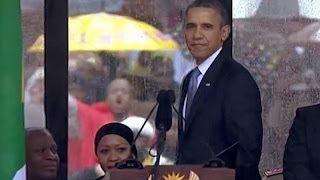 Barack Obama on Nelson Mandela's Legacy: Ubuntu, justice, and courage2013 · 19 min · full transcript
 Barack Obama on Grace and Racial Justice: Charleston Memorial Remarks2015 · 38 min · full transcript
 Barack Obama on Election Victory: Yes We Can2008 · 17 min · full transcript
 Barack Obama on Hope & Democracy: The Best Is Yet to Come2008 · 30 min · full transcript
 Barack Obama on Inaugural Address: Hope, Unity, and Renewal2009 · 99 min · full transcript
 Barack Obama on Media and Democracy: Lessons from the 2016 Election2016 · 61 min · full transcript