Mr. Market’s Moods
Use the market’s emotions as an opportunity, not an instruction manual.
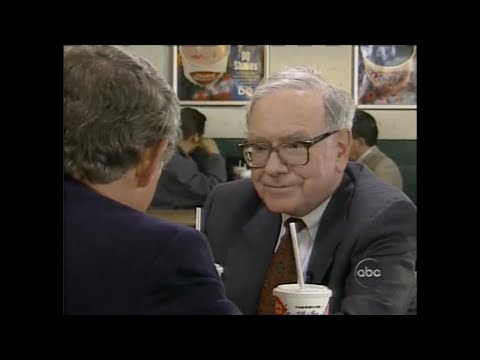
“All I'm trying to do is buy a piece of a business at an attractive price…”Nightline interview, 1999 · 12:12
The lesson
Buffett’s Mr. Market lesson starts with a simple shift: stop treating a stock as a moving squiggle and start treating it as part ownership of a business. When you think like an owner, daily price changes become less like commands and more like offers. That is why he keeps returning to the idea that the market exists to serve you, not to tell you what to think or do.1234
This changes how you react to volatility. If the business is understandable and attractive, a falling quote is not automatically bad news; for a long-term net buyer, lower prices can be helpful. Buffett’s stance is that he and Munger do not build decisions around stock-market forecasts or macro predictions, because the useful question is whether you are getting good value for your money.567
Mr. Market becomes most useful when he is emotional. In panics, the market can react instantly and violently even though the underlying economy and business value change more slowly, so fear can create chances for disciplined buyers. Buffett is clear that uncertainty is normal, that long-run progress continues through interruptions, and that betting against that progress is a mistake.8910
But using the market’s moods well requires discipline, not constant action. Buffett emphasizes staying within your circle of competence, ignoring predictions about things you cannot know, and waiting for the right pitch instead of forcing decisions. He would rather do nothing than buy something he cannot understand or cannot value with confidence, which is why he pairs the servant-market idea with a margin of safety.11121314
So the practical lesson is not just 'be calm.' It is to prepare in advance: know what kinds of businesses you can understand, what would make them attractive, and what price would give you a cushion. Then when greed or fear takes over the market, you are not taking instructions from the crowd; you are comparing Mr. Market’s offer with your estimate of value and acting only when the gap is favorable.151617
5 principles from Warren Buffett
Treat stocks as businesses, not tickers
Start by asking what business you would own, why it is durable, and what it is worth. That mindset makes market quotes secondary rather than central to your decision.
“All I'm trying to do is buy a piece of a business at an attractive price…”
Use market prices as offers, not instructions
A quote tells you what someone will pay or accept today; it does not tell you intrinsic value. You can ignore the market when it is unhelpful and act only when the price serves your purpose.
“The stock market is there to serve you, not to instruct you.”
Welcome lower prices if you are a net buyer
If you expect to keep allocating capital over time, cheaper markets improve your future opportunities. This is the opposite of the emotional reflex that treats every decline as a signal to flee.
“…if I'm a net buyer, I will do better if prices are lower.”
Stay inside your circle of competence
Do not make decisions that depend on forecasting rates, markets, or complex situations you cannot truly evaluate. Focus on the few things that are knowable and important to you.
“I have never been able to predict interest rates, and I've never tried…”
Wait for the right pitch with a margin of safety
You do not need to swing at every opportunity. Be patient until you understand the business and the price gives you room for error.
“…we keep waiting for the right pitch…”
In his own words
The quotes behind the lesson, word for word from the transcripts. Numbers match the lesson above.
“…look at a stock not as some thing that wiggles around…”
“You think of them as parts of a business;…”
“The stock market is there to serve you, not to instruct you.”
“…you use it to serve you and not to instruct you;…”
“…if I'm a net buyer, I will do better if prices are lower.”
“We have no—we're not good at forecasting market, so I mean, we knew that we were getting enormous bargains in the mid-'70s. We knew that the market went crazy to some extent in the late '90s, but we don't have much—we don't spend any time. Charlie and I spend no time thinking or talking about what the stock market is gonna do because we don't know. We do know sometimes that we're getting very good value for our money when we buy some stocks or some bonds, as it may be, but we are not operating on the basis of any kind of macro forecasts about stocks.”
“We've never decided not to buy a business we like because of a macro view.”
“…we'll come out better on the other end…”
“It does not make sense to bet against America.”
“There's always a list of reasons why the country will have problems tomorrow, but there's always a list of opportunities which don't get mentioned quite as often. So we don't sit down and make a list of the bad things that are happening in the economy and the good things that are happening and therefore expecting the stock market—it might not—it doesn't behave that way. Even if you, if you could correctly forecast some of the bad things or good things overall, I'm an enormous bull on the country. I mean, over time, I mean, this is the most remarkable success story in the history of the world, if you think about it.”
“The the question is, is the box that says knowns and important... Knowable and important Mhmm. Is there anything in that box? And can you tell what's in that box and what isn't in that box? And it's what I call knowing your circle of competence. And my circle of competence doesn't include the ability to predict interest rates a day from now or a year from now or five years from now. So I say, can I function without knowing that? Same way as predicting what business is going to do or the stock market's going to do. I can't do any of those things, But that doesn't mean that I can't do well investing over time.”
“…we keep waiting for the right pitch…”
“…always have a margin of safety…”
“…the idea of a margin of safety, of always leaving some extra room in things.”
“All I'm trying to do is buy a piece of a business at an attractive price…”
“If you need to use a computer or calculator to make the calculation, you shouldn't buy it.”
“We don't think of stocks as as little items that wiggle around in the paper and that have charts attached to them.”
Reflect
- Think of one asset you follow often. If you treated it as a business instead of a quote, what facts would you study first?
- Where in your work or investing do you let fast-changing signals instruct you instead of merely inform you?
- What is inside your circle of competence today, and what kinds of opportunities should you automatically pass on because they depend on prediction rather than understanding?
Check your understanding
Go deeper
 Warren Buffett on Value Investing: Wait for the Right Pitch2006 · 52 min · full transcript
 Warren Buffett on Value Investing: Think Like an Owner2008 · 243 min · full transcript
 Warren Buffett on Macro Forecasting: Focus on Value, Not Predictions2005 · 260 min · full transcript
 Warren Buffett on Tech Bubble Skepticism: Why They Avoided Big Tech1999 · 324 min · full transcript
 Warren Buffett on Crisis Investing: Derivatives, Bailouts, and Bargains2009 · 270 min · full transcript
 Warren Buffett on Value Investing: Buy Businesses, Not Stocks1999 · 27 min · full transcript
 Warren Buffett on Markets in Crisis: Buying Through Panic2021 · 150 min · full transcript