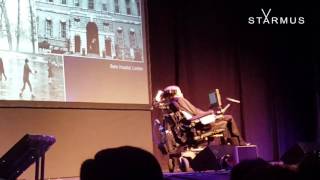
Stephen Hawking on Time
Hawking sees time as part of the universe itself: it began with the Big Bang in ordinary time, is shaped by gravity and motion, and may be best understood near the origin through quantum ideas like no-boundary and imaginary time.
- Time is not absolute; it changes with motion, gravity, and the structure of the universe.
- In ordinary time, Hawking says time began at the Big Bang, so asking what happened before it can be misguided.
- His no-boundary idea says the universe may have no edge or prior moment in the usual sense.
- To understand the beginning of time, Hawking argues physics must combine relativity with quantum theory.
- Backward time travel is highly constrained and likely blocked by known physics.

“I have shown that this is not possible if energy density is always non-negative…”StarTalk interview, 2014 · 24:49
Time is part of the universe, not a clock outside it
Hawking rejects the idea that time is a universal background ticking the same way everywhere. In his view, relativity changed the picture by showing that space and time are dynamic and depend on the matter and energy in the universe rather than standing apart from it123.
That shift matters because it changes the kind of questions we can sensibly ask. If space and time are defined only within the universe, then time is not something the universe sits inside; it is one of the ingredients of the cosmos itself23.
For Hawking, ordinary time begins at the Big Bang
Hawking’s clearest claim is that time, in the ordinary sense, begins with the Big Bang4. He treats the expanding universe as evidence that the cosmos was not eternal in a simple, unchanging way, but had an early hot, dense phase from which the present universe developed5.
This is why he says the question of what happened before the Big Bang can be the wrong kind of question. If time itself starts there, then asking for an earlier moment is like asking for a location farther south than the South Pole6783.
The no-boundary idea removes the need for a first edge of time
Hawking’s no-boundary proposal tries to make the beginning of the universe intelligible without a sharp temporal edge. He describes the universe with a boundary condition in which it has no boundary, meaning the origin need not be a conventional starting line where the laws of physics fail910.
On this view, the universe can be self-contained and governed by laws all the way through its earliest stage. Hawking presents this as a way to say that physics may still hold at the beginning, instead of breaking down exactly where our biggest questions start111213.
Imaginary time is Hawking’s tool for thinking about the origin
To explain the universe near its beginning, Hawking uses imaginary time as a serious scientific idea, not a metaphor. He says imaginary time can be treated like another direction in space, which helps smooth out the notion of a hard beginning or end14.
This does not mean ordinary time disappears from everyday life. It means that at the deepest level, especially near the origin of the universe, the most useful description may differ from common intuition and require a mathematical framework in which the earliest universe is more like a rounded geometry than a sharp starting instant14.
Time travel backward is not ruled in by Hawking’s physics
Hawking explored time travel, but his view is cautious and restrictive. He argues that traveling backward in time would require exotic conditions such as negative energy density, and he emphasizes that known physics strongly limits whether such arrangements are possible16.
This fits his broader outlook on time: the universe follows laws, and those laws may protect chronology rather than allow easy shortcuts around cause and effect. Even where general relativity suggests strange possibilities such as wormholes, Hawking does not treat them as practical permission to rewrite the past1611.
“I have shown that this is not possible if energy density is always non-negative…”StarTalk interview, 2014 · full transcript →
Why time matters: it connects the origin of the universe to our own existence
For Hawking, questions about time are really questions about why the universe is as it is and why it exists at all17. He thinks the search for the laws governing the universe can bring even the most basic questions within scientific understanding, rather than leaving them permanently mysterious1811.
That is why he links cosmology, quantum theory, and time so tightly. If the early universe is governed by lawful physics, then our existence can be traced to processes in that first era, including quantum fluctuations in the very early universe19.

“It is really the reason why the universe is as it is and why the universe exists at all.”A Meeting of Minds documentary interview, 1988 · full transcript →
Hawking on time, in his own words
“Time's not a universal quantity.”
“…the boundary condition of the universe that it has no boundary…”
“Imaginary time is just time measured with imaginary numbers instead of real numbers…”
Where to watch
 Stephen Hawking on Cosmology and Time: The Universe, No Boundaries, and Time Travel2014 · 47 min · full transcriptBest overview of Hawking on no-boundary, the Big Bang, and why “before” the Big Bang may be the wrong question.
 Stephen Hawking on the Origin of the Universe2009 · 67 min · full transcriptBest lecture for understanding why relativity makes space and time dynamic rather than absolute.
 Stephen Hawking on Origin of the Universe: No-Boundary Cosmology1988 · 60 min · full transcriptBest source for Hawking’s no-boundary cosmology and his claim that the laws of physics can hold at the beginning.
 Stephen Hawking on Big Bang and God: The Universe, Time, and Science1988 · 52 min · full transcriptBest concise statement of Hawking’s view that time began at the Big Bang and why that matters philosophically.
 Stephen Hawking on The Big Bang: the sound of the beginning of time2004 · 89 min · full transcriptBest for seeing Hawking connect the Big Bang with the non-absolute character of time.
Questions people ask
- What did Stephen Hawking say about how to judge a theory of the universe?
- What did Stephen Hawking say about time before the universe began?
- What did Stephen Hawking say about whether God intervenes in the universe?
- How did Stephen Hawking think we should understand the origin of the universe?
- What did Stephen Hawking say are the big questions left in cosmology?
- How does Stephen Hawking say a galaxy could have a single standard time?
Sources
Every quote above, word for word from the transcripts. Numbers match the text.
“Time's not a universal quantity.”
“Space and time were no longer absolute, no longer a fixed background to events.”
“Space and time were no longer absolute, no longer a fixed background to events. Instead, they were a dynamical one that was warped by the matter and energy in the universe. They were defined only within the universe, so it made no sense to talk of a time before the universe began. That would be like asking for a point south of the South Pole.”
“…time began at the big bang.”
“The universe was not unchanging with time, as everyone had thought previously.”
“There is nothing south of the South Pole…”
“Nothing was around before the Big Bang…”
“It would be like asking for a point south of the South Pole.”
“…the boundary condition of the universe that it has no boundary…”
“…the boundary condition of the universe is that it has no boundary…”
“…the universe ought to be self-contained and determined completely by the laws of science…”
“…the laws of science may hold even at the beginning of the universe…”
“…the laws of physics would hold even at the beginning of the universe…”
“Imaginary time is just time measured with imaginary numbers instead of real numbers…”
“I have shown that this is not possible if energy density is always non-negative…”
“It is really the reason why the universe is as it is and why the universe exists at all.”
“In the last 300 years, we have discovered the laws that govern the universe in all but the most extreme conditions.”
“We are the product of quantum fluctuations in the very early universe.”
How this guide was made: drafted with AI from the full transcripts of the recordings cited, then checked: every quotation must match a transcript word for word and be the speaker's own words, and an independent review gates accuracy. Methodology and corrections.